Ap Government Unit 1
0.0(0)
Studied by 2 people Call Kai
 Learn
Learn Practice Test
 Spaced Repetition
 Match
Match Flashcards
 Knowt Play
Card Sorting
1/23

Earn XP
Description and Tags
Last updated 2:17 PM on 9/16/22
Name | Mastery | Learn | Test | Matching | Spaced | Call with Kai |
|---|
No analytics yet
Send a link to your students to track their progress
24 Terms
1
New cards
Elite-Class Theory
A belief that certain groups hold disproportionate power in a political system
2
New cards
Pluralist Theory
A theory of government and politics emphasizing that politics is mainly a competition among groups, each one pressing for its own preferred policies. Because many groups compete, there is not an elite group that dominates. Compromise is common.
3
New cards
Articles of Confederation
1st Constitution of the U.S. 1781-1788 (weaknesses-no executive, no judicial, no power to tax, no power to regulate trade) Each state retained sovereignty, the ability to act independently of the Confederation. Each state had equal representation in a unicameral (single house) legislature.
4
New cards
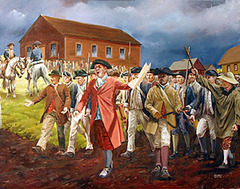
Shays' rebellion
Rebellion led by farmers in western Massachusetts in 1786-1787, protesting mortgage foreclosures. It highlighted the need for a strong national government just as the call for the Constitutional Convention went out.
5
New cards
Checks and Balances
A system that allows each branch of government to limit the powers of the other branches in order to prevent abuse of power
6
New cards
Separation of powers
A way of dividing the power of government among the legislative, executive, and judicial branch to prevent tyranny.
7
New cards
Popular sovereignty
A government in which the people rule by their own consent.
8
New cards
Bicameral
A legislature consisting of two parts, or houses with separate rules
9
New cards
Federalists
Those who favored a stronger national government and weaker state governments. Supported the ratification of the Constitution.
10
New cards
Anti-Federalist
Those who favored strong state governments and a weaker national government. Advocated for a bill of rights to formally address individual and state rights. Concerned about the concentration of power in a central government under the Constitution.
11
New cards
Federalism
A system of government in which power and responsibilty is divided between the federal and state governments
12
New cards
Supremacy clause
Article VI of the Constitution, which makes the Constitution, national laws, and treaties supreme over state laws when the national government is acting within its constitutional limits.
(ex. McCulloch v. Maryland)
(ex. McCulloch v. Maryland)
13
New cards
Virginia Plan
Initial proposal at the Constitutional Convention made by the Virginia delegation for a strong central government with a bicameral legislature dominated by the big states.
14
New cards
New Jersey Plan
Proposal at the Constitutional Convention made by William Paterson of New Jersey for a central government with a single-house legislature in which each state would be represented equally.
15
New cards
Connecticut or Great Compromise
Compromise agreement by states at the Constitutional Convention for a bicameral legislature with a lower house in which representation would be based on population and an upper house in which each state would have two senators.
16
New cards
Republican Democracy
Format chosen by Founding Fathers. People vote for representatives who then make laws. People do not vote directly on legislation.
17
New cards
Three fifths clause
slave counted as 3/5 of a person for population counts to determine how many representatives.
18
New cards
Federalist Papers
A collection of 85 articles written by Alexander Hamilton, John Jay, and James Madison under the name "Publius" to defend the Constitution in detail.
19
New cards
Bill of Rights
A formal statement of the fundamental rights of the people of the United States, incorporated in the Constitution as Amendments 1-10. Satisfied Anti-federalist concerns.
20
New cards
Tyranny of the majority
Madison was most concerned with this aspect of the new government
21
New cards
hyperpluralism
A state in which many groups or factions are so strong that a government is unable to function
22
New cards
Federalist Paper #10
Written by James Madison to convince people to support the ratification of the Constitution. Argued that factions were inevitable but were best controlled by a large republic that employed a Federalist structure. Argued that competition among factions would limit their negative impacts.
23
New cards
Brutus 1 - Anti-federalists
Before the constitution was ratified; too much power in national government; won't be able to survive bc it's too big
24
New cards
Federalist #51 (1788)
An essay from the Federalist Papers that was written by James Madison. The essay explains the virtues of separation of powers and checks and balances in the proposed new Constitution.