Biology - Final
 Call Kai
 Learn
Learn Practice Test
 Spaced Repetition
 Match
Match Flashcards
 Knowt Play
1/60

Earn XP
Description and Tags
Dr. Z @Trinity
Name | Mastery | Learn | Test | Matching | Spaced | Call with Kai |
|---|
No analytics yet
Send a link to your students to track their progress
61 Terms
Before you continue…
This final covers the relevant topics in Chapters 3, 4, 5, 6, 7, 9 and 10.
Chapter 3 includes organic compounds and macromolecules.
Chapter 10 includes mitosis and meiosis.
Review Packets
OK
Nucleic Acids Quiz Review Guide
Unit 4, Quest 1 Review Guide
OK
Unit 4, Quest 2 Review Guide
OK
Unit 5, Quest 1 Review Guide
OK
Unit 5, Quest 2 Review Guide
OK
Final Review Guide
OK
Tests/Quizzes
OK
Midterm
(Unit 1, Unit 2 Q1 & Q2, Unit 3 Q1)
Nucleic Acids Quiz
OK
How are genes used by cells to build proteins?
a) The genes in RNA direct the synthesis of a DNA molecule, which is used to build a protein.
b) The genes in DNA direct the synthesis of an RNA molecule, which is used to build a protein.
c) DNA is transcribed into an amino acid sequence.
d) The genes in RNA direct the synthesis of proteins directly.
B
Which of the following statements regarding nucleotides is false?
a) Nucleotides contain lipid rings.
b) Nucleotides contain sugar molecules.
c) Nucleotides can be linked together to form nucleic acids.
d) Nucleotides contain nitrogenous bases.
A
Which of the following options correctly pairs a polymer and its monomer?
a) cellulose, amino acids
b) DNA, nucleotides
c) keratin, protein
d) amino acid, nucleic acid
e) B and C
B
DNA differs from RNA because DNA
a) contains the sugar deoxyribose rather than the sugar ribose.
b) consists of a single rather than a double polynucleotide strand.
c) contains the sugar ribose rather than the sugar deoxyribose.
d) contains 3 phosphate groups instead of one.
A
Name the 3 parts of a monomer of nucleic acids.
Nitrogenous base
Pentose sugar
Phosphate group
What is the monomer called?
Nucleotide
Write the complementary DNA base pairs for this short sequence of DNA.
A-T-C-G-C-C-G-A-T-T
T-A-G-C-G-G-C-T-A-A
What is the process by which nucleic acid monomers are linked to make polymers?
Dehydration synthesis
In a sentence or 2, describe what kinds of bonds are involved in holding the polynucleotide chain and the double helix of DNA.
The bonds between the nucleotides’ sugars and phosphate groups form something similar to the sides of a ladder; they are connected by covalent bonds. As for the bonds between the rungs (nitrogenous bases), that would be hydrogen bonds.
What roles do complementary base pairing play in the functioning of DNA?
Complementary base pairing allows a way to store and easily replicate the important genetic information of living organisms. This leads to traits being passed down through generations and also maintains that double helix structure.
Unit 4, Quest 1
OK
Which of the following cells has the smallest surface-to-volume ratio?
a) a bacterium
b) an amoeba
c) human cheek cell
d) chicken egg
D
A dish of animal cells was grown in the presence of radioactive phosphorus. The phosphorus largely ended up in nucleotides inside the actively growing animal cells. In which cellular structure or structures would you predict the majority of the radioactive phosphorus to accumulate?
a) rough endoplasmic reticulum
b) either rough or smooth endoplasmic reticulum
c) nuclei
d) mitochondria and chloroplasts
DNA → nucleus
C
As cell size increases, the
a) volume and surface area decrease.
b) volume increases proportionally more than the surface area.
c) surface area increases proportionally more than the volume.
d) ratio of surface area to volume stays the same.
1:2 → 1:8
B
A researcher made an interesting observation about a protein made by the rough endoplasmic reticulum and eventually found in a cell’s plasma membrane. The protein in the plasma membrane was actually slightly different from the protein made in the ER. The protein was probably altered in the ___.
a) Golgi apparatus
b) plasma membrane
c) transport vesicles
d) rough endoplasmic reticulum
rough ER → transport vesicle → golgi → transport vesicle → plasma membrane… only stop that alters is the Golgi, since already past rough ER
A
The cells of an ant and an elephant are, on average, the same small size; an elephant has more of them. What is the main advantage of small cell size?
a) A small cell has a larger plasma membrane surface than does a large cell.
b) Small cells can better take up sufficient nutrients and oxygen to service their cell needs.
c) It takes less energy to make an organism out of small cells.
d) Small cells require less oxygen than do large cells.
nutrients can travel faster through the cell
B
Which organelle and function is correctly matched?
a) Golgi apparatus — produce ATP or cellular energy
b) Lysosomes — cellular digestion with enzymes
c) Mitochondria — supports the cell
d) Centrioles — produces ribosomes
B
The cells that produce testosterone contain a lot of __, while the cells that produce amylase contain a lot of __.
a) smooth endoplasmic reticulum … lysosomes
b) rough endoplasmic reticulum… smooth endoplasmic reticulum
c) smooth endoplasmic reticulum… rough endoplasmic reticulum
d) mitochondria… lysosomes
testosterone (steroid/lipid) → smooth ER
amylase (enzyme/protein) → rough ER
C
Which of the following will be found in all eukaryotic cells?
a) cell wall
b) mitochondria
c) chloroplast
d) nucleoid
B
Prokaryotes are classified as belonging to two different domains. What are the domains?
a) Bacteria and Eukaryota
b) Bacteria and Protists
c) Bacteria and Fungi
d) Bacteria and Archaea
D
Which of the following correctly describes the pathway taken by a protein destined for secretion from an animal cell?
a) plasma membrane → transport vesicle → Golgi → transport vesicle → rough ER
b) Golgi → rough ER → transport vesicle → plasma membrane
c) rough ER → transport vesicle → lysosome → transport vesicle → plasma membrane
d) rough ER → transport vesicle → Golgi → transport vesicle → plasma membrane
e) rough ER → transport vesicle → Golgi → transport vesicle → lysosome → plasma membrane
protein starts in the rough ER; doesn’t reach lysosome unless breaking down
D
Cristae, DNA, and ribosomes are all components found in
a) vacuoles
b) chloroplasts
c) mitochondria
d) prokaryotes
C
Which statement(s) about the endosymbiotic theory is/are true?
I. It provides evidence for the origin of prokaryotes.
II. It provides evidence for the origin of eukaryotes.
III. It provides evidence for multicellularity.
a) II only
b) I only
c) II and III only
d) I, II and III
A
Reorganize these words in terms of increasing size.
tissue, cell, atom, electron, organ, organelle, molecule, macromolecules
electron, atom, molecule, macromolecules, organelle, cell, tissue, organ
During an investigation of a freshwater lake, a Biology student discovers a previously unknown microscopic organism. They observe the cells under a microscope and determine that these organisms have nucleic acids, ribosomes, a cell membrane and a cell wall. Based on these findings, he concludes that the organism belongs to the Kingdom Plantae. He proudly presents his findings to his research team and he is surprised by the reaction of his professor and peers. What kind of reaction might you have about his conclusions? Would you agree or disagree with the student? Explain your answer.
The organism has both a cell membrane and a cell wall, similar to prokaryotes, along with DNA and ribosomes. Since the DNA is never described as bound, it is most likely free-floating. Therefore, I would disagree with this student and say the organism is a prokaryote.
What is the claim made by the endosymbiotic theory? Keep your answer to 1 sentence.
Mitochondria and chloroplasts originated from prokaryotes being engulfed by larger prokaryotes and developing a symbiotic relationship, evolving over time into the eukaryotic cell.
Provide three major lines of evidence for the endosymbiotic theory with reasoning for each piece of evidence.
Mitochondria and chloroplasts have prokaryotic DNA and ribosomes, along with a double membrane. The double membrane implies their ancestor had their own membrane long ago before a larger prokaryote engulfed them.
Additionally, they are both able to independently replicate through binary fission like prokaryotes.
Lastly, there is evidence of chloroplast DNA being very closely related to photosynthetic cyanobacteria. These all provide evidence that the two organelles evolved from prokaryotes.
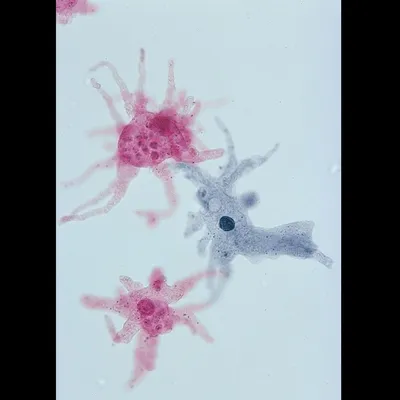
You are told that the cells in an image are magnified 400 times as seen in a light microscope. You know that the ocular lens magnifies 10 times.
a) What was the objective lens used in this case?
b) Identify the organisms.
c) These organisms are aquatic. Describe how these organisms might maintain homeostasis with respect to water regulation in 2-3 sentences.
d) Identify four organelles (not including the nucleus) that should be present in this organism.
a) 400/10 = 40 → 40x
b) Amoeba
c) These organisms may possess a contractile vacuole. They could use this vacuole to store excess water and then squeeze it out once the vacuole is full, allowing them to regulate their water intake.
d) Mitochondria, Endoplasmic reticulum, Golgi apparatus, Contractile vacuole
Bergmann’s rule is a biological principle stating that, in general (there are exceptions), animals of larger size are found in colder environments, while smaller-sized animals exist in warmer regions. Can you explain this based on what you’ve learned about surface area and volume? Avoid using human beings to explain this.
Larger animals have a small surface area to volume ratio and as such, they have lots of mitochondria generating a lot of ATP and heat, despite not having a lot of surface area for nutrients to enter. Smaller animals, however, have a large surface area to volume ratio; as such, they not many mitochondria to produce as much energy and heat. Additionally, the larger surface area to volume ratio means they can lose heat faster — suited for warmer environments. With the small surface area to volume ratio of a larger organism, heat radiates out into the environment at a much slower pace.
The table below provides information for three types of cells. Identify each of the three cell types and briefly explain how you know.
Trait | Cell 1 | Cell 2 | Cell 3 |
Cell wall | X | √ | √ |
Nucleus | √ | X | √ |
Ribosomes | √ | √ | √ |
Flagellum | √ | √ | X |
Chloroplast | X | X | √ |
Centrioles | √ | X | X |
Cell 1: Animal Cell
It has centrioles, which are only found in animal cells. It has a nucleus, so it has to be a eukaryote.
Cell 2: Bacterium
It has no nucleus, so it is prokaryotic. Additionally, the presence of a flagellum, ribosomes, and a cell wall indicates that it is most likely a bacterium.
Cell 3: Plant Cell
It has a cell wall and chloroplasts, so it must be a plant cell. It also has a nucleus, so it must be eukaryotic.
Unit 4, Quest 2
OK
Which of the following types of molecules are the major structural components of the cell membrane?
a) phospholipids and cellulose
b) nucleic acids and proteins
c) phospholipids and proteins
d) phospholipids and cellulose
C
The presence of cholesterol in the plasma membranes of animals
a) enables the membrane to stay fluid more easily when cell temperature drops.
b) enables the animal to remove hydrogen atoms from saturated phospholipids.
c) enables the animal to add hydrogen atoms to unsaturated phospholipids.
d) makes the membrane less flexible, allowing it to sustain greater pressure from within the cell.
cholesterol (lipid), stops the phospholipids from packing together too tight in cell membrane during temperature drop
A
Which of the following is one of the ways that the cell membranes of winter wheat are able to remain fluid when it is extremely cold?
a) by increasing the percentage of unsaturated phospholipids in the membrane
b) by increasing the percentage of saturated phospholipids in the membrane
c) by decreasing the number of hydrophobic proteins in the membrane
d) by using active transport
unsaturated makes the cell membrane fluid, the bent shape is what makes it the way it is
A
The primary function of polysaccharide attached to the glycoproteins and glycolipids of animal cell membranes is
a) to facilitate diffusion of molecules down their concentration gradients.
b) to actively transport molecules against their concentration gradients.
c) to maintain the integrity of a fluid mosaic membrane.
d) to mediate cell-to-cell recognition.
D
What kinds of molecules pass through a cell membrane most easily?
a) large and hydrophobic
b) small and hydrophobic
c) large polar
d) ionic
B
Carbon dioxide gas crosses a plasma membrane by
a) osmosis.
b) active transport.
c) endocytosis.
d) passive transport.
diffusion
D
Celery stalks that are immersed in fresh water for several hours become stiff and hard. Similar stalks left in a 0.15 M salt solution become limp and soft. From this, we can deduce that the cells of the celery stalks are
a) hypotonic to both fresh water and the salt solution.
b) hypertonic to both fresh water and the salt solution.
c) hypertonic to fresh water but hypotonic to the salt solution.
d) hypotonic to fresh water but hypertonic to the salt solution.
water entering cells → rigid → more inside than out → hypertonic
water leaving cells → limp → less inside than out → hypotonic
C
Mammalian blood contains the equivalent of 0.15 M NaCl. Seawater contains the equivalent of 0.45 M NaCl. What will happen if red blood cells are transferred to seawater?
a) Water will leave the cells, causing them to shrivel and collapse.
b) NaCl will be exported from the red blood cells by facilitated diffusion.
c) The blood cells will take up water, swell, and eventually burst.
d) NaCl will passively diffuse into the red blood cells and reach equilibrium.
seawater greater than blood (hypertonic)
water moves from low (blood) → high (seawater)
A
An illustration of an animal cell shows less water going out than in. What type of environment is the cell in?
less out than in (hypotonic)
C
A bacterium engulfed by a white blood cell through phagocytosis will be digested by enzymes contained in
a) peroxisomes.
b) lysosomes.
c) Golgi vesicles.
d) vacuoles.
B
You are sent to the emergency room due to dehydration. You notice that a med student is starting to hook you up to an IV labeled “hypotonic saline solution”. You know what hypotonic means and that it relates to human cells. What do you do?
a) You admire the knowledge of the med student
b) You scream at the top of your lungs “Noooooo!” and tell the med student that the solution will cause your cells to burst, which would be bad!
c) You scream at the top of your lungs “Noooooo!” and tell the med student that the solution will cause your cells to shrivel up, which would worsen your dehydration.
d) You question the student, asking if it might not be better to use a hypertonic solution.
dehydrated → less in than out (hypertonic)
UNFINISHED
Which of the following phenomena is responsible for raisins swelling in water?
a) Diffusion
b) Absorption
c) Osmosis
d) Active transport
Diffusion of water
C
Which process listed below would decrease the size of the cell membrane?
a) Phagocytosis
b) Hydrolysis
c) Exocytosis and pinocytosis
d) Endocytosis and phagocytosis
D
Continue from #14
Unit 5, Quest 1
OK
Unit 5, Quest 2
OK
Unit Packets
OK
Review Guide (skip 26, 27, 28, 40)
OK
Take a breather.
4/4. You’re free. At last.ヽ(•‿•)ノ