Immunology and Disease
 Call Kai
 Learn
Learn Practice Test
 Spaced Repetition
 Match
Match Flashcards
 Knowt Play
1/63

There's no tags or description
Looks like no tags are added yet.
Name | Mastery | Learn | Test | Matching | Spaced | Call with Kai |
|---|
No analytics yet
Send a link to your students to track their progress
64 Terms
Define Pathogenic
An organism that causes damage to its host
Define Infectious
A disease that may be transmitted from one individual to another
What is a carrier?
An individual who shows no symptoms when infected but can pass the disease on to another
What is a disease resevoir?
Where a pathogen is normally found; this may be in humans or another animal and may be a source of infection.
What does endemic mean?
A disease which is always present at low levels in an area
What is an epidemic?
Where there is a significant increase in the usual number of cases of a disease, often associated with a rapid spread.
What is a 'Pandemic'?
A global epidemic
What is a vaccine?
Uses non-pathogenic forms, products or antigens of micro-organisms to stimulate an immune response, which confers protection against subsequent infection.
What is an antibiotic?
Substances produced by microorganisms that affect the growth of other microorganisms.
Define 'Antibiotic resistance'.
Where a microorganism, which should be affected by an antibiotic, is no longer susceptible to it
What is an 'Antigen'?
A molecule that causes an immune response
What is an antibody?
A protein produced by the immune system to recognise and destroy antigens.
What is a 'Vector'?
A living organism which transfers a disease from one individual to another
What is a toxin?
A chemical produced by a microorganism, which causes damage to its host.
What is an antigentic type?
Organisms with the same or very similar antigens on the surface. Such types are subgroups or strains of a microbial species, which may be used to trace infections. They are usually identified by using antibodies from serum.
What is the causative agent of Cholera?
Gram-negative bacterium
Which tissue is affected by the Cholera infection?
Toxins affect the gut lining causing watery diarrhoea leading to dehydration and death.
How is Cholera transmitted?
It’s water borne
What are the control methods and treatments to cholera?
Treatment of water.
Rehydration therapy.
Antibiotics.
Vaccine.
What is the causative agent for Tuberculosis?
Bacteria
Which tissues are affected due to tuberculosis?
Lungs, neck and lymph nodes.
Causes coughing, chest pain, coughing up blood
What is the mode of transmission for Tuberculosis?
Airborne droplets through coughs and sneezes
What are the control methods and treatments for Tuberculosis?
BCG vaccination and Antibiotics
What is the causative agent for Smallpox?
The Variola major virus
Which tissues are affected due to smallpox?
Mouth, throat, lymph nodes, blood stream. Characterised by fluid filled blisters on the skin.
What is the mode of transmission for smallpox?
Contact Person to person or from contaminated objects
What were the control methods and treatments for smallpox?
Low antigenic variation of the virus led to a vaccine and there being no animal reservoir led to eradication of smallpox
What is the causative agent for influenza?
Virus- 3 sub-groups with many antigenic types.
Which tissue is affected by the Influenza virus?
The lining of the upper respiratory tract, leads to sore throats, coughing and fever.
What is the mode of transmission of influenza?
Airborne droplet infection.
WHat are the control methods and treatments for influenza?
Quarantine and hygiene.
Annual vaccination- not always effective.
What type of parasite causes Malaria?
Protoctistan parasite (2x Plasmodium spp.)
What tissues are affected by malaria?
Liver and red blood cells.
Red blood cells full of virus burst infecting more cells. This corresponds with bouts of fever.
How is Malaria transmitted to humans?
By the female mosquito vector when taking a blood meal
What are the control methods and treatments to Malaria?
Stop the vector-
Nets, clothing, insect repellent, fish to eat larvae, drain breeding grounds, spray water surfaces with oil. Use insecticides, bacterial infections of mosquitos, or sterilisation of mosquitos.
Kill the parasite-
drugs affect the parasite outside of blood cells but resistance is increasing. Vaccine difficult as the parasite mutates, and antibodies only help when the parasite is outside of blood cells.
Describe the characteristics of Gram - bacteria
Thin peptidoglycan cell wall with a layer of lipopolysaccharide.
Gram negative bacteria stain red using Gram staining technique.
The additional layer of lipopolysaccharide protects the bacterial cells from lysozyme and from penicillin type antibiotics.
Describe the characteristics of Gram + bacteria
Thick peptidoglycan cell wall and no lipopolysaccharide layer.
Gram positive bacteria stain purple using Gram staining technique.
Gram positive bacteria are susceptible to lysozyme and penicillin.
Why can’t a virus reproduce on its own?
A virus cannot reproduce on its own. It is an intracellular parasite and needs a host cell metabolism, for example ribosomes for protein synthesis, to produce more virus particles.
How do viruses cause pathogenic effects?
By::
Viral DNA/RNA instructs the cell to make virus particles; when full cell lysis occurs and the virus escapes to infect other cells/organisms (shedding)
Production of toxic substances
Viral cell transformation, where they can trigger cells to become cancerous
Viruses infecting white blood cells suppress the immune system (e.g. HIV)
Click to flip
How does skin act as a defence mechanism?
A tough barrier. Strong connective tissue maintained by vitamin C that prevents microbes entering the body. Skin flora competes with pathogenic bacteria to avoid infection.
How do Lysozymes act as a defence mechanism?
An enzyme in tears, saliva and stomach acid that kills bacteria.
How does ciliated mucous membranes act as a defence mechanism?
Mucus traps microbes in inhaled air. Passes up cilia waft mucus containing trapped microbes up the trachea for swallowing and destruction in the stomach.
How does blood clotting act as a defence mechanism?
Seals wounds in skin quickly to prevent infection
How does Inflammation act as a defence mechanism?
Raised temperature is unfavourable to microbes and increase in blood flow delivers phagocytes to the area.
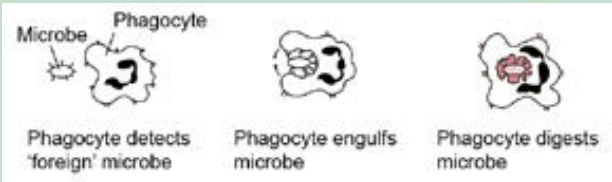
How does Blood (WBC) act as a defence mechanism?
white blood cells called phagocytes kill invading microbes in a process called phagocytosis.
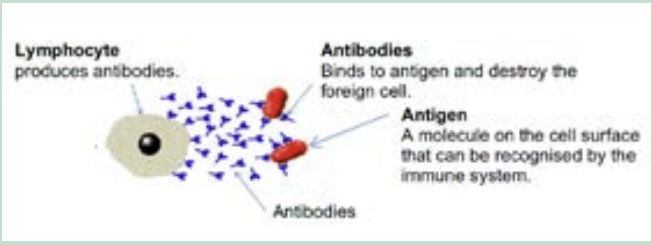
How are antibodies produced?
These are produced by white blood cells called lymphocytes.
Describe the basic structure of an antibody.
They are Y-shaped proteins (globulins) formed from four polypeptide chains with two binding sites
How are antibodies formed?
They are specific to the antigen and they bind to form an antigen-antibody complex. This renders the antigen inactive by:
1. agglutination
2. marking for phagocytosis.
How do antibiotics work?
These drugs don’t affect the host cells but disrupt bacterial metabolism. They work in two ways:
Bacteriostatic: prevents the growth of bacteria.
Bactericidal: kills bacteria
Describe how penicillin works.
• Peptidoglycan bacterial cell walls are strengthened by polysaccharide cross-linked by amino acids. This stops osmotic lysis.
• Penicillin affects the formation of the cross links by inhibiting the enzyme that makes them. The wall is weakened and osmotic changes can cause cells to burst.
• Gram negative bacteria have an outer lipopolysaccharide layer that protects the cells from penicillin.
How does Tetracycline work?
Tetracycline acts as a competitive inhibitor of the second anticodonbinding site on the 30S subunit of bacterial ribosomes.
It prevents the binding of a tRNA molecule to its complementary codon. This prevents protein synthesis common to all bacteria.
Tetracycline is a broader spectrum antibiotic.
Why are viruses not affected by antibiotics?
Viruses have no metabolic pathways
How does antibiotic resistance developed?
Overuse of antibiotics has led to the development of antibiotic resistance.
1. Bacteria divide rapidly and have a high mutation rate. Bacteria can also obtain plasmids that carry antibiotic resistance genes from other resistant bacteria by conjugation.
2. Some mutations confer resistance to antibiotics. Overuse of these antibiotics gives the resistant strain a selective advantage.
3. Numbers of the resistant strain increase, making infections more difficult to treat with the usual antibiotics.
Describe the Humoral immune response
1. Stem cells in the bone marrow make B lymphocytes that mature in the spleen and lymph nodes and have receptors for the detection of specific antigens on the surface of foreign cells.
2. When the B lymphocytes are activated by a corresponding antigen, they divide rapidly forming antibody secreting plasma cells. This clonal expansion is increased by the cytokines from the cell mediated response.
3. B lymphocytes also make memory cells that remain in the bloodstream and divide rapidly if the antigen is encountered again.
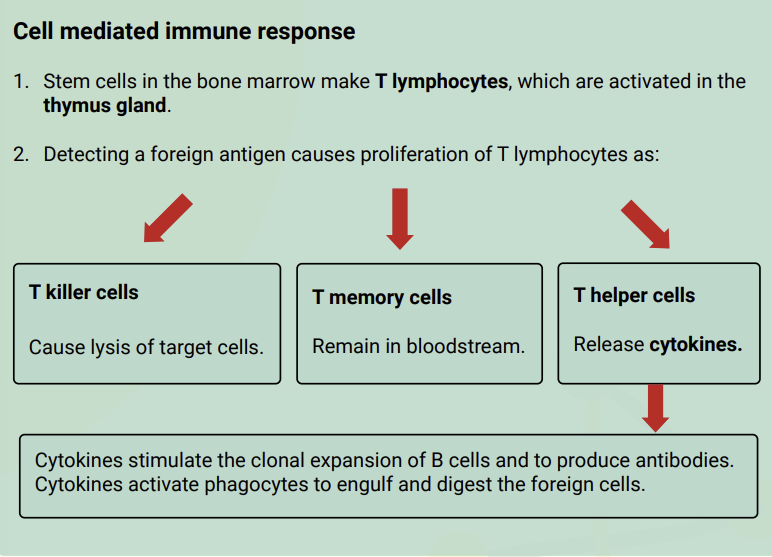
Describe the cell mediated immune response
What types of Immunity are there?
Active: individual produces antibodies. Protection is long lasting due to production of antigen specific memory cells.
Passive: Individual receives antibodies from someone else. Protection is short lived as no memory cells are produced and the antibodies themselves identified as foreign and destroyed.
What are the two types of active immunity?
Natural: Following an infection
Artificial: Following a vaccination
What are the two types of passive immunity?
Natural: Antibodies are transferred to the foetus via the placenta, or to the baby in breast milk.
Artificial: Presynthesised antibodies are injected into an individual, e.g. tetanus antitoxin.
What occurs during the latent period of a primary immune response?
Antigen presenting cells (including macrophages) carry out phagocytosis and incorporate foreign antigen into their cell membranes
Describe the Primary immune response to antigens.
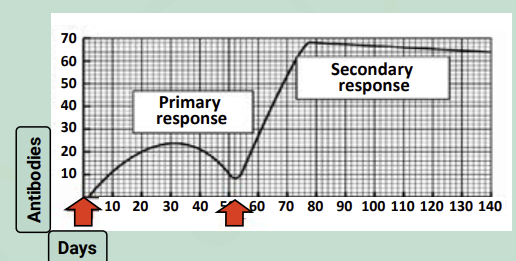
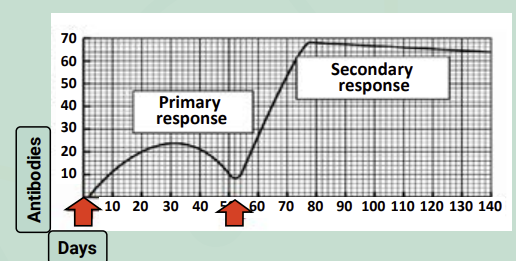
1. On first exposure to the antigen, there is a latent period when antigen presenting cells (including macrophages) carry out phagocytosis and incorporate foreign antigen into their cell membranes (antigen presentation).
2. T helper cells detect these antigens and secrete cytokines that stimulate B cells to undergo clonal expansion and stimulate macrophages to carry out phagocytosis.
3. Some B cells then differentiate to become antibodysecreting plasma cells with short lives. Others become long-lived memory cells that retain the ability to undergo mitosis in case of secondary infection.
Low level of antibody is secreted, which clears the infection and symptoms over a period of 2 – 3 weeks.
Describe the secondary immune response to antigens
Following re-exposure to the same antigen, there is a very short latent period due to the presence of memory cells.
Only a very small amount of antigen is required to stimulate rapid production of plasma cells.
Antibody levels increase to between 10 and 100 times greater than the initial response in a very short time frame. Antibody levels stay high for longer and no symptoms develop.
What does a vaccination do?
• A vaccination stimulates artificial active immunity in an individual.
• A vaccine must contain an immunogenic antigen that stimulates a strong immune response.
What is the advantage and disadvantage of vaccines?
•A: Vaccinations for pathogens that exhibit low levels of antigenic variation can protect an organism after one immunisation, e.g. Rubella.
•D: Some pathogens have many antigenic types and mutate frequently. These require seasonally repeated immunisations.
What are the ethical considerations of immunisation programmes
• cost vs effectiveness of the vaccine
• protection of the individual compared to protection of the community
• the rights of the individual when considering mandatory or voluntary programmes
• side effects.