APUSH Period 2 - The Colonial Era - Study Guide Review
 Call Kai
 Learn
Learn Practice Test
 Spaced Repetition
 Match
Match Flashcards
 Knowt Play
1/37

There's no tags or description
Looks like no tags are added yet.
Name | Mastery | Learn | Test | Matching | Spaced | Call with Kai |
|---|
No analytics yet
Send a link to your students to track their progress
38 Terms
Trade promoted the spread of customs and ideas.
Very strong attachment to the land and spiritual beliefs
Characteristics of Native American societies
Culture was focused around the extended family unit.
Trade encouraged cultural diffusion
Slavery (within Africa)
Characteristics of West African societies
Life was focused on social order, patriarchy, and the nuclear family.
Christianity shaped the European worldview.
Absolute monarchies developed and consolidated power during the 15th and 16th centuries.
Characteristics of European societies
God, Gold, and Glory
Motives for European exploration
The clash of these cultures led to the Columbian Exchange and the triangular trade.
In what ways did the clash of these three cultures impact/change the world?
The transfer of plants, animals, technology, and diseases between the two hemispheres.
What was the Columbian Exchange?
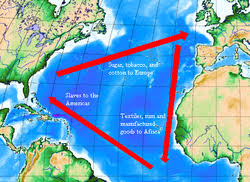
sugar, tobacco, cotton, textiles, rum, and manufactured goods, slaves
During the triangular trade -, -, and - were sent to Europe.
-, -, and - - were sent to Africa.
- were sent to the Americas.
The second leg of the triangle trade, where slaves from Africa were transported to the Americas.
Define: Middle Passage:
a company whose stock is owned jointly by the shareholders.
Define: Joint-Stock Company
Low risk, potential for high profit.
Allowed several investors to pool their money in support of a colony.
List 2 advantages of a joint-stock company:
King James I, Virginia Company, John Smith, Christopher Newport
Who was the founder of Jamestown?
- - - granted a royal charter to the - - which founded Jamestown. (The colony was led by Captains - - and - - )
Terrible living conditions (harsh climate, disease, etc.)
Mostly men (very few women)
Poor work ethic
gold, valuable resources, trade routes, return
List:
Characteristics of Jamestown
Characteristics of settlers
Goals: Find - and other - -, establish profitable - - , and secure a - on their investment.
Disease, food shortages, and strained relations with the Powhatan Confederacy
What were the early issues/problems in Jamestown?
John Rolfe, 1610 or 1612, saved, brown gold
What was the significance of tobacco in the Jamestown colony?
- credited with introducing a sweeter, more commercially viable tobacco strain (Nicotiana tabacum, likely from the Caribbean) to Jamestown around year or year. This proved to be a lucrative cash crop, often referred to as "- -," which became the economic foundation of the colony and - it from failure.
Pay your own way and receive 50 free acres of land
A rich man will pay your way in exchange for 7 years of service.
-Included Africans + whites.
Early Labor Systems: Headright System, Indentured Servitude:
1670s, free men, indentured Servants, impoverished, land, rights, rich, poor, colonial government, social and racial, to racial slavery, racial
Bacon’s Rebellion – causes/significance?
By the -, many of Virginia’s - - were former - -, who were - and could not afford to buy -, and had no -. This led to tension between the - and - Virginians.
-Challenged the - -
-Highlighted - and - tensions
-Fueled the transition to - -
-Shaped the development of - hierarchies in the colonies.
Religious Beliefs, morality, simplicity, worship, life, bible, authority, teachings, work ethic, glorify God.
Plymouth: characteristics of Puritanism
Intense - -
Strong emphasis on -
Desire for - in - and -
Believed the - was the ultimate -
Sought to live according to its -.
(contrary to Jamestown) Strong - - (in order to - -)
Puritans, Separatists (of the Anglican church)
Establish a colony where they could freely practice their religion
Preserve their English language and cultural identity
Describe the settlers of Plymouth in terms of their characteristics & goals:
2 characteristics:
2 Goals:
Established a civil government (run by the people)
-Helped shape the present-day U.S. government
Importance of the Mayflower Compact?
John Winthrop
model Christian society, example, righteousness, moral leadership.
Who was the founder of Massachusetts Bay?
What did he mean by “city upon a hill?”
He wanted to create a - - - that would serve as an - of - and - - for the world.
Puritans, religious beliefs, religious dissenters, Roger Williams, Anne Hutchinson, different, dominant.
Explain the religious tensions that led to the development of colonies such as Rhode Island:
The - were very intolerant of other - -. Two main - - , (name) and (name), had beliefs that were - from the - Puritan beliefs.
separatist minister, Rhode Island in 1636, church, state, religious freedom, all.
Role of Roger Williams?
The - - founded the colony of - - in (year)
-Guaranteed separation of - and -, as well as - - for (whom).
resident, authority, ministers.
Role of Anne Hutchison?
As a -, she questioned the - of several -.
40 years of rising tensions.
Native Americans were driven westward or sold as slaves.
King Philip’s War – causes and significance?
The Dutch West India Company (1621)
to capitalize on the fur trade and other trade opportunities
1621 or 1624
Establishment of New Netherland:
Who? Why? When?
1664
The British
Primarily due to its strategic location and the economic benefits it offered.
The British takeover of New Netherland?
When? Who? Why?
William Penn
So that the Quakers and other persecuted groups could freely practice their religion without fear of persecution.
1681
Establishment of Pennsylvania:
Who? Why? When?
1663,
King Charles II granted a charter to eight noblemen, known as the Lords Proprietors, rewarding them for their support in restoring him to the throne.
Served as a buffer colony against Spanish Florida and as a source of wealth
Establishment of the Carolinas:
When? Who? Why?
James Oglethorpe.
Served as a buffer colony between the other established British colonies and Spanish Florida. Also, for poor English debtors to start over.
1732
Establishment of Georgia:
Who? Why? When?
Focused on fishing and shipbuilding due to their rocky soil and harsh winters.
Regional Differences/Variations:
Identify the societal & economic characteristics of the New England / Northern Colonies:
Grew grains and had fertile land, resulting in a diverse economy.
Regional Differences/Variations:
Identify the societal & economic characteristics of the Middle Colonies:
Depended on plantations for cash crops like tobacco and rice, supported by a warm climate and fertile soil.
Regional Differences/Variations:
Identify the societal & economic characteristics of the Southern Colonies:
States that in order to become wealthy, a country must acquire as much gold, & silver as possible.
Define: Mercantilism
market, raw materials, supplier, manufactured, other nations, price, produce, mother, purchase.
Colonial advantages & disadvantages in regards to mercantilism?
-Guaranteed a reliable - for their - -, as well as an eager - of - foods/goods.
-Prevented them from selling goods to - - (even if they could get a better -).
-If a colony was unable to - items needed by the - country, it was unable to - manufactured goods.
1651, colonial trade, goods, British, ONLY, sugar, tobacco, cotton, wool, and indigo, resentment, smuggling.
What was the Impact of the Navigation Acts? (YEAR)
Imposed restrictions on - -.
Required all - shipped to & from the colonies to be carried on -ships.
Listed specific products that could - be sold to England (5 examples).
Problem?
Eventually led to colonial - and -.
1730s - 1750s
The Puritan church had begun to lose its grip on society.
Members declined, and colonists were more reluctant to live by the rules of Puritanism.
The Great Awakening (TIMEFRAME)
What caused/catalyzed the Great Awakening?
shared experience, destiny, independence, Revolution, religious, social, political.
What was the significance of the Great Awakening?
Fostered a sense of - - and a belief in America's unique -, ultimately contributing to the spirit of - that fueled the American -.
-shaped American -, -, and - landscape.
the Scientific Revolution, the Renaissance, and the Protestant Reformation,
Transformed European thought and became the foundation of modern Western political and intellectual culture
The Enlightenment
What caused/catalyzed the Enlightenment?
(3)
Significance of movement?
(2)