Thermodynamics and Kinetic Theory
 Call Kai
 Learn
Learn Practice Test
 Spaced Repetition
 Match
Match Flashcards
 Knowt Play
1/19

Earn XP
Description and Tags
Vocabulary and key concepts from lecture notes covering thermodynamics, thermal energy transfer formulas, kinetic theory assumptions, ideal gas laws, and black body radiation laws.
Name | Mastery | Learn | Test | Matching | Spaced | Call with Kai |
|---|
No analytics yet
Send a link to your students to track their progress
20 Terms
Specific Heat Capacity (c)
The amount of energy required to increase the temperature of 1kg of a substance by 1∘C or 1K, without changing its state.
Energy required to change temperature of a substance
Calculated using formula E=mcΔθ where e is energy required, m is the mass, c is the specific heat capacity Δθ is the change in temperature
Energy required to change the state of a substance
Calculated using formula E=Lm where E is energy required and L is specific latent heat and m is mass
Specific Latent Heat (L)
The amount of energy required to change the state of 1kg of material without changing its temperature.
Specific Latent Heat of Fusion
The specific latent heat required for energy transfer when a substance changes from a solid state to a liquid state.
Specific Latent Heat of Vaporisation
The specific latent heat required for energy transfer when a substance changes from a liquid state to a gaseous state.
Internal Energy of a Body
The sum of all the kinetic energies and potential energies of all the particles within a body, which are randomly distributed. When the state of a substance is changed its internal energy also changes due to change in potential energy whereas kinetic energy stays constant.
Absolute Zero
The lowest possible temperature, valued at −273∘C (0K), where particles have no kinetic energy and the volume and pressure of a gas are zero.
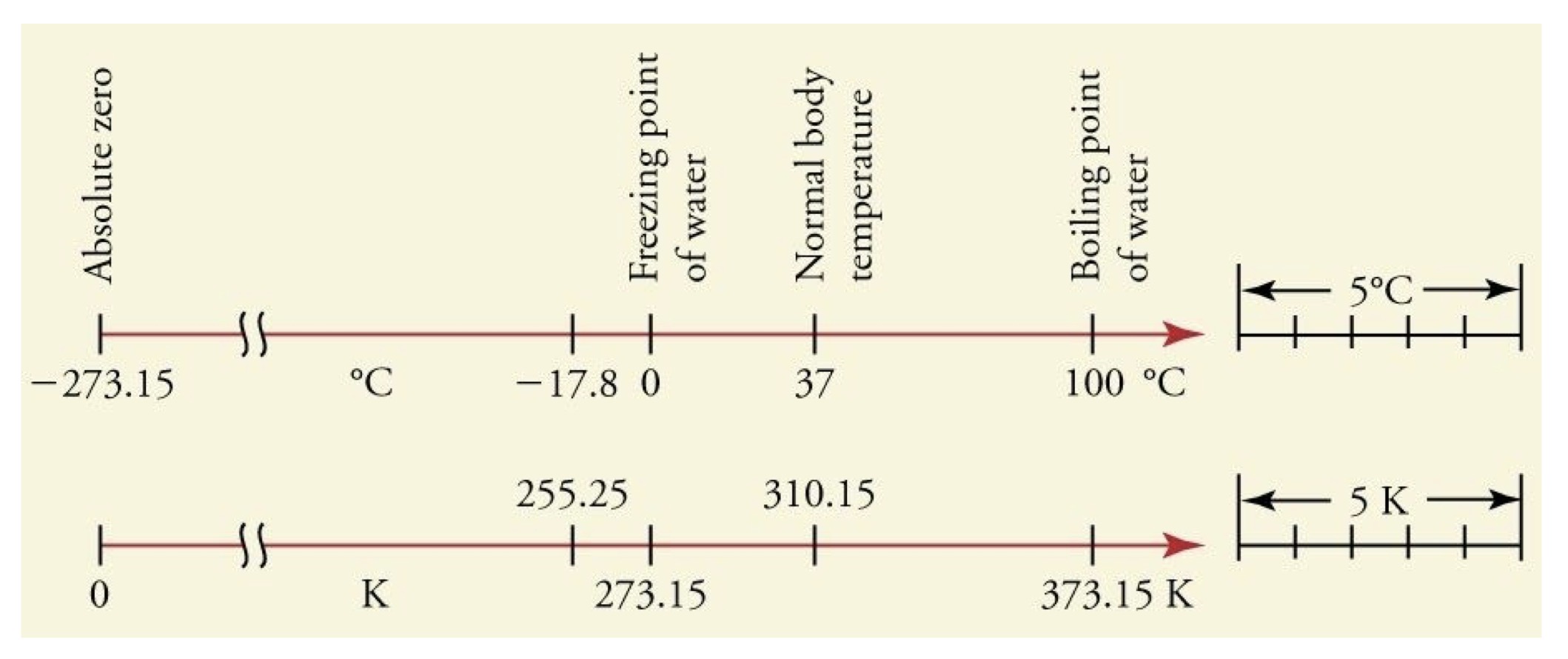
Kelvin scale
K=C+273. K is temperature in kelvin and C is temperature in Celsius
Average kinetic energy of molecules equation
Average molecule kinetic energy = 23kT where k is the Boltzmann constant an T is temperature in kelvin.
Kinetic theory model
Relates features of fixed mass of gas including its pressure, volume and mean kinetic energy. There are several underlying assumptions: No intermolecular forces act on the molecules, the duration of collisions is negligible in comparison to time between collisions, the motion of molecules is random and experience perfectly elastic collisions, motion follows newtons laws and move in straight lines between collisions
Mean Square Speed (<c2>)
A quantity defined as the mean of the square speeds of the gas molecules in a system.
Ideal Gas
A gas in which there are no interactions other than perfectly elastic collisions between molecules, meaning no intermolecular forces act and internal energy is equal to the sum of the kinetic energies of its particles as there is no potential energy.
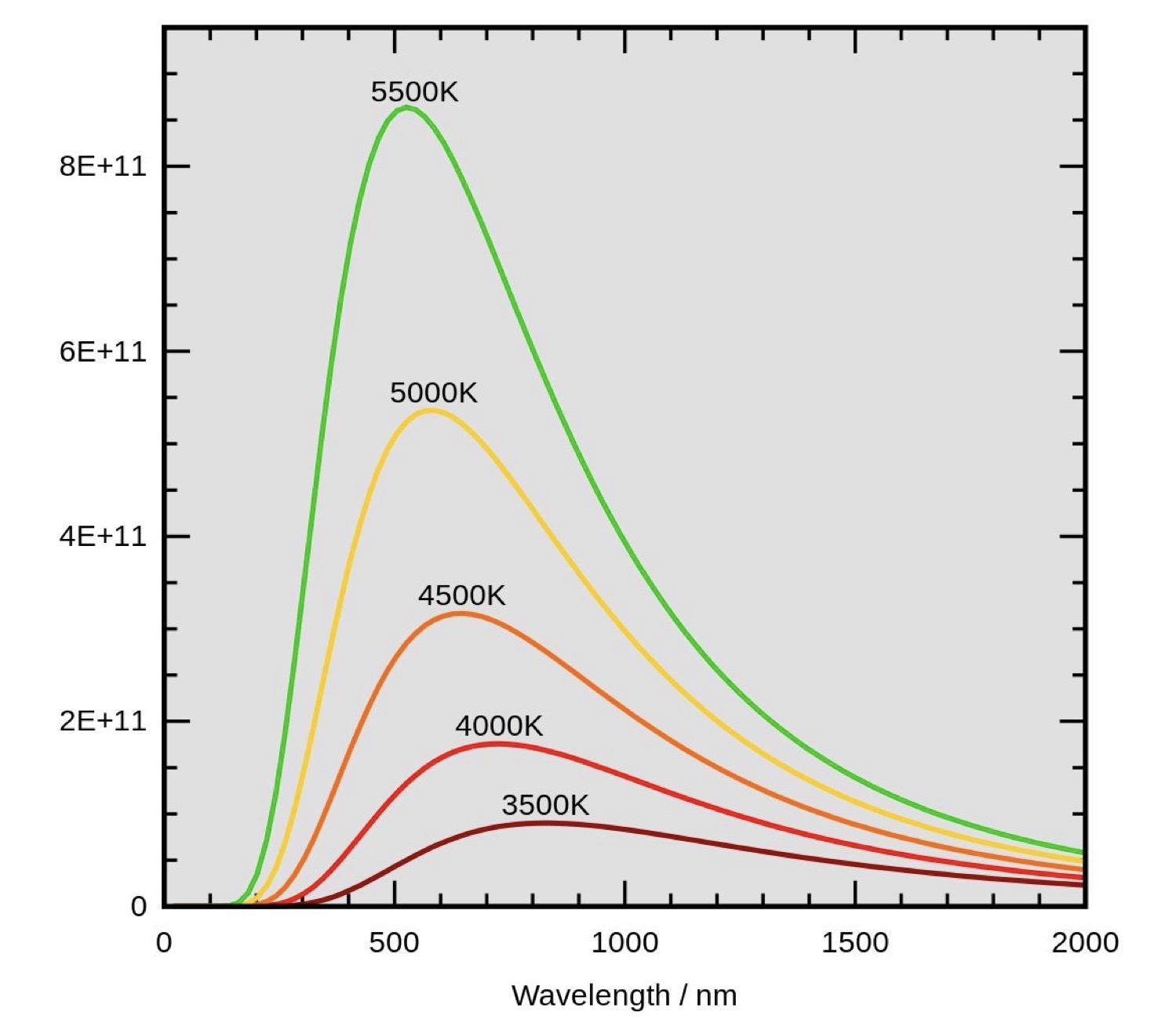
Black Body Radiator
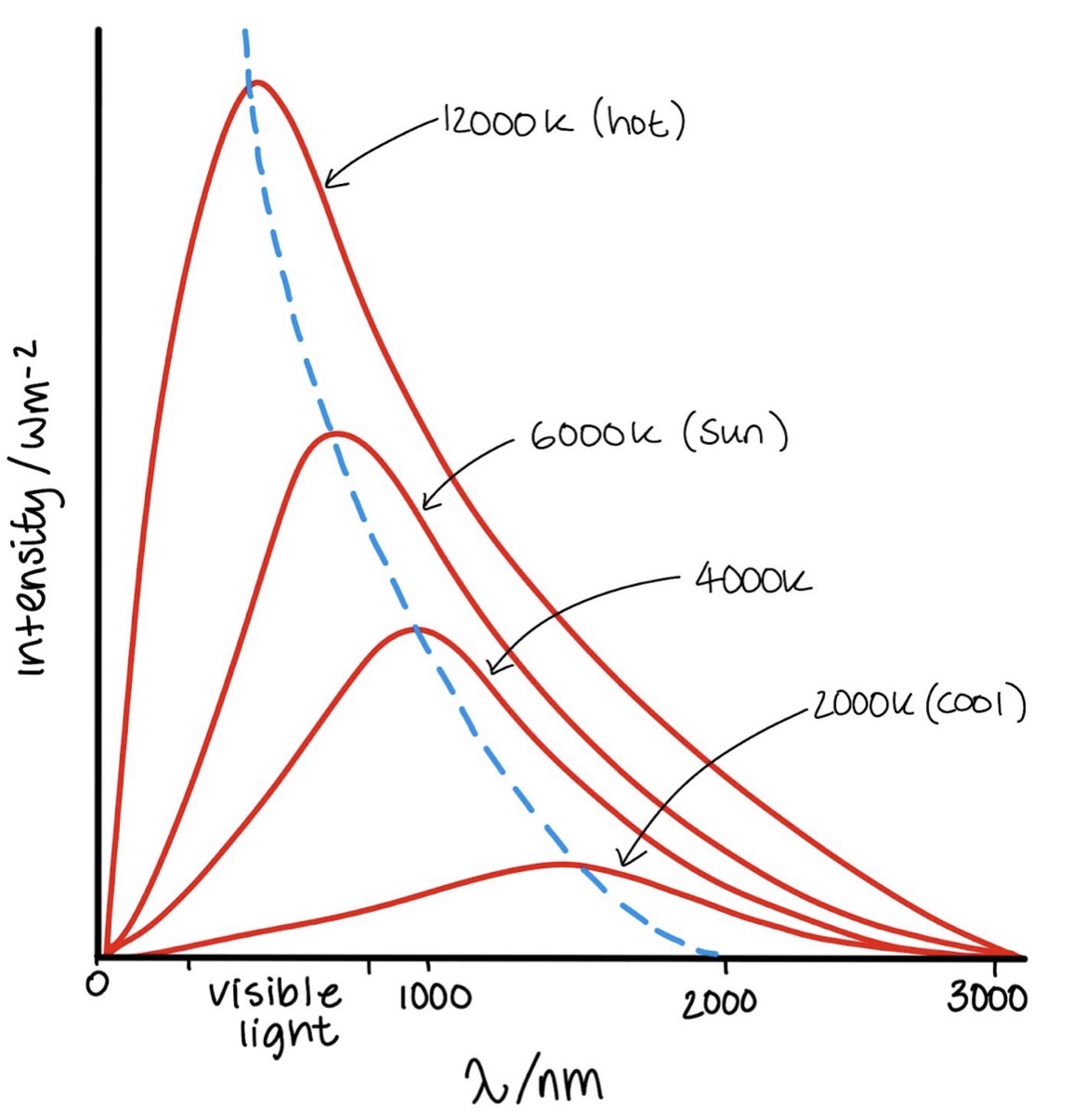
An object that acts as a perfect emitter and absorber of all possible wavelengths of radiation. Radiation curves are graphs of intensity against wavelength of radiation emitted by objects at different temperatures.
Luminosity (L)
The total power output of a black body radiator.
Stefan-Boltzmann Law
The law stating that the luminosity of a black body is directly proportional to its surface area and its absolute temperature to the fourth power (L=σAT4). Where T is absolute temperature and σ is the Stefan constant (5.67×10⁻⁸ ) Can be used to compare power output, temperature and size of stars
Wien's Displacement Law
The law stating that the peak wavelength of emitted radiation is inversely proportional to the absolute temperature of the object (λmaxT=constant=2.898×10⁻³ ). Shows peak wavelength of a black body decreases as it gets hotter meaning frequency increases so the energy of the wave increases.
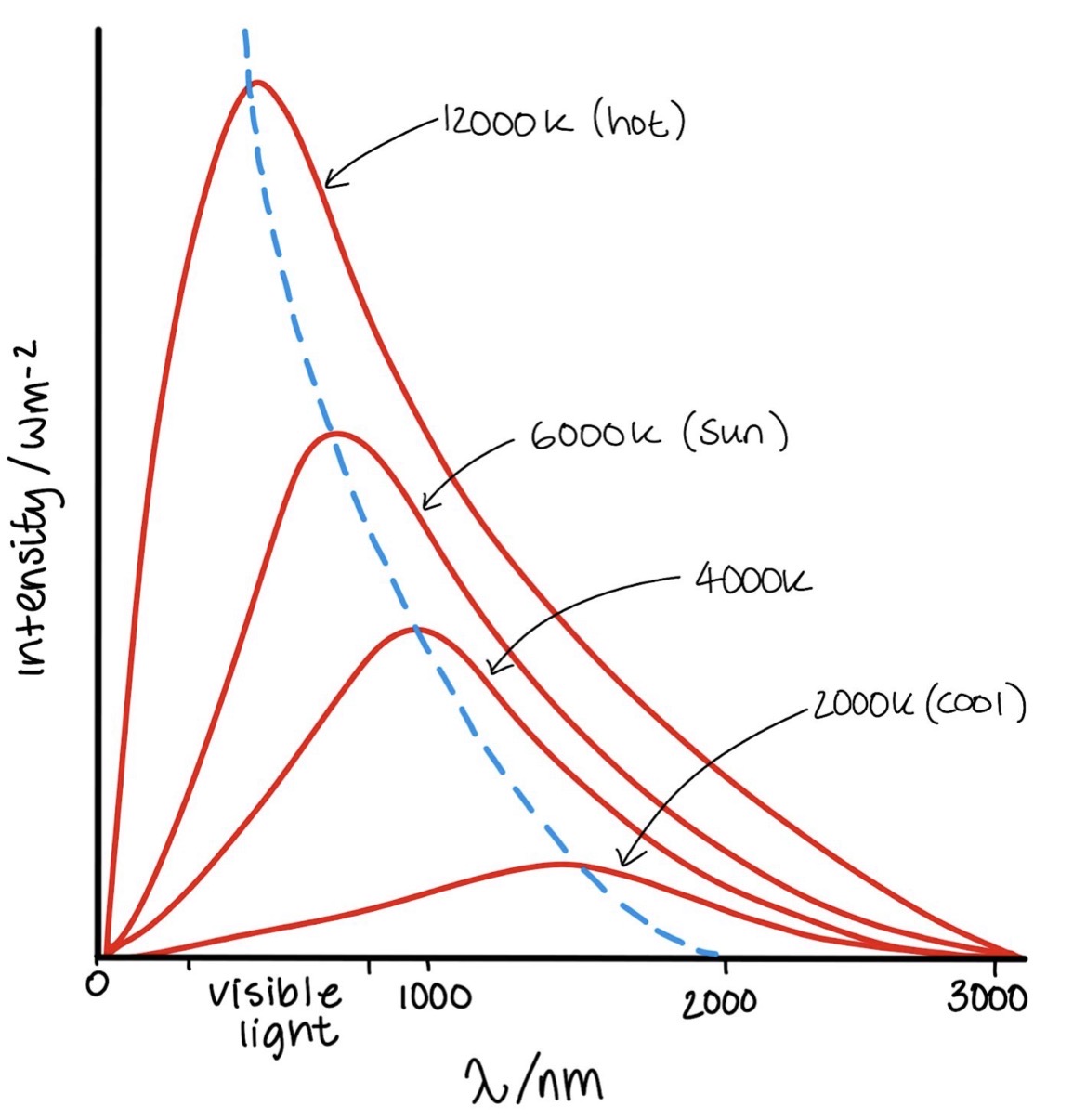
Peak Wavelength (λmax)
The wavelength of light released at maximum intensity by a black body radiator.
Boltzmann Constant (k)
A constant relating the average kinetic energy of molecules to their absolute temperature and appearing in the ideal gas equation (pV=NkT).
Stefan Constant (σ)
The proportionality constant in the Stefan-Boltzmann law, valued at 5.67×10⁻⁸Wm−2K−4.