Glycogenesis (Glycogen synthesis)

0.0(0)
Studied by 0 people
call kaiCall Kai
learnLearn
examPractice Test
spaced repetitionSpaced Repetition
heart puzzleMatch
flashcardsFlashcards
GameKnowt Play
Card Sorting

1/3

flashcard set

Earn XP

Description and Tags

L18

Last updated 11:04 PM on 12/4/25
Name
Mastery
Learn
Test
Matching
Spaced
Call with Kai

No analytics yet

Send a link to your students to track their progress

4 Terms

1
New cards

How does phosphoglucomutase work in glycogenesis?

  • isomerizes G6P to G1P

  • G6P is a branch point, can go either glycolysis (for energy) / glycogenesis (for storage)

  • phosphoglucomutase uses phosphorylated serine @ active site, adds Pi to C1, forming G-1,6-biP

  • then uses unphosphorylated serine to remove Pi @ C6, regenerates enzyme

  • result: glucose now has P on C1 instead of C6 (G1P)
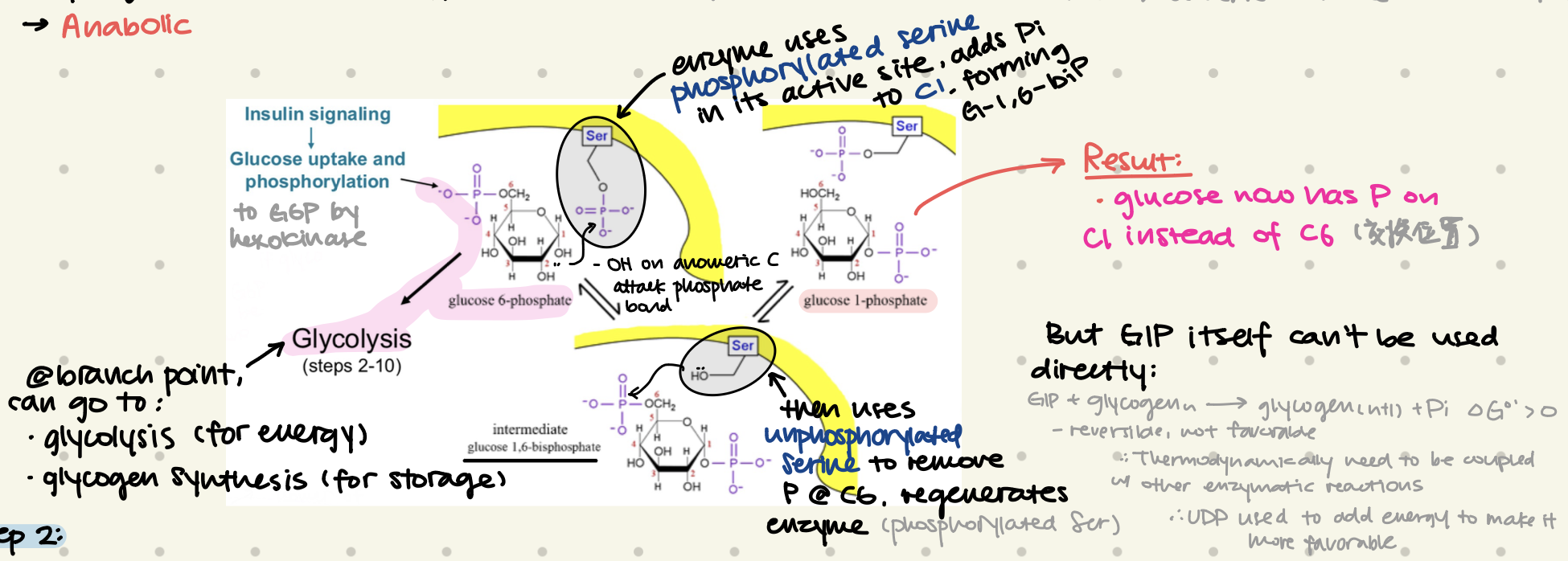
<ul><li><p>isomerizes G6P to G1P</p></li><li><p>G6P is a branch point, can go either glycolysis (for energy) / glycogenesis (for storage)</p></li><li><p>phosphoglucomutase uses <strong>phosphorylated serine</strong> @ <u>active site</u>, <strong>adds Pi to C1</strong>, forming G-1,6-biP</p></li><li><p>then uses <strong>unphosphorylated serine</strong> to <strong>remove Pi @ C6</strong>, regenerates enzyme</p></li><li><p>result: glucose now has P on C1 instead of C6 (G1P)</p></li></ul><p></p>
2
New cards

How does UDP-glucose pyrophosphorylase work in glycogenesis?

  • uses UTP to attach UDP to G1P, forming UDP-glucose

  • UTP loses PPi when attacked by G1P (∵pyrophosphate)

    • hydrolysis of PPi into 2Pi - very exergonic, pulls reaction forward

<ul><li><p>uses <strong>UTP</strong> to attach UDP to G1P, forming <strong>UDP-glucose </strong></p></li><li><p>UTP loses <strong>PPi</strong> when attacked by G1P (∵pyrophosphate)</p><ul><li><p>hydrolysis of PPi into 2Pi - very exergonic, pulls reaction forward </p></li></ul></li></ul><p></p>
3
New cards

How does glycogen synthase work in glycogenesis?

  • adds UDP-glucose to non-reducing ends of glycogen chain, creating new α-1,4 glycosidic bond

    • irreversible reaction (another pathway needed to break glycogen)
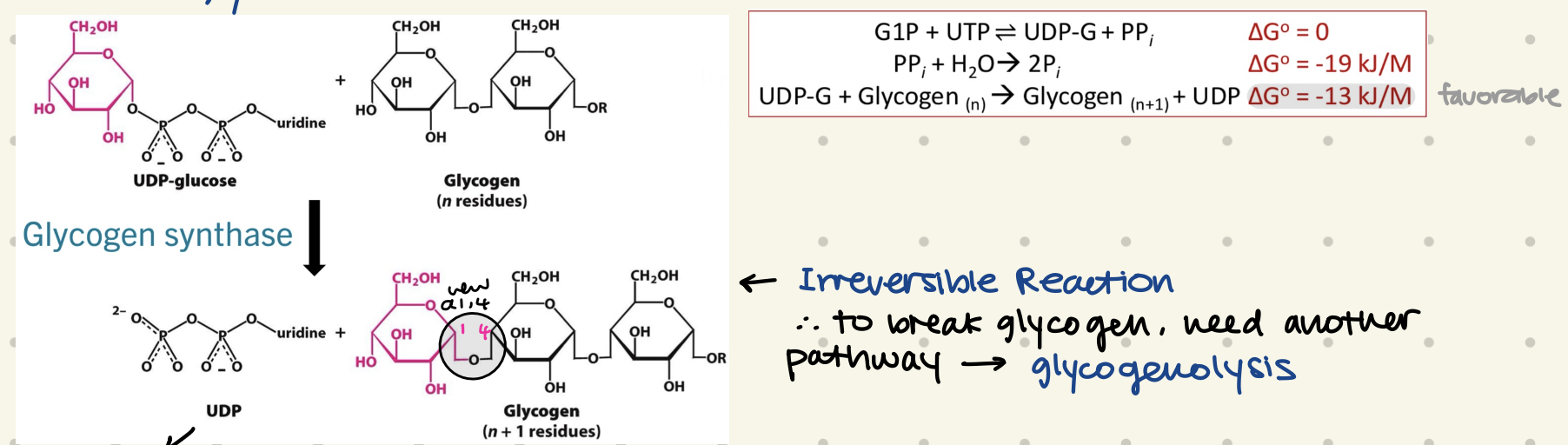
<ul><li><p>adds UDP-glucose to <strong>non-reducing ends</strong> of glycogen chain, creating new <strong>α-1,4</strong> glycosidic bond</p><ul><li><p>irreversible reaction (another pathway needed to break glycogen)</p></li></ul></li></ul><p></p>
4
New cards

-

-



