MCAT BIo
 Call Kai
 Learn
Learn Practice Test
 Spaced Repetition
 Match
Match Flashcards
 Knowt Play
1/141

There's no tags or description
Looks like no tags are added yet.
Name | Mastery | Learn | Test | Matching | Spaced | Call with Kai |
|---|
No analytics yet
Send a link to your students to track their progress
142 Terms
Kcat formula
kcat = vmax / [E] total
What graph shape does a cooperative process have?
Sigmoidal shape
Cells that continue though mitosis after maturation
epithelial cells (epidermis, gastrointestinal, respiratory), bone marrow stem cells, germ cells, fibroblasts
How many rings does a purine have
2 rings
Proteasome
ATP-dependent complex that selectively degrades ubiquinated proteins within a cell
Protease
Any enzyme that breaks down proteins into peptides or amino acids
What amino acids does phosphorylation typically happen?
serine, threonine, tyrosine
What amino acid residue does ubiquintation take place
Lysine
What is ubiquination?
A post translational modification to target protiens for location, signaling, or degradation
Charge of a protein that has an isoelectric point above physiological pH?
Negative -
What does detergent / SDS do?
Lyses bilayers by inserting itself
Extract lipids to lyse bilayers
Southern Blot
Targets DNA
Northern Blot
Targets RNA
Western Blot
Targets protiens
Prion
Misfolded variants of a protein that can cause misfolding when interacting with normally folded proteins of the same protein
Centrosome
A centrosome is the primary microtubule-organizing center & regulator of the cell cycle
Centromere
A section of non-coding DNA that is responsible for the movement of replicated chromosomes to daughter cells in mitosis / in the middle of the chromosome
Kinetochore
A structure on the centromere of a chromosome that acts as the attachment point for spindal microtubules mainly during mitosis / meiosis
Where are the variable regions of an antibody?
On the ends of the V
What is the cross-bridge cycle
The cycle calcium binding to troponin, exposing tropmyosin, exposing actin for myosin to bind, releasing ADP to form a power stroke
Cell Theory
All living things are made of cells
Basic functional unit of life
Cells come from pre existing cells
Endomembrane system pathway
DNA —> RNA —> Protiens (ribosomes) —> vesicles (golgi) —> membrane —> exocytosis —>
Epithelial Tissue
Covers the body and lines cavities - involved with absorption and secretion
the "parenchyma” (functional parts of tissue)
Endothelial Tissue
Connective tissue / the framework
extracellular matrix (collagen + elastin)
Types of Tissues
Epithelial
Endothelial
Nervous
Muscles
Bacteria Types
Coccus / spherical (staph, s. aueus)
Bacillus / rod shaped (e coli)
Spital / helical (syphylsis)
3 Types of prokaryotic genetic recombination
transformation
conjugation
transduction
Transformation
A bacteria dies, other bacteria takes in its genetic material
Conjugation
Bacteria sex; F- becomes F+; F+ has the conjugation bridge
Transduction
Genetic info comes from a virus
Retrovirus
Uses reverse transcriptase and their RNA to produce DNA to highjack cells
What types of cells don’t replicate
Heart cells and neurons
G1 phase
Increases size of the cell; checkpoint before S phase to ensure proper DNA
S Phase
Replicates genetic material; each cell has 46 chromosomes at this point
G2
Nucleus dissolves & final growth / checkpoint before mitosis
Steroid Hormones
Cholesterol derivative; 4 ringed structures; mainly non-polar (ends in oid, ol, one)
Amino acid hormones
Very polar; must bind to a receptor because it can’t pass through membranes; causes signal transduction cascades
Peptide hormones
Polar and protein-derived hormones (ex. insulin) - need to bind to a receptor
Heart electrical pathway
SA node —> AV node —> Bundle of His —> Purkinjie fibers
Explain the electrical conduction
SA node fires
AP spreading across both atria causes contraction (atrial kick)
Reaches the AV node
AP swiftly travels down the interventricular septum, wrapping around the ventricular walls
How does the heart pump
Blood drains into the ventricles follwoing passive opening of TV/BV
SA node fires
AV node delay
Ventricles depolarize
Ventricles contract opening the aortic and pulmonary vlaves pushing blood out of the heart
ventricles repolarize and relax
Mean arterial pressure formula
MAP = Cardiac output (HR x SV) x system vascular resistance
Oncontic pressure formula
ii = imRT
What causes high osmotic pressure?
Higher concentration of solutes = higher osmotic pressure
What is formed by the ectoderm?
epidermis, hair, epithelium of nose, mouth, lower anal canal, lens of the eye, inner ear, adrenal medulla, nervous system
What is formed by the mesoderm?
musculoskeletal system, circulatory system, excretory system, gonads, connective tissue of digestive and respiratory systems, adrenal cortex
What is formed by the endoderm?
epithelium of digestive and respiratory systems, pancreas, thyroid, bladder, distal urinary tract, liver
Products of PPP oxidative phase
NADPH, CO2
Products of PPP non oxidative phase
Ribose-5-Phosphate, fructose-6-phosphate
How much ATP does 1 glucose molecule make during aerobic respiration?
30-32 ATP
Net products of glycolysis (1 unit of glucose)
2 ATP
2 NADH
2 Pyruvate / Acetyl CoA
Net products of CAC (1 Acetyl CoA)
3 NADH
1 FADH2
1 ATP / GTP
When is insulin released and what happens when it is?
release with high BGL
when released it promotes glycogenesis and increases glycogen synthesis and storage
When is glucagon released and what happens when it is?
released with low BGL
when released it promotes glycolysis and causes glycogen to be turned into glucose
Can acetyl-CoA from fatty acids be used in the CAC
NO!
Why are triglycerides good for energy storage?
energy-rich
inert (no random rxns)
no functional roles
very hydrophobic (not weighed down by water)
What limb of in the loop of Henele is permeable to water
descending limb
When is the glucose and amino acids reabsorbed in the renal system
Proximal convoluted tubule
Oxidoreductase
Transferes electrons from one molecule to another (Dehydrogenases, Cytochrome)
Transferases
Transfers functional groups between molecules (all kinases, phoshorylase)
Hydrolases
Uses water to break bonds (decarboxylase, phosphatases, GTPase, protease)
Lyases
Break bonds through means other than the addition of water (isomerases, mutases)
Ligases
Joins two large molecules together by forming a new chemical bond (DNA ligase)
Convergent Evolution
When unrelated species develop similar traits due to similar environements
Divergent Evolution
Related species branch out and develop different traits due to different pressures, often leading to speciation. This produces homologous structures
Parallel Evolution
Related species evolving similar traits independently
Hardy weinberg equilbirum
p²+2pq+q²=1
p+q=1
What is another name for complex II of the ETC
Succinate Dehydrogenase
Genomic Imprinting
The process by which only one copy of a gene in an individual (either from their mother or father) is expressed while the other copy is suppressed.
Osteoblasts
Builds bones / bone marrow
Osteoclasts
Breaks down old or damaged bone and does bone resorption
How can inbreeding effect the population?
It can increase the incidence of expression of deleterious recessive traits
Phosphorylase
Adds phosphate groups
Phosphotase
Removes phosphate groups
Kinase
Transfers phosphate group from ATP to other molecules
Cytochrome
A redox-active protein that it’s primary function is to be an electron transporter
During phosphorylation the phosphate group be exchanged for an H or an O atom?
H atom. Will bind to the O
Where does fatty acid oxidation take place?
The mitochondria
Where does fatty acid synthesis take place
Cytosol
What gets added to Acetyl-CoA to make Malonyl-CoA
A carboxylic acid
What decreases O2 affinity for hemoglobin?
Increased CO2
Decreased pH (acidosis)
Increased temperature
Increased 2,3-BPG
Henry’s Law
Higher pressure of a gas above a liquid means more gas will dissolve into the liquid (S=k*p)
What does microRNA do?
They are post-transcriptional regulators of gene expression that bind to RNA, which leads to mRNA degradation, destabilization, or translational inhibition effectively “silencing” genes
Native PAGE
Separates molecules based on their electrophoretic mobility relying on length, confirmation, and charge
Gel filtration chromatography
Separates proteins only on the basis of size
Ion exchange chromatography
Separation of molecules based on their charge
Isoelectric focusing
Separates molecules based on their isoelectric points
B cells
A lymphocyte developed in the bone marrow that produces antibodies
Helper T cells (CD4+)
Activated by antigens presented on Class II MHC receptors and they secerete cytokines that activate other cells (B cells and killer T cells) and initiate the adaptive immune system
Killer T cells (CD8+)
Activated by antigens associated with Class I MHC receptors present on nucleated cells in the body, and upon activation they release cytoxoic granules that induce apoptosis in target cells
Microglia
The central nervous system (brain’s) specialized macrophages
Macrophages
Part of the innate immune system, they engulf pathogens, digest them, and present antigens on the MHC. They also release cytokines that cause inflammation and attract more immune cells
Desmosomes
Intercellular junctions that function as anchors to from strong sheets of cells
Gap Junctions
Intercellular junctions that provide cytoplasmic channels between adjacent cells
Intercalated discs
Specialized intercellular junctions between cardiac muscle that provide direct electrical coupling among cells
Tight Junctions
Intercellular junctions that prevent the movement of solute within the space between adjacent cells
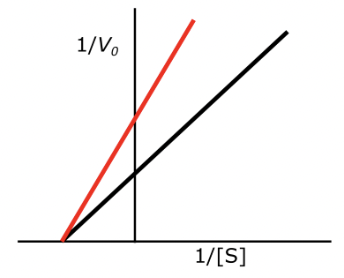
vmax decrased
km not affected
Noncompetitive Inhibition
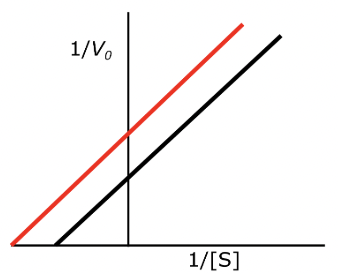
Vmax increased
Km increased
Uncompetitive Inhibition
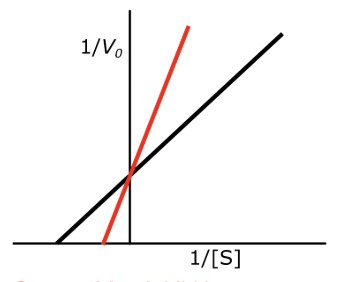
Vmax not affected
Km increased
Competitive inhibition
Steady state assumptions
Solutions are behaving ideally
Constants remain constant
Substrate to product reaction that occurs without enzyme is negaligable