Lectures 24-33 Chem II
 Call Kai
 Learn
Learn Practice Test
 Spaced Repetition
 Match
Match Flashcards
 Knowt Play
1/60

There's no tags or description
Looks like no tags are added yet.
Name | Mastery | Learn | Test | Matching | Spaced | Call with Kai |
|---|
No analytics yet
Send a link to your students to track their progress
61 Terms
Spontaneous process
a process that occurs without intervention
Spontaneity is…
independent of the speed or rate of reaction; a spontaneous process proceeds slowly
Factors of spontaneity
Energy change
Temperature ΔH (measures the total heat content of a system)
Entropy change
Gibbs Free energy equation with entropy
ΔG= ΔH-TΔS
negative ΔG means…
spontaneous
positive ΔG means…
non-spontaneous
Entropy
measures the disorder of a system
Greater disorder = greater entropy
ΔS ΔH and ΔS -ΔH
spontaneous at high temp. and spontaneous at all temp.
-ΔS ΔH and -ΔS -ΔH
non-spontaneous at any temp. and spontaneous at low temp.
First Law of Thermodynamics
energy of the universe is constant, but the various forms of energy can be interchanged in physical and chemical processes
Second Law of Thermodynamics
in any spontaneous process, there is always an increase in entropy
Third Law of Thermodynamics
a perfect crystal at absolute zero (0 Kelvin) has an entropy value of zero
S (entropy) equation
S = k*ln(W), where k is the Boltzmann constant (1.38E-23 J/K) and W is the number of microstates (energetically equivalent ways to arrange components in a system)
Entropy of gas, liquid, solid (allotropes- different forms of the same element)
Sgas > Sliquid > Ssolid
Entropy of pure substance vs mixture
Smixture > Spure substance
Entropy with temperature
Shigh temperature > Slow temperature
Entropy with mass
Sincreasing mass > Sdecreasing mass
More complex structures have
have greater entropy
Equation of entropy with universe
Suniverse = Ssys + Ssurroundings
▪ System: the reaction
▪ Surroundings: everything else
S(system) S(surroundings) S(universe)
Spontaneous
-S(system) -S(surroundings) -S(universe)
Non-spontaneous (reaction will proceed in reverse)
S(system) -S(surroundings) S(universe)?
Spontaneous if system is larger in magnitude than surroundings
-S(system) S(surroundings) S(universe)?
Spontaneous if surroundings are larger in magnitude than system
Tabulated standard entropy ∆S° values
Standard state = at 25 degrees Celsius (298K), 1M, 1 atm, etc.
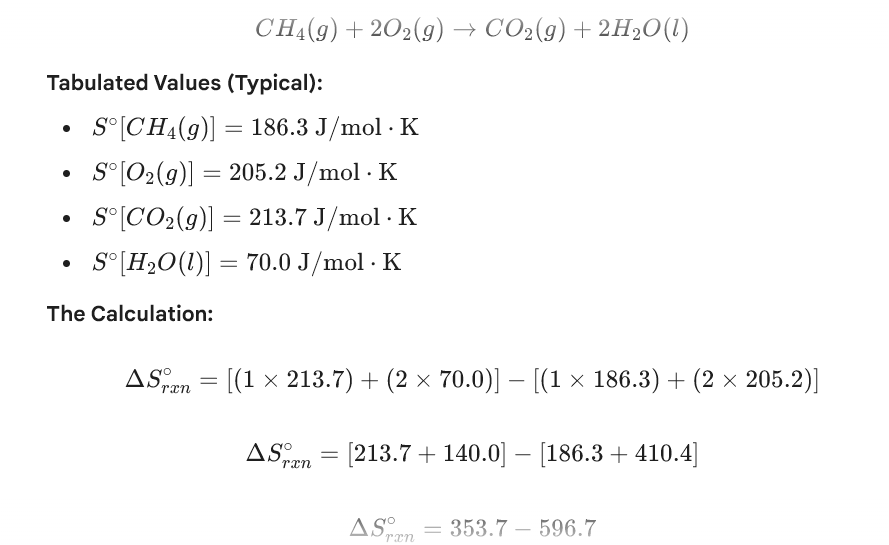
Standard entropy equation and example
∆S°(rxn) = Σn∆S°(products) - Σm∆S°(reactants)
Change in entropy of the surroundings is and equation…
directly proportional to the enthalpy of the system
∆Ssurr = -∆Hsys/T
Exothermic process corresponds to
positive entropy change in surroundings
What is a major difference between chemical kinetics and thermodynamics?
Chemical kinetics focuses on the pathway between reactants and products (path-dependent); thermodynamics only considers initial and final states (state functions).
What do you notice about entropy values for elements and compounds?
Entropy values for elements are much smaller than entropy values for compounds, since compounds typically have more microstates.
What is the difference between ∆S(universe) in spontaneous and equilibrium processes?
∆S(universe) > 0 for spontaneous processes, but ∆S = 0 in equilibrium processes.
Define Gibbs Free Energy.
Gibbs Free Energy: the maximum amount of non-expansion work that can be extracted from a closed system
∆G°(rxn) equation
∆G°(rxn)= Σn∆G°f(products) - Σm∆G°f(reactants) at 25 degrees Celsius
∆G°(rxn)
is a measure of the driving force
The free energy of formation of pure elements in their standard states…
is zero
Negative ∆G(rxn) indicates…
forward reaction has excess energy and will occur spontaneously
Positive ∆G(rxn) indicates…
there is not enough energy in the forward direction, so the backward reaction will occur
∆G(rxn) equation
= ∆G°(rxn) + RTln(K)
∆G(rxn) at equilibrium
= 0 at equilibrium; ∆G°(rxn) = -RTln(K) at equilibrium
Hess’s Law for ∆G.
If a reaction is reversed, the sign of its ∆G value reverses
If the amount of materials is multiplied by a factor, the value of the ∆G is multiplied by the same factor
∆G under nonstandard conditions equation
∆G = ∆G° + RTln(Q) (yes, equilibrium never leaves)
▪ Remember Q and K are calculated the same way – [products]/[reactants]
The larger the value of K (equilibrium constant)
the more negative the value of ∆G°
If ∆G° = -RTln(K), then you should be able to solve for K using algebra
▪ K = e^(-∆G°/RT), where K can be any equilibrium constant (Keq, Ksp, etc.)
Reactant-favored vs product-favored
+∆G° vs -∆G°
Favorable entropy is
is positive; unfavorable entropy is negative
Favorable enthalpy is
is negative; unfavorable enthalpy is positive
Gibbs free energy with entropy and enthalpy equation
∆G = ∆H-T∆S
Determine the minimal temperature for spontaneity, which means the “threshold” temperature where a reaction becomes spontaneous
T = ∆H/∆S you can derive this; prove this to yourself (hint: what does ∆G have to be for a reaction to be spontaneous?)
Why are most real reactions irreversible?
In a real reaction, some (if not most) of the free energy is “lost” as heat.
Electrochemistry:
the study of the interchange between chemical change and electrical work
Electrochemical cells
systems utilizing redox reactions to produce or use electrical energy
Oxidation
loss of electrons; Reducing Agent: the species that gets oxidized
▪ Electron(s) is a product
Reduction
gain of electrons; Oxidizing Agent: the species that gets reduced
▪ Electron(s) is a reactant
Electrons are negatively charged, so if you gain electrons (reduction)…
The oxidation number becomes more negative; if you lose electrons (oxidation), the oxidation number becomes more positive
Cathode
Where oxidation occurs
Where electrons are produced
Anions migrate towards
Has a negative sign
Anode
Where reduction occurs
Where electrons are consumed
Cations migrate towards
Has a positive sign
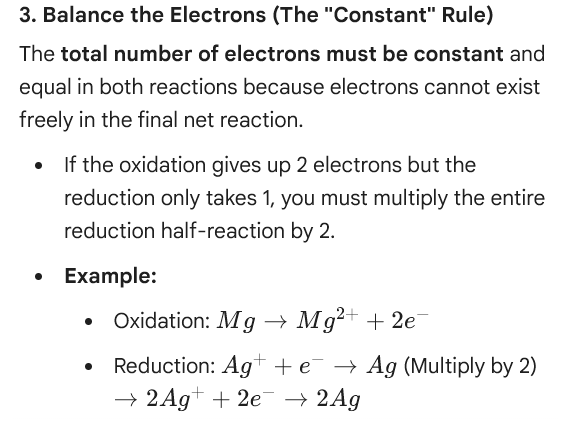
How to write half-reactions
Electrons remain constant
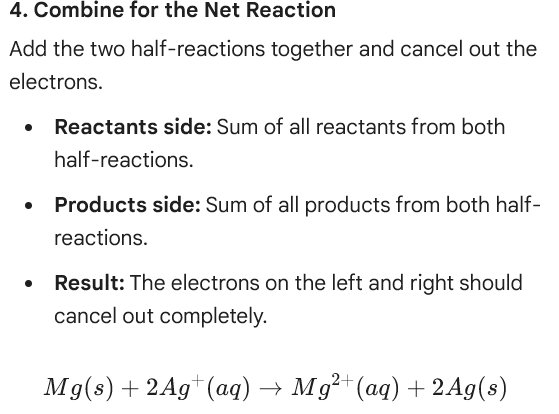
How to write net reaction
No electrons here
Physical meaning of an oxidation number
Indicates a degree of oxidation and reduction
Tracks electron loss (oxidation) or gain (reduction) during chemical reactions, particularly in covalent compounds where actual charge transfer does not occur
Oxidation number rules (that are a hierarchy!).
Pure element has an oxidation number of zero
Monatomic ion has an oxidation number equal to the charge on the ion
Polyatomic ions must have the sum of the oxidation numbers equal to the charge on the whole ion
Hydrogen = +1 (unless a hydride- NaH, LiH, CH4, LiAlH4)
Oxygen = -2 (unless peroxide- H2O2, Na2O2, BaO2)
Fluorine = -1
Active Metals (Group 1 and Group 2)
Lose electrons easily
Easily oxidized
Strong reducing agents
Active nonmetals (Halogens in Group 17)
Gain electrons easily
Easily reduced
Strong oxidizing agents