Patient Care - Pharmacology & Medical Emergencies (Unit 3)
 Call Kai
 Learn
Learn Practice Test
 Spaced Repetition
 Match
Match Flashcards
 Knowt Play
1/170

There's no tags or description
Looks like no tags are added yet.
Name | Mastery | Learn | Test | Matching | Spaced | Call with Kai |
|---|
No analytics yet
Send a link to your students to track their progress
171 Terms
Analgesics
Relieve pain without causing loss of consciousness.
Aspirin, Fentanyl, Oxycodone, Tramadol, Tylenol (acetaminophen)
Anesthetic Agents
Reversibly depress neuronal function, producing loss of ability to perceive pain and other sensations.
Xylocaine (lidocaine)
Antianxiety
Treatment of anxiety. Act on the CNS to calm or relax the anxious patient.
Midazolam (versed)
Antiarrhythmic
Treat arrhythmias
Xylocaine (lidocaine)
Antibiotics
Used to kill or inhibit the growth of microorganisms.
Amoxicillin
Anticholinergic
Reduce the smooth muscle tone, motility of the GI tract, and secretions from respiratory tract and secretory glands.
Anticoagulant
Inhibit clotting of the blood or increase the coagulation time.
Heparin, Warfarin (coumadin)
Antidepressants
Treatment of depression. Often require 6 to 12 weeks of administration to achieve their maximal therapeutic effect.
Antidiabetics
Treatment to control/manage diabetes. Works to lower high blood glucose levels.
Metformin (Glucophage)
Antiemetic
Prevent and treat nausea and vomiting.
Ondansetron (Zofran)
Antiepileptics
Prevent or control the occurrence of seizures. They do not treat the cause of seizures; they reduce or eliminate seizure activity.
Antihistamine
Treat allergic disorders, both acute and chronic.
Benadryl (diphenhydramine)
Antihyperlipidemics
Management of hyperlipidemia. Reduction of lipid levels in the blood.
Antihypertensive
Treat high blood pressure.
Antiplatelets
Inhibit platelet aggregation.
Aspirin
Antipyretic
Used to prevent or reduce fever.
Tylenol (acetaminophen)
Bronchodilators
Used in the treatment of asthma and COPD. Relax bronchial smooth muscles and dilate the respiratory passages.
Epinephrine (adrenalin)
Cathartic (laxative)
Act to promote the passage and elimination of feces from the large intestines.
Coagulants
Used to control hemorrhage or to speed up coagulation.
Corticosteroids
Used to reduce the symptoms associated with chronic inflammatory disorders or acute inflammatory conditions.
Diuretics
Increases the amount of urine excreted by the kidneys, thus removing sodium and water from the body.
NSAIDs
Have analgesic, antipyretic, and anti-inflammatory actions.
Ibuprofen (Motrin)
Opioid Antagonist
Block the effects of opioids.
Naloxone (Narcan)
Sedatives/Hypnotics
Produce varying degrees of CNS depression ranging from mild sedation to sleep.
Stimulants
Increase the activity of the brain and spinal cord.
Epinephrine (adrenalin)
Thrombolytic
Dissolve the thrombi (clots) that have already formed.
Vasoconstrictors
Cause blood vessels to constrict, thus increasing heart action and raising blood pressure.
Epinephrine (adrenalin)
Vasodilators
Cause blood vessels to dilate.
Nitroglycerin
Drugs can have at least 3 different names:
Chemical name
Generic name
Brand name
Chemical Name
Identifies the actual chemical structure of the drug
Generic Name
Name given to the drug when it becomes comercially available.
May also be called: Nonproprietary name
Brand Name
Given to a drug manufactures by a specific company.
May also be called: Trade name
What is the physicians' desk reference (PDR)?
Provides a drug summary listing the essential info on medications
What are some substances that are not controlled by the FDA, but may be listed as 'drugs' by your patient? It is important to document these as they may interfere with prescribed medications.
Dietary supplements, vitamins, supplements, and herbal remedies
Tablet
Powder or granulated drug that has been compressed into a solid hard disk.
Capsule
Powered or liquid drug is contained in a gelatin shell. Shell dissolves in the stomach.
Inhalant
Breathable chemical vapor that may cause systemic and local effects.
Suppository
Shaped for insertion into a body opening. Dissolves in the body at body temperature.
Solution
One or more drugs dissolved in a liquid carrier. They are rapidly absorbed and administered orally or parenternally.
Suspension
One or more drugs in small particles are suspended in a liquid carrier. Administered orally, never intravenously.
Transdermal Patch
Permits a drug to be applied on the skin surface, where it is absorbed into the blood stream.
Antagonist Drug
Drug that blocks the passage of impulses through the parasympathetic nerves. Blocks or interferes with the effects of another substance, preventing a biological response.
Benzodiazepines are classified as antianxiety or anxiolytics, but these drugs may also be used in the radiology department for:
A common brand name is:
Preoperative drugs for various procedures.
Ativan, Xanax, Versed, Valium
Patients with diabetes often need to discontinue __________ prior to administration of IV contrast media. What is the brand name and generic name?
Antidiabetics or Metformin
Glucophage/Metformin
The __________ is the main organ involved in metabolism.
Liver
The __________ is the main organ incolced in excretion.
Kidneys
__________ is a pain reliver that does not cause the loss of consciousness. It is divided into 2 subgroups: non-opioid & opioid.
Analgesic
__________ is a drug classification used to treat allergic disorders, both acute & chronic. For severe allergic reactions, the drug administration route is usually __________.
List common drugs under this classication:
Antihistamines
Intramuscularly
Allegra, Benadryl, Claritin, Vistaril
__________ is a commonly used anticoagulant; administered parenterally.
Heparin
__________ & stimulants are both drug classifications that may treat shock.
Vasoconstrictors
__________ may be administered parenterally for acute MI & strokes.
Thrombolytic
__________ may be given to diabetics who are hyperglycemic.
Insulin
__________ is a vasodilator that may be used on a patient who suffers from angina pectoris.
Nitroglycerin
__________ abnormal response to a drug; something that wasnt expected to occur.
Idiosyncratic
__________ an unintended secondary effect from a drug.
Side effect
__________ an adverse effect resulting from too high of a dose or is the body is unable to filter the drug out.
Toxic effect
__________ is used to stimulate defecation; it can be classified as a laxative.
Cathartic
List the 6 rights to drug administration:
Right patient
Right medication
Right dose
Right route
Right time
Right documentation
Pharmacokinetics
Study of drugs within the body; absorption, distribution, metabolism, and excretion.
Pharmacodynamics
Study of what the drug does to the body (physiological and biochemical effects).
Pharmacogenetics
Study of how people respond to a drug based on their genetic makeup.
How many times should the drug label be checked?
3 times minimum
Once when container is removed from shelf
When drug is removed from the container
When the container is replaced
if you accidentally drew up more medication than you needed into a syringe, what should you never do with the extra?
Never put it back into the original container
List the enteral routes of administration:
Oral, sublingual, buccal, and rectal
The most common method of drug administration is:
Medications ordered to be administered this way use what abbreviation?
Oral
PO
Nitroglycerin is commonly given via this route: _____________. Which allows for rapid absorption.
Sublingual
Topical routes of administration will apply the drug directly onto the __________ where it is absorbed into the __________. Examples include:
Skin
Bloodstream
Ointments, creams, transdermal patch
Define parenteral routes of administration:
Drugs that are injected into the body, not be mouth/GI
Intravenous
Injected directly into the vein
Intra-arterial
Injected directly into an artery
Intrathecal
Injection into the subarachnoid space of the spine.
Intramuscular
Injected directly into the muscle; fast acting.
Subcutaneous
Injected directly under the skin
Intradermal
Injected inbetween the layers of the skin
Intraosseous
Injected directly into the bone marrow
A __________ angle is used for intramuscular injections.
90
A __________ angle is used for subcutaneous injections.
45
A __________ angle is used for intravenous injections.
25 or less (around 15)
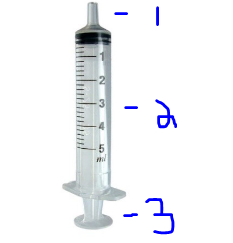
Label synringe
Tip
Barrel
Plunger
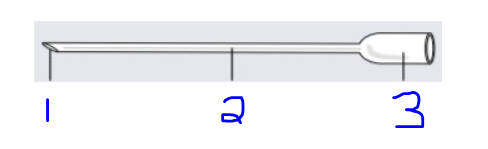
Label needle
Bevel (make sure it is always up)
Shaft
Hub
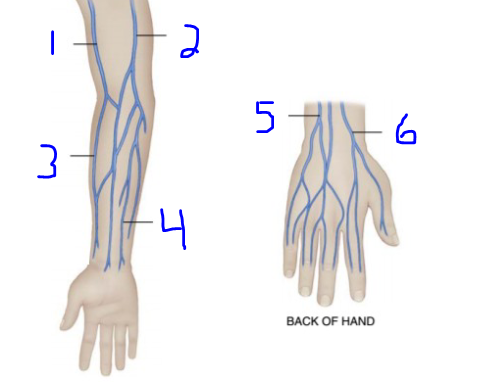
Label
Cephalic vein
Basilic vein
Radial vein
Median vein
Basilic vein
Cephalic vein
Intravenous injection methods:
Slow single administration of the drug: administering a drug throug a syringe that is connected to an IV.
Intravenous bolus or push: allows for rapid push of drugs into the vein.
Drip infusion: used for administering large amounts of fluid. Can control the amount administered over a specific period of time.
Bolus
Amount or quantity of fluid being injected
Extravasation
Discharge or escape of fluid from a vessel into the surrounding tissue that can cause localized vasoconstriction.
List the steps you must take if extravasation (infiltration) occurs:
Remove the needle
Apply pressure
Apply a cold compress
What should be administered through the IV before and after contrast media?
Saline
HIV exposure risk is relatively low/high after an accidental needle stick.
Low
What steps should you take after a needle stick?
Wash hands with soap and water
Notify supervisor and clinical coordinator
Blood tests for HIV, HPV, etc
Define C.A.B
Compressions, Airway, Breathing
Current AHA ratio for adult CPR:
Compression Rate:
Compression Depth:
30:2
100-120 compressions/min
2” depth
Current AHA ratio for pediatric CPR:
Compression depth:
Ratio for 2 person pedi CPR:
30:2 (100 compressions/min)
1/2-1” depth
15:2 (100 compressions/min)
Which heart arrythmia would require the used of an AED?
Ventricular fibrillation
If a patient is choking and verbalizes they are, what should be done?
Encourage them to keep coughing
If a patient is chocking and cannot speak, what should be done?
Heimlich maneuver
List signs & symptoms of someone experiencing a deteriorating state of consciousness:
Irritability, lethargy, slowing pulse rate, slowing breathing
List some medical supplies that may contain latex:
Tourniquet, enema tips, catheters, gloves, syringes, any healthcare product could have latex
What is the Glasgow Coma Scale?
Numerical scale used to evaluate changes in a patient’s LOC over time.
4 LOC's
Alert and Conscious
Drowsy but responsive
Unconscious but reactive to painful stimuli
Comatose
List and describe the 4 types/classifications of shock:
Hypovolemic Shock - loss of blood or tissue fluid
Cardiogenic Shock - variety or cardiac disorders including MI
Neurogenic Shock - spinal anesthesia or damage to upper spinal cord
Vasogenic Shock - sepsis, deep anesthesia, or anaphylaxis
Signs and symptoms of shock
Restlessness
General anxiety
Tachycardia
Decreasing blood pressure
Cold and clammy skin
Palor