Micro development
 Call Kai
 Learn
Learn Practice Test
 Spaced Repetition
 Match
Match Flashcards
 Knowt Play
1/42

There's no tags or description
Looks like no tags are added yet.
Name | Mastery | Learn | Test | Matching | Spaced | Call with Kai |
|---|
No analytics yet
Send a link to your students to track their progress
43 Terms
Balsahki treatment analysis
students that are lagging behind are given extra help
issues with pre vs post
then difference in difference analysis, know the equation for a diff-in-diff
relies on parallel trends, spillovers can bias results
good to account for common shocks
RCT is alternative method of analysis
take a large group and randomly assign participants to treatment group or control group
important that differences between the groups before treatment should be statistically insignificant
pros: simple, credible flexible
cons: cost, timing, ethics of giving random people treatment, requires large sample for true randomisation
types of validity, what might cause it to fail
Internal validity: Whether we can conclude that the measured impact is indeed caused by the intervention in the sample
External validity: Whether the impact we measure would carry over to other samples or populations
environmental dependence
randomisation bias 1: participants behave differently due to being evaluated
randomisation bias 2: people need to consent to study so those that choose to consent may have different characteristics to general population
General eqm effects: results may not hold if everyone does it due to limited resources
RCT applied to study of bed nets
Cohen and Dupas (2010)
insecticide treated bed nets effective in malaria infections of pregnant women, with positive externalities
problem with subsidising it is that unlike something like vaccine effectiveness requires active usage
positive prices have three important benefits
selection effect
psychological effect
price signals effect
different levels of subsidy given
results: demand drops substantially at modest cost sharing, no evidence that usage increases with offer price
missing long run effects
what are two opposite long run effects of cost sharing
1. Entitlement effect: Subsidies may generate unwillingness to pay more for the product later I
One-off subsidies may negatively affect long-run adoption
2. Learning effect: Subsidies induce more people to experience the benefits and learning the true value of the product (which they may have been underestimating) I
One-off subsidies could boost long-run adoption
short run vs long run effects of subsidies on healthcare
Dupas (2014)
long lasting insecticide treated bed nets
phase 1: assign subsidies randomly across households
results: usage does not increase with price, steep demand curve
phase 2: give everyone the opportunity to buy bed nets at medium price a year later
results: small but positive effect of high phase 1 subsidy on phase 2 adoption, suggests learning effect dominates entitlement effect
Facts about credit markets in developing economies
lending rates are higher than deposit rates, AER 40%-200%
Extreme variability in interest rate within the same sub-economy
low default rates
ex-ante competition in markets, costly to switch so not much ex post
rich have larger loans and pay lower interest
information asymmetries in credit market
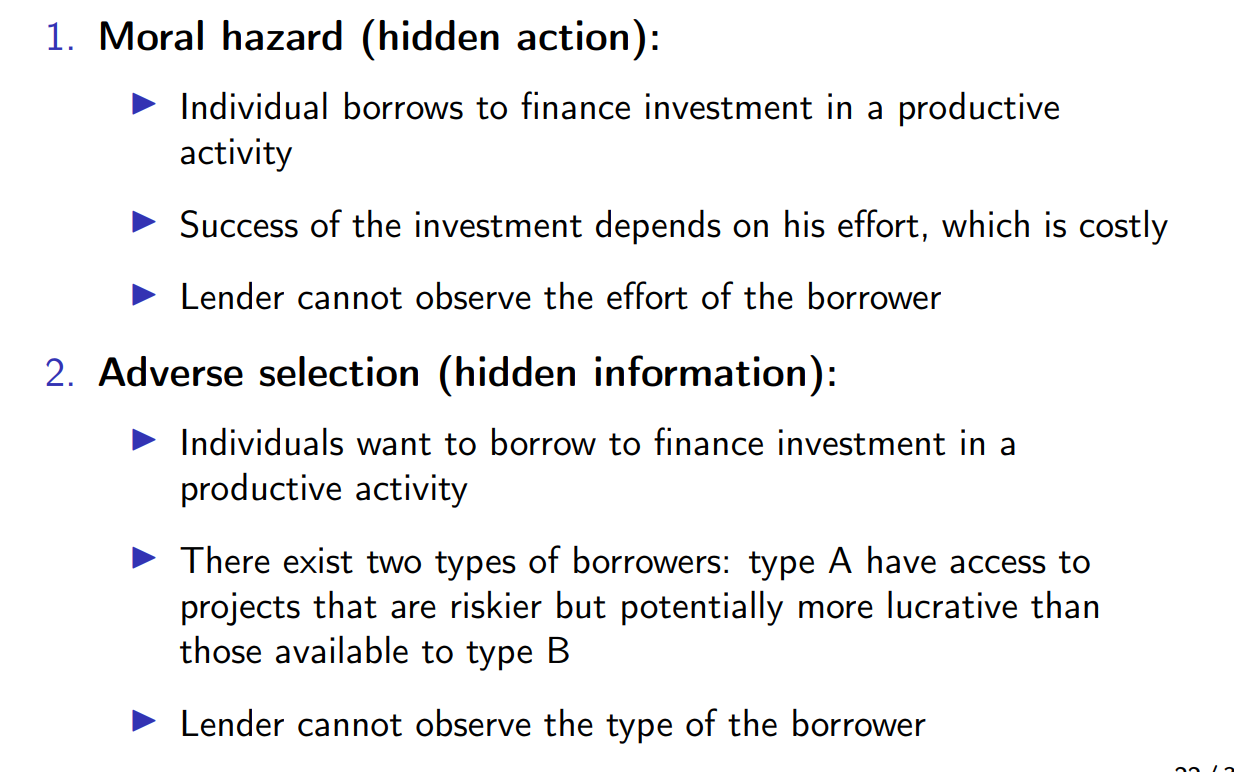
estimating whether we have hidden action or hidden information
Karlan and Zinman (2009)
Randomization occurs along three dimensions:
An initial “offer interest rate” featured on a direct mail solicitation
A “contract interest rate” that was revealed only after a borrower agreed to the initial offer rate
A dynamic repayment incentive that was also a surprise and that extended preferential pricing on future loans to borrowers who remained in good standing
Hidden information effect can be identified by considering the sample that received the low rc , and comparing the repayment behavior of those who took up at the high ro (cells 2 and 3 in the figure) with those who took up at the low ro
Similarly, hidden action effect can be identified by considering the sample that took up at the high ro, and comparing the repayment behavior of those who received the high rc (cell 1) with those who received the low rc
Hidden action effect can also be identified by comparing the repayment behavior of borrowers who both selected in and contracted at identical rates, but faced different dynamic repayment incentives because of randomly assigned future interest rates rf
find no evidence of hidden information effect but strong hidden action effect through both channels
characteristics of Grameen Bank
Loans almost exclusively to women
equality, less likely to have access to other credit, more likely to use profits on health and education
weekly repayment schedule
for rational individuals less rigid repayment should not increase defaults, studies show no significant effect of repayment schedules on default rate
group lending with joint liability
screening effect: mitigates adverse selection as people only want to go with individuals deemed trustworthy
monitoring effect: clients monitor each other for free
creates excessive pressure, but banks moving away from it towards individual liability, again no change in default found for individual liability
Regular meetings
social capital, ineraction can lead to support and reputation, defaults found to be lower if members live close by and share culture
Small initial loans
same idea as building up credit score
Effectiveness of microfinancing in alleviating poverty
Banerjee et al. (2015)
RCT of slums in India where some were given microcredit immediately and some after 2 years
microcredit follows grameen characteristics
results,
only a quarter of eligible people use it,
no difference in consumption,
only helps existing businesses, not more entrepreneurs
No HDI change
microfinancing not transformational
two main categories of risk coping strategies
Ex-post strategies (after the realization of the shock)
They are aimed at stabilizing consumption in the face of realized income fluctuation
Ex-ante strategies (before the realization of the shock)
Risk-averse households use them to reduce the variance of their incomes
Ex-post strategies
Credit
transfer from government
benefits are rare in developing countries, govt only intervenes with large shocks like drought
transfer from social network
most beneficial when income streams across members are negatively correlated
Selling Assets
Paxson (1992), use rain shocks and finds that savings are used to smooth consumption, but thailand has well established financial systema
livestock as insurance finds little evidence of selling animals to smooth consumption
everyone selling at the same time creates low price
reduce investment in education during hard times
Labour Supply
may increase labour supply to weather shock, however shock lowers labour demand so wages even lower
Ex-ante strategies
Consumption side
Accumulate savings
allows for ex-post dissaving
Buy insurance
Other
Investments that are shock resistant
requires large initial sums
Diversification
returns to different income streams should not be positively correlated
extent to which this is possible is limited
Sharecropping
rent out land to pass risk on to tenant, but only receive portion of profits
Avoidance of risk
study on weather risk and portfolio riskiness
Rosenzweig and Binswanger (1993)
capture the risk that farmers face through the coefficient of variation of monsoon onset date in India
do individuals that face higher risk invest in less risky assets
yes
does this relationship change across wealth levels
yes higher wealth means more risky but more profitable assets
estimate relationship between weather risk and farm profits
one standard deviatino decrease in weather risk raises average profits by 35% for poorest farmers
poorest farmers are most inefficient because they are poor, choose to be inefficient
issue with formal crop insurance and proposed solution
adverse selection: farmers inherently more risky will select in
moral hazard: once insured farmers excert less effort
very high transaction/ verification costs
Weather index insurance
pay-out determined by level of rainfall
premium and payout can hence be determined based on historical trends and is unaffected by household characteristics and behaviour
dont need monitoring
study of impact of insurance on magnitude and riskiness of agricultural investment
Karlan and Udry, (2014)
find that constraint for farmers is uninsured risk not availability of credit
look at investment response to cash and insurance grants
set up model to show
complete credit and insurance: input choices indpeendent of wealth
imperfect capital market only: cash grant leads to increase in I insurance leads to lower investment
imperfect insurance market only: incurance and cash grant lead to increase in investment
both imperfect: in this model capital constraint dominantes so same results as in imperfect capital market
RCT results
investment increases with insurance grant but small effects with cash grant
liquidtiy constraint not as binding as thought
why has weather index insurance had a low uptake
Price
some are actuarily unfair but even if they are low uptake
Financial Literacy
apparently farmers are unfamiliar with millimetres of rainfall
Behavioural explanations
when considered in isolation insurance product may be perceived as unattractive risky asset, mental bracketing
Credit Constraint
need to buy insurance to start off with, wealthy individuals can cope with risk better
Basis Risk
likelihood that harvest fails but you also dont get paid since rainfall isnt low enough
Alternative Risk coping strategies
informal insurance can crows out formal insurance
social networks, informal insurance better equipped to handle moral hazard
Trust
of insurance provider or product
Catastrophe type insurance
if insurance only pays out rarely have higher perceived basis risk
less likely to learn from it and trust it more
ROSCAs
rotating savings and credit associations
pass a pot of money around a group
very popular, 50% of savings in Cameroon
random ROSCAs or Bidding ROSCAs
although negative interest and risk of loosing it still very popular
because more likely to afford indivisible good earlier than through individual savings
mostly women, have stronger preference for indivisible good like education
discipline and commitment device
Internal vs External constraints to saving
External: limited availability of saving at formal institutions, demands from social network
Internal: lack of self control
using a commitment device to counter hyperbolic discountign study
Ashraf et al. (2006)
test whether individuals open savings account with commitment feature that limits access
quarter of people that were offered such an account would accept
are individuals with hyperbolic preferences more likely to open such an account
women yes
does this lead to higher savings
yes by 81%
RCT
ROSCA is an actual commitment device
how does a lack of self control help alleviate principal agent problem, how does timing of self control problem change
since agents are risk averse, tying pay to performance usually requires risk premium. However if if workers are aware of self control problem they will value sharper incentives as a way to motivate future selves and this increases probability of reaching high state
closer to payday reduces lack of self control since reward and cost are closer together
study of self control problem at work
Kaur et al. (2015)
test for
demand of dominated contracts
offered to only get half the pay per unit if quota not met
third opted in and it increased their production and earnings
presence of payday effect
all paid weekly but randomise on which day of week
output per worker is 8% higher on payday
heterogeneity in extent of payday and contract effects
those with higher pay day effects were more likely to opt into dominated contracts
if option to choose dominated contract further away from payday then the treatment effects are greater since the self control problem is greater
study on reason for low fertiliser use and how to increase in
Duflo et al. (2011)
claim that procrastination can explain it
need to purchase fertiliser in advance which they put off until it is too late
offer commitment device in the form of discount for early purchase of fertiliser
prediction
small cost reduction in period 1 should increase usage more than same cost reduction in period 2
if they want to use it as a commitment device given the option they should prefer to have the discount in period 1
yes offering cost reduction increases usage by up to 70% and this effect greater for period 1
suggests policy should offer time limited subsidies
What are the three reasons that make social learning difficult
Difficult to define set of farmers an individual learns from
Difficult to observe what an individual learns from
Difficult to distinguish learning from other reasons that may cause similar observed outcomes
study on effects of social learning from fertiliser usage
Conley and Udry (2010)
collect detailed data on who the farmers talk to to establish information links
dates of planting provides timing at which new information is revealed
Prediction 1: farmers adjust inputs towards suprisingly succesful input levels
Prediction 2: adjust away from unsucseful
Predicitoin 3: observed profit above expectation induces switch to that input level
Predicition 4: probability of changing input levels in response to new info is decreasing in farmers experience
idnetifying assumption is that information is uncorrelated iwth unobserved determinants of changing in growing conditions, maybe mistake changes in conditinos with changes to fertiliser
control for change in common growing conditions by taking difference of fertiliser input between average plots close to i and the i
know the regression in lecture 10
all predicitions hold
what are the benefits of learning from other and what might it depend on
can be a slow process
if learning from other is possible depends on whether agricultural technology is sensitive to local cricumstances
what are two opposite effects that learning from neighbour might have on adoption
Spillover: On the one hand, it can fosters adoption because it increases expected profits
Free-Riding: On the other hand, it may delay adoption because the farmer may refrain from experimenting himself and instead wait for enough useful information to be accumulated by his neighbours
impact of technology on markets, fishing
Jensen (2007)
price at market just determined by amount of fish caught nearby since fishers cant check prices and can only go to one market
staggered adoption of cell towers along the coast
identifying assumption: without introduction of cell service no differential in outcomes across these regions
should test for parallel trends assumption for all three before and for the two that dont have adoption after 1 adopts
use dummy regression
significantly reduces variance of prices and hence markets are more efficient due to price competition
two channels through which poor property rights might influence investment
fear of expropriation
access to credit might be limited if land cannot be used as collateral
study on property rights and agricultural investment in Africa
Goldstein and Udry (2008)
land in western Africa is under the control of a chief
land is allocated to individuals on perceived need and political influence
do individuals with better political connections have more secure tenure rights and does this lead to higher investment
fallowing for which land is left empty to increase fertility, is long term investment strategy that increases probability that land is lost
identification strategy: plots are owned individually so can control for household characteristics, only look at variation between individuals within the same household
empirical strat: effect of political standing on fallowing choice conditional on plot characteristics and household characteristics
results
start with profitability by gender and find women make less even after controlling for characterstics of land and household
concluded that this difference in gender is because women do not have the same political standing as the men, do the husbands not care about their wives?
gender coefficient becomes insignificant after controlling for fallowing decisions, household, spacial and year fixed effects
can also control for if household comes from inherited office or not to account for reverse causality
might still have endogeneity if productivity is correlated with political status
can control for if land comes from chief allocation or commercial for given individual, commercially purchased plots have property rights regardless of political standing, results robust
study on alternative channel though which property rights can increase economic welfare
Field (2007)
looks at efficiency gains from transferring role of property protection to the state
opportunity cost higher in urban settings
Peru gave formal property rights to more than a million people at staggered intervals
diff in diff comparing labour supply of benefeciearies across neighbourhoods that received compared to did not receive
as always this requires parallel trends assumption
need treatment to be random
results show that households work more hours, and work further away and not at home, around 13 hours worked more per household per week
two hypotheses for the creation of permanent labour contracts
Monitoring hypothesis: can hold individuals accountable, thus permanent contracts more likely for activities that are harder to monitor
Insurance hypothesis: risk averse workers value consumption smoothing so it is cheaper to hire workers on a fixed basis for risk neutral employer
impact of productivity shocks to poor study
Jayachandran (2006)
productivity shocks lead to larger change in wage if labour supply is inelastic which occurs if workers are close to subsistence, more credit-constraint, less able to migrate, which this paper tests for
income effect dominates substitution effect
rainfall used as exogenous productivity change
use model given on ipad to find theoretical results of relationship between poverty, ability to smooth consumption and migration
Proposition 1: wage elasticity increasing in poverty, poverty given as ratio of subsistence level to average productivity
Proposition 2: wage elasticity incresing in banking cost
Proposition 3: wage elasticity is increasing in migration cost
intensive margin: effect of local labour supplied
extensive margin: effect on migration
Use of instrumental variable
crop yields depend on productivity but also on other inputs and amount of labour
use rainfall as IV for crop yield
relevance and exclusion restriction ( rainfall can must only effect wages through its effect on productivity
presence of banks and roads could also be correlated with omitted variables
Results
wage responds to rainfall shock since lot of casual employment
baking presence using different measures leads to lower wage elasticity
same with cost of migration measured by things like road density, railway closeness to city
poverty proposition is not significant, but higher the proportion of landless people the more wage is inelastic
three views on the role of microenterprises in development
La Porta and Shleifer (2008)
Romantic view
entrepreneurs are constraint by environment, financial and regulatory
Parasite view
small firms can only exist because they exist in the informal sector and avoid taxation and regulation so can afford to be unproductive
Dual economy view
small and large firms use different human capital. high quality goes to large firms whilst small firms have decreasing returns to scale and are only focused on covering subsistence
study on if small and informal firms are credit constraint and this is hindering them
de Mel (2008)
RCT of different cash grant amounts or capital grants
measure change to profits
find positive impacts of both grants to capital and profit, also hours increased a bit for some grants, but this stops us from measuring the effect of capital purely
thus need IV, try to net out changes in profits that are due to labour profits
find that value of return to capital which is around 60% is greater than market real interest rate implying credit constraint
study on the effect of management on business performance
Bloom et al. (2013)
textile plants in india received five months of management consulting randomly
control plants only got one month of diagnostic consulting (say whats wrong but dont help)
basic management practises were implemented and this led to
quality defects fell by 50%
inventory fell by quarter
output rose by nearly 10%
TFP rose by 15%
so why dont more firms adopt
didnt think changes would impact profits for basic changes they were aware of
some consulting suggestions firms were unaware of
reaon why low productivity is sustainable is due to low competiiton
Business training
one of the most common forms of support given to small firms
research has shown mixed results of this
differences in quality and intensity of training as well as starting out conditions of firms play large impact on effectiveness of training
study on how conflict of interest between principal and agents leads to barriers of technology adoption
Atkin et al. (2017)
more effective cutting of footballs
three groups
tech group were allocated new technology
cash group were gien cash equal to new technology
control group given nothing
found that almost no one in any group adopted new technology
workers were resistant and misinformed owners about productivity benefits
this is due to pay structure as paid per unit but new technology reduces quantity in short run and potentially in long run
second experiment suggested change to pay structure
although small sample results show better uptake of new technology if change to pay structure is implemented
importance of long term realtionships and contract enforcement, study
Machiavello and Morjaria (2016)
when efficient legal remedies and reliable information are missing buyers are less willing to switch to low cost sellers
especially in the absence of formal contract enforcement
Kenya exporters to foreign buyers do not have enforceable contracts
flowers is better to have contract, sellers can plan production, buyers can combine into bouqets more easily if they know supplu
thoeretical model
no contract enforcement, uncertainty over seller type ( reliable or unreliable)
rational contract must be such that neither party has incentive to change
two tehoretical results
if lack of enforcement atters volume of trade is limited by incentive compatability constraint so decreases with temptation to deviate
learn about sellers type means value of relationship increases with age of relationsihp
can also include violence which is negative shock, inverted U shape between deliveries with violence and age of relationship, first increases as relationship is valuable so want to keep it so go through extra effort to still deliver, if relationship is sufficiently old sellers ability has been proven so can get away with not delivering in one perio
backed up by empirics, sellers might have to accept initial losses to acquire good relationship
two aspects of corruption that can effect firm performance
value of political connections
incidence and level of graft, which firms must pay bribes and how much do they pay
study on estimating the value of political connections
Fisman (2001)
indonesia has highly centralised and stable political structure
Event study triggered by rumors about poor health of president
measure stock price of firms with varying connections to president
give rating on the degree to which firms depend on political connections
if rumors of very poor health then the most politically connected firms should see the largest drop in share price
empirics support this
study on what exactly political connections help with, more specifically if they help with preferential lending
Khwaja and Mian (2005)
political connectiveness measured by if board has a politician
fixed effects
measure if borrowing from government or pivate bank is different
resutls
bigger loans, worse return to banks
results most striking for government bank, results even negative for private banks
another strategy is exploiting changes in political connectedness within the same firm
allows to control for firm fixed effects
use variation in terms of electoral success of politicians party
measure changes to loan size within same firm
results support this idea, both when politician is in power and when politicians party is in power
power of politician also matters
what determines size and sector that pays bribes study
Svensson (2003)
large variation in bribes theorised to be due to control rights and bargaining strength across firms