Fisheries final
 Call Kai
 Learn
Learn Practice Test
 Spaced Repetition
 Match
Match Flashcards
 Knowt Play
1/115

There's no tags or description
Looks like no tags are added yet.
Name | Mastery | Learn | Test | Matching | Spaced | Call with Kai |
|---|
No analytics yet
Send a link to your students to track their progress
116 Terms
important legal innovations of US environmental law
creating national parks, conducting environmental assessments, and allowing public access to information
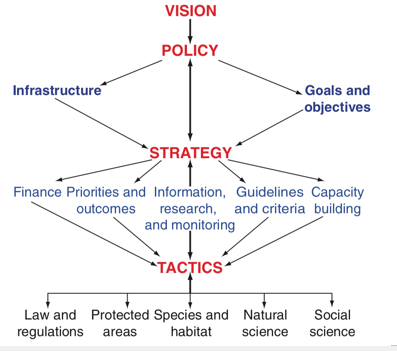
vision
values and objectives are set
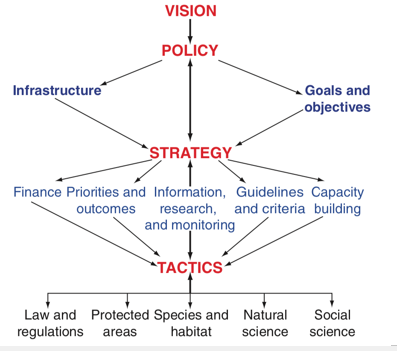
policy
creates objectives and infrastructure (many different disciplines and interest groups)
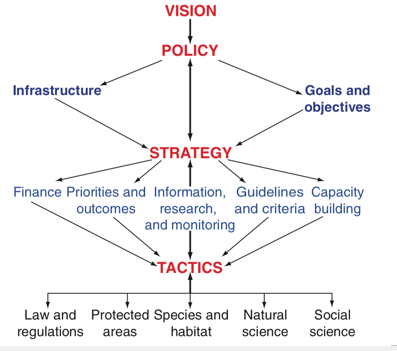
strategy
plan of action to reach targets (resources, priorities, goals, data collection, evaluation)
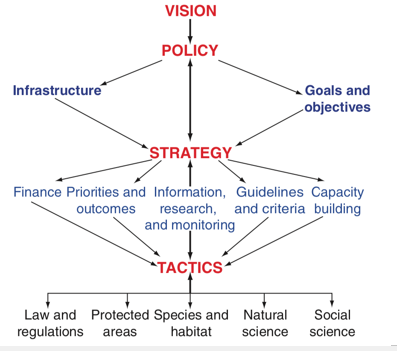
tactics
specific actions and tools (natural and social sciences)
legislative branch
enacts environmental laws (congress)
executive branch
administers environmental laws through federal agencies (white house and cabinet)
judicial branch
ensures that laws are applied correctly and are constitutional (Supreme and Federal Courts)
Statutory laws
conventional laws promulgated by the legislative branch – Congress
Regulatory laws (or administrative laws)
laws promulgated by the executive branches and agencies (rules, regulations, applications, licenses, hearings, appeals, and decision-making)
Common laws
laws promulgated by court cases or judicial power
example of importance of common law in environmental/conservation regulations
United States v. Maine (1975) – Defining Federal Control Over Fisheries
Conflicts over jurisdiction over offshore resources (state vs federal)
Supreme Court ruled that beyond 3 miles from shore, control over marine resources and fisheries belonged to the federal government, not individual states
Administrative Procedure Act (APA)
regulates the involvement of private entities in litigation
authorizes judicial review of agency actions
serves as a "constitution" for administrative and regulatory law.
problematic statutory language in environmental laws
vague or open-ended language that federal agencies must interpret—such as the phrase "best available science" in the ESA or the Magnuson-Stevens Act (MSA)
Magnuson-Stevens Act (1976)
Regulate fisheries in US federal waters
Endangered Species Act (1973)
One of the most powerful laws of species protection
Protects species and identifies critical habitat
Marine Mammal Protection Law (1972)
Protect mammals as important ecosystem units
Ecosystem-based protection
National Environmental Policy Act (1970)
Mandate federal agencies to make Impact Assessments and Environmental Impact Statements of major federal actions
Clean Water Act (1972)
regulate pollutant discharges into waterways
establish industrial water quality standards
Marine Protection, Research, and Sanctuaries Act (1972)
Regulate dumping materials
Authorizes National Marine Sanctuaries
Sustainable Fisheries Act of 1996
required:
definition for “overfishing” and “overfished”
each fishery to specify criteria for both
each FMP establish measures for rebuilding overfished species, identify essential fish habitat, and establish methodology to assess bycatch
Magnuson-Stevens Fishery Conservation and Management Reauthorization Act (MSRA) (2006)
Annual Catch Limits (ACLs)
Accountability Measures (AMs)
Accountability Measures (AMs)
designed to prevent ACLs from being exceeded and to respond to any catches over the ACL (quota reductions, gear restrictions, closures of a fishery)
Annual Catch Limits (ACLs)
amount of fish that may legally be caught each year (cannot exceed scientific recommendations and cannot allow overfishing)
Magnuson-Stevens Act Main Themes
Governance
U.S Federal Jurisdiction
Territorial Sovereignty
International Conservation
Domestic Conservation
The Department of Commerce oversees all _________ in the US. The Secretary of Commerce is the supreme head of fisheries in the US.
fisheries
__________ is the biggest regulating body responsible for managing all fisheries in federal waters
NOAA
Coastal fisheries are managed by…
State commissions (VMRC) and Interstate Management Commissions like the Atlantic States Marine Fisheries Commission
Freshwater fisheries are managed by…
US Fish and Wildlife Service of the Department of the interior
tragedy of the commons
need to take control of territorial waters (MSA) and enforce international conservation (ban driftnet fishing, ID nations doing IUU fishing)
Ban on Large-Scale Driftnet Fishing
Driftnets are non-selective, large gillnets with high bycatch (sharks, sea turtles, marine mammals)
1991 UN passed global ban on driftnet fishing in international waters.
1992 U.S. Congress enacted High Seas Driftnet Fisheries Enforcement Act, integrating it into the MSA and making it enforceable under U.S. law
main goals of the MSA for domestic management and conservation:
Prevent overfishing (Science-based catch limits).
Rebuild overfished stocks.
Increase long-term economic and social benefits of fisheries.
Ensure a safe and sustainable seafood supply.
Fisheries Management Plans are enacted by…
Regional Fisheries Management Councils
FAO Code of Conduct for Responsible Fisheries
provides principles and standards applicable to the conservation, management and development of all fisheries
Regional Fisheries Management Organizations (RFMOs)
international bodies established by treaties composed of countries sharing interest in managing and conserving fish stocks in a particular region
UNEP
key role in the development and facilitation of international environmental law
UN Convention on the Law of the Sea (UNCLOS)
international agreement that defines the rights and responsibilities of nations with respect to their use of oceans (guidelines for businesses, environment, management of marine resources)
Convention on International Trade in Endangered Species of wile Fauna and flora (CITES)
Ensure that trade in animals and plant does not threat their existence
"legally binding" means all who have agreed to the treaty are legally obligated to comply with its terms and provisions
three appendices of CITES
Appendix I threatened species (species need import permit, export permit)
Appendix II species whose market could be detrimental for their survival (species need export permits)
Appendix III species protected in some parties and thus trade need to be monitored also by other countries (species need export permits)
Convention on the Conservation of Migratory Species of Wild Animals (CMS)
international treaty aimed at the conservation and sustainable use of migratory wild animals and their habitats
similar to CITES
fishing industry and seafood production
represent a considerable portion of developing countries' GDP and a marginal portion of GDP of developed countries
Globally, ___ is the leading producer with 15% of production
China
Developed countries like USA, EU, and Japan are mainly _______, and developing countries like China, India, Viet Nam, and Chile are the leading ________
importers; exporters
41% of catches are __ species
35
top three species
Anchoveta, pollock, and skipjack
__________ models are important tools to understand the behavior of fishers and their response to fisheries management
Bioeconomic
Revenue
landed catch multiplied by the unit price of fish
Costs
Fixed long-term costs: loans, insurance, depreciation, maintenance
Variable short-term costs: fuel, labor, operational costs (depend on the specifics)
Profits
revenue - costs
Gordon model
explains why profits are low in open-access fisheries (as fishing effort increases, production increases, and stock declines → overexploited)
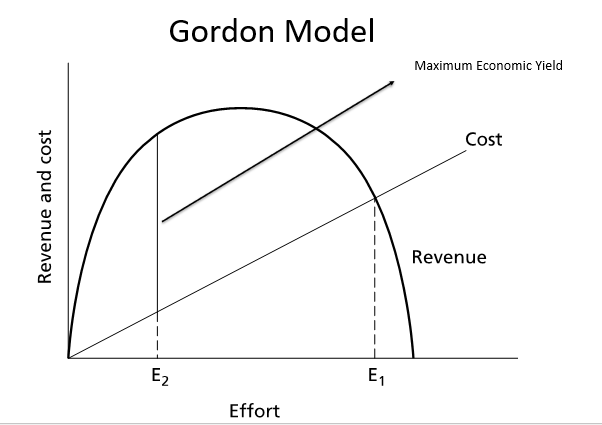
Non-Malleable Capitals
waiting to rebuild fish stocks and reducing fishing effort can be substantially costly because capital invested in fisheries is non-malleable (value decreases over time)
Discount rate
rate at which the perceived value of the fish stock declines over time
Fishers generally have _______ discount rates than managers (fishers = focused on immediate income/short-term survival; managers = responsible for long-term sustainability)
steeper
Yield per Recruit Analysis
not always profitable to catch as much as we can immediately
predict optimal level of F and which age is best to start exploitation to get greatest yield (discount rate)
Subsidies
financial schemes to keep fishing even though this is unprofitable or will help fishers reconvert their capital
Capacity-enhancing subsidies (CES)
reduce the costs of loans, gas, gears, and boats
Beneficial subsidies
help conservation and management
Ambiguous subsidies
lead to investment or disinvestment of natural capital
downsides of subsidies
can change the relationship between cost and fishing effort lowering the slope of this linear relationship
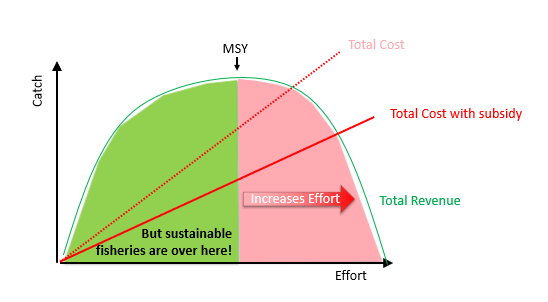
Much fishing of the largest fishing fleets would be unprofitable without ________
subsidies
Food security
main driver for subsistence fishing (2% of total global harvest)
optimal foraging theory and optimal diet theories
search and selection of seafood respond to search time and efficiency, physiological state of predators, and nutrient and energy content
why does commercial fishing make fisheries more likely to be overexploited?
natural limits in subsistence fishing often disappear—competition, profit-seeking, and social changes encourage fishers to catch more fish instead of only taking what they need
high motivation to target most profitable species/sizes and discard more catches
human incentives for fishing
social/recreational/traditional value; religion
Recreational fisheries can have strong impact on ecosystems:
- Reduce predators
- Reduce fish stocks
- Spread invasive species
- Cause inbreeding of exploited species
recreational fisheries are essentially ___________ fisheries (difficult to manage such a diffused fishing effort)
open access
recreational fishing management needs to…
understand behavioral feedback of fisheries
communicate scarcity to fishers
provide incentives for sustainability
policymakers need to recognize the value of ________ fisheries where management approaches may not apply (bioeconomic models may be more appropriate)
recreational
co-management
done through angler associations (know local needs and involve anglers in management decisions and monitoring)
Successful co-management considers:
1) practices embedded locally, historically and socio culturally
2) focus on fishers
3) empower fishers in decision making
Arapaima fisheries co-management method
Fishers participated in monitoring schemes using alternative methods (counted the times Arapaima surfaced to breath)
Standard quota = 18; increased by 5 if fishers participated in counts; decreased by steps of 2 if they infringed regulations.
Arapaima fisheries co-management results
Population, adults, quotas, and income increased
Reduced violations of the management quota
Illegal, Unreported, and Unregulated fishing (IUU)
can cause overfishing, harm marine ecosystems, reduce fish populations, and create economic losses for legal fishers
Socio-economic Impacts of IUU
Food security, local revenue, homicides, organized crime (drugs, slavery, human trafficking, piracy)
highest area of IUU
Eastern central Atlantic (rich ecosystem, poor governance, and corruption)
Drivers of IUU
poverty, poor governance (no monitoring; corruption), no consequences, high value of species, subsidies
Why is it so hard to understand the natural conditions of reefs, number of seals, and baselines of fish populations pre human-impact
Over millennia, humans have been altering the structure and function of marine ecosystems, causing ecological change, but science has recorded only a small fraction of this exploitation history, and modern ecology is mainly based on observations of the last 60-70 years
shifting baseline syndrome
intergenerational loss of ecological knowledge that affects fishers, scientists, and managers
fisheries managers accept the stock size and species composition at the start of their careers as the baseline and use that to assess future change rather than considering historical conditions
historical approach allows us to…
capture the full extent of ecological processes (full dynamics of long-living animals; better reference points on which to base fisheries management)
reveal unexpected natural states → set new recovery targets
historical data is often:
- Non-traditional
- Difficult to collect
- Difficult to integrate into conventional frameworks
- Multidisciplinary
apples to oranges
disciplines of historical ecology
computer and data science, math and stats, ecology and biology, history and social science
_________ statistics is perhaps the greatest opportunity in historical ecology because it allows you to incorporate prior knowledge into the focal analysis
Bayesian
__________ allows you to combine multiple parameters and estimates from different studies in an objective and statistically rigorous framework
Meta-analysis
__________ modeling is the best framework to combine multiple modeling parts and carry on uncertainty (combine meta-analysis and Bayesian inference)
hierarchical
Chagos archipelago
extremely remote, one of the biggest marine protected areas, human impact is very well recorded
MPAs
Areas of the ocean set aside for long-term conservation aims (not necessarily no-take)
Multiple levels of protections, objectives, and configurations.
Goals can be economic, ecologic, social and cultural.
MPA coverage in the World Ocean
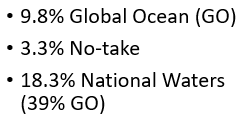
Ia MPS
Strict nature reserve (Chagos); no-take
Ib MPA
Wilderness area; protect env. services
II MPA
National park; large-scale ecosystem
III MPA
Natural monument; small and specific
IV MPA
Habitat/species management area; sanctuaries
V MPA
Protected Landscape/Seascape/Area (Coastal biospheres)
VI MPA
Protected Area with Sustainable Use of Marine Resources (Multiple use)
Chagos example
Historical studies showed shark populations had already declined before scientific monitoring began due to illegal fishing and long-term human impacts. By combining historical records, surveys, and ecological models, researchers found major declines in silvertip sharks and showed the importance of historical ecology for understanding true ecosystem baselines and improving marine conservation.
MPA Guide
objective framework to categorize MPAs based on their stage of implementation, level of protection, and intended outcomes
MPA effects
higher biomass, density, individual size, richness
promote spillover
most effective MPA
no-take, high enforcement, over 10 years old, larger than 100 km2, isolated
cons of MPAs
consequences to fishers
don’t work for migratory sp
ban inconsequential local fishing
just move effort to another area (same amount)
Considering the Kennedy family’s management goals, what management actions would you recommend?
Management should focus on reducing the overabundance of small largemouth bass to improve growth and condition. This can be done by encouraging harvest of smaller bass and protecting larger individuals through size limits. Improving habitat and maintaining good water quality will support both forage availability and overall ecosystem health, helping balance predator–prey dynamics and enhance recreational fishing and food provision goals.