Lesson 2 (Marine bio)
 Call Kai
 Learn
Learn Practice Test
 Spaced Repetition
 Match
Match Flashcards
 Knowt Play
1/27

There's no tags or description
Looks like no tags are added yet.
Name | Mastery | Learn | Test | Matching | Spaced | Call with Kai |
|---|
No analytics yet
Send a link to your students to track their progress
28 Terms
Reynolds Number
a parameter used to predict flow behavior by calculating the ratio between inertial and viscous forces
Re > 1: inertia forces predominate
Re < 1: viscous forces predominate
2 types of lift based swimming
Body and Caudal Fin swimming (BCF)
Median and Paired Fin swimming (MPF)
Body and Caudal Fin swimming (BCF)
Most common form of swimming.
A wave of contractions from head to tail: swings tail back and forth
strength and amplitude of contraction increases toward tail
Different fish swim by undulating or oscillating different parts of their body.
Undulation
waves passing down body or fin
Oscillation
flapping motion
Median and Paired Fin swimming (MPF)
Other fish have developed alternative swimming mechanisms that involve the use of their median and pectoral fins
termed median and/or paired fin (MPF) locomotion
Although the term paired refers to both the pectoral and the pelvic fins, the latter (despite providing versatility for stabilization and steering purposes) rarely contribute to forward propulsion
Advantages of Lift-based Swimming
High speed – Most efficient for long-distance cruising
Energy efficient – Requires less energy, once moving, they glide efficiently
Continuous thrust – Lift provides smooth, steady movement without intermittent
Low drag – Streamlined bodies and minimal undulation reduce water resistance
Disadvantages of Lift-based Swimming
Complex musculoskeletal system – Requires specialized skeletal adaptation
Unable to hover backward – Requires forward movement to generate thrust
Single Caudal Propulsor
uses only the tail or flukes to generate thrust.
The body remains relatively rigid while the tail structure moves to propel the animal forward.
This is distinct from BCF swimming where the body undulates.
Concentrate all propulsive power in a specialized tail, keep the body rigid, and let the hydrofoil do the work
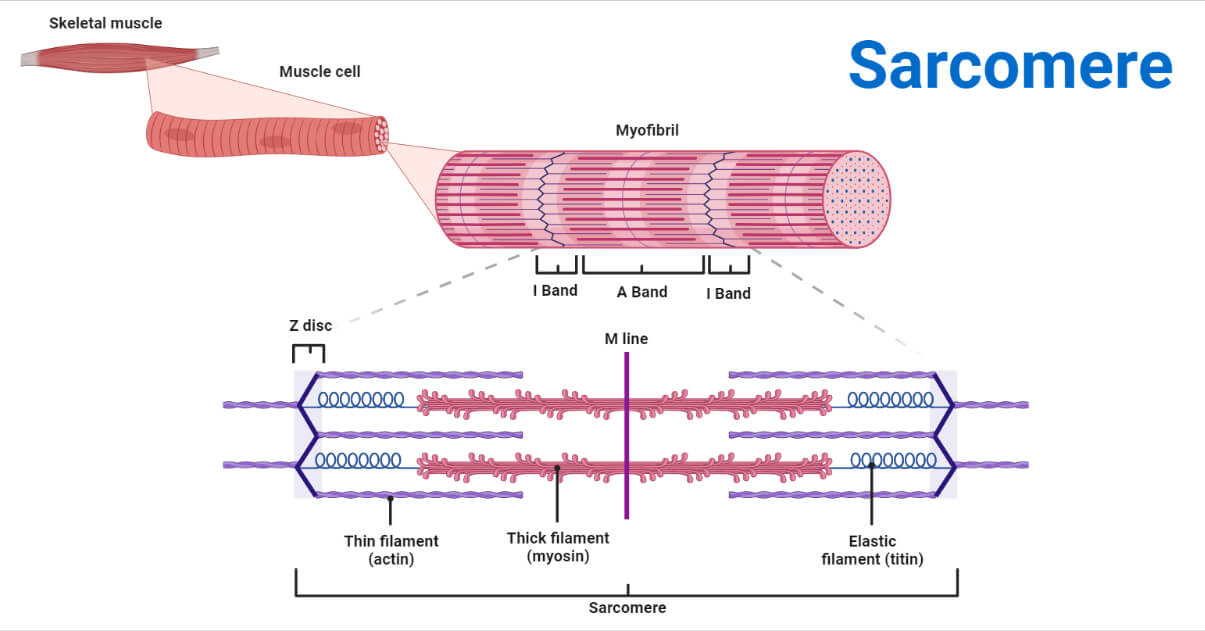
Sarcomeres consist of two types of myofilaments
Myosin – (thick filament) contains small protruding heads
Actin – (thin filament)
Titin – a protein molecule that holds the myosin filaments from M band to the Z line
Z lines
hold the myofilaments
A band
overlap of actin and myosin
I band
only actin present in this region
H zone
only myosin present in this region
Actin and Myosin
Cross-Bridge Formation
White Muscles
White muscle makes up about 85% of the muscle mass of fish.
(aka) fast-twitch muscles or glycolytic muscles
For high intensity swimming
Quick short bursts of movement
Anaerobic activity
Example: Seabass
Skeletal Muscle Fibre Types: White muscle
Burst activity: short duration and high intensity
Less myoglobin
Fast twitch
Glycolytic
Red Muscles
Red muscles makes up to 20% of the muscle mass of fish
Red muscles are also known as slow-twitch muscle or oxidative muscles
Red muscles contains myoglobin, capillaries and lots of glycogen and lipids
For low intensity swimming
Can also make use of lipids as a source of energy for sustained swimming
Example: Tuna
Skeletal Muscle Fibre Types: Red muscle
Floating mechanism
passive → drift with ocean currents
no muscular effort
eg: plankton, jellyfish
factor role in floating
neutrally or positively buoyant
low density tissues, gels, oils
flat, spread-out
move horizontally or vertically due to ocean currents