10. adapted from quizlet: ryanef123 FP 19 - Temporary and Permanent Cements (Dr. Filokyprou)
 Call Kai
 Learn
Learn Practice Test
 Spaced Repetition
 Match
Match Flashcards
 Knowt Play
1/115

There's no tags or description
Looks like no tags are added yet.
Name | Mastery | Learn | Test | Matching | Spaced | Call with Kai |
|---|
No analytics yet
Send a link to your students to track their progress
116 Terms
Define the following:
A binding agent used to firmly unite two approximating objects
A material that, on hardening, will fill a space or bind adjacent objects
Cement
Define the following:
The process of attaching parts, or a restoration to natural teeth by means of cement
Attaching a restoration t natural teeth by means of a cement
Cementation
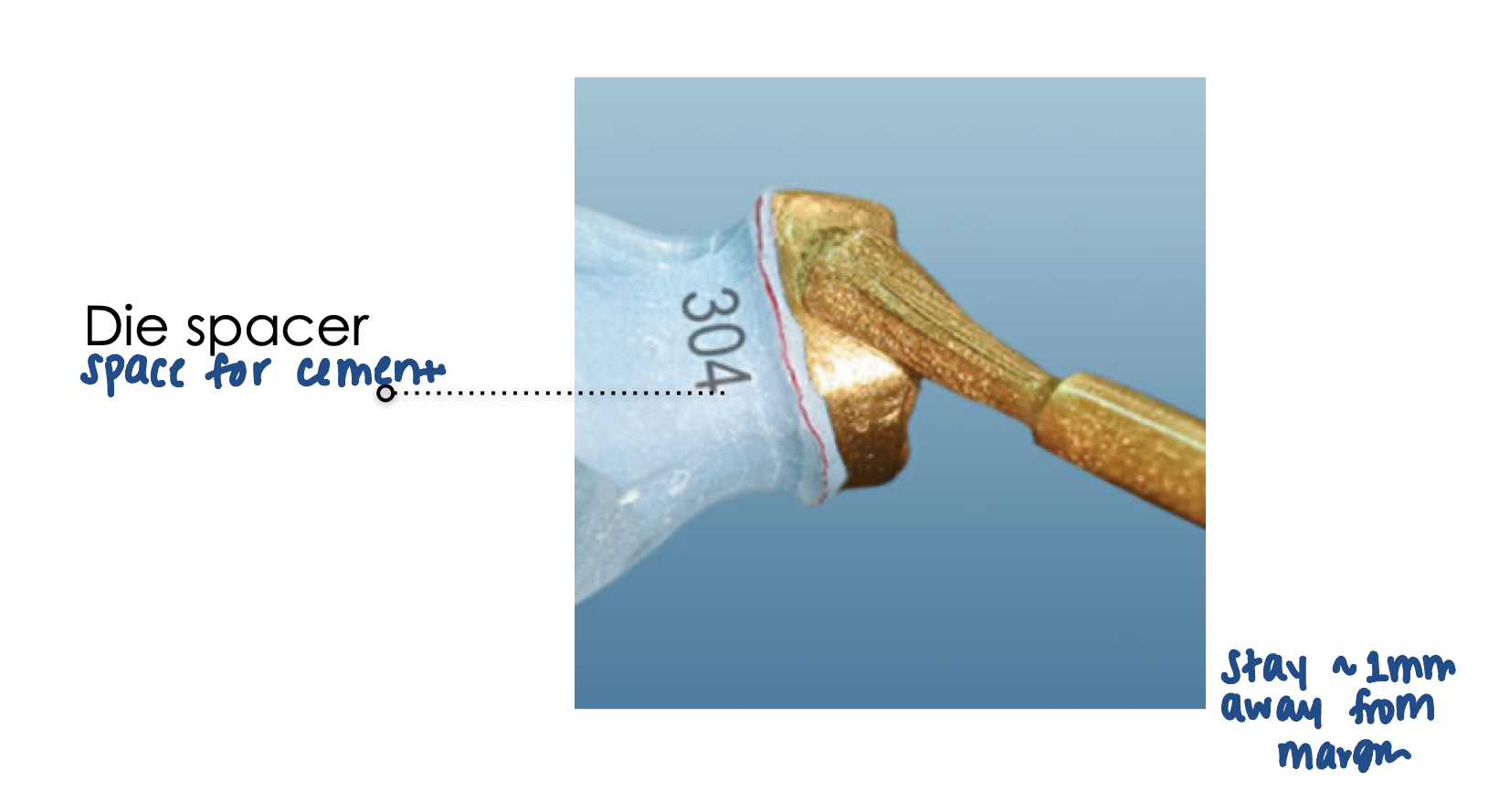
Define the following: Thin golden enamel painted on cast of prep to allow space for cement to exist between tooth and crown
Die spacer
What acts as...
Luting agents to bond preformed restorations and orthodontic attachments in or on the tooth
Cavity liners and bases to protect the pulp and foundations and anchors of restorations
Restorative materials
Dental cements
What is the primary function of cement for cementation? (!)
To fill the void between the restoration and the tooth, mechanically lock the restoration in place, and prevent its dislodgement during mastication
What has the following characteristics: first or contemporary adhesive cements?
Not adhesive
Fill the microscopic space and create a strong physical attraction to both substrates
Mechanical retention - shape and roughness of tooth
macro level
First dental luting cements
What has the following characteristics: first or contemporary adhesive cements?
Chemical adhesion of the cement, tooth and restoration, micro-mechanical interlocking
Examples of materials that interact chemically with hydroxyapatite: zinc polycarboxylate, glass ionomer, resin modified glass ionomer, self-adhesive resin cements
(micro level)
Contemporary adhesive cements
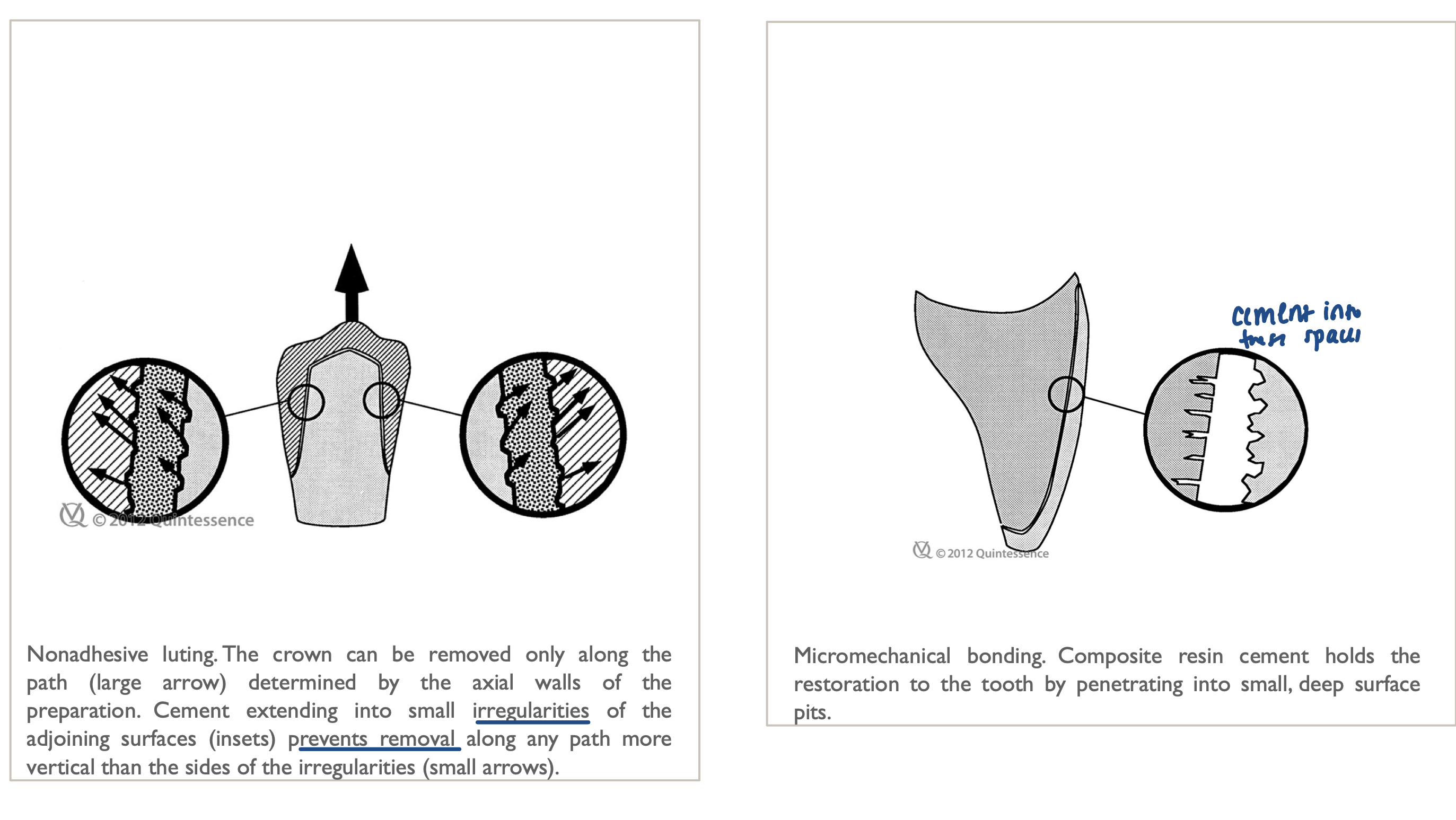
Non-adhesive cement relies on _________
Micromechanical bonding of the tooth to the prep (mechanical retention and frictional resistance)
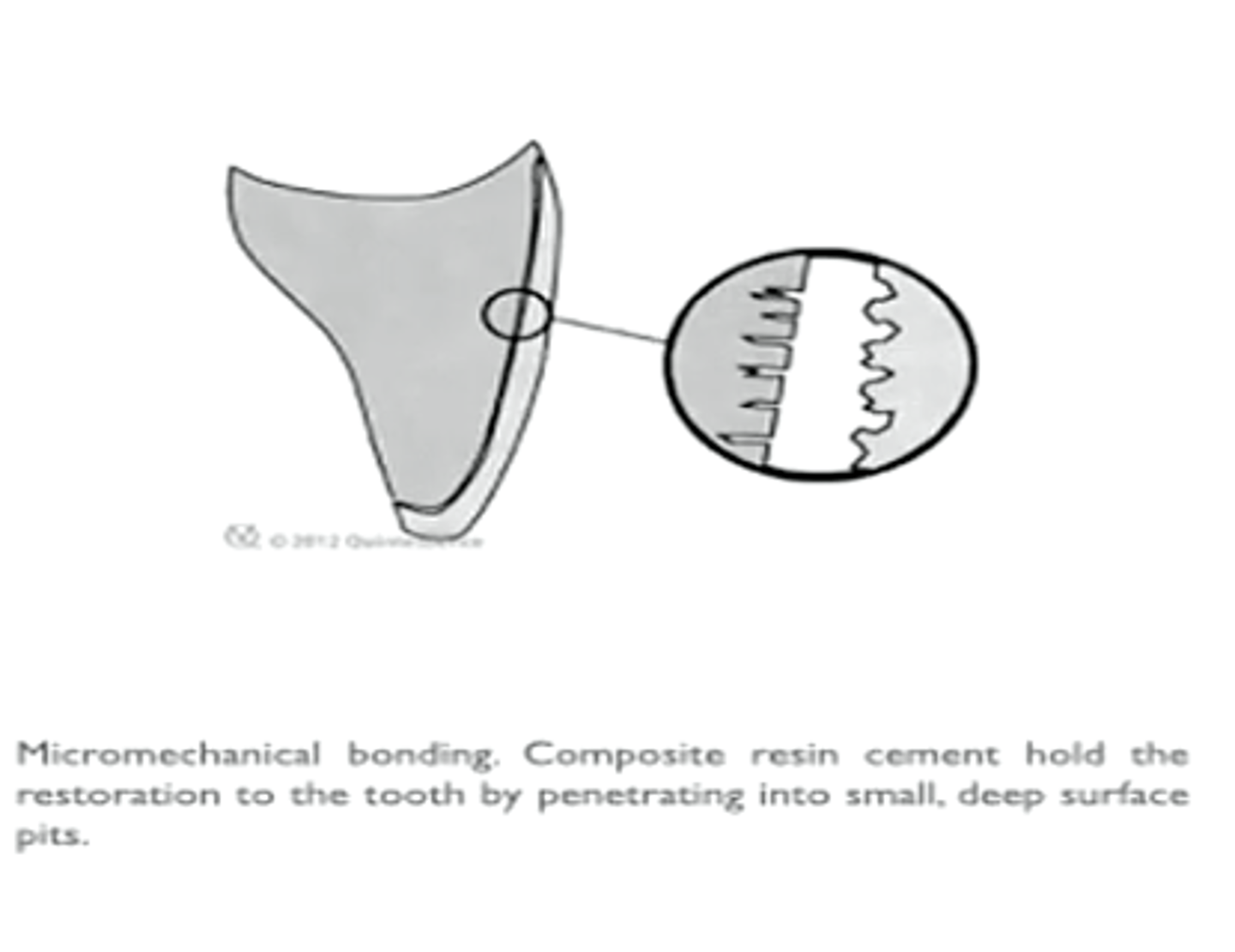
non-adhesive luting VS micromechanical bonding
Non-adhesive luting relies purely on macro-mechanical friction and geometry to hold restorations in place, filling gaps with cements like zinc phosphate. In contrast, micromechanical bonding uses acid etching and primers to create microscopic surface porosities, allowing resin cements to interlock with the tooth and restoration for significantly higher strength and sealing
Requirements for cement:
Adequate resistance to dissolution in the oral environment (low solubility)
Adequate bond through mechanical interlocking and adhesion
High strength in tension, shear, and compression
Good fracture toughness to resist stresses at the restoration-tooth interface and unstable crack propagation
Good wear resistance
Adequate working and setting time
Easy removal of excess
Low viscosity
Compressible into thin layers
Thixotropic
Biocompatible/ nontoxic to the pulp
Cariostatic - no caries
the property of certain gels or fluids that become less viscous (thinner and easier to flow) when they are shaken, stirred, or subjected to stress, and then slowly return to their original, thicker state when allowed to rest
thixotropic
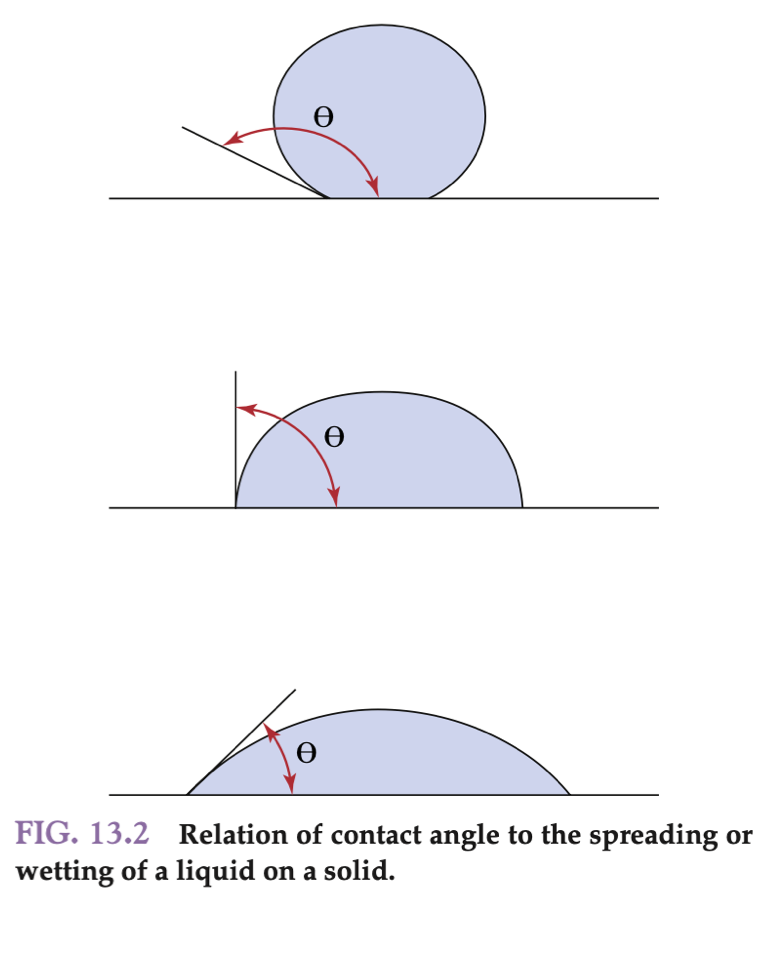
contact angles (less than/greater than) 90° indicate favorable wetting of the surface
less than
What are five classifications of cements?
Length of time in function
Matrix bond type
Knowledge and experience of user
Principal setting mechanism
Basic main ingredients
Depending on the expected longevity of the restoration, a luting agent can be considered _________ or _________
Definitive (long term)
Provisional (short term)
definitive or provisional cement:
Should have a relatively low strength, be easily handled and not irritate the pulp
Examples: zinc oxide-eugenol (ZOE), noneugenol cements, calcium hydroxide pastes
Provisional cements
What are some main ingredients of cement?
Zinc phosphate
Zinc silicophosphate
Zinc oxide-eugenol
Zinc polyacrylate
Glass-ionomer
Resin
what are the five matrix bod cement types?
Phosphate
Phenolate
Polycarboxylate
Resin
Resin-modified glass-ionomer
This group of cements set by which reaction: acid-based, water-based, resin-based?
Glass ionomer, resin-modified glass ionomer, ZOE, zinc polycarboxylate, and zinc phosphate
acid base reaction
This group of cements set by which reaction: acid-based, water-based, resin-based?
Dissolution and reprecipitation in aqueous medium (calcium aluminate cements)
Water based
This group of cements set by which reaction: acid-based, water-based, resin-based?
Polymerization reaction (resin cements, compomers, and self-adhesive resin cements)
Resin based
Zinc phosphate, polycarboxylate, glass-ionomer are (conventional/contemporary) cements?
Conventional
Resin-modified glass-ionomer, resin are (conventional/contemporary) cements?
Contemporary
what are six conventional luting agents?
zinc-oxide eugenol ZOE
zinc-oxide non-eugenol
reinforced zinc oxide-eugenol
zinc phosphate
zinc polycarboxylate
glass ionomer
what are two contemporary luting agents?
resin-modified glass-ionomer cement
resin cements
__________ is mainly used for provisional cementation of crowns and FPD, and as a cavity liner in deep cavity preparations
ZOE (zinc-oxide-eugenol)
One of the cements with the widest range of applications is (zinc oxide eugenol/zinc phosphate)
zinc phosphate cements -- oldest cement available for dental use, and is the standard that other cements are compared to
ID luting agent:
Main use is the provisional cementation of crowns and fixed partial dentures, and as a cavity liner in deep cavity preparations
Powder (mostly pure zinc oxide)/liquid (purified eugenol or oil of cloves) ratio 3:1 or 4:1 for maximum strength
In improved ZOE cements liquid is a mixture of EBA and eugenol (2:1) which allows for a higher powder-to-liquid ratio (6:1)
Zinc Oxide Eugenol
ID the luting agent:
Working time is long because moisture is required
Setting time varies from 2 to 10 minutes
Eugenol can have a soothing effect on pulpal tissue
Can be an irritant on soft tissue
Has good sealing ability and is resistant to marginal penetration
zinc oxide-eugenol ZOE
disadvantages of which luting agent?
low strength and abrasion resistance, solubility, disintegration in the oral fluids, and little anticariogenic action
zinc oxide-eugenol ZOE
The working time of ZOE is long because __________ is required
Moisture
Why is ZOE mainly used as a liner now?
Eugenol can have a soothing effect on pulpal tissue but can be an irritant on soft tissue
What is the setting time of ZOE?
2 to 10 mintes
Temporary cements using non phenolic components are often preferred due to what effect? (!)
An inhibitory effect of eugenol on polymerization of methacrylate-based resins and luting composites
(non/eugenol) materials contain a combination of different carboxylic acids in the liquid (long-chain aliphatic acids or aryl-substituted butyric acid) to react with zinc oxide particles
Noneugenol
example of zinc oxide non-eugenol
Temp-Bond NE
ID the luting cement:
Powder consists of zinc oxide with 10% to 40% finely divided natural or synthetic resins together with accelerators
Liquid is mostly eugenol (which may contain dissolved resins and accelerators) as well antimicrobial agents
Setting time is 7 to 9 minutes (can be lengthened by reducing the powder/ liquid ratio)
Reinforced zinc oxide-eugenol
_________-reinforced zinc oxide-eugenol can cause irritation in connective tissues. It may cause softening and discoloration of some resin restorative materials (!)
Polymer
reinforced ZOE is reinforced with ___________
natural or synthetic resins/acrylics together with accelerators
T/F ZOE can create problems for further permanent cementation, so a lot of temporary bonds have NE (non-eugenol) formulas to not have problems with bonding
TRUE
ID the luting cement:
In EBA modified cements, the powder is mainly zinc oxide containing 20% to 30% aluminum oxide or other mineral fillers
Liquid consists of eugenol and 50% to 66% EBA
To obtain optimal properties, a high powder/liquid ratio (3.5g/ mL for cementation, and 5 to 6 g/mL for liners or bases) is recommended
Reinforced zinc oxide-eugenol
ID the luting cement:
Adequate time in the mouth should be allowed for full setting
Several days may be needed for the material to reach full strength
Advantages include ease of mix, long working time, good flow characteristics, and low pulp irritation
Disadvantages include the critical proportioning, hydrolytic breakdown in oral fluids, liability to plastic deformation, and poorer retention than zinc phosphate cements
Reinforced zinc-oxide eugenol
What is the setting time of reinforced zinc-oxide eugenol?
7 to 13 minutes
ID the luting agent:
Widest range of applications, from the cementation (luting) of fixed cast alloy and porcelain restorations and orthodontic bands to their use as a cavity liner or base to protect pulp from mechanical, thermal, or electric stimuli
Powder is mainly zinc oxide (90%) with magnesium oxide (10%) and small amounts of pigments
Liquid is an aqueous solution of phosphoric acid containing 45% to 64% H3PO4 and 30% to 55% water, 2% to 3% aluminum phosphate, and up to 9% zinc phosphate
Zinc phosphate cements
ID the luting agent:
A chilled thick glass slab will help to slow the reaction and allows for the incorporation of more powder, giving superior properties in the set cement (recommended powder/
liquid ratio is 2.5 to 3.5 g/ml)
At room temperature, the working time at luting consistency is 3 to 6 minutes, and the setting time is 5 to 14 minutes
Initial pH (2 min after mixing) is about 2 and increases to 5.5 in 24 hours
Zinc phosphate cements
ID the luting agent:
Advantages: Zinc phosphate cement can be mixed easily and set to a relatively strong mass
Disadvantages: Can cause pulpal irritation (due to the initial low pH), lacks antibacterial action and adhesion, is brittle, and soluble in oral fluids
Zinc phosphate cements
Retention of zinc phosphate cements is achieved by (chemical/mechanical) interlocking
Mechanical interlocking
which conventional cements were developed to attempt to combine the strength properties of the phosphate system with the biologic acceptability of the zinc oxide-eugenol materials?
Zinc polycarboxylate cements
ID the luting agent:
Powder consists of zinc oxide, 1% to 5% tin or magnesium oxide, 10% to 40% aluminum oxide, and small percentages of stannous fluoride may be included to improve mechanical properties
Liquid is 40% aqueous solution of polyacrylic acid or an acrylic acid copolymer with other organic acids
Zinc polycarboxylate
ID the luting agent:
Powder/liquid ratio is 1.5 :1 by weight
Should be mixed rapidly in 30 to 40 seconds
Working time is 2.5 to 3.5 minutes
Setting time is 6 to 9 minutes at 37ºC
Bonding to clean enamel and dentin surfaces can occur through calcium complexation (The polyacrylic acid bonds to calcium ions on the surface of enamel and dentin)
Zinc polycarboxylate
What is the first cement known to have adhesion by chemical interaction?
zinc polycarboxylate
zinc polycarboxylate's chemical adhesion occurs via _________
calcium complexation
What luting agent has the following advantages?
Low irritation
Adhesion to tooth and alloys
Easy manipulation, strength, solubility, and film thickness
Zinc polycarboxylate
What luting agent has the following disadvantages?
Need for accurate proportioning, critical manipulation
Low compressive strength
Short working time
Greater viscoelasticity
Zinc polycarboxylate
name of common zinc carboxylate cement
durelon
What luting agent has the following indications?
-Restorations with good resistance and retention form, when minimal pulp irritation is desired and contraindicated for implant crowns on titanium abutments
Zinc polycarboxylate
ID the luting agent:
Powder consists of finely ground calcium aluminum fluorosilicate glass
Liquid is 50% aqueous solution of a polyacrylic-itaconic acid or other polycarboxylic acid copolymer with about 5% tartaric acid
Powder/liquid ratio is about 1.3:1
Set time is 6 to 9 minutes (luting materials), with lining materials setting in 4 to 5 minutes, and restorative materials setting in 3 to 4 minutes
Light curing materials set in about 30 seconds when exposed to light
Glass ionomer
What luting agent has the following advantages?
Easy mixing
High strength and stiffness
Fluoride, release
Good resistance to acid dissolution
Potentially adhesive characteristics
Translucency
Glass ionomer
What luting agent has the following disadvantages?
Initial slow setting and moisture sensitivity (instruct to be careful for 24 hrs after cementation)
Variable adhesive characteristics
Radiolucency
Possible pulpal sensitivity
Glass ionomer
T/F: Glass ionomer is a self-cure material, and newer products have a light-curing functionality too
True (like FujiTemp)
glass ionomers can act as what three functions?
Luting Agent: Used to permanently cement indirect restorations (crowns, bridges, inlays, onlays), orthodontic bands, and posts; continuous fluoride release Fuji
Liner/Base: Applied in a thin layer under composite resins, amalgams, or metallic restorations to protect the pulp, reduce microleakage, and block thermal shock; vitrebond
Restorative Material: Indicated for low-stress restorations (such as Class III and V cavities), root caries, and pediatric dentistry. Because they naturally bond to the tooth and continually recharge and release fluoride,
*light cure options
What is the setting time for glass ionomer? (as luting agent, liner, restorative material, light cure)
Used as a luting agent: 6-9 min
Used as a liner: 4-5 min
Used as restorative material: 3-4 min
Light-cure: 30 seconds when exposed to light
Glass ionomers are mainly used as a __________ rather than as a cement
Liner
ID the luting agent:
Hybrid material derived from adding polymerizable resins to conventional glass- ionomer cement
Once mixed, the resin phase polymerizes quickly and the glass- ionomer phase proceeds slowly via an acid-base reaction
Resin-modified glass-ionomer cement
T/F: Resin-modified glass ionomer cement is a hybrid material derived from adding resins to conventional glass ionomer cement
True
T/F: Once the RMGI is mixed, the resin phase polymerizes quickly, and the glass ionomer phase proceeds slowly via an acid-base reaction
True
__________ is less susceptible to early erosion during setting, less soluble, and has higher compressive and tensile strengths than unmodified glass-ionomer luting cement
Resin-modified glass-ionomer (advantage)
ID the luting agent:
The restoration should be seated firmly with finger pressure
The tooth should be well isolated and the material kept dry for 7 to 10 minutes to minimize loss of cement at the margins due to its early solubility
Not recommended for luting all-ceramic restorations that are susceptible to etching or posts due to possibility of hygroscopic expansion
Resin-modified glass-ionomer
define hygroscopic expansion
dimensional swelling of a material caused by the absorption or adsorption of moisture from its surrounding environment
common RMGI
RelyX
the addition of resin to GI (RMGI) makes it less susceptible to what three things?
early erosion during setting
less solubility
higher compressive strength & tensile strength
What do you need to make sure happens when using RMGI as a cement?
Tooth should be well isolated and material kept dry for 7-10 minutes to minimize loss of cement at the margins due to its early solubility
What are the applications of resin cement? (5)
All-ceramic
Metal
Metal- ceramic restorations
Veneers
Post cementation in endodontically treated teeth
ID the contemporary cement:
Popular choice
High compressive/tensile strength
Low solubility
Aesthetic qualities
Useful for all-ceramic, veneers, metal, post-cementation in ETT
Most esthetic luting materials, different options of shade and translucency
resin cements
Resin cements are classified according to mechanism of (?) which has three classifications
mechanism of matrix formation:
1) Chemical (self) cure
2) light cure
3) dual cure
main constituents of which contemporary luting agents?
Predominant functional acidic monomers, blends of polymerizable monomers of methacrylates/ dimethacrylates (bis-GMA, UDMA, and TEGDMA/ polymethacrylates
Additives (4-META, MDP): promote bonding to ceramics, metals
Diluents (HEMA & TEGDMA): reduce viscosity
Filler particles, activator initiator systems
Resin cements
ID the luting agent:
Self-adhesive resin cements must be presented as separated two-part materials to avoid contamination and premature setting
Most of current systems are dual-cure materials
Transparent shade cements are recommended for HT ceramics
Resin cements
Which contemporary luting agent has the following advantages?
High compressive and tensile strengths
Low solubility,
Aesthetic qualities
Most esthetic luting materials
Different options of shade and translucency
Resin cements
the most esthetic (contemporary) luting material with different options of shade and translucency
resin cements
T/F you can use light cure to cement on pfm restoration
FALSE -- light wouldn't reach the cement
T/F most of the resin cements are dual-cure
True
T/F: The greater the brightness of resin cement, the higher the color stability
FALSE - LOWER the brightness of resin cement, the HIGHER the color stability
(transparent/opaque) shade cements are recommended for HT ceramics
transparent
t/f: In vitro studies have concluded that the use of resin cements of different shades did not cause a clinically significant color difference in the final glass ceramic restoration
true
Variolink II and RelyX universal are examples of which common contemporary cement?
resin cement
Rely X is a 2 paste resin cement that works well with teeth that ________
Teeth that also have shading of A2 -- the built-in shade of the cement is A2 (RMGI and resin cement)
What is the biggest advantage of variolink resin 2 paste system (contemporary - resin cement)?
You can play with the shading of the tooth by coloring the cement, or you can have the cement be a transparent cement
adhesive, dual cure resin cement
Define the following:
Refers to the establishment of molecular interactions between a substrate (adherend) and an adhesive brought into close contact, creating an adhesive joint
May occur by chemical or physical bonding, micro mechanical
interlocking, or friction
Adhesion
Adhesive resin cements— bonding agent is needed to promote adhesion to (enamel/dentin)
Dentin
Self adhesive resin cements (one-component materials) — aim to eliminate the steps of what?
Etching, Priming, and Bonding
which cement type has these benefits of bonding?
Protects the restoration interface against penetration of bacteria
Improves interfacial sealing
Increases retention of the restoration
Strengthens the restoration especially for low-strength ceramics
Resin cements
Define the following: Designed to be a single adhesive system for bonding to all surfaces relevant to restorative dentistry (!)
Universal adhesives
What has the following characteristics?
Bond to tooth surfaces, direct restoratives (methacrylate resin-based and glass ionomer or resin-modified glass ionomer), indirect restoratives (e.g., metals, glass-ceramics, and high-strength alumina and zirconia
Are compatible with self-cure, light-cure, and dual-cure resin-based cements
Universal adhesives
What is the key for successful performance for universal adhesives?
To have the right hydrophilic-hydrophobic balance in the formulation
What contains...
A polymerizable acidic phosphate ester as primary functional monomer (modern adhesives use 10-MDP) which:
Can etch tooth and other substrates
Bonds to hydroxyapatite through the formation of soluble Ca2+
Common monomers: Bis-GMA, UDMA, HEMA
Photoinitiators, stabilizers, carrier solvents, silanes, zirconia primers
Universal adhesives
resin cements can bond to
cast alloys
silica-based ceramics
zirconia ceramics
ceramics
These are the steps of using resin cements to bond to what?
Sandblasting with aluminum oxide is the most commonly used method to prepare metal substrates for receiving bonding resins or resin cements
Creates micro-retentive, high-energy surface
Monomers such as 10-MDP and 4-META improve retention of cast alloy restorations (more effective with base metal alloys)
Metal primers (inconsistent results)
Cast alloys
These are the steps of using resin cements to bond to what?
Etching with hydrofluoric acid
Attacks the glass phase of ceramics, leaving a mirco-retentive honeycomb- like high-energy surface
Silane Primer
Improves the wettability of the resin cement on the ceramic surface and establishes covalent bonds with the ceramic surface and the resin cement
Silica-based ceramics
silane coupling agents hint to cement bonding to what?
to silica-based ceramics
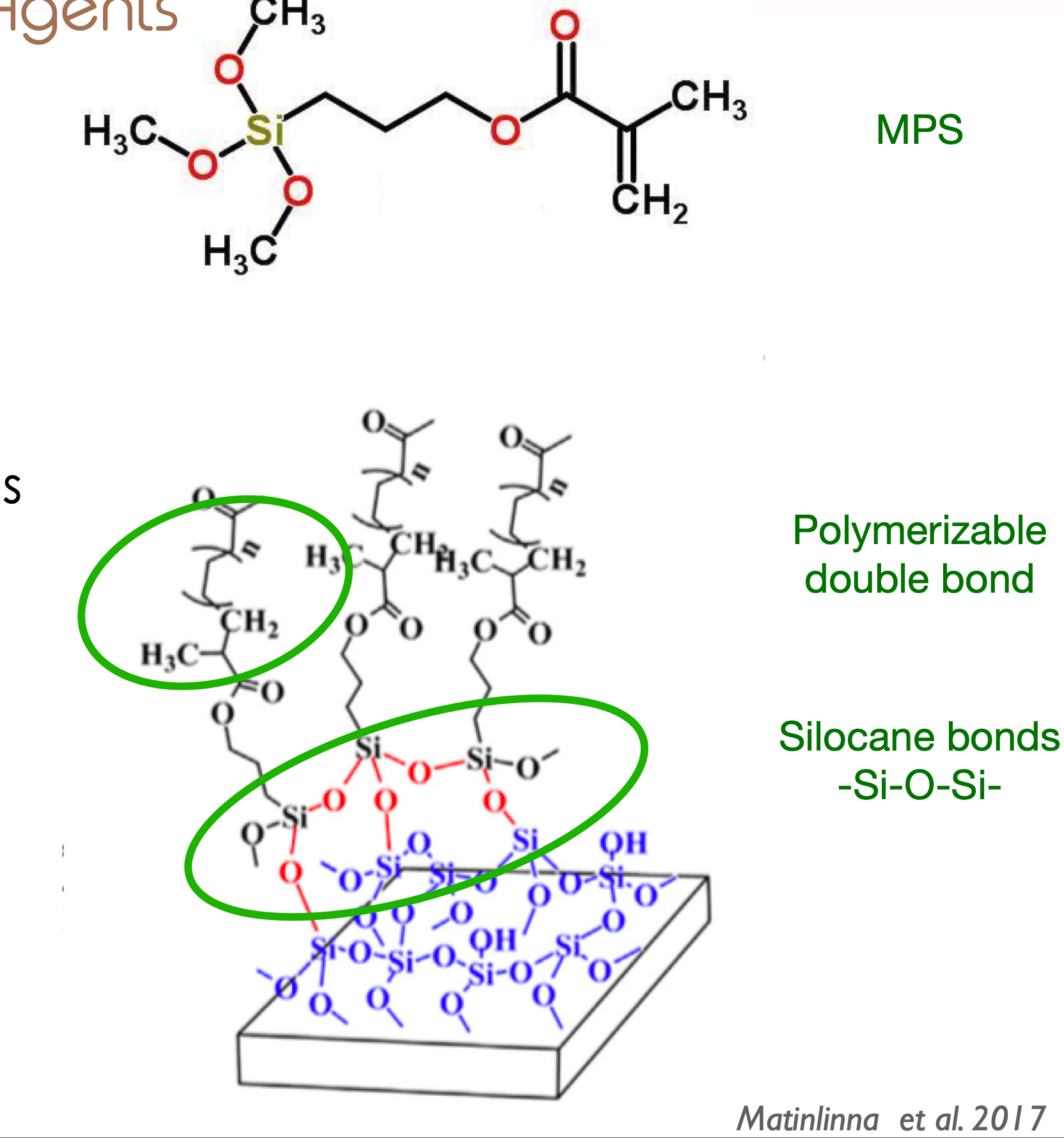
silane coupling agents:
Usually contain 3-methacryloxyproyltrimethoxysilane (MPS)
Effective in bonding silica-based restorative materials
Applications in bonding between:
Silica-based ceramics and resin
Polymeric matrix and fillers of resin composites (silanized fillers)
Resin composite repairs, ceramic repairs
These are the steps of using resin cements to bond to what?
Sandblasting with aluminum oxide to roughen the bonding surface
Zirconia Primer containing phosphate or phosphonate monomers
These monomers also contain a hydrophobic backbone and a methacrylate group that can copolymerize with the adhesive resin cement
Most widely used: 10-MDP
Zirconia ceramics
10- MDP hints that cement is being bonded to what?
zirconia ceramics
10-MDP:
Achieves direct bifunctional adhesion
With metal oxides (e.g. zirconium or aluminum oxide) via a phosphate ester group and
With the resin bis-GMA matrix via a methacrylate group