PE Paper 1 : Skill Acquisition
 Call Kai
 Learn
Learn Practice Test
 Spaced Repetition
 Match
Match Flashcards
 Knowt Play
1/140

There's no tags or description
Looks like no tags are added yet.
Name | Mastery | Learn | Test | Matching | Spaced | Call with Kai |
|---|
No analytics yet
Send a link to your students to track their progress
141 Terms
Negative transfer occurs when the learning of one skill hinders the learning of another.
Outline two causes of negative transfer.
(2)
• Performer misunderstanding the different movement requirements. (1)
• First skill hasn’t been fully learnt/overlearned. (1)
• A familiar stimulus/cue requiring a new response. (1)
• Skills that seem to be performed the same way but aren’t. (1)
• Conflicting skills are taught close together. (1)
• When practice environment is different to competition environment. (1)
• Poor coaching. (1)
Negative transfer occurs when the learning of one skill hinders the learning of another.
Describe one way a coach can prevent negative transfer occurring.
(1)
• Draw the performer’s attention to the differences. (1)
• Make sure the first skill is thoroughly learned before moving on. (1)
• Avoid teaching/ performer practising skills together that might cause confusion. (1)
• Make practice sessions similar to the performance/competition situation. (1)
• Punish incorrect response/reinforce correct response. (1)
Skills in sport can be classified in different ways.
Define the term ‘continuous skill’. Give a sporting example.
(2)
Definition : A skill with no clear beginning or end (1)
Sporting Example : Running/swimming/cycle (1)
Explain why bowling in cricket might not be placed exactly at either end of the
Gross – Fine continuum.
(2)
• Bowling can be placed towards gross/away from fine as it requires large muscle groups to generate speed. (1)
• Bowling can be placed towards fine/away from gross as it requires smaller muscle groups for accuracy/produce spin. (1)
Define Bilateral Transfer (1)
• Bilateral transfer: the transference of physical performance learned by one side of the body to the opposite side of the body (1)
Give a sporting example of bilateral transfer (1)
• Learning to throw with your left (non-dominant) hand after learning how to throw with your right (dominant) hand (1)
• Learning to kick with your left (non-dominant) foot after learning how to kick with your right (dominant) foot (1)
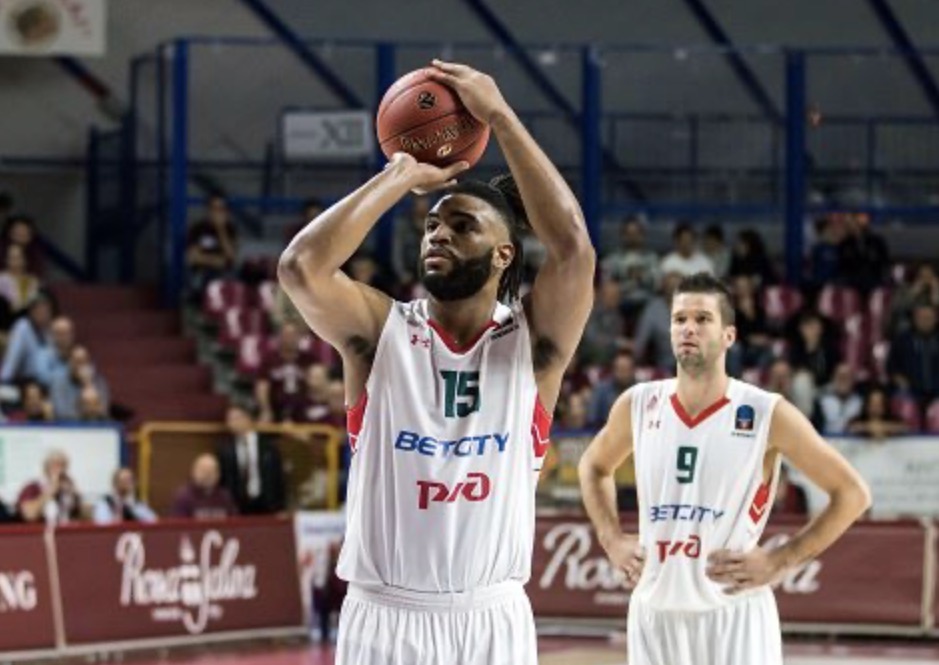
Justify the classification of a free throw on the following continua :
Open or closed
Self-paced or externally
Discrete, serial or continuous
• Closed – as the environment is predictable / stable, no other performers affected / closed as the skill can be repeated consistently with very few decisions (1)
• Self-paced – as the performer controls when / how fast the shot is performed / externally paced as players must shoot in the designated time period (1)
• Discrete – as the skill has a clear beginning and end (1)
Discuss whether massed practice is suitable for a basketball player wanting to develop the skill of a free throw.
(4)
Advantages (Sub-max 2 marks)
The free throw has natural breaks, therefore massed practice good as no need for recovery (1)
Massed practice is good if performer is in autonomous stage of learning / experienced as the free-throw can be performed repetitively and efficiently, without losing technique (1)
Massed practice can support adopting a quicker feel / kinaesthesis / habitual response for the free-throw (1)
Massed practice can be used quickly to allow the performer to move on to other skills / parts of the game during a training session (1)
Disadvantages (Sub-max 2 marks)
Massed practice not suitable if cognitive learner as the basketball player may develop the wrong / incorrect technique (1)
Massed practice may not allow enough time for the basketball player to receive feedback and therefore not allow them to improve their technique (1)
Massed practice can become boring/repetitive, which leads to a loss of motivation / confidence to continue shooting (1)
Massed practice could fatigue a less fit player and therefore their technique may deteriorate, resulting in frustration or injury occur, which may hinder future training / performance (1)
Repeated failure can result in loss of motivation / confidence to continue shooting (1)
Which one of these skills will benefit from positive transfer if the performer is already able to perform a serve in tennis?
(1)
C
State two ways a coach can encourage positive transfer of learning.
(2)
• Making training realistic (1)
• Ensuring the first skill is well learnt (1)
• Slow planned progression (1)
• Use of rewards / reinforcement to encourage positive transfer (1)
• Make performer aware of opportunities for positive transfer / highlight similarities (1)
When considering transfer of learning, a skill learnt in netball may aid the learning of another skill in basketball.
Which one of the following types of transfer is best described by this statement?
(1)
C
Performers need to learn skills in order to take part in physical activity. Skilled movements are learned, economic and consistently successful.
State three other characteristics of skill.
(3)
• Coordinated / controlled (1)
• Fluency / flowing / smooth (1)
• Adaptable (1)
• Aesthetically pleasing (1)
• Goal orientated behaviour / predetermined results (1)
• Precise / accurate / correct technique (1)
Vicky is a badminton player. She has recently begun to play tennis.
Explain the impact of negative and zero transfer of learning on Vicky’s progress in tennis. Give examples from badminton and tennis to support your answer.
Negative transfer:
Zero transfer:
(4)
Negative transfer
The skills Vicky has learnt in badminton will hinder the learning of skills / techniques in tennis (1) for example, in badminton forehand shots are played with a flexible wrist but in tennis the wrist should be firmer (1).
Zero transfer
Zero transfer means that some badminton skills will have no impact on Vicky’s tennis performance, due to the differences in the skill (1). For example, in badminton, players serve underarm but the serve is overarm in tennis / no top spin in badminton (1).
Classify the corner kick in football using the following continua:
• open – closed
• self-paced – externally paced.
Justify your answers.
(2)
Open-closed: closed / towards closed end of continuum because the opposition cannot directly interfere with the player taking the corner (1).
Open-closed: open / towards open end of continuum because the players are constantly moving around which will affect the player’s decisions taking the corner (1).
Self-paced – externally-paced: self-paced / towards self-paced end of continuum because the player decides when they want to kick the ball (1).
Self-paced – externally-paced: externally-paced / towards externally-paced end of continuum because the player has to take the corner when the referee has blown the whistle (1).
Describe the high – low organisation skill continuum.
(1)
This continuum refers to how easily a skill can be broken down / the nature of phases / subroutines that make up a skill (1).
Low organisation skills tend to be made up of discrete phases / subroutines / can easily be broken down / phases can be practiced separately (1)
High organisation skills tend to have phases / subroutines that cannot be easily broken down / the phases of the skill cannot be practiced separately (1).
Give one example of a low organisation skill in football.
Taking a penalty / passing the ball / taking a goal kick / making a shot / throw in (1).
The triple jump can be classified using the following continua:
• open − closed
• self-paced − externally-paced
• discrete − serial − continuous
• gross − fine.
Explain where you would place the skill of triple jumping on each of these continua.
(4)
• Open – closed: closed / towards closed end of continuum because no other athlete can directly interfere with the triple jumper (1)
• Self-paced – externally-paced: self-paced / towards self-paced end of continuum because the athlete decides when they start their run up towards the take-off board (1)
• Discrete – serial – continuous: Serial because the triple jump is made up of discrete skills of the run up, hop, step and jump (1)
• Gross – fine: Gross because the triple jump uses large muscle groups to complete the skills (1)
State two factors that determine whether a skill is classified as open or closed.
• If the environment constantly changes it is an open skill (1).
• The degree to which a skill is perceptual and externally paced – more perceptual and externally paced usually means it is more open (1).
• If the environment is stable and predictable it is a closed skill (1).
• Skills tend to be self-paced when closed (1).
Define each of the following terms and give a sporting example.
Gross
Fine
(4)
Gross
• Large muscle movements / dynamic / ballistic movements (1)
e.g. a long jump (1)
Fine
• Small muscle movements / intricate movements (1)
e.g. badminton flick serve (1)
Define the terms simple skill and complex skill and give a sporting example of each.
(4)
Simple Skill
• One or few stimuli to process / limited information to process / one or few decisions to make / skill with few subroutines / limited cognitive demand / limited perceptual requirements / less feedback / limited decision making / one movement
• e.g. running / sprinting / sprint start / throwing / kicking / jumping
Complex Skill
• Many stimuli to process / lots of information to process / many decisions to make / increased perceptual requirements / more feedback / skill with more or many subroutines / several movements
• e.g. batting or bowling in cricket / basketball dribble / tennis serve / hitting a ball / gymnastics routine / somersault / high jump / triple jump / golf swing / receiving a ball in a game / delivering a pass in a game
Which one of the following classifications accurately describes the skill of taking a football penalty kick?
(1)
C
Which one of the following classifications accurately describes the skills of a dive at the start of a swimming race?
(1)
A
Which one of the following options accurately classifies the tennis serve?
(1)
A
Justify your classification on the gross-fine continuum
(1)
Involving large muscle groups (1)
Do not accept lots of muscles
Involving large (range of) movement (1)
Skills can be classified on the following continua:
• open – closed
• self-paced – externally paced
• discrete – serial – continuous.
Classify the badminton serve using these three continua. Justify your answers.
(3)
A Closed – limited information processed prior to serving / opponent(s) / environment stable.
must state classification as well as justification
B Self-paced – speed / timing is controlled by performer.
C Discrete – Clear beginning and end.
One form of transfer is positive transfer.
Outline three other forms of transfer of learning that may occur.
(3)
A Negative – hinders learning of new skill.
do not accept ‘has negative effect on learning’
B Zero – no effect / impact on learning of skill.
do not accept ‘has zero effect on learning’
do not accept no transfer
C Retroactive – current practice affects learning of previously learned skill.
D Proactive – current practice affects learning of skill yet to be learned / to be learnt in the future.
E Bilateral – practise on limb on one side of body improves other side.
Skills can be classified on continua as:
• open – closed
• self-paced – externally paced
• discrete – serial – continuous.
(i) Classify the skill of taking a penalty in football using these three continua.
(1)
Closed – self-paced – discrete
Explain how shooting at goal during general play may alter these classifications.
(2)
Closed becomes open – (affected by the environment) need to make decisions due to opponents or team mates or environmental factor
Self-paced becomes externally paced – environment decides when player shoots.
The swimming start can be classified on continua as ‘open – closed’, ‘self paced – externally paced’ and ‘discrete – serial – continuous’.
Identify the classification of the swimming start using these three continua.
(3)
Closed,
Externally-paced,
Discrete.
Explain how two of these continua may change during the race.
(2)
Becomes open – affected by environment – pacing / keeping up /
adjusting speed.
(Idea that environment changes / decisions are made.)
Becomes self-paced – speed determined adjusted by performer.
(Idea that performer decides speed / pace.)
Becomes continuous – repeated actions / cycles / strokes / no clear beginning or end or becomes serial – different actions linked together – start; strokes; turns.
Give examples from a team game of an open skill and a closed skill.
(2)
Open skill: open play situation / passing.
Closed skill: dead ball situation / set piece.
Coaches will encourage performers to practise skills so that the skills can transfer to the competitive situation.
Outline three different forms that transfer can take.
(3)
Positive – enhances / helps / aids the learning of a new skill / egs.
Not has positive affect
Negative – hinders learning of new skill.
Not has positive affect
Zero – has no effect on learning of new skill.
Not has zero affect
Bilateral – practise on limb on one side of body improves other side.
Describe what is meant by the term ‘positive transfer of learning’. (1)
Positive transfer – enhances / helps / aids the learning of a new skill
Describe how a coach can make sure that successful transfer of learning takes place.
(3)
Coach makes performer aware of transfer potential / highlight elements of skill
that are similar;
Identify elements that may hinder learning;
Ensure original task is well learnt / practice;
Planned progression;
Make practice sessions realistic / relevant to the competitive environment;
Eg practising against opposition / time / equiv;
Eliminate bad habits;
Performer is well motivated / confidence.
The skill of triple jumping can be classified according to various skill continua.
Classify the triple jump according to the following continua.
• Open to closed
• Self-paced to externally paced
• Discrete to continuous.
(3)
Closed
Self-paced
Discrete
The skill of springboard diving can be classified according to various skill continua.
Classify springboard diving according to the following four continua and justify each of your choices.
• Open to closed
• Self-paced to externally paced
• Discrete to continuous
• Gross to fine
(4)
Closed – unchanging environment / few decisions.
Self-paced – performer decides speed of movement / when to start.
Discrete – distinct beginning and end or serial – sequence of discrete skills.
Gross – large muscle groups.
Springboard divers often train using trampolines.
Explain how a coach can ensure that practising on a trampoline assists the learning of skills in diving.
Positive transfer (of learning) / develop schema.
Make performer aware of transfer potential / highlight elements of skill that are similar.
Ensure original task is well learnt / practised.
Planned progression / part learning of skill / break skill down.
Make practice sessions realistic / relevant / same movements.
Eliminate bad habits.
Practising on trampoline is safer / reduce risk of injury.
Repeated practice more possible – aids reinforcement.
Only use if performer is well motivated / confident / avoid tedium.
Describe the factors that need to be considered before deciding whether to teach a skill by progressive part practice.
(4)
Depends on nature / type of task / skill;
• Use PPP if skill can be broken down into parts / complex;
• PPP for serial skills;
• Either PPP or whole to help gain ‘feel’ / kinesthesis;
• Use PPP if element of danger;
Depends on stage of learning;
• Whole for experienced / part for novice;
Depends on level of motivation;
• PPP is time-consuming
Explain the advantages and disadvantages of using whole practice when learning a dance routine.
(4)
Advantages
• Time efficient so can learn a new routine/several routines quickly for an upcoming competition or show (1)
• Fluency/relationship between subroutines is maintained which is vital for an aesthetic dance (1)
• Mental picture of whole dance can be developed aiding memory/future performances (1)
Disadvantages
• A whole new dance routine may be too much information which is difficult for the performer to remember (1)
• Doesn’t allow the development of new/weaker skills as the performer is attempting the whole routine/not focussing on developing specific new skills (1)
• May cause fatigue leading to errors/injury (1)
Evaluate the impact of an athlete only using whole practice to develop their triple jump technique.
(4)
Evaluations for using whole practice to develop triple jump (sub max 3 marks)
• May be good because the triple jump is fast/ballistic/closed in its nature (1)
• Provides a more realistic method to transfer training into performance/it involves replicating/rehearsing the complete technique of triple jump as would be performed during a competition (1)
• Can aid consistency in performing the whole action of the triple jump/creates autonomous performance of the technique, increasing the athlete’s confidence/consistency when performing (1)
• Can develop/maintain the links between sub-routines/the run-up, hop-step-jump phases, ensuring the connectivity/fluidity (1)
Evaluations against using whole practice to develop triple jump (sub max 3 marks)
• Can place increased physical demands leading to fatigue/injury, which may mean the athlete has to miss training/competitions (1)
• Information overload, resulting in important aspects of the triple jump technique being missed/not performed adequately (1)
• May have a technical weakness that cannot be targeted during whole practice, which means they fail to make progress in their technique/distance jumped (1)
• Triple jump can be broken down and therefore other methods of practice may be more appropriate (1)
Discuss the effectiveness of using massed practice with performers in gymnastics.
(4)
For (sub max 3)
• Helps develop motor programmes/allows overlearning of a named gymnastic skill or routine (1)
• Increased sports specific fitness due to repeatedly performing a named gymnastic skill or routine (1)
• Time efficient which may allow the learning of a specific routine in the lead up to a competition (1)
• Particularly suited to closed, self-paced skills like a gymnastics routine (1)
Against (sub max 3)
• Limited time for feedback which may limit error correction in named gymnastic skill or routine (1)
• Fatiguing which may cause a decrease in gymnastic performance/increased likelihood of injury in dangerous sport like gymnastics (1)
• Boring/demotivating when performing same named gymnastic skill or routine leading to lack of focus/decreased performance (1)
‘Changing the practice type and the practice drills.’
Identify this type of practice.
(1)
C
To develop skills, performers will use different types of practice.
Define the term ‘massed practice’.
Repeated practice of the same skill with little or no recovery periods between blocks of practice (1)
Explain three situations where a coach would use massed practice to produce optimum improvements in performance.
Performer has high levels of fitness so they can work for longer before fatigue affects the learning of the skill (1)
• Skills are discrete/simple/ballistic therefore they take a short time to perform reducing impact of fatigue (1)
• Replicates fatigue of a game situation so the performer becomes familiar with situations/condition they will need to perform the skill under (1)
• Performer is highly skilled/autonomous stage of learning/experienced therefore they are familiar with the task and need to be placed under pressure to replicate the demand of the game/physical activity (1)
Explain the factors that help coaches decide whether to use massed practice or distributed practice.
(4)
• Stage of learning - Massed for autonomous performer/distributed for cognitive performer.
• Fitness - Massed for very fit performer/distributed for less fit.
• Motivation - Massed for highly motivated performer/distributed for less motivated.
• Complexity - Massed for simple skills/distributed for complex/strenuous.
• Continuity - Massed for discrete skills/distributed for continuous skills.
• Skills involved / Muscles used - Massed for fine skills/distributed for gross skills.
• Time available - Massed when time is limited/distributed when plenty of time available.
• Speed of action - Massed for quick/rapid skills/distributed for long-lasting skills.
• Safety - Massed when no danger/distributed when potential danger;
Explain how four factors would help a coach decide whether to use ‘massed practice’ or ‘distributed practice’ to develop skills.
(4)
Complexity – Massed for simple skills / distributed for complex / strenuous;
Continuity – Massed for discrete skills / distributed for continuous skills;
Muscles used – Massed for fine skills / distributed for gross skills;
Time available – Massed when time is limited / distributed when plenty of time available;
Speed of action – Massed for quick/rapid skills / distributed for long-lasting skills;
Safety – Massed when no danger / distributed when potential danger.
State two characteristics of a performer who is in the associative stage of learning.
(2)
• In the practice stage (1)
• Uses trial and error (1)
• Still needs feedback (1)
• Start to use intrinsic feedback/develop kinesthesis (1)
• Compare their performance to others/modelling (1)
• Fewer errors made (1)
Which stage of learning is a performer at if they are creating a mental picture of the skill?
(1)
C
Which one of these is a characteristic of a performer in the cognitive stage of learning?
C
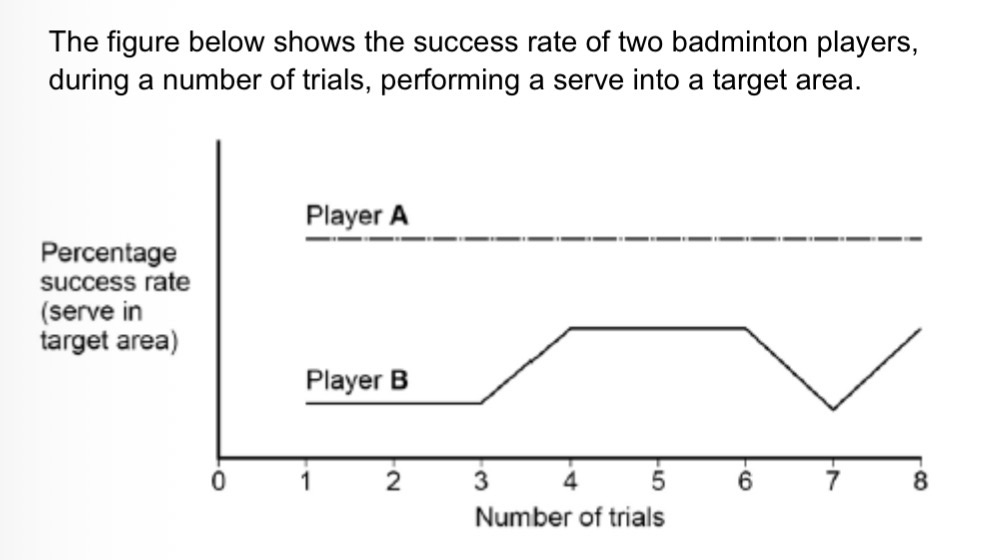
Identify the stage of learning of player A and two characteristics of a performer in this stage of learning (3)
• Performer A – Autonomous (1)
• Skill is performed easily/habitual/sub-consciously (1)
• High level of consistency (1)
• Quick processing time/decisions made quickly (1)
• Good selective attention/able to focus on relevant cues/not easily distracted (1)
• Performer can detect and correct own errors/intrinsic feedback (1)
There are three stages of learning.
Identify the first stage of learning
(1)
Cognitive
Outline why the use of demonstrations is beneficial at this stage.
(1)
• Performer lacks mental image/allows the performer to form mental image
• To develop understanding of relationships between sub-routines/whole movement pattern
• Learns through observing/ observational learning/Social learning theory
Within physical education, students may be taught in mixed ability groups.
Outline how feedback may differ between students in the associative and autonomous stages of learning.
(3)
Associative stage
Mainly extrinsic feedback
Do not accept internal and external
Aim to eliminate gross errors / mistakes
As a performer improves intrinsic feedback more relevant
Kinaesthetic being developed
Autonomous stage
Mainly intrinsic feedback / kinaesthetic
Ability to correct own errors
Extrinsic feedback is more detailed / specific / correction of minor errors
Can deal with negative / critical feedback
Name the early and the final stages of learning.
(2)
Cognitive
Autonomous
Describe how the ‘feedback’ that a tennis player uses will change as they progress to the final stage of learning.
(3)
(mainly) intrinsic
Knowledge of performance (KP);
Accept opposites – less extrinsic; less KR; immediate; terminal; positive; simple / general;
Negative / become more important;
Describe how feedback differs between the cognitive and autonomous stages of learning.
(4)
Cognitive :
Extrinsic / coach / augmented.
Knowledge of Results / KR;
General / simple / basic / positive;
Receive intrinsic feedback / kinaesthetic but cannot use it;
Autonomous :
Intrinsic / kinaesthetic / correct own mistakes;
Knowledge of performance / KP;
Specific / detailed / critical / negative
A trampolinist is learning to perform a somersault using a harness.
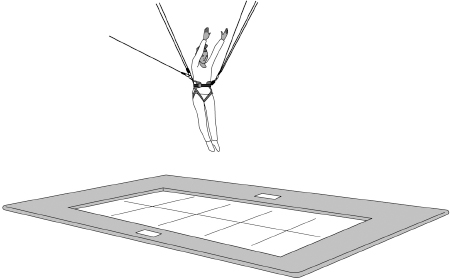
Evaluate the use of mechanical guidance for this performer.
(3)
Positives (sub max 2)
• Improves confidence, so will attempt the somersault/be motivated to practice etc. (1)
• Develops kinaesthetic awareness, so they can repeat the somersault without support/develop the correct motor programme etc. (1)
• Keeps the performer safe/reduces the risk of injury, so they can continue to practice/perform many repetitions/perform without constant support etc. (1)
Negatives (sub max 2)
• Becomes over reliant on the harness, so will lack the confidence/motivation to perform without support etc. (1)
• Incorrect kinaesthetic awareness/intrinsic feedback experienced, so they don’t develop the appropriate timing/feel of the movement etc. (1)
‘Verbal guidance is a suitable way of introducing a new skill to a cognitive learner. ’
Discuss this statement.
(4)
Advantages (sub max 3 marks)
• Can be used in conjunction with visual guidance to give cognitive learner more information / highlight specific cues (1)
• Helps to build correct mental image which a cognitive learner can refer back to (1)
• Positive feedback / verbal guidance can be used to maintain motivation as the performer is in the cognitive stage of learning (1).
Disadvantages (sub max 3 marks)
• Too much information / information overload may cause confusion / place too much demand on the memory of a cognitive learner (1)
• Verbal guidance during performance can cause the performer to lose concentration especially in the cognitive stage (1)
• Technical terms may not be understood by a cognitive performer (1)
• Incorrect verbal guidance may decrease the performance which could develop bad habits in a cognitive learner / unaware of correct technique (1)
• Some performers may struggle to create a mental image from verbal guidance alone / visual guidance may be more effective (1).
Outline how three different types of feedback can be used in the autonomous stage of learning.
(4)
Autonomous stage
A. Intrinsic / kinaesthetic / internal – can correct own mistakes / developed kinaesthetic awareness
B. Extrinsic / coach / augmented / external – specific / detailed to refine movements
C. Knowledge of performance – need to know why the performance was correct / incorrect
D. Critical / negative – to aid error correction / accept criticism
E. Positive – to encourage them to persevere / motivate
A swimming teacher may use floats and arm bands with a group of beginners to keep them safe when they are learning to swim.
Identify this type of guidance.
(1)
Mechanical
In most sports, coaches can give feedback during a break in play.
Identify and describe two different types of feedback that a coach could give during a break in play. Give a sporting example to support each answer.
(4)
(AO1) Positive feedback can be given by the coach, praising / recognising what is going well (1) (AO2) e.g. taking a quick corner catching the defence out so the goal was scored (1).
(AO1) Negative feedback can be given by the coach providing criticism / information on what is going wrong / weaknesses during play (1) (AO2) e.g. the team keep giving away free kicks (1)
(AO1) Knowledge of performance can be given by the coach to explain why a technique is working or not working (1) (AO2) eg if a player’s shots were going over the goal the coach would explain the fault in technique causing this, ie weight on the back foot (1).
Outline the advantages and disadvantages of using extrinsic feedback.
(4)
Advantages
A Easy to give
B Good for all stages of learning
C Cognitive learners rely on this type of feedback
D Cognitive learners – general feedback/knowledge of results/ Lots of errors so where to improve/strengths and weaknesses
E Autonomous learners – specific/detailed feedback/knowledge of performance
F Focuses attention/motivating/increases confidence
Disadvantages (sub max 3)
J Information overload if given too much
K Difficulty in understanding/poor delivery by coach/incorrect feedback leads to poor performance
L Time consuming
M Can be boring/lose its power if too much
N Performer can become over-reliant on feedback (given during/after training session)
O Do not develop own kinaesthetic awareness
P If negative can demotivate
Outline four advantages of using visual guidance when introducing weight training exercises.
(4)
A Demonstrations / images / video.
B Provides a clear idea of the movement pattern / technique / analysis of technique.
C Helps develop a mental image.
D Important for safety / to prevent injury through incorrect technique.
E Suitable for learners in the cognitive / associative stages of learning.
F Specific cues can be highlighted.
G Focused attention on the visual guidance (demonstration / image / video) given.
H Suitable for large groups.
I Can motivate by using a significant other / role model.
J Can be used in conjunction with verbal guidance.
Describe how a coach can use visual guidance effectively.
(4)
• Visual needs an accurate / perfect demonstration;
• Learner must be paying attention;
• Highlight cues;
• Skill within performers capabilities / memory limitations;
• Better for beginners;
Describe four different forms of feedback available to a performer.
(4)
• Intrinsic – from within / proprioception.
• Extrinsic – from outside / coach / crowd.
• Positive – praise and acknowledgement of a correct or successful action.
• Negative – external information about how a movement was incorrect or could have been better, critical comments.
• Knowledge of result (KR) – feedback in the form of information about how successful the movement was in accomplishing the task / feedback about the outcome / result.
• Knowledge of performance (KP) – information was given as feedback as to how well the movement was performed, regardless of the end result.
Define the term ‘learning plateau’.
(1)
A learning plateau occurs when a learner stops progressing/no improvement in performance is evident (1)
State two potential causes of a learning plateau.
(2)
• Performer not physically ready/task too difficult/goals too high (1)
• Performer lacks ability to develop/modify current skills/reached potential (1)
• Fatigue/lack of fitness (1)
• Still developing mental model of more complex skill (1)
• Boredom/tedium/lack of motivation/extrinsic rewards/goals not challenging enough (1)
• Poor/low quality coaching/teaching/earlier faulty learning (1)
Identify three causes of a learning plateau.
(3)
• Performer not physically ready / task too difficult at this stage (1)
• Fatigue (1)
• Lack of fitness (1)
• Still developing mental model of more complex skill (1)
• Boredom / tedium/lack of motivation (1)
• Poor / low quality coaching/teaching/earlier faulty learning (1)
• Goals too high/not challenging enough (1)
Identify four strategies a coach may use to help a performer to overcome a learning plateau.
(4)
A Distributed sessions/rest/recovery periods
B Reset goals/make tasks more challenging
C Offer extrinsic rewards/encouragement/praise/positive reinforcement
Accept other examples of extrinsic rewards
D Using mental rehearsal/imagery/visualisation
E Provide feedback/visual guidance
F Use of whole-part-whole/part method/breaking the skill down
G Ensure performer focuses on appropriate cues
H Make practices more varied/more interesting/fun/enjoyment
I Make performer fitter
J Different coach/teaching style
Outline four strategies that a coach could use to minimise a learning plateau.
(4)
Distributed sessions / rest / recovery periods;
Resetting of goals / tasks more challenging / competition against opposition;
Offering extrinsic rewards / encouragement / praise / positive reinforcement;
Using mental rehearsal / imagery / visualisation;
Provide feedback / visual guidance;
Use of whole – part – whole / part method / breaking the skill down;
Ensure performer focuses on appropriate cues;
Make practices more varied / more interesting / fun / enjoyment;
Make performer fitter;
Better quality coaching / new coach / change coaching method;
Concept of plateau in performance explained to performer;
Games players practise to improve their skills. Improvements in skill performance may be identified through repeated attempts at the skill over a period of time.
The figure below shows a typical performance curve, where skill performance is recorded over time.
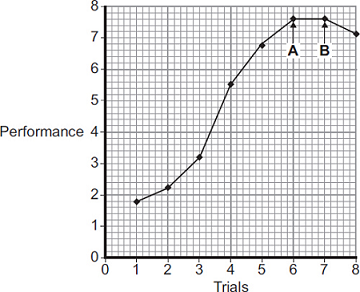
Describe what is happening in relation to skilled performance between point A and point B.
No improvement / levels off / equiv;
Accept optimum / maximum performance
(Learning) plateau;
Games players practise to improve their skills. Improvements in skill performance may be identified through repeated attempts at the skill over a period of time.
The figure below shows a typical performance curve, where skill performance is recorded over time.
State four possible solutions to limit what is happening between point A and point B in the figure above.
(4)
Distributed sessions / rest / recovery periods;
Resetting of goals / tasks more challenging;
Offering extrinsic rewards / encouragement / praise / positive reinforcement;
Increase motivation on own too vague.
accept rewards / prizes / etc
Using mental rehearsal / imagery / visualisation;
Provide feedback / visual guidance;
Competition against opposition;
Use of whole-part – whole / part method / breaking the skill down;
Ensure performer focuses on appropriate cues;
Make practices more varied / more interesting / fun / enjoyment;
Make performer fitter;
Better quality coaching / new coach / different teaching style.
Describe the insight theory of learning (2)
• Cognitive (1)
• Problem-solving (1)
• Uses existing knowledge/past experiences (1)
• It focuses on the whole task (1)
Outline four reasons why a teacher may decide to use insight learning during a lesson rather than operant conditioning.
(4)
(Insight learning) – develops more independent learners / students have to think more / cognitive processes
(Insight learning) – develops greater understanding of relationship between sub-routines / timing
(Insight learning) – able to modify / adapt actions or skill in a new situation
(Insight learning) – increased motivation of students
(Insight learning) – encourages creativity / decision making
Outline what is meant by the term ‘insight learning’ and how this approach could have a positive effect on learning.
(3)
Insight learning : Involves cognitive processes / development.
Understanding the process to achieve the result / why / reasons you do things.
Accept eureka moment.
Coach questions performer about why they’re performing in a particular way.
Experiences the ‘whole’ activity rather than skills in isolation.
Allows learners to develop their own strategies and / or routes of understanding;
Better for the performer rather than being told what to do all the time;
Performer able to adjust movements as required;
Improves motivation.
Which one of the following is most commonly described as trial and error learning?
(1)
Operant Conditioning
Define the term ‘positive reinforcement’. Give a sporting example.
(1)
AO1
• (Positive reinforcement) a pleasant stimulus is given to increase the likelihood of a correct response (1)
AO2
• Reward/certificate/trophy/praise is given when a correct response occurs (1)
Negative reinforcement and punishment are key aspects of operant conditioning.
Define the terms negative reinforcement and punishment.
Give a sporting example of each.
(4)
• Negative reinforcement: removal of an unpleasant stimulus to encourage desired response (AO1), coach stops shouting at a player when the performer does something well (AO2)
• Punishment: introduction of an unpleasant stimulus to break the SR bond/prevent the response from reoccurring (AO1), a red card/penalty is awarded after a foul has been committed (AO2)
Operant conditioning is based upon developing a stimulus-response bond.
Explain how a coach could strengthen the stimulus-response bond for a player passing a ball in a game of football.
(2)
• Positive reinforcement – when a player makes the correct pass then the coach may offer praise or a reward to encourage the correct response to be repeated (1)
• Negative reinforcement – A coach may make negative comments when a player miss places a pass, but stop making / remove these comments when the correct pass is made (1)
Name and give examples of the different types of reinforcement.
(3)
Positive and negative reinforcement (1)
Positive – Use of praise / rewards / self-satisfaction to encourage correct behaviour (1)
Negative – Removal of criticism / unpleasant stimulus to encourage desired response / eg coach stops shouting
State three ways, other than reinforcement, that a coach can make sure that operant conditioning results in successful learning
(3)
Use of punishment
Correcting mistakes / equiv
‘Trial and error’ learning
Manipulating the environment to obtain desired response
Describe operant conditioning.
(3)
Learning based on strengthening the relationship between stimulus and response / S-R bond;
Increases the likelihood of the desired response reoccurring / equiv
Trial and error learning;
Learner associates consequences of previous action with current situation;
Shaping : manipulation of the environment to get the desired action;
Outline the term negative reinforcement and give an example from a team game.
(2)
(Negative reinforcement) – when the adverse stimulus is withdrawn when the desired response occurs;
Eg coach stops criticising when skill is successful
Describe operant conditioning theory and how a diving coach may use it to improve learning.
(4)
use of rewards / praise or removal of criticism to encourage learning / repeat
successful performance / change behaviour.
Trial and error learning.
Strengthen S-R bond / successful response associated with stimulus.
Use of (positive / negative) reinforcement.
Shaping / altering environment to allow success.
Vygotsky’s social development theory focuses on building learning in stages.
Explain how this theory applies to a badminton player learning a new skill.
(4)
• What can be done alone – e.g. grip racket, get into position and make contact with shuttle to perform overhead clear (1)
• What can I do with help from a coach – e.g. generating more power to clear shuttle further, by getting my feet and body in better position – angled side on, grip racket more efficiently with thumb and index finger better positioned (1)
• What cannot be done yet – e.g. generating consistent power / distance (1)
• To help / support the badminton player would need to observe and copy others / socially learning from others / help them through 3 stages and set targets / goals (1)
• Learn from More Knowledgeable Other / take advice from coach (MKO) (1).
Vygotsky ’s Social Development Theory is a constructivist theory. Learning is built up in stages based on the current level of performance.
Outline the three stages of development in this theory.
Give a sporting example for each stage.
(3)
• What can I do (alone) e.g. I can hold a golf club and stand correctly (1)
• What can I do with help e.g. I can swing the club and make contact with the ball with help from my coach (1)
• What can I not yet do e.g. I cannot yet hit the golf ball with any accuracy towards a target (1).
Vygotsky suggested that a sports performer could learn new skills by using the method of constructivism.
Describe the constructivism method of learning in sport.
(4)
• Performer 'builds' learning in stages
• Based on what can I do alone
• What can I do with help
• Using 'More Knowledgeable Other'
• What can I not yet do
• Called 'Zone of Proximal Learning'
The zone of proximal learning is a feature of which one of the following theories of learning?
(1)
Constructivism
Which of the following is the correct order of the central mechanisms in Whiting’s Information Processing Model?
(1)
C
The diagram shows Whiting's information processing model, with five arrows entering the perceptual mechanism and only one leaving.
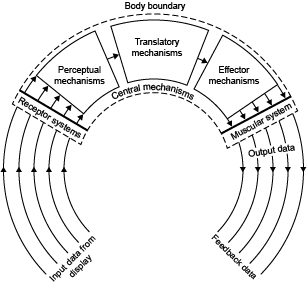
Describe the process involved and why it is necessary. (4)
• Selective attention
• Filtering of unnecessary information
• Focussing on relevant information
• Too much information for limited capacity
Name the stage in Whiting's model that could be referred to as:
• Response selection stage
• Stimulus identification stage
• Response programming stage
Response selection - Translatory mechanisms
Stimulus identification - Perceptual mechanisms
Response programming - Effector mechanisms
Outline the functions of each of the following stages:
• Perceptual mechanism
• Translatory mechanism (5)
Perceptual Mechanism
• Information/stimulus is received from display by receptor systems
• Discriminates information/selective attention/filters out of information
• Coding of important information / interpretation of data / identify stimulus / making sense of information / equiv
• Pass information into translatory
Translatory Mechanism
• Developed / adapts to information
• Compares information with memory / past experiences
• Decision making process
• Selects the appropriate motor programme
Whiting's information processing model includes translatory and effector mechanisms.
Outline what you understand by these terms and give appropriate examples from volleyball.
(4)
Translation
• To decide what is happening and what to do about it / recognise the input and make a decision on the action to be taken / decision-making
• e.g. the ball is at chest height I will use a set/volley/equiv
Effector control
• Put a motor programme into effect/doing the movement
• Send impulses to the muscular system in order for the movement to be carried out
• e.g. hands high/viewfinder/extend the legs.
Outline the function of each of the central mechanisms during a game situation. (3)
• (Perceptual mechanism) interprets information from the environment/display (1).
• (Translatory mechanism) uses gathered information to make a decision (1).
• (Effector mechanism) transfers decision via nervous system to the muscles to complete the action (1).
Baddeley and Hitch’s working memory model consists of a central executive, which controls and coordinates three subsystems.
Outline the role of the three subsystems named below.(3)
Visuospatial sketchpad:
Phonological loop:
Episodic buffer:
Visuospatial sketchpad (inner eye) (sub-max 1 mark)
• Deals with visual and spatial information (1).
• Stores and processes information in a visual or spatial form (1).
• The Visio-Spatial Sketchpad is used for navigation (1).
• Displays and manipulates visual and spatial information held in long-term memory (1).
Phonological loop (sub-max 1 mark)
• Deals with spoken and written material. It can be used to remember a phone number. It consists of two parts (1).
• Phonological Store (inner ear) − Linked to speech perception. Holds information in speech based form (i.e. spoken words) for 1−2 seconds (1).
• Articulatory control process (inner voice) − Linked to speech production. Used to rehearse and store verbal information from the phonological store (1).
Episodic buffer (sub-max 1 mark)
• Acts as a 'backup' store which communicates with both long term memory and the components of working memory (1).
• Links to other two subsystems and perception (1).
• Allows visual and audio information to be ‘chunked together’ (1).
• Holds information temporarily and is key to conscious awareness (1).
Identify the four main components of Baddeley and Hitch's working memory model. (4)
• Central Executive
• Visuo-spatial sketch pad
• Phonological loop
• Episodic buffer
Describe the role of the visuo-spatial sketchpad and phonological loop in Baddeley and Hitch's working memory model. (2)
Visuo-spatial sketchpad
Responsible for manipulating visual images
Phonological loop
Deals with spoken and written material
The figure below shows the impact of the number of possible responses on response time.
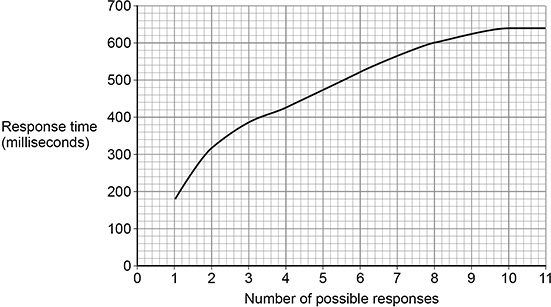
Analyse the figure to suggest why response times may be longer when passing in football than at the start of a 100 m race. Support your answer with data from the figure above.
• Start of 100m has one possible response to stimuli which the graph suggests would result in a response time of 180 ms. (1)
• Passing in football has many possible responses so response time longer (must include relevant data from graph). (1)
• Passing in football represents choice reaction timewhich takes longer/this increase can be explained by Hicks Law. (1)
State relationship between reaction time, response time and movement time? (1)
Reaction Time + Movement Time = Response Time
Define simple reaction time and choice reaction time.
Simple reaction time:
Choice reaction time:
Simple reaction time – One / a stimulus and one / a response.
Choice reaction time – Several stimuli and / or several responses.