BISC Week 7 Readings
 Call Kai
 Learn
Learn Practice Test
 Spaced Repetition
 Match
Match Flashcards
 Knowt Play
1/29

There's no tags or description
Looks like no tags are added yet.
Name | Mastery | Learn | Test | Matching | Spaced | Call with Kai |
|---|
No analytics yet
Send a link to your students to track their progress
30 Terms
Homeostasis
Stability in the chemical and physical conditions within an organism’s cells, tissues, and organs
Homeostasis achieved via Regulation
Many organisms can regulate their internal condition even when the environment fluctuates.
Some organisms conform to environmental conditions
Both are at the extremes, most organisms are in between
Why Is Homeostasis Important?
When homeostasis occurs, conditions inside the body allow molecules, cells, tissues, organs, and organ systems to function at an optimal level. However, occasional departures from homeostasis can represent important adaptations.
E.g. A fever is a response to an infection by a pathogen. This increase in body temperature can help fight off the pathogen.
The Role of Regulation and Feedback
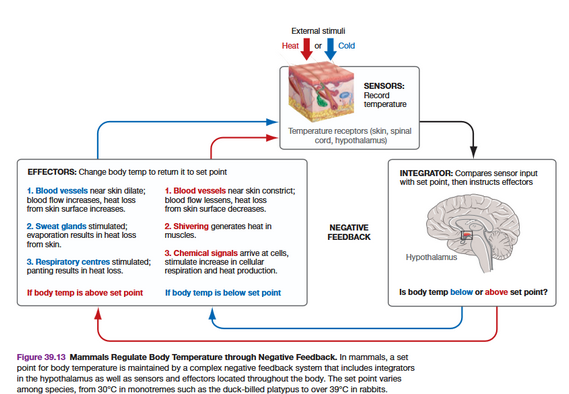
Homeostasis is achieved by using regulatory systems that monitor internal conditions
Each of these systems has a set point—a normal or target range of values for the controlled variable.
A homeostatic system consists of three general components
Sensor
Integrator
Effector
Sensor
a structure that senses some aspect of the external or internal environment
Integrator
evaluates the incoming sensory information by comparing it to the set point and determines whether a response is necessary to achieve homeostasis.
Effector
Any structure that helps restore the internal condition being monitored by the system
Redundancy is common in feedback systems—there are usually several ways to change a parameter.
Feedback systems usually work in “antagonistic pairs”: One set of responses increases a parameter while a corresponding set of responses decreases i
Input from sensors and integrators happens continuously, so feedback systems are constantly making fine adjustments relative to the set point.
Negative Feedback
When negative feedback occurs, effectors reduce or oppose the change in internal conditions.
Mechanisms of Heat Exchange
Animals exchange heat with the environment in four ways: conduction, convection, radiation, and evaporation
Overheating can cause enzymes & other proteins to denature and cease functioning.
Sharp drop in temperature can slow enzyme function and energy production.
Thermoregulatory Strategies
Two ways to organise thermoregulation variations:
Examine how animals obtain heat
Examine whether body temperature is held constant
Endotherms
Produces heat to warm its own tissues
Higher metabolic rates
Maintains high body temperature at all times
Requires energy-rich intake
Ectotherms
Relies on heat gained from environment
Lower metabolic rates
Lower food intake
Homeotherms
Keeps body temperature constant
Poikilotherms
Allows their body temperature to rise or fall depending on environmental conditions
Humans
strictly endothermic homeotherms
torpor
reduced metabolic rate and reduces temperature
Occurs in small mammals living in cold environments because their surface area is large relative to volume
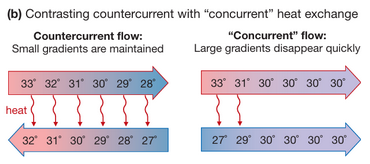
Countercurrent Heat Exchangers
Have vessels in close contact that carry warm and cool fluids in opposite directions
Osmolarity
The concentration of solutes in a solution, measured in osmoles per litre.
Osmotic Stress
When water and solute concentrations are different from setpoints.
Osmoregulation
The process by which organisms control the concentration of water and solutes in their bodies.
Osmoconformers
Organisms that maintain an internal osmotic environment that matches the osmolarity of the surrounding environment.
Isomostic
The solute concentrations inside and outside these animals are equal.
How is the challenge of osmotic stress different for marine, freshwater, and land animals?
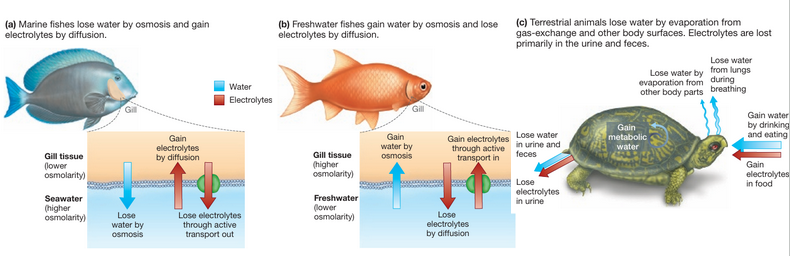
How Do Electrolytes and Water Move across Cell Membranes?
Primary and secondary active transport
Primary active transport
A source of energy like ATP is used to move ions against their gradients.
Secondary active transport (cotransport)
Relies on membrane proteins that use an electrochemical gradient established by a pump during primary active transport.
Symporter
A co transporter that moves different solutes in the same direction.
Antiporter
A co transporter that moves different solutes in opposite directions.
How does Water cross the membrane?
Cells use pumps to transport ions and set up an osmotic gradient; water then follows by osmosis—often through aqua porins.