Anthro 4 Final
0.0(0)
Studied by 0 people Call Kai
 Learn
Learn Practice Test
 Spaced Repetition
 Match
Match Flashcards
 Knowt Play
Card Sorting
1/49

There's no tags or description
Looks like no tags are added yet.
Last updated 10:18 PM on 5/31/26
Name | Mastery | Learn | Test | Matching | Spaced | Call with Kai |
|---|
No analytics yet
Send a link to your students to track their progress
50 Terms
1
New cards
Abjad
A writing system in which each letter represents a consonant, while vowels are left out and inferred by the reader. One symbol = one consonant. (Hebrew, Arabic, Ugaritic)
2
New cards
Abugida
A type of writing system where each primary character represents a consonant combined with a default "inherent" vowel. One symbol = consonant + vowel. (Brahmic, Ethiopic)
3
New cards
Logogram
A single written symbol or character that represents an entire word or meaningful unit of language (a morpheme). One symbol = one concept. (Chinese, Japanese, Mayan Script)
4
New cards
Syllabary
A writing system in which each distinct symbol represents a single spoken syllable. (Katakana Japanese, Cherokee, Mayan Script)
5
New cards
Alphabet
A writing system where one symbol represents one sound. One symbol = one sound. (Latin, English, Spanish)
6
New cards
Semasiograph
A symbol or sign used to communicate meaning directly without representing spoken words. (Red stop octagon, hazard triangles)
7
New cards
Rebus Principle
Using existing symbols to represent the sound of a word rather than its meaning. (I
8
New cards
Cuneiform
The oldest writing system. Wedge shaped marks on clay tablets for 3000 years in the Ancient Near East. (Elamite, Hurrian, Hittite)
9
New cards
Hieroglyphs
A writing system that uses pictorial characters to represent objects, ideas, or spoken sounds. (Ancient Egyptian Writing, Mayan Writing)
10
New cards
Turtle Shell Divination
A 1600 BCE Chinese practice of cracking turtle shells, oracle bones, and ox bones in fire for divine knowledge.
11
New cards
Hangul
The writing system for the Korean language. Created by King Sejong in 1443.
12
New cards
Sequoyah
A Native American that created the Cherokee Syllabary in the 1810s.
13
New cards
King Sejong
One of the kings of Korea. Created Hangul for the Korean language.
14
New cards
Mesrop Mashtots
In 405 CE he developed the Armenian Script.
15
New cards
Yuri Knorozov
Russian linguist that decoded the Mayan Script. (Evil cat guy)
16
New cards
Orthography vs Script
Different languages may use the same writing system (script) but an orthography that represents phonemes (small units of sound that distinguish one word from another) differently. (Honor vs honour, recognize vs recognise)
17
New cards
International Phonetic Alphabet (IPA)
A standardized system of symbols used to represent the sounds of spoken language. It provides a one-to-one match between a speech sound (phoneme) and its written symbol. The IPA is not based on what we speak but how we speak anatomically and linguistically.
18
New cards
Place of Articulation (IPA)
Defines the exact location in the vocal tract where airflow is restricted or blocked to produce a consonant. It describes where the sound is made.
19
New cards
Manner of Articulation (IPA)
Describes how the vocal tract (lips, tongue, and throat) restricts airflow to produce consonant sounds.
20
New cards
Vernacularization
The process of translating and adapting ideas, texts, or global concepts from a high-status, formal language (like Latin or classical Sanskrit) into a local, everyday spoken language. It makes knowledge accessible to the general public and promotes cultural identity. (Through the printing press and the mass market of readers)
21
New cards
Liturgical Language
A language formally used by religious communities for worship, prayer, and sacred texts, even though the practitioners may speak a different primary language in their daily lives. (Hebrew, Latin)
22
New cards
Print Capitalism
Benedict Anderson’s theory describing how the mass production and commercial distribution of printed materials (newspapers and books) in vernacular languages helped create modern nation-states.
23
New cards
Martin Luther
The printing press allowed him to share his revolutionary ideas and spark mass readership and the Protestant Reformation. (Nailed his theses to the chapel door)
24
New cards
Benedict Anderson
A political scientist known for theorizing that the circulation of print is the reason for the rise of the modern nation state.
25
New cards
Nation
“An imagined political community - and imagined as both inherently limited and sovereign”. Nationalism should be studied more like kinship or religion, than as other “-isms” or politics or philosophy.
26
New cards
Reformation
A 16th century political and religious upheaval in Europe. Splintering Western Christianity and giving birth to Protestantism.
27
New cards
The Jesuit Relations
A collection of annual reports, correspondence, and journals written by French Jesuit missionaries operating in New France (North America) between 1610 and 1791. They serve as some of the most critical primary records for early Indigenous languages in North America.
28
New cards
The Enlightenment
An intellectual movement in the 17th and 18th centuries that emphasized reason, science, and individual rights.
29
New cards
Jean Jacques Rousseau
Philosopher that was critical of The Enlightenment. He helped inspire the French Revolution.
30
New cards
Kondiaronk
Native American Wendat chief that signed the Peace of Montreal. A treaty that ended decades of war between the French, Dutch, and dozens of other native tribes.
31
New cards
Oka Crisis
A violent 78 day standoff between the Canadian government and the Mohawk Nation. Caused by a golf course officially sitting on native land.
32
New cards
Noble Savage
A stereotype suggests that "primitive" human beings are morally superior because they live in harmony with nature and are uncorrupted by societal greed, materialism, and artificial laws. The archetype contrasts the perceived moral corruption of modern societies with the idyllic simplicity of indigenous or pre-civilized life.
33
New cards
The Myth of the Myth of the Noble Savage
The stereotype of the Noble Savage was never true. Being called an inferior breed or the embodiment of ancient wisdom are equally as annoying.
34
New cards
Schismogenesis
Coined by Gregory Bateson in the 1930s to describe how individuals or groups define their social identities and behaviors in opposition to one another, leading to progressive differentiation. (Counterculture, nerds vs jocks)
35
New cards
Selective Writing Systems
Visual scripts that represent a portion of speech. Can be adapted to express abstract ideas, thoughts, feelings, etc.
36
New cards
Bound Writing Systems
Rigidly tied to specific, unalterable ritual contexts. Its sole purpose is to allow the reader to remember some piece of specific information, nothing more.
37
New cards
Winter Count
A historical record and document of every winter. A winter count keeper would keep track of all the counts that came before.
38
New cards
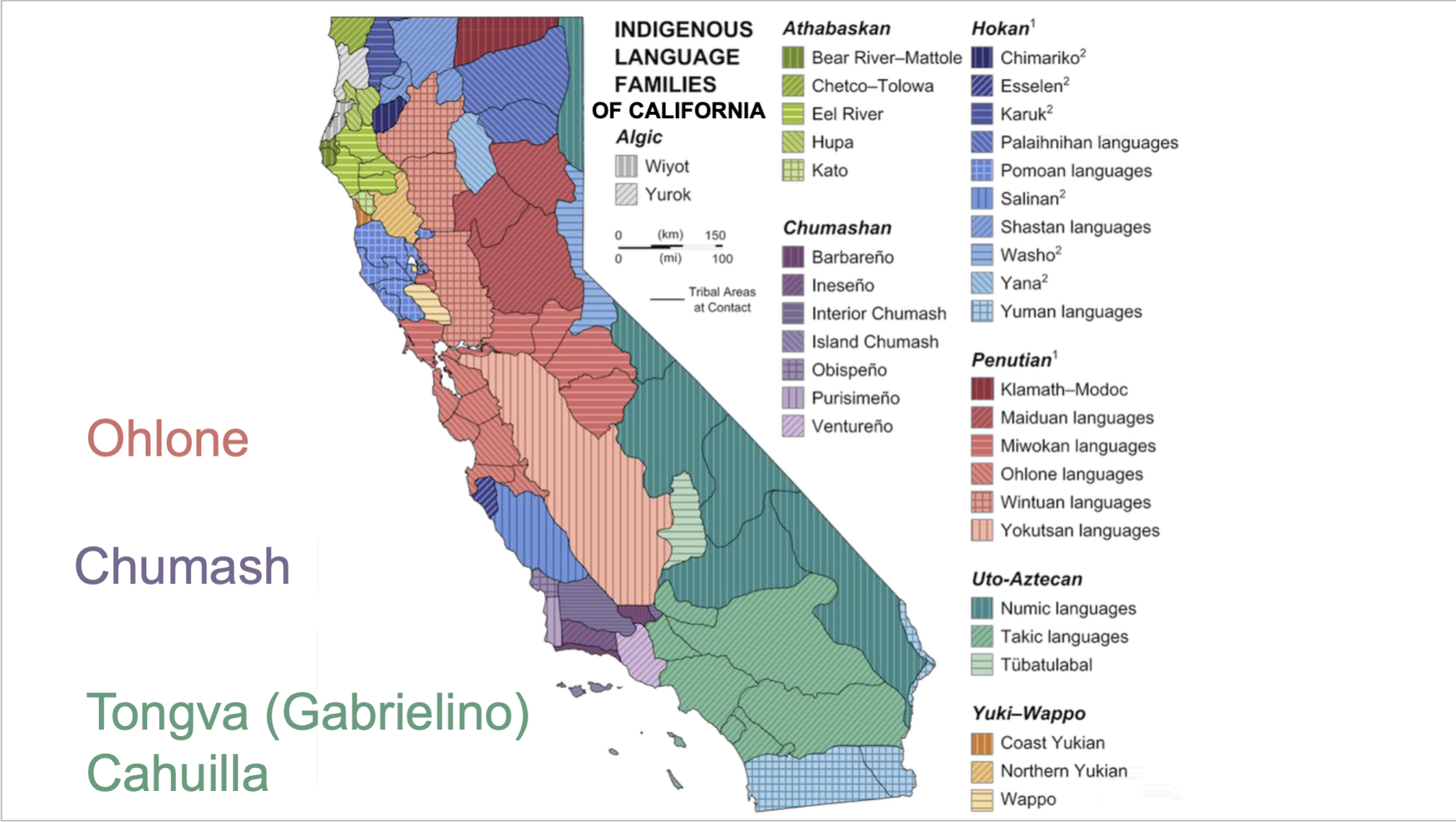
Indigenous Language Families of California
Uto-Aztecan, Athabaskan, Algic, Hokan, Chumashan, Penutian, Yuki–Wappo,
39
New cards
Athanaskan Languages
Hupa, Navajo, Apache
40
New cards
Uto-Aztecan Languages
Aztecan, Nahuatl, Corachol, Taracahitan/Tepiman
41
New cards
Chumash Languages
Obispeño, Barbareño, Purisima, Cuyama, Emigdiano, Ventureño, Cruzeño
42
New cards
Algic Languages
Anishinaabemowin (Ojibwa), Fox, Micmac, Cree, Miami, Shawnee
43
New cards
Iroquoian Languages
Cherokee, Huron, Seneca, Onondaga, Nottoway
44
New cards
US State Names Language Origins
Algonquian, Iroquoian, Uto-Aztecan, Hawaiian, Spanish, French, Latin, etc.
45
New cards
Media Ideologies
People’s beliefs, attitudes, and strategies about the media that they use that function in ways parallel to how language ideologies function. (Media in text messages, vs on socials, vs on email, vs in a handwritten letter)
46
New cards
Counterpublic
Alternative social spaces, discourses, or communities formed by marginalized groups to challenge mainstream narratives, foster solidarity, and articulate their own identities and political interests.
47
New cards
Emic vs Etic
The emic perspective represents the "insider's" viewpoint, while the etic perspective represents the "outsider's" viewpoint. Emic is a category recognized within a community. Etic is a category only recognized by analysis.
48
New cards
Bahasa Gay
Slang or coded languages developed by LGBTQ+ communities in Southeast Asia, most notably in Indonesia and the Philippines. It functions as playful wordplay, a tool for discreet communication, and a way to build community and shared identity.
49
New cards
Polari
Secret slang and coded language historically used in the UK among the queer community, as well as by actors, circus performers, and sailors.
50
New cards
Cryptolect
A specialized variety of language used by a specific subculture or social group. It is deliberately designed to be obscure, misleading, or unintelligible to outsiders, allowing the "in-group" to communicate privately, build solidarity, and maintain group boundaries.