Operating Systems and Scheduling Algorithms Review
 Call Kai
 Learn
Learn Practice Test
 Spaced Repetition
 Match
Match Flashcards
 Knowt Play
1/38

Earn XP
Description and Tags
Practice questions covering process management, CPU scheduling algorithms, memory management, and operating system architectures based on the tutorial notes.
Name | Mastery | Learn | Test | Matching | Spaced | Call with Kai |
|---|
No analytics yet
Send a link to your students to track their progress
39 Terms
What is a process in the context of computer systems?
A process is a program execution that includes the program code, current activity (program counter and processor registers), and the process stack containing temporary data.
What specific temporary data is contained within a process stack?
Function parameters, return addresses, and local variables.
List the five possible states of a process as it executes.
New, Running, Waiting, Ready, and Terminated.
Define each process state
New. The process is being created, Running. Instructions are being executed, Waiting. The process is waiting for some event to occur, Ready. The process is waiting to be assigned to a processor, Terminated. The process has finished execution.
Define the 'Ready' state of a process.
The process is waiting to be assigned to a processor.
CPU scheduling
In a single-processor machine only one process can occupy the CPU at any moment; all other processes must wait until the processor becomes free and can be scheduled again
What components make up a thread?
A thread identifier, a program counter, a set of registers, and its own stack.
What is the role of the dispatcher?
The dispatcher is the component that transfers control of the CPU to the process chosen by the short-term scheduler.
In which four situations do CPU scheduling decisions arise?
A process moves from running to waiting; 2. A process moves from running to ready; 3. A process moves from waiting to ready; 4. A process terminates.
How is the next process chosen in the Shortest Job First (SJF) scheduling algorithm?
The CPU is given to the process whose next CPU burst is the shortest, based on an estimate of duration.
What is the definition of a CPU burst?
The period during which a process executes instructions on the processor without being interrupted for I/O.
Define pre-emption.
The act of forcibly taking the CPU away from a running process before it has finished its current CPU burst.
What are the three main tasks of an operating system?
Accept and execute commands/requests; 2. Load, manage, and execute software; 3. Manage computer hardware resources.
Explain Kennel structures
Operating system (OS) kernels manage system resources and hardware communication. The four main architectures differ in how they organize these essential services, balancing performance, stability, and flexibility. These structures are monolithic, microkernel, hybrid and layered or hierarchal kernels.
Explain each individual kennel structure
Monolithic; all of the OS’s small programs are bundled into one big program which is loaded into one continuous section of memory. Microkernel; use a minimal set of OS functionality with servers outside of the kernel providing extra services. Hybrid: Hybrid kernels try to combine with both monolithic and microkernel architectures. Layered or hierarchal kernels; have different layers handling different functions
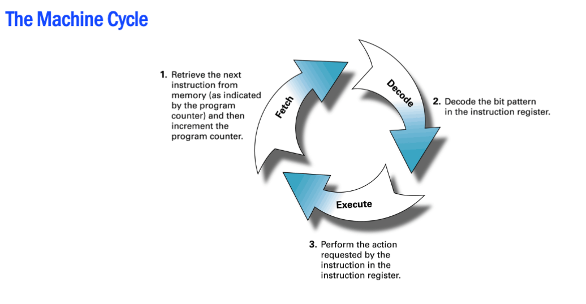
Operating system components
Fetch, Decode, Execute
What is memory latency
The delay caused by waiting for data to load from memory
Name two methods mentioned to fix memory latency issues.
Move necessary data into faster memory (cache and registers); 2. Change the architecture to Harvard architecture.
What is an operating system?
An operating system is a collection of software that acts as an interface between hardware and the user.
Major functionalities of an operating system
- Process management: CPU scheduling
- Memory management: allocation/freeing
- Device management: printer, keyboard
- I/O management: the data movement
- File management: store organisation
- Network management: data communication
What is process and what does the OS do in this?
A program execution is called a process. In case of multiple processes, the operating system OS decides the order in which the processes get access of the processor
Context Switch
Process of storing and restoring the state (context) of a CPU such that multiple processes can share a single CPU resource. Essential feature of a multitasking operating system.
What is main memory and what does the OS do?
Main memory (RAM) is accessed directly by the CPU, a program must be loaded into main memory to execute. The OS manages memory through tracking memory usage and deciding memory acess,
What is the difference between dynamic allocation and deallocation in memory management?
Memory is allocated when a process starts and released when the process finishes.
What is the primary role of the Operating System in device management?
The OS tracks all connected devices(input/output I/O devices), controls access by deciding which process gets a device and for how long, and deallocates devices when they are no longer required.
How do access methods differ between a Keyboard, a Disk, and a Network card?
The keyboard uses character-based input, the disk uses block-based access, and the network card uses packet-based transfer.
How does the operating system manage devices?
Tracks devices, controls access, deallocates devices
Managing multiple I/O devices
Device requests, device coordination, resource release.
What is I/O management and what does the OS do?
I/O (Input/Output) management is the operating system's (OS) process of controlling data exchange between the computer's CPU and hardware (like keyboards, drives, and networks). The OS abstracts complex hardware details to provide a uniform interface for applications to read and write data smoothly.
Describe the 'Interrupt-driven I/O' strategy.
The device notifies the OS when it is ready, characterized by the phrase 'I will tell you when I am ready'.
Device management versus I/O management
Device management manages hardware devices as system resources, whereas I/O management manages the flow of data into and out of the system. Device management tracks device status, whereas I/O management uses polling, interrupts, DMA and buffering.
What is file management and what does the OS do?
A file system organises files into directories for efficient navigation and usage. The operating system manages how files are stored, accessed and protected.
What is network management and what does the OS do?
A computer network connects two or more devices to share and transmit information. When a computer interacts with another computer over a network, the Operating system manages the communication.
What is the 'Direct memory access (DMA)' strategy?
A strategy where the device accesses main memory without CPU intervention.
What is a file in the context of file management?
The smallest addressable unit on the disk.
What is modularity in software design?
The technique of breaking down a complex system or task into separate, independent subtasks or manageable parts called modules.
Why does an OS need modularity?
A single large system is difficult to manage, Hard to debug and maintain, Poor scalability and flexibility
What are the four major components of an Operating System?
Kernel, device drivers, user interface, and System Utilities.
Which operating systems are provided as examples for Monolithic and Hybrid kernels?
Linux is an example of a Monolithic Kernel, and Microsoft windows is an example of a Hybrid Kernel.