AQA GCSE Physics - FORCES (FT)
 Call Kai
 Learn
Learn Practice Test
 Spaced Repetition
 Match
Match Flashcards
 Knowt Play
1/102

There's no tags or description
Looks like no tags are added yet.
Name | Mastery | Learn | Test | Matching | Spaced | Call with Kai |
|---|
No analytics yet
Send a link to your students to track their progress
103 Terms
______ quantities have magnitude only
Scalar
______ quantities have magnitude and an associated direction
Vector
A vector quantity may be represented by an _____
arrow
The length of the vector arrow represents the _________ of the vector quantity
magnitude (size)
The direction of a vector arrow represents the _________ of the vector quantity
direction
A force is a ____ or ____ that acts on an object
push or pull
_______ Forces require objects to be physically touching
Contact
Objects can be physically separated and experience a __________ force
non-contact
Examples of contact forces include ________, air resistance, _______ and normal force
friction, air resistance, tension and normal force
Examples of non-contact forces are gravitational force, _____________ force and magnetic force
gravitational pull, electrostatic force and magnetic force
Force is a ______ quantity
vector
______ is the force acting on an object due to gravity
Weight
The force of gravity close to the _____ is due to the gravitational field around the _____
Earth
The ______ of an object depends on the gravitational field strength at the point where the object is
weight
The equation relating weight and mass is...
Weight = mass x gravity strength (W=mg)
The unit of weight, W
Newtons, N
The unit of mass, m
kilograms, kg
The unit of gravitational field strength, g
Newtons per kilogram, N/kg
The weight of an object may be considered to act at a single point referred to as the object's ______ __ ____
centre of mass
The weight of an object and the mass of an object are ________ ____________
directly proportional
Weight is measured using a ___________
newtonmeter
A number of forces acting on an object may be replaced by a single force that has the same effect as all the forces acting together. This single force is called the _________ _____
resultant force
When a force causes an object to move through a distance ____ is done on the object
work
A force does work on an object when the force causes a ____________ of the object
displacement
The equation for Work Done is...
Weight = Force x distance (W=Fs)
The unit of work done, W
Joules, J
The unit of force, F
Newtons, N
The unit of distance, s
metres, m
One _____ of work is done when a force of one newton causes a displacement of one metre
Joule
1 joule = 1 ______-_____
Newton-metre (1J = 1Nm)
Work done against the frictional forces acting on an object causes a rise in the ___________ of the object
temperature
To change the shape of an object (by stretching, bending or compressing), ____ ____ ___ force has to be applied
more than one
After _______ deformation of an object, it will return to it's original shape
elastic
After _______ deformation of an object, it will NOT return to it's original shape
inelastic
Hooke's Law: The extension (or compression) of an elastic object, such as a spring, is ________ ____________ to the force applied
directly proportional
Hooke's Law only applies to an elastic object provided that the _____ __ _______________ is not exceeded
limit of proportionality
The equation relating force applied to- and extension of an elastic object is...
Force = spring constant x extension (F=ke)
The unit of spring constant, k
Newtons per metre, N/m
The unit of extension (or compression), e
metres, m
A force that stretches (or compresses) a spring does work and _______ _________ energy is stored in the spring
elastic potential
Provided the spring is not inelastically deformed, the work done on the spring and the elastic potential energy stored are _____
equal
The equation relating elastic potential energy stored in- and extension of an elastic object is...

________ is how far an object moves
Distance
Distance is a ______ quantity and so does not involve direction
scalar
Displacement includes both the distance an object moves, in a straight line from A to B, and the _________ of that straight line
direction
Displacement is a ______ quantity
vector
Speed is a scalar quantity and so does not involve _________
direction
The speed of a moving object is ______ constant
rarely
When people walk, run or drive their speed is constantly ________
changing
The speed at which a person can walk, run or cycle depends on many factors including:
age, terrain, fitness and distance travelled
Typical value of walking speed:
̴ 1.5 m/s
Typical value of running speed:
̴ 3 m/s
Typical value of cycling speed:
̴ 6 m/s
It is not only moving objects that have varying speed. The speed of _____ and the speed of the ____ also vary
sound and wind
A typical value for the speed of sound in air is ___m/s
330m/s
The equation relating speed, distance and time is:
distance = speed x time (s=vt)
Unit of speed, v
metres per second, m/s
Unit of time, t
seconds, s
The ________ of an object is its speed in a given direction
velocity
Velocity is a ______ quantity
vector
If an object moves along a straight line, the distance travelled can be represented by a ________-time graph
distance
The _____ of an object can be calculated from the gradient of its distance-time graph
speed
The gradient of a linen a graph can be calculated using:
Gradient = Change in y-axis / change in x-axis
The average acceleration of an object can be calculated using the equation:
acceleration= change in velocity / time taken
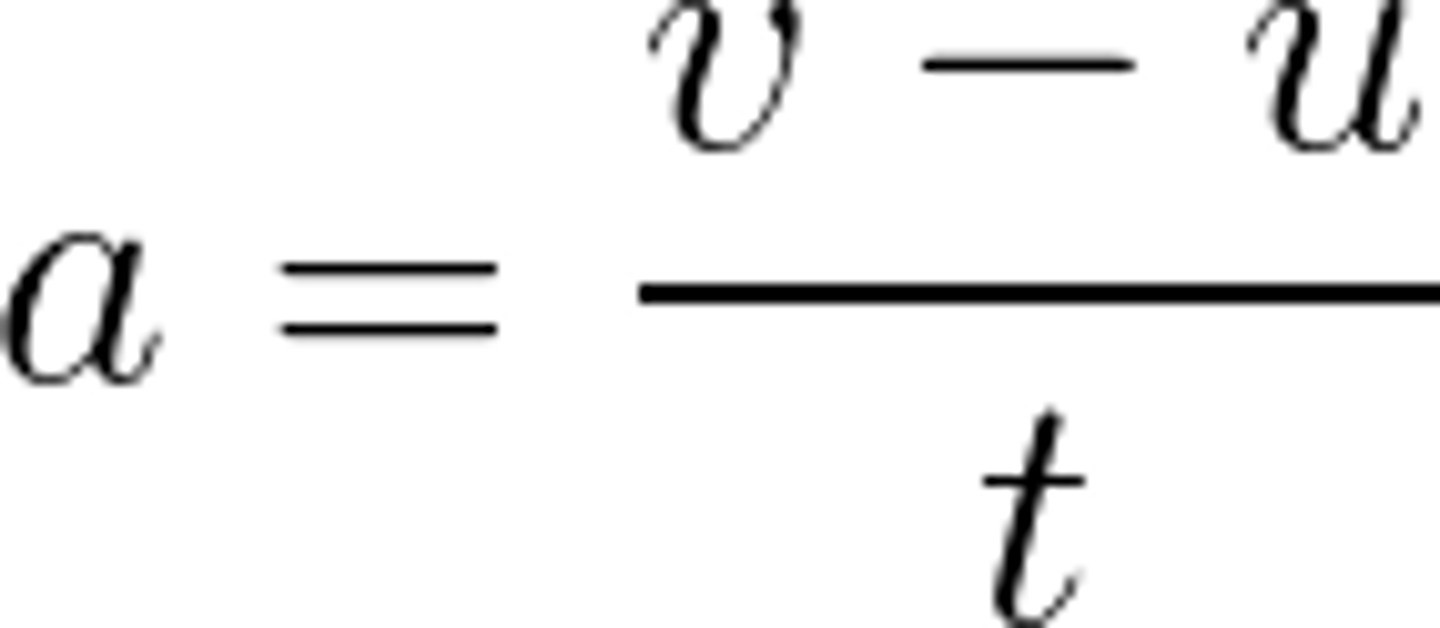
Unit of acceleration, a
metres per second squared

Unit of change in velocity, Δv
metres per second, m/s
An object that slows down is ____________
decelerating
The ____________ of an object can be calculated from the gradient of a velocity-time graph
acceleration
The equation relating constant acceleration, distance and velocity is:

Unit of final velocity, v
metres per second, m/s
Unit of initial velocity, u
metres per second, m/s
Near the Earth's surface any object falling freely under gravity has an acceleration of about ___

An object falling through a fluid initially ___________ due to the force of gravity
accelerates
Eventually the resultant force on a falling object will be zero, and it will move at its ________ ________
terminal velocity
Newton's First Law: If the resultant force acting on an object is zero and the object is stationary, the object _______ __________
remains stationary
An object that travels at in one direction at constant speed has an unchanging ________
An object that travels at in one direction at constant speed has an unchanging velocity
Newton's First Law: If the resultant force acting on an object is zero and the object is moving, the object continues to move at ________ ________
constant velocity
When a vehicle travels at a steady speed the resistive forces balance the _______ force
driving
The velocity (speed and/or direction) of an object will ONLY change if a _________ force is acting on it
resultant
Newton's Second Law: The acceleration of an object is ____________ to the resultant force acting on the object
proportional
Newton's Second Law: The acceleration of an object is inversely proportional to the ____ of the object
mass
Newton's Second Law: The greater the resultant force on an object, the _______ the acceleration of the object
greater
Newton's Second Law: The greater the mass of an object, the _______ the acceleration of the object
smaller
symbol for proportionality

The equation for Newton's Second Law:
Resultant Force = mass x acceleration (F=ma)
Symbol that indicates an approximate value is

Newton's Third Law: Whenever two objects interact, the forces they exert on each other are _____ and ________
equal and opposite
The stopping distance of a vehicle is the sum of the ________ distance and the _______ distance
thinking and braking
Thinking distance is the distance travelled during the driver's ________ ____
reaction time
Braking distance is the distance travelled while _______
braking
For a given braking force the greater the _____ of the vehicle, the greater the stopping distance
speed
Reaction times vary from person to person. Typical values range from ___s to ___s
0.2s to 0.9s
A driver's reaction time can be affected by _________, _____ and _______
tiredness, drugs and alcohol
____________ may also affect a driver's ability to react
Distractions
The _______ distance of a vehicle can be affected by adverse road and weather conditions and poor condition of the vehicle
braking
Adverse road conditions include ___ or ___ conditions
wet or icy ONLY
Poor condition of the vehicle is limited to the vehicle's _____ or _____
brakes or tyres
When a force is applied to the brakes of a vehicle, work is done by the ________ force between the brakes and the wheel
friction
When a force is applied to the brakes of a vehicle, work done by the friction force between the brakes and the wheel reduces the ______ energy of the vehicle
kinetic
When a force is applied to the brakes of a vehicle, work done by the friction force between the brakes and the wheel reduces the kinetic energy of the vehicle and the ___________ of the brakes increases
temperature