SOA Exam FM Master Review Flashcards
 Call Kai
 Learn
Learn Practice Test
 Spaced Repetition
 Match
Match Flashcards
 Knowt Play
 Podcast
1/38

Earn XP
Description and Tags
A comprehensive set of vocabulary flashcards covering interest theory, annuities, loans, bonds, duration, and immunization for the SOA Exam FM.
Name | Mastery | Learn | Test | Matching | Spaced | Call with Kai |
|---|
No analytics yet
Send a link to your students to track their progress
39 Terms
Effective Rate per Period (Nominal Rate Trick)
For a nominal rate i(m), the effective rate per period is expressed as i(m)/m, not i(m).
Accumulation Function
Simple Interest
</p><p>a(t)=1+it</p><p>
Compound Interest
</p><p>a(t)=(1+i)t</p><p>
Force of Interest
</p><p>a(t)=eδt</p><p>
Discount Function
</p><p>v(t)=a(t)1</p><p>
Accumulation Factor from Time \(s\) to Time \(t\)
</p><p>a(s)a(t)</p><p>
Discount Factor from Time \(t\) to Time \(s\)
</p><p>a(t)a(s)</p><p>
Interest Earned During Year \(n\)
</p><p>In=a(n)−a(n−1)</p><p>
Effective Interest Rate During Year \(n\)
</p><p>in=a(n−1)a(n)−a(n−1)</p><p>
Effective Discount Rate During Year \(n\)
</p><p>dn=a(n)a(n)−a(n−1)</p><p>
Relationship Between Effective Interest and Effective Discount
</p><p>d=1+ii</p><p>
</p><p>i=1−dd</p><p>
\section*{Special Case: Simple Interest}
Accumulation Function
</p><p>a(t)=1+it</p><p>
Interest Earned During Any Year
</p><p>In=i</p><p>
Effective Interest Rate During Year \(n\)
</p><p>in=1+i(n−1)i</p><p>
Effective Discount Rate During Year \(n\)
</p><p>dn=1+ini</p><p>
\section*{Special Case: Compound Interest}
Accumulation Function
</p><p>a(t)=(1+i)t</p><p>
Interest Earned During Year \(n\)
</p><p>In=i(1+i)n−1</p><p>
Effective Interest Rate During Every Year
</p><p>in=i</p><p>
Effective Discount Rate During Every Year
</p><p>dn=d=1+ii</p><p>
\section*{Force of Interest Relationships}
Accumulation Function
</p><p>a(t)=eδt</p><p>
Discount Function
</p><p>v(t)=e−δt</p><p>
Convert Force to Effective Interest
</p><p>i=eδ−1</p><p>
Convert Effective Interest to Force
</p><p>δ=ln(1+i)</p><p>
Accumulation Over \(t\) Years Using Force
</p><p>(1+i)t=eδt</p><p>
\section*{Useful FM Facts}
Present Value at Time 0 of Amount \(A\) at Time \(t\)
</p><p>PV=Av(t)</p><p>
Future Value at Time \(t\) of Amount \(A\) at Time 0
</p><p>FV=Aa(t)</p><p>
Accumulation Function Must Satisfy
</p><p>a(0)=1</p><p>
For Compound Interest
</p><p>a(t+s)=a(t)a(s)</p><p>
For Simple Interest
</p><p>a(t+s)=a(t)a(s)</p><p>
Force of Interest Accumulation Factor
This is one of the highest-yield FM topics because it ties together accumulation functions, interest rates, discount rates, and calculus.
Here's the version I'd put in a cheat sheet.
Force of Interest ((\delta))What does Force of Interest represent?
The force of interest is the instantaneous rate of growth of an investment.
Think of it as:
"If I zoom in to an infinitely small moment in time, how fast is the account growing right now?"
For compound interest:
<br>δ=ln(1+i)<br>
For example, if
<br>i=8
then
<br>δ=ln(1.08)=0.07696<br>
Notice:
\delta<i
Definition of Force of Interest
Given an accumulation function (a(t)),
<br><br>δt=a(t)a′(t)<br><br>
Interpretation:
Numerator = rate of change
Denominator = current balance
So force of interest is:
<br>current balancegrowth per year<br>
The Most Important Formula
Starting with
<br>δt=a(t)a′(t)<br>
we get
<br>a′(t)=δta(t)<br>
Integrating:
<br><br>a(t)=e∫0tδs,ds<br><br>
This is the master formula.
Whenever FM gives a force of interest, your first thought should be:
Integrate (\delta), then exponentiate.
Constant Force of Interest
If
<br>δt=δ<br>
is constant:
<br>a(t)=eδt<br>
This is the continuous-compounding formula.
Relationship Between (i), (d), and (\delta)
Given force:
<br>i=eδ−1<br>
<br>d=1−e−δ<br>
Given effective interest:
<br>δ=ln(1+i)<br>
Given effective discount:
<br>δ=−ln(1−d)<br>
Quick Conversion Triangle
Starting with (i):
<br>d=1+ii<br>
<br>δ=ln(1+i)<br>
Starting with (d):
<br>i=1−dd<br>
<br>δ=−ln(1−d)<br>
Starting with (\delta):
<br>i=eδ−1<br>
<br>d=1−e−δ<br>
Discount Function
If
<br>a(t)=e∫0tδsds<br>
then
<br>v(t)=a(t)1<br>
Therefore
<br><br>v(t)=e−∫0tδsds<br><br>
For constant force:
<br>v(t)=e−δt<br>
Effective Interest Rate During Year (n)
If force varies with time:
<br>in=<br><a(n)−a(n−1)br>a(n−1)<br>
Using force:
<br><br>in=<br>e∫n−1nδtdt−1<br><br>
This shortcut appears often on FM.
Effective Discount Rate During Year (n)
<br>dn=<br><a(n)−a(n−1)br>a(n)<br>
Using force:
<br><br>dn=<br>1−e−∫n−1nδtdt<br><br>
Simple Interest and Force
Simple interest:
<br>a(t)=1+it<br>
Differentiate:
<br>a′(t)=i<br>
Thus
<br>δt=<br>1+iti<br>
Key Understanding
Simple interest does NOT have a constant force.
Instead:
<br><br>δt=<br>1+iti<br><br>
which decreases over time.
Example:
<br>i=8
At (t=0):
<br>δ0=0.08<br>
At (t=5):
<br>δ5=<br>1.40.08</p><p>0.0571<br>
Force gets smaller as time passes.
Compound Interest and Force
Compound interest:
<br>a(t)=(1+i)t<br>
Differentiate:
<br>a′(t)=<br>(1+i)tln(1+i)<br>
Thus
<br>δt=<br>ln(1+i)<br>
which is constant.
Therefore:
<br><br>δ=ln(1+i)<br><br>
Deriving (a(t)) from Force Quickly
When given (\delta_t):
Step 1
Integrate
<br>∫0tδsds<br>
Step 2
Exponentiate
<br>a(t)=e∫0tδsds<br>
Step 3
Simplify
Example:
<br>δt=10+t2<br>
Integrate:
<br>∫0t10+s2ds</p><p>2ln(1010+t)<br>
Exponentiate:
<br>a(t)</p><p>e2ln((10+t)/10)<br>
<br><br>a(t)=(1010+t)2<br><br>
FM Shortcut for Finding (a(t))
When you see
<br>δt=<br>a+btk<br>
immediately think
<br>∫a+btkdt</p><p>bkln(a+bt)<br>
and therefore
<br>a(t)</p><p>(aa+bt)k/b<br>
This pattern appears repeatedly on FM.
Three Facts to MemorizeConstant force
<br>a(t)=eδt<br>
Simple interest
<br>δt=1+iti<br>
Compound interest
<br>δ=ln(1+i)<br>
If you know those three formulas plus
<br>a(t)=e∫0tδsds,<br>
you can solve essentially every FM force-of-interest problem.
Annuity-Immediate
Payments of 1 at the end of each period for n periods, with PV=an∣=(1−vn)/i.
Annuity-Due
Payments at the beginning of each period, where a¨n∣=(1+i)an∣.
Deferred Annuity (k∣an∣)
An annuity valued at time k and then discounted back k periods using vk⋅an∣.
Perpetuity
Immediate: An annuity with payments continuing forever, with a present value of 1/i.
Due: An annuity with payments continuing forever starting at time 0, with a present value of 1/d.
Geometric: A perpetuity where payments grow by rate g each period, valid if g < i, with a value of 1/(i−g).
Increasing Arithmetic
Decreasing Arithmetic
Increasing Annuity-Immediate (Ian∣)
An annuity with payments of 1,2,3,…,n ; valued as Ia=(a¨n∣−nvn)/i.
Decreasing Annuity-Immediate (Dan∣)
An annuity with payments of n,n−1,…,1; valued as (n−an∣)/i.
Arithmetic Identity
(Ia)n∣+(Da)n∣=(n+1)an∣
Continuous Level Annuity
The present value (PV) of receiving $1 per year continuously for n years is defined as:
an∣=lim_m→∞a_n∥(m)=δ1−vn =δi⋅i1−vn=δia_n∥.
The accumulated value (AV) for the same annuity is described as:
s_n∥=a_n∥(1+i)n =δ1(a_n∥(1+i)n)=s_n∥.
Varying Continuous Annuity
The present value (PV) of a continuous annuity with varying payment rate f(t) and force of interest δt is defined as:
PV=∫0nf(t)exp(−∫0tδsds)dt.
The accumulated value (AV) is given by:
AV=∫0nf(t)exp(∫tnδsds)dt.
If f(t)=t for a continuous increasing annuity:
(Ia)n∣=∫0ntvtdt=δan∣−nvn.
(Is)n∣=∫0nt(1+i)n−tdt=(Ia)n∣(1+i)n.
(Ia)∞=δ21.
For a continuous decreasing annuity where f(t)=n−t:
(Da)n∣=∫0n(n−t)vtdt=δn−an∣.
(Ds)n∣=∫0n(n−t)(1+i)n−tdt=(Da)n∣(1+i)n
Prospective Outstanding Balance (OBk)
The present value of remaining payments: PMT⋅an−k∣.
Retrospective Outstanding Balance (OBk)
The accumulated value of the loan minus the accumulated value of payments: L(1+i)k−PMT⋅sk∣.
Sinking Fund Method
A loan repayment method where the borrower pays interest to the lender and separately accumulates a fund at rate j to repay the principal in one lump sum.
IRR (Internal Rate of Return)
The interest rate r∗ that sets the Net Present Value (NPV) of a cash flow stream to zero.
Dollar-Weighted Rate of Return (DWRR)
The rate of return equivalent to the IRR on a fund, which is affected by the timing and size of external cash flows.
Time-Weighted Rate of Return (TWRR)
A measure of a fund manager's performance that eliminates the effect of external cash flows by chain-linking sub-period returns.
Par Bond
A bond where the coupon rate r equals the yield rate i, resulting in the Price P equaling the Redemption Value C.
Premium Bond
A bond where the coupon rate r is greater than the yield rate i (r>i), resulting in a Price P>C.
Discount Bond
A bond where the coupon rate r is less than the yield rate i (r<i), resulting in a Price P<C.
Premium/Discount Formula
P=C+(Fr−Ci)an∣
Makeham Formula
P=K+ig(C−K), where K=Cvn and g=Fr/C.
Callable Bond Pricing
The process of pricing a bond at every possible call date and selecting the minimum price to account for the worst-case yield.
Spot Rate (st)
The effective annual rate for an investment made from time 0 to time t.
Forward Rate (ft,m)
The rate agreed upon today for lending that occurs from time t to time t+m.
No-Arbitrage Relationship
(1+st+m)t+m=(1+st)t⋅(1+ft,m)m
Macaulay Duration (D_Mac)
Macaulay Duration (MacD) is a measure of the average time until cash flows from a financial asset are received, weighted by the present value of those cash flows. Mathematically, it is defined as:
MacD=P∑tA_t=−P_δdδdP_δ
where:
P = price of the asset
A_t = present value of the cash flow at time t
Interpretation:
MacD represents the average time at which cash flows occur, considering their present value.
If there is only one cash flow, then: MacD=time until that cash flow occurs
A bond with higher coupon payments tends to have a shorter MacD.
A bond with a higher yield also tends to have a shorter MacD.
Par Bond Shortcut: If a bond is priced at par, MacD can be approximated as:
MacD=a¨_n∥(m)−m1a_n∥mj
where:
j=mi(m) is the effective interest rate per period.
m = number of coupon payments per year.
Important Note:
The par value of the bond does not influence MacD.
If not specified, it is common to use a par value of 100.
Duration of a Portfolio: The MacD for a portfolio of multiple assets is defined as:
MacD_P=P_1+P_2+⋯+P_nP_1MacD_1+P_2MacD_2+⋯+P_nMacD_n
where:
P_i = market price of asset i
MacD_i = MacD of asset i
Approximation Using Macaulay Duration: The future price of a bond can be approximated as:
P_i_1≈P_i_0(1+n_11+n_0)MacD
where:
P_i_0 = price at the original effective annual yield i_0
P_i_1 = price at the new effective annual yield i_1
Notes:
It is crucial to express interest rates as effective annual rates since MacD is measured in years.
Using MacD provides a better price approximation compared to Modified Duration when cash flows are positive.
FM Memory Box: Macaulay Duration = weighted average time of cash flows
To remember this concept, think of: MacD=PriceTime-Weighted PV of Cash Flows
Quick Facts:
Higher coupon rate ⟹ Lower Duration
Higher yield ⟹ Lower Duration
Zero-coupon bond ⟹ MacD = maturity
Portfolio duration = weighted average of component durations
The par bond shortcut is a key concept in financial mathematics
MacD is measured in years
Modified Duration (DMod)
Modified Duration (ModD) quantifies a bond's price sensitivity to changes in yield. It is mathematically defined by:
ModD=−P1didP
where:
P = price of the bond,
dP = change in price due to yield change,
di = change in yield.
Interpretation: This formula allows us to approximate the percentage change in price for small changes in yield:
PΔP≈−ModD⋅Δi
A larger ModD indicates greater sensitivity to interest rate fluctuations.
ModD serves as the slope of the price-yield curve, illustrating the inverse relationship between interest rates and bond prices.
Relationship Between Modified Duration and Macaulay Duration:
The relationship can be expressed as:
ModD=v⋅MacD=1+iMacD
where:
v=1+i1 is the present value factor.
Equivalently, Macaulay Duration (MacD) can be expressed as:
MacD=(1+i)ModD
Macaulay Duration (MacD):
Macaulay Duration is defined as:
MacD=P∑tAt=−PδdδdPδ
Interpretation:
MacD represents the weighted average time until cash flows are received, measured in years.
For a single cash flow, it simplifies to:
MacD=time until that cash flow occurs
For zero-coupon bonds:
MacD=maturity
Higher coupon bonds generally exhibit shorter MacD values, as do bonds with higher yields.
Approximating Bond Prices Using MacD:
To approximate bond prices when yields are expressed as effective annual rates:
Pi1≈Pi0(1+i11+i0)MacD
where:
Pi0 = price at yield i0
Pi1 = price at yield i1.
When to Use ModD:
Utilize ModD when you need:
An approximate percentage change in price due to small yield changes,
To assess the sensitivity of the bond price to interest rate changes,
An answer to questions regarding price sensitivity:
PΔP or "How sensitive is price to yield?"
When to Use MacD:
Opt for MacD when:
You are analyzing the average timing of cash flows,
Engaging in duration matching or immunization strategies,
Approximating bond prices with:
Pi1≈Pi0(1+i11+i0)MacD,
Considering interest rates expressed as effective annual yields.
FM Memory Box:
MacD=Weighted Average Time
$$ Mod
Convexity (C)
A measure of the curvature of the price-yield curve, calculated as C=P1dt2d2P=P1∑(1+i)tt(t+m1)vt+2⋅CFt=P1∑(1+i)tt(t+m1)v2⋅PV(CFt).
Convexity (C) measures the sensitivity of the duration of a bond to changes in interest rate, indicating how the price of a bond changes as interest rates fluctuate (second derivative of Price formula).
Where:
C = Convexity
P = Price of the bond
t = Time period
CFt = Cash flow at time t
i = Yield to maturity
v = Present value factor, calculated as v=1+i1.
Redington Immunization
A strategy to protect against small parallel yield shifts by matching PV of assets and liabilities, matching durations, and ensuring Asset Convexity > Liability Convexity.
Full Immunization
A strategy that protects against any single yield shift by requiring asset cash flows to bracket liability cash flows (one before, one after).
Portfolio Yield Method
A method where new investments earn the same rate as the existing portfolio average.
New Money Method
Also known as the investment year method; new investments earn a rate based on current market conditions, tracked separately by cohort.
Zero-Coupon Bond Cheat Sheet
Definition: A zero-coupon bond pays:
✅ No coupons
✅ One payment at maturity
Key Formulas:
Price: P=Cvn
Duration: D=n
Yield: i=PC1/n−1
Book Value: BVt=Cv−(n−t)
Properties:
Highest duration for a given maturity.
Most price sensitive to interest rate changes.
No reinvestment risk.
Highest convexity.
Ideal for immunization strategies.
FM Exam Clues: Remember these facts for zero-coupon bonds:
One payment only
Duration = Maturity
Highest duration
Highest interest-rate sensitivity.
Interest Rate Behavior
Connection with Bond Prices:
When interest rates fall, bond prices increase.
Long-term bonds are more sensitive to interest rate changes than short-term bonds because they have a higher duration.
Low-interest-rate bonds benefit more in percentage terms when rates drop.
In a falling rate environment, the bond that offers the most price sensitivity maximizes profit opportunity.
Common Linh’s mistake
Duration:
First payment at time 0 as will be multiplied by 0!
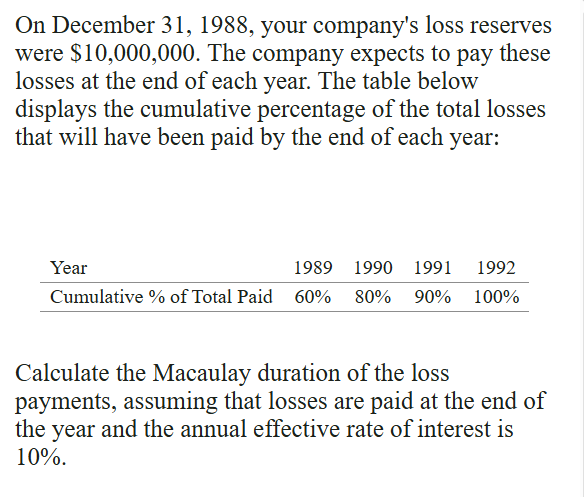
whenever you see a cumulative loss payment pattern, immediately convert it to incremental payments by taking differences between consecutive cumulative percentage
Special Case: Simple Interest
Accumulation Function: a(t)=1+it. The interest earned during any year is given by In=i and the effective interest rate during year n is in=1+i(n−1)i. Effective discount rate during year n is dn=1+ini.
Special Case: Compound Interest
Accumulation Function: a(t)=(1+i)t. The interest earned during year n is given by In=i(1+i)n−1, and the effective interest rate during every year is in=i. The effective discount rate during every year is dn=d=1+ii.