Lectures 15, 16, 17 (memory and sleep)
 Call Kai
 Learn
Learn Practice Test
 Spaced Repetition
 Match
Match Flashcards
 Knowt Play
1/21

Earn XP
Description and Tags
I only finsihd lect 15
Name | Mastery | Learn | Test | Matching | Spaced | Call with Kai |
|---|
No analytics yet
Send a link to your students to track their progress
22 Terms
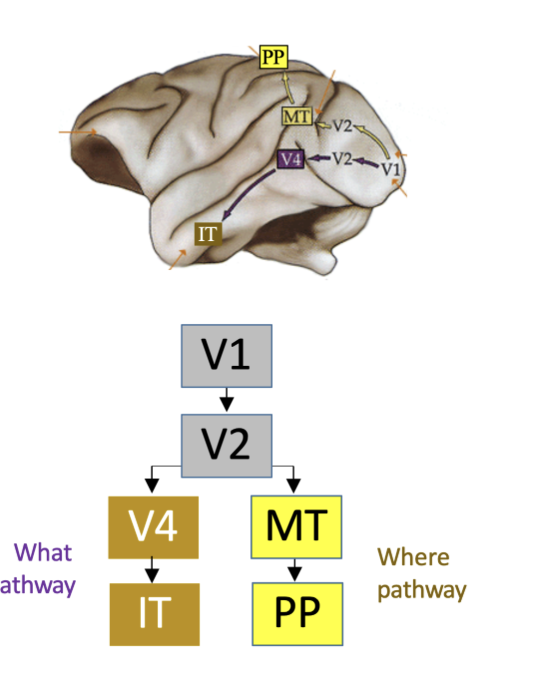
visual streams in the primate brain
V1 + V2 are primary and secondary visual cortex in the occipital lobe
dorsal/back stream - where?
MT is the medial temporal area (also called V5) near the border of the temporal and parietal lobes
PP is the posterior parietal area (behind the primary somatosensory cortex in the parietal lobe)
ventral/front stream - what?
V4 = associational visual cortex lying near the border of occipital and temporal cortex
IT is the inferior temporal cortex
Hippocampus
location = a small, seahorse shaped structured located deep wtihin the medial temporal lobe
function = the brain’s memory indexer,
primary job = convert STM into LTM, also acts as personal internal GPS, playing a vital role in spatial navigation and help you map our your physical environ
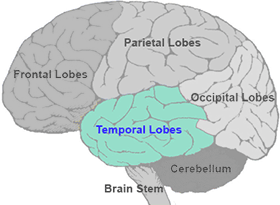
temporal lobes
location = positioned on both sides of the brain, just beneath your temples and near your ears
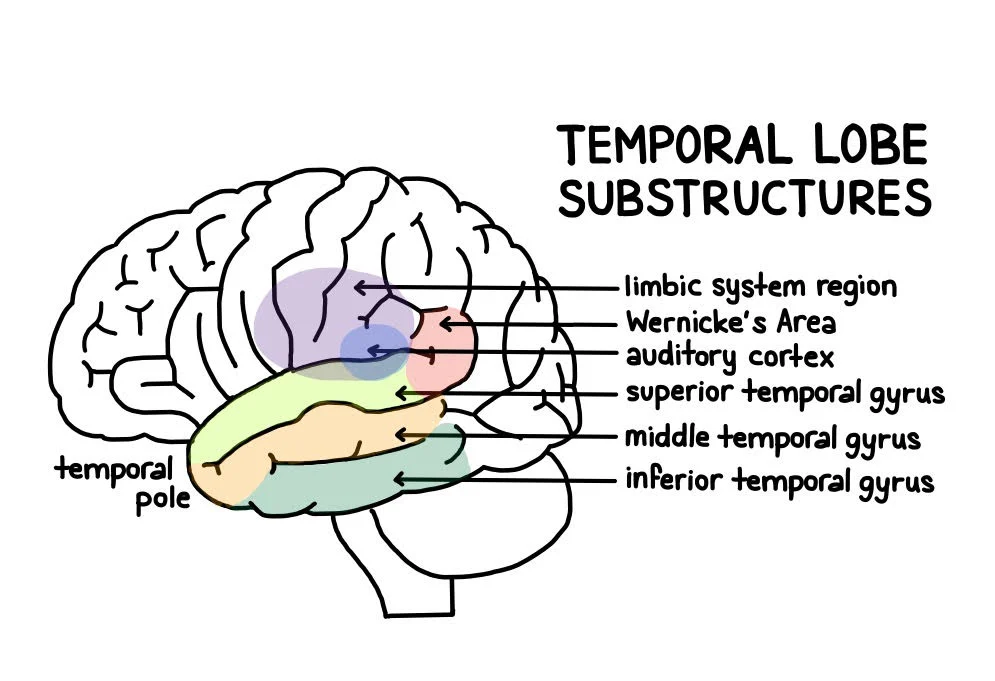
fucnt = create and preserve conscious, long-term memories (workign closely with the hippocampus). they are also the command centers for processing auditory info (like recognizing speech and sounds), lang comprehension, and obj/facial recognition
includes
primary auditory cortex (superior temporal gyrus)
wernickes area = processes and interprets the meaning of spoken and written lang
inferior and middle temporal gyri
fusiform gyrus = specialized for facial recognition and distinguish fine detials btw similar objs
medial temporal lobe (includes hippocampus and amygdala)
parietal lobes
location = the top-middle and upper back sectin of the brain, behind teh frontal lobes
func = process sensory info from the body, they interpret touch, temp, pressure, and pain, also handle spatial awareness, helping your brian to judgge distances and understand where your body is in relation to surroudning objs
primary somatosensory cortex (postcentral gyrus) - nociception
somatosensory association cortex - integrates raw sensations iwth memories to recognize objects by feel without seeing them
superior parietal lobe - handles spatial orientation, body awareness, and tracking the location of objects in physical space.
inferior parietal lobe - auditory, visual, and somatosensory inputs for reading, math, and lang comprehension
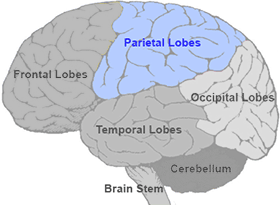
“lobes”
def = major segments of brain
greek word - lobos, meaning a rounded, protruding part, or vegetable pod — historically used to describe any rounded organ segment, like an earlobe.
occipital lobes
location = at the very back of the brain, behind the temporal and parietal lobes
function = visual processing center of the brain, takes the raw signals transmitted by your eyes and translates them into meaningufl information — allowing you to perceive shapes, colors, movments, and distances.
also works coorperatively with the temporal lobe to help you read and recognize text
inlcudes
primary visual cortex (V1/striate cortex) = Located at the extreme back tip. It receives raw visual data from the retinas via the optic nerve to map basic edges, lines, and orientations.
Secondary Visual Cortex (V2, V3, V4 / Extrastriate Cortex): Surrounds the primary visual area. It processes intermediate visual traits like color depth, complex shapes, and binocular disparity.
Visual Area 5 (V5 / MT): Located near the junction with the temporal lobe. It specializes exclusively in detecting the speed and direction of moving visual objects.
frontal lobes
location = at the very front of the brain , right behidn your forehead
funct = executive center, manages high-level cog skills like decision-making, prob solving, long term planning, and emptional control.
also houses the primary motor cortex, which controls voluntary body movements
includes
Prefrontal Cortex (PFC): Located at the very front. It manages working memory, complex planning, personality expression, decision-making, and social behavior.
Primary Motor Cortex (Precentral Gyrus): A strip at the back border of the frontal lobe. It controls voluntary movements of specific skeletal muscles across the body.
Premotor Cortex and Supplementary Motor Area: Situated just in front of the primary motor cortex. They plan, sequence, and prepare complex movement chains before execution.
Broca’s Area: Located in the lower left frontal lobe (in most people). It manages the motor actions required for speech production and grammatical structure.
Frontal Eye Fields: Located in the middle frontal region. They control voluntary visual tracking and rapid, synchronized eye movements.
the brain stem
funct = survival center of hte body, automates life-sustaining involuntary functions, like heart rae, breathing, blood pressure, swallow, sleep cycles.
cerebellum
location - a separate, highly folded structure nestled underneath the back of the cerebrum,
name = little brain
fucnt = brains coordination engine. does not initiate movement, but it fine tunes your balance, posture, equillibrium, and compelx motor tracking, like chatching a ball or play an instrument
declarative memory
what
memory for facts and past events acquired through learning that can be stated or described in words (thngs we are consicously aware of knowing and remembering
discrepent, you cant recall when and where you learned X
like knowing paris is the captial of france
non-declarative (procedureal memory)
how
shown by performance rather than consicuos recollection (things we may not be aware we have leanred)
eg, ride bike, driving
do animals have declarative memroy?
yes,
primates = early studies showed that primates were impaired in a delayed-nonmatch-to-sample (DNMS) memory task
rodents = early attempts at findign hippocampus memroy impoariemtns in rats were not successful
rodent hippocampus and the neural GPS
rat hippocampus stores cognitve maps of spatial environments
hippocampus and enetorihinal cortex contain pops of spatially tuned neurons such as place, grid, and border cells
in rats, hippocampus occupies a larger proportion of total brain volume, bc rats have smaller cerebral cortex
cerebral cortex
the thin, highly folded outer layer of gray matter that covers the entire surface of the cerebrum.
“gray matter”
the brain's ultimate control and information-processing center, managing everything that makes us human—including conscious thought, memory, language, reasoning, and voluntary movement
Gyri and Sulci: The cortex is packed with folds. The ridges or bumps are called gyri (singular: gyrus), and the grooves or valleys between them are called sulci (singular: sulcus). This folding triples the brain's surface area, allowing a massive number of neurons to fit inside the skull
function = processing info, computation, and decision making
process sensoru input
generate motor commands
higher cognition
corpus callosum
a massive, thick band of nerve fibers located deep in the center of the brain that acts as the primary communication bridge between the left and right cerebral hemispheres
largest collection of white matter in the entire brain, containing more than 200 million axons (the "wires" of the nervous system).
Interhemispheric Communication: It continuously transmits electrical signals back and forth between the left and right sides of the brain.
Information Integration: It ensures that what your left hand is doing coordinates perfectly with your right hand, and that the visual data from your left eye blends seamlessly with data from your right eye.
Unified Consciousness: It allows the two distinct halves of your brain to work together as a single, harmonious unit.
thalamus
a large, egg-shaped mass of gray matter. You have two of them—one in each hemisphere.
funct. = central sorting and relay station for nearly all information flowing into the brain
also relays motor signals from the cerebellum to the cortex to smooth out movement, and it plays a major role in regulating consciousness, sleep, and alertness.
hypothalamus
below the thalamus
size of almond
fucnt = homeostasis = keeping the bodys internal environment stable, balanced, alive
The Master Regulator: It directly controls the autonomic nervous system and dictates involuntary survival drives. It regulates:
Body temperature (acting as your internal thermostat)
Hunger, thirst, and satiety
Sleep-wake cycles (circadian rhythms)
Heart rate and blood pressure
The Link to the Endocrine System: The hypothalamus bridges the nervous system and the hormone system. It sits right above the pituitary gland(the master gland) and sends chemical signals telling it when to release hormones that control growth, metabolism, and stress responses (like adrenaline
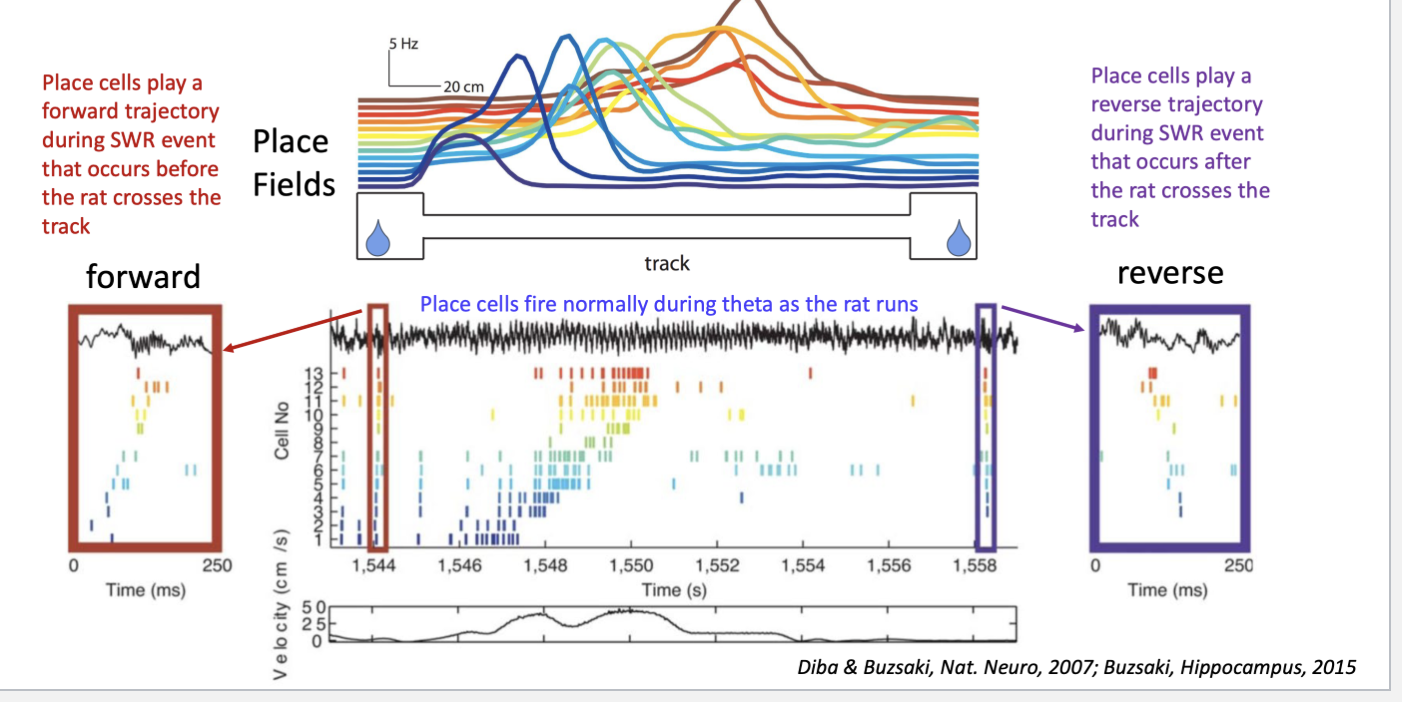
hippocampal place cell s
fires when the rat visits a preferred location, called the cell’s place field
bursts at theta rhytem (8Hz )
firing rate maps are often plotted as colored heat maps with hote colors = high firing
this cell seems to store a kind of “mem” that may allow the rat to recognize this specific familiar location every time it is visited (familiarity)
even distribution of field centeres of place cell s
preferred firing locations aren’t topographically organized == place cells that are near each other in the brain are not more likely to have place fields that are close in the environ
rats use their hippocampal place cells to sovle spatial memory tasks == the Morris water maze
rats with hippocampal lesions are impaired at learning to find teh hidden platform int eh water
2 ways to know where you are
where am i w respect to knonw external landmarks?
where (in visual field)
what (which buildings0
where am i w respect to where i know i used to be?
Hippocampal compressed replay during SWR events