PD E2- Neuro
 Call Kai
 Learn
Learn Practice Test
 Spaced Repetition
 Match
Match Flashcards
 Knowt Play
1/167

There's no tags or description
Looks like no tags are added yet.
Name | Mastery | Learn | Test | Matching | Spaced | Call with Kai | Chat |
|---|
No analytics yet
Send a link to your students to track their progress
168 Terms
What is the inability to initiate movement?
Akinesia
What is the inability to remain motionless?
Akathisia
What is a slight or incomplete paralysis (weakness)?
Paresis
What is a loss or impairment of motor function (paralysis)?
Plegia
What is loss or impairment of one side of the body?
Hemiplegia/hemiparesis
What is loss or impairment of the legs and lower body?
Paraplegia/paraperesis
What is loss of impairment of all four limbs?
Quadriplegia/quadriparesis
What is the progressive degeneration and shrinkage of muscle and/or nerve tissue?
Atrophy
What is the enlargement of an organ or part due to an increase in size of its constituent cells?
Hypertrophy
What is an increase in size without true hypertrophy?
Pseudohypertrophy
What is hypertonicity w/ inc DTRs?
Spasticity
What is stiffness or inflexibility?
Rigidity
What is loss of tone w/ diminished DTRs?
Flaccidity
What are extrapyramidal abnormal movements, as seen in Parkinsons?
Tremor- rest, pill rolling
Rigidity- lead pipe, cogwheel
Akinesia/bradykinesia
Postural instability
What are brief, repetitive, stereotyped, coordinated movements occurring at irregular intervals that can be caused by Tourette’s syndrome or drugs (phenothiazines, amphetamines)?
Tics
What are unpredictable, brief, rapid, jerky, irregular movements that occur at rest or interrupt normal coordinated movements and seldom repeat themselves, and are associated with Sydenham’s chorea and Huntington’s?
Chorea
What body parts are often involved in Chorea?
face, head, lower arms, hands
What are slower movements that are more twisting and writhing and have a larger amplitude; often associated with spasticity and cerebral palsy?
Athetosis
What body parts does athetosis most commonly involve?
face & distal extremities
What are movements similar to athetoid but involve larger portions of the body (trunk) that can result in grotesque twisted posture and can be caused by spasmodic torticollis, primary torsion dystonia, and phenothiazines?
Dystonia
What abnormal thought process involves indirection and delay in reaching a point because of unnecessary detail?
Circumstantial
What is it called when a person shifts from one unrelated subject to another?
Loose associations
What is it called when thought process is almost continuous flow of accelerated speech with abrupt topic changes?
Flight of ideas
What is incomprehensible speech because of illogic, lack of meaningful connections, abrupt topic changes, or disordered word use/grammar?
Incoherence
What is fabrication of facts of events to fill in gaps in impaired memory?
Confabulation
What is the persistent repetition of words or ideas?
Perseveration
What is the repetition of words or phrases of others?
Echolalia
What are invented or distorted words?
Neologisms
What is the sudden interruption in mid sentence or before completion of an idea?
Blocking
What is it called when a person chooses a word based on sound instead of meaning?
Clanging
What are recurrent, uncontrollable thoughts, images, or impulses that a persons considers unacceptable or strange?
Obsessions
What are repetitive acts that a person feels driven to perform to prevent or produce some unrealistic future state of affairs?
Compulsions
What are false, fixed, personal beliefs that are not shared by other members of the person’s culture?
Delusions
What are persistent, irrational fears accompanied by a compelling desire to avoid the stimulus?
Phobias
What are apprehensions, fears, or tensions that may be free-floating or focused?
Anxieties
What is a sense that things in the environment are strange, unreal, or remote?
Feelings of unreality
What is a sense that oneself is different, changes, or unreal & identity is lost?
Feelings of depersonalization
What is a marked reduction in mental and physical activity requiring a vigorous stimuli to provoke a response?
Stuporous
What level of consciousness is characterized by drowsiness/somnolence, clouded consciousness, and slow thought, movement, and speech?
Obtunded
What level of consciousness is completely unconscious, can’t be aroused by painful stimuli, absence of voluntary movement, +/- reflexes?
Comatose
What is the acute confusion state that is potentially reversible and usually occurs over a period of days to weeks?
Delirium
What is the confusion/disorientation state that is slow & insidious in onset, progresses slowly over Mos-yrs, and is NOT reversible?
Dementia
Delirium or Dementia?
acute onset
fluctuating pattern
orientation usually impaired
attention impaired or fluctuating
impaired memory
lasts hrs-days
Delirium
Delirium or Dementia?
insidious onset
progressive
normal or impaired orientation
normal attention
impaired memory
duration - mos-yrs
Dementia
What can cause delirium?
Drugs, ethanol
Electrolyte imbalance
Low PO2 (hypoxia)
Injury to brain
Relapsing fever (malaria)
Infection
Uremia
Metabolic (liver damage)
What are causes of dementia?
Drugs and toxins
Endocrine
Metabolic and mechanical
Epilepsy
Nutrition and nervous system
Tumor and trauma
Infection
Arterial compromise
What are misinterpretations of real external stimuli?
Illusions
What are subjective sensory perceptions in the absence of stimuli?
Hallucinations
What test screens for cognitive dysfunction and assesses orientation, attention, immediate and short term memory, language/speech, and ability to follow simple verbal and written commands?
Mini Mental Status Exam (MMSE)
How do you test for attention in MMSE?
depends on integrity of dominant hemisphere and intelligence;
ex: spell WORLD backwards, recite months forwards/backwards, digit span, serial 7s or 3s
How is memory tested for in MMSEs?
Immediate recall- name 3 objects & pt immediately repeat
Recent- ask pt to recall after 5 mins
Remote- as well known events in the past that is verifiable
How is thought content and perceptions assessed in MMSE?
Thought process (logic, relevance, organization, coherence)
Thought content (delusions, obsessions, compulsions, phobias)
Perceptions (hallucinations)
Insight
What part of the MMSE requires higher cerebral function where you would ask the patient to interpret a simple problem?
Judgement
What part of the MMSE asses higher cerebral function that requires comprehension and judgement and proverbs are commonly used, asking pts to interpret sayings such as “people who live in glass houses should not throw stones”?
Abstraction
What is being assessed in the speech portion of MMSE?
Quantity (spontaneity), rate (fast vs slow), rhythm (hesitant), volume, articulation and fluency (recite no ifs, ands, or buts)
What is difficulty producing or understanding language?
Aphasia
Where would the lesion be if a patient has aphasia?
Dominant cerebral hemisphere (Broca’s or Wernicke’s)
What is difficulty in articulation?
Dysarthria
Where would the lesion be if a pt presents with dysarthria?
tongue and palate
What is difficulty in phonation?
Dysphonia
Where would the lesion be if a pt presents with dysphonia?
palate and vocal cords
What is difficulty comprehending or speaking?
Dysphasia
What does dysphasia indicate?
Cerebral dysfunction
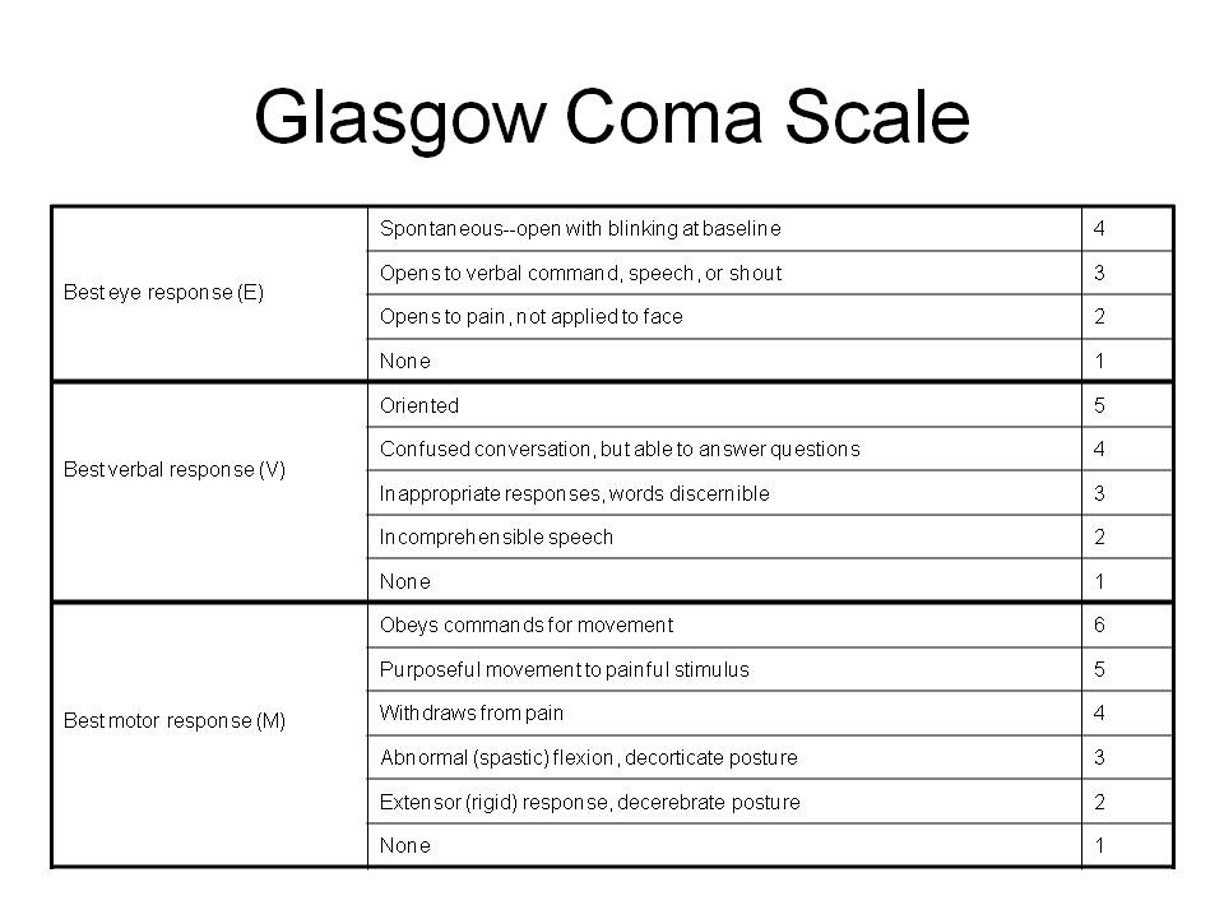
What is the critical score in the Glasgow Coma Scale?
8
What does a Glasgow Coma scale score of 9-11 indicate?
Not in a coma; moderate severity
What does a Glasgow coma score of ≥12 indicate?
Not in a coma, minor injury
What does a Glasgow coma scale score pt ≤8 indicate?
90% of pts are in a coma
if persists at 6 hrs → 50% die
What is defined as not opening eyes, not obeying commands, and not uttering understandable words?
Coma
What 3 responses are measured in the Glasgow Coma Scale?
best motor response (max score 6), best verbal response (max score 5), eye opening (max score 4)
Pupillary light reaction _____ in a metabolic coma.
reamins intact
What is one of the most important signs to distinguish structural from metabolic causes of a coma?
Presence/absence of light reaction
Pupillary light reaction is ______ in structural comas?
absent
What assesses brainstem function in a comatose patient by holding open upper eyelids, turning pt’s head quickly from one side then the other, looking at eye movement?
Oculocephalic reflex (“doll’s eyes)
How does a comatose patient with an intact brainstem respond to the Oculocephalic reflex (Doll’s eye reflex)?
As the head is turned, the eye move towards the opposite side
What assesses brainstem in a comatose patient by elevating the pt’s head 30° & instilling ice water followed by warm water into the ear canal, looking for nystagmus?
(*performed after oculocephalic reflex fails)
Oculovestibular reflex (Calorics)
What is the normal response the Oculovestibular reflex (Caloric), indicating an intact cortex and brainstem?
Rapid side to side eye movements (nystagmus) initially
Cold water: eyes quickly move away from cold water then slowly back toward
Warm water: eyes move toward warm water then slowly move away
What response to Oculovestibular reflex (Caloric) indicates no cortical response with an intact brainstem?
No nystagmus
Eyes turn slowly toward cold water
What response to the Oculovestibular reflex (Caloric) indicates no cortical response and no brainstem response?
No eye movement seen
What drugs can damage the vestibular nerve, causing an abnormal response to the oculovestibular reflex?
antimalarial drugs, certain abx, diuretics, and salicylates
What conditions are you ruling out by performing the oculovestibular reflex?
Acoustic neuroma, BPPV, labyrinthitis, meniere’s
What is a normal response to painful stimulus?
Avoidant - push stimulus away or withdraw
What is the stereotypic response to painful stimuli in a comatose patient?
Abnormal postural responses of trunk and extremities (decorticate or decerebrate)
Which posturing?
abnormal flexor response
rigidity, flexion of arms, clenched fists, extended legs
arms bent inward toward body w/ sits and fingers bent and held on chest
destructive lesion of corticospinal tracts
Decorticate
What posturing?
abnormal extensor reflex
rigid extension of arms and legs, downward pointing of toes and backward aching of head
caused by deterioration of structures of nervous system, particularly upper brain stem
lesion in diencephalon, midbrain, pons
metabolic disorders
Decerebrate
How do you test muscle tone in a comatose patient?
grasp forearm near wrist, raise vertical, lower off bed and watch how it drops (normal = arm drops slowly)
support flexed knees, extend one leg at time at the knee and let fall or flex both legs so that the heels rest on bed and release them (normal - slowly return to extension)
Monocular visual disturbance is associated with a lesion _____ to the optic chiasm.
Anterior
Binocular visual disturbance is associated with a lesion _____ to the optic chiasm.
Posterior or at
If visual problems improve with glasses, what kind of issue is it?
Refractive error
What medication can produce a blue hue in the eye?
Viagra
What medication can produce a yellow or green hue in the eye?
Digitalis
What condition is associated with “rainbows” or “halos” in their vision?
Acute glaucoma
What condition is associated with wavy vision?
Migraine
What condition is associated with a “drawn curtain” over vision?
Retinal detachment
What is the standard clinical test for BPPV?
Dix Hallpike
What are involuntary eye movements, usually triggered by inner ear stimulation, that begin as a slow pursuit movement followed by a fast, rapid resetting phase?
Nystagmus
What condition is associated with nystagmus that is provoked with the head turned to 1 side?
BPPV
What is the treatment for BPPV?
Epley
What are precautions that should be taken when performing the Epley maneuver?
avoid driving 24 hrs, avoid strenuous activities, and stop procedure if severe N/V
What is the most important diagnostic clue for differentiating a primary vs secondary headache?
Steady, B/L, non throbbing pain that is worse in the AM, may awaken patient at night, and is worse w/ valsalva
What condition?
U/L pain in orbital, frontal, or temporal region
often accompanied by conjunctival injection, lacrimation, rhinorrhea, congestion, ptosis, and sweating
lasts 15min-3 hrs; occurs frequently for wks-mos before remission
Cluster HA