Topic 1 Nutrition
 Call Kai
 Learn
Learn Practice Test
 Spaced Repetition
 Match
Match Flashcards
 Knowt Play
1/8

There's no tags or description
Looks like no tags are added yet.
Name | Mastery | Learn | Test | Matching | Spaced | Call with Kai |
|---|
No analytics yet
Send a link to your students to track their progress
9 Terms
Ev - What are the macronutrient energy contents?
Proteins - 16.7 kJ/g
CHO - 16.7 kJ/g
Lipids (fats) - 37.7 kJ/g
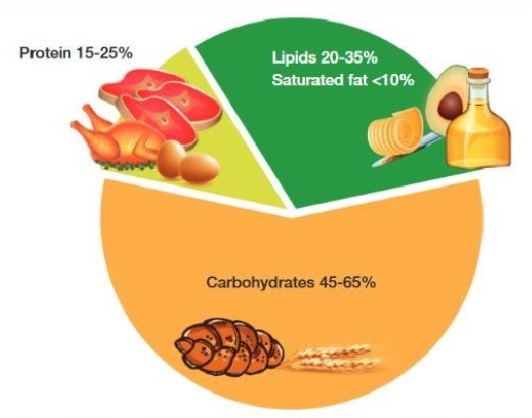
Ev - AMDR, what does it stand for and what are they for each macronutrient?
AMDR stands for acceptable macronutrient range and
20-35% from fats
45-65% from CHO
15-25% from proteins
The energy distribution of a category for a specific individual can be calculated using:
energy distribution = (amount of energy provided per macronutrient)/(total energy provided) x 100 = _____%
Ev - What does NRV stand for and what are a few?
Nutrient reference values and they provide recommended intakes based on current nutrition research:
- RDI = recommended daily intake
- EAR = estimated average requirement
- AI = adequate intake
- UL = tolerable upper intake
- EER = estimated energy requirement
Ev - Energy importance? Sources? Alcohol and water?
Energy is required for humans to maintain life so they can do activities and the body can continue normal bodily functions.
They should be primarily sourced from macronutrients.
Alcohol provides 29.3 kJ but is not considered essential as it does not supply any other nutrients.
Water provides 0 kJ/g
Ev - What are other nutrients that are required for essential body processes?
Vitamins and minerals, which are micronutriients are required for growth and metabolism.
Water is needed as it is about 60% of the adult body mass. It is essential for moving fluid and electrolytes around the body and excreting wastes.
Ev - Energy Balance
the relationship between energy intake and energy expenditure
positive = energy intake>expend leading to excess energy being stored as body fat, resulting in weight gain.
negatice = energy intake<expend weight loss
food consumed should meet the nutritional needs without takin too much or too little, however, a person's apetite determines how much they eat/how often.
Energy can be expended through three things when they are physically active, resting quietly (BMR stands for Basal Metabolic Rate. It is the minimum number of calories your body needs to perform basic, life-sustaining functions—such as breathing, pumping blood, maintaining body temperature, and cell repair—while at complete rest) and the thermic effect of food (energy expended for food digestion)
Ev - What does BMR do?
The energy the body expends for basal metabolic activites which support all basic processes of life including:
- maintain body temp at 37 degrees celsius
- keep lungs inhaling and exhaling air
- allow bone marrow to keep producing red blood cells
- keep heart beating 100,000 times a day and keep kidneys filtering blood and removing wasts.
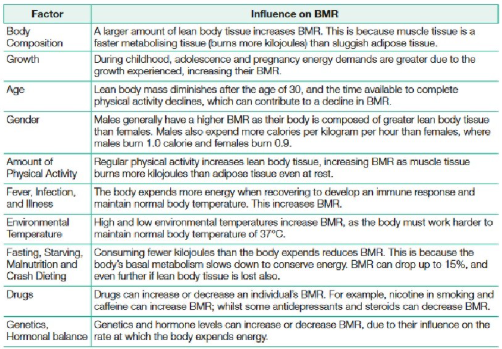
However, the rate at which an individual expends energy for these activites varies from person to person and may vary for the same person with a change of circumstances to physical conditions.
Ev - calculate BMR Australian
Females - 1 kg of body weight burns roughly 0.9 of a calorie per hour.
weight x 0.9 × 24 hours = _____ calories per day
to convert to kJ = calories x 4.2 = _____ kJ/day
Males - 1 kg of body weight burns roughly 1 calorie per hour.
weight x 1.0 × 24 hours = _____ calories per day
to convert to kJ = calories x 4.2 = _____ kJ/day
Ev - Factors influencing an individual’s BMR