Labs 7-11
 Call Kai
 Learn
Learn Practice Test
 Spaced Repetition
 Match
Match Flashcards
 Knowt Play
1/153

There's no tags or description
Looks like no tags are added yet.
Name | Mastery | Learn | Test | Matching | Spaced | Call with Kai |
|---|
No analytics yet
Send a link to your students to track their progress
154 Terms
Differential Biochemical Tests are used for?
identification of bacteria by analysis of different biochemical properties
Name the 5 tests for fermentation of carbohydrates & aerobic/anaerobic respiration
1. Oxidation-fermentation (OF)
2. Phenol Red Glucose/Sucrose/Lactose
3. Methyl Red (MR)
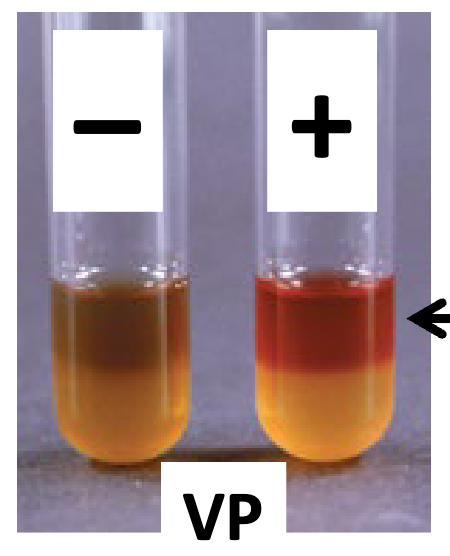
4. Voges-Proskauer (VP)
5. Nitrate Reduction
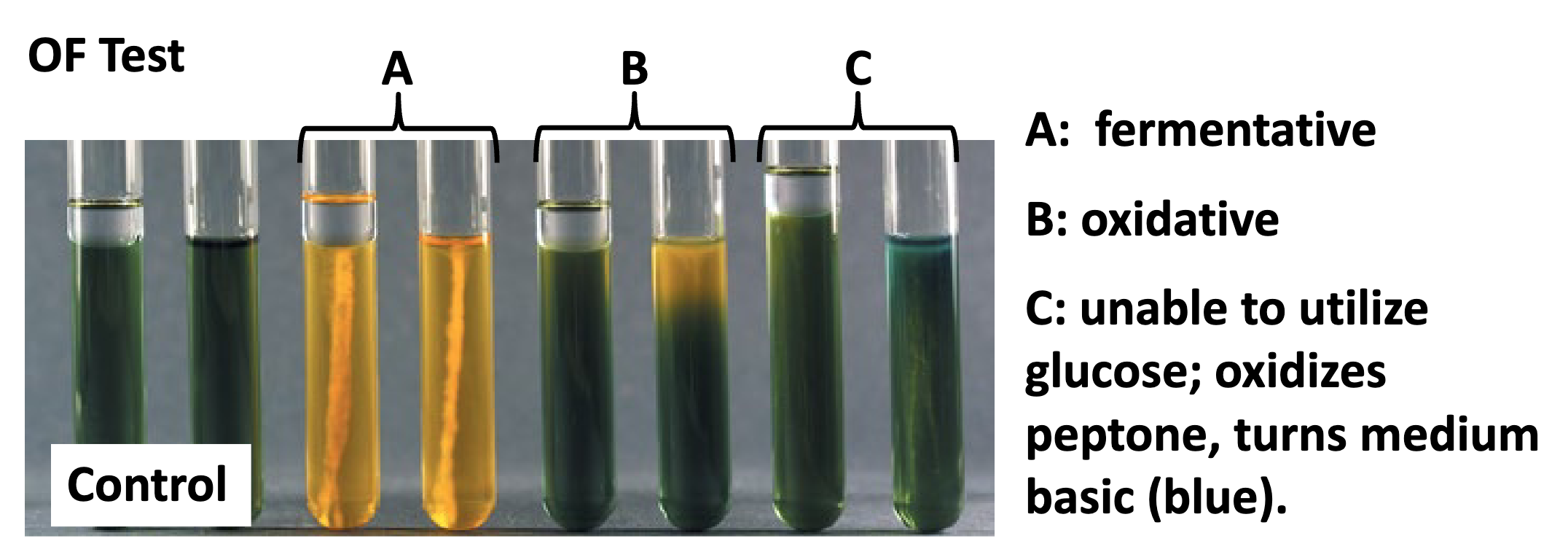
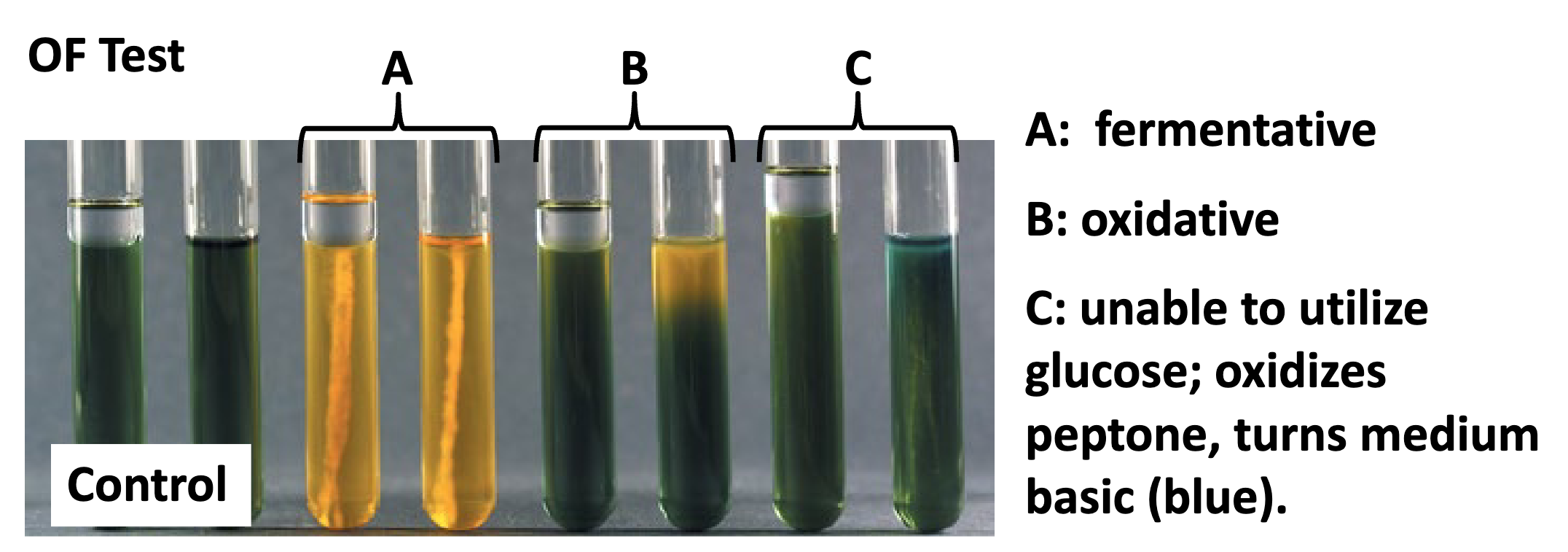
Oxidation-fermentation (OF) determines ___
whether or not bacteria is able to ferment or oxidate
The media in Oxidation-fermentation (OF) contains _____, ________, and _____.
glucose, peptone, and pH indicator bromomethyl blue
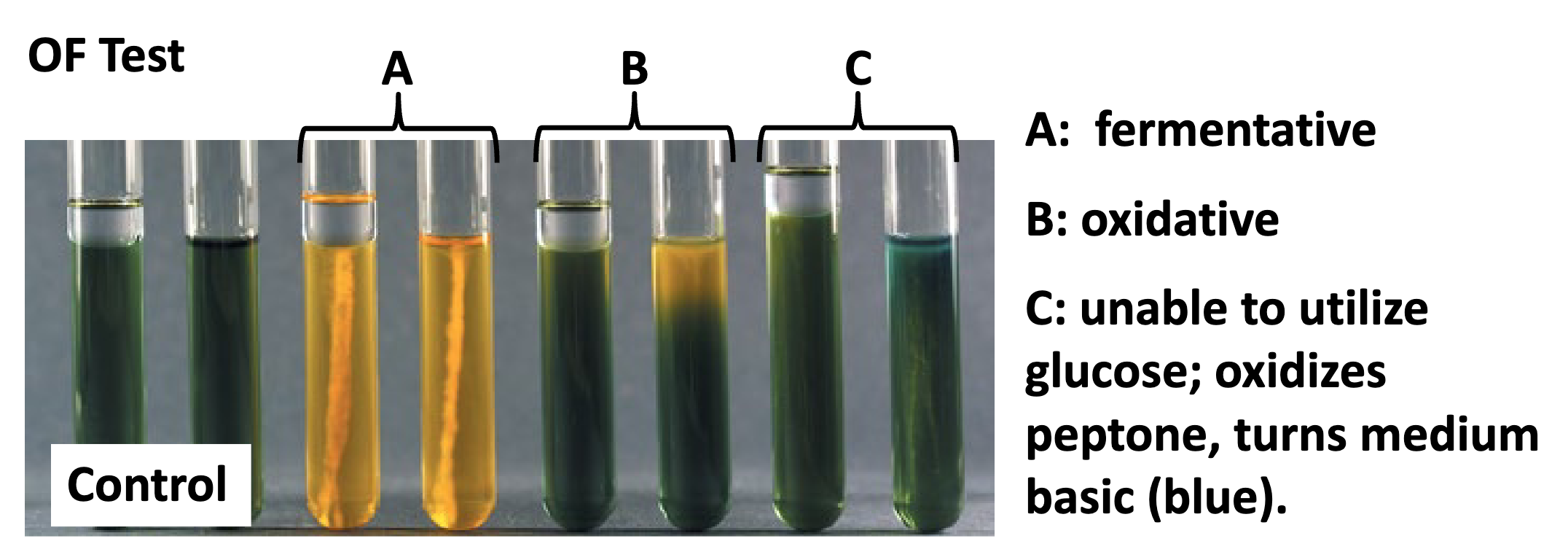
In Oxidation-fermentation (OF), the yellow result is what pH and represents fermentation, fermentation, or unable to use glucose (oxidizes peptones)?
yellow = @pH 6 fermentation
In Oxidation-fermentation (OF), the green result is what pH and represents fermentation, fermentation, or unable to use glucose (oxidizes peptones)?
green = @pH 7.1 oxidation
In Oxidation-fermentation (OF), the blue result is what pH and represents fermentation, fermentation, or unable to use glucose (oxidizes peptones)?
blue = @pH 7.6 unable to use glucose
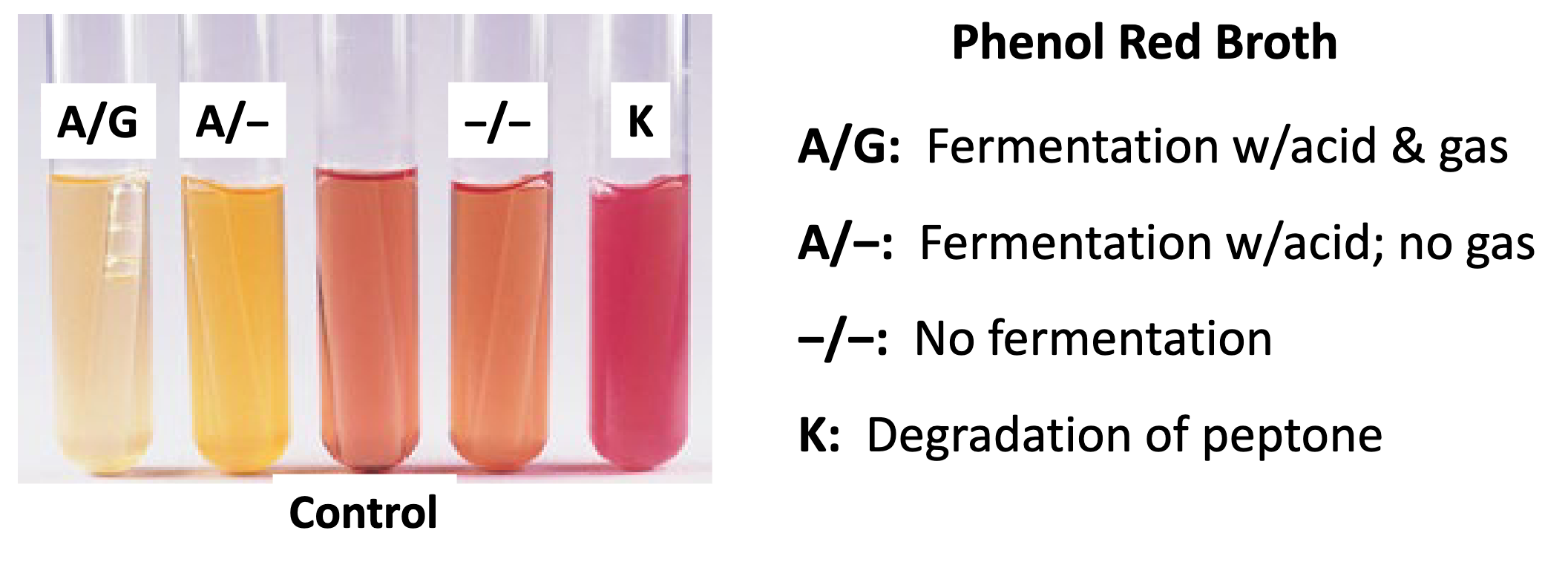
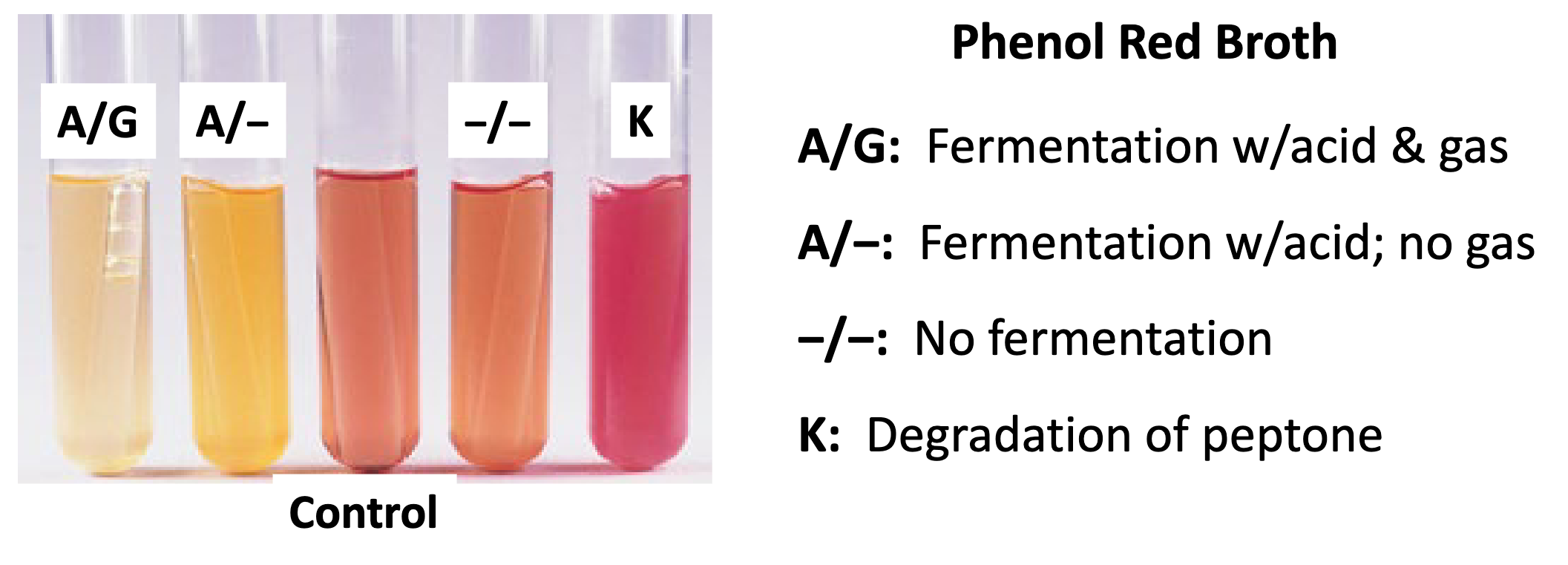
Phenol Red Glucose/Sucrose/Lactose tests for …
fermentation of sugar & gas production
If a non-fermenting bacterial species showed gas production via the presence of bubbles in the Durham tube after 24-hour incubation, how would you interpret this? Would it be necessary to add reagents, A & B to this tube, why or why not?
this indicates that denitrification occurred, producing nitrogen gas from nitrate reduction rather than fermentation.
It is not necessary to add Reagents A & B because the presence of gas (bubble) in the Durham tube already confirms a positive result for this process.
A ______ _______ is popped inside to see gas production in the Phenol Red Test.
A durham tube
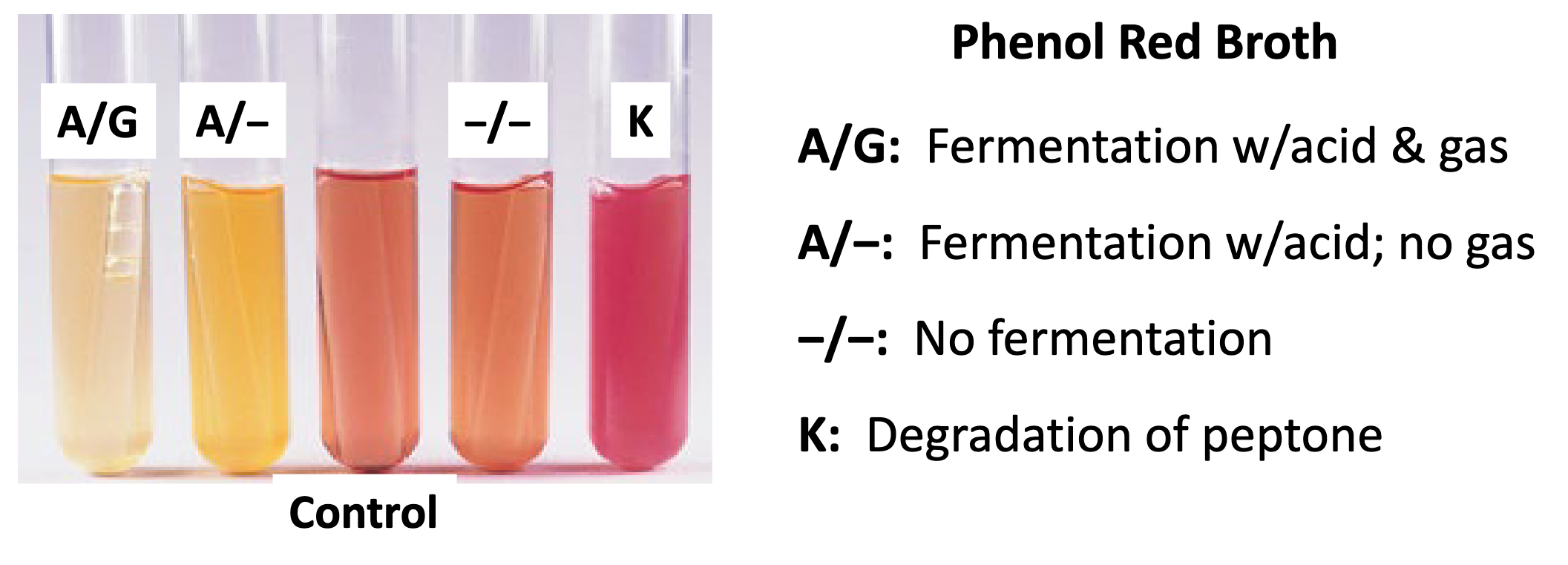
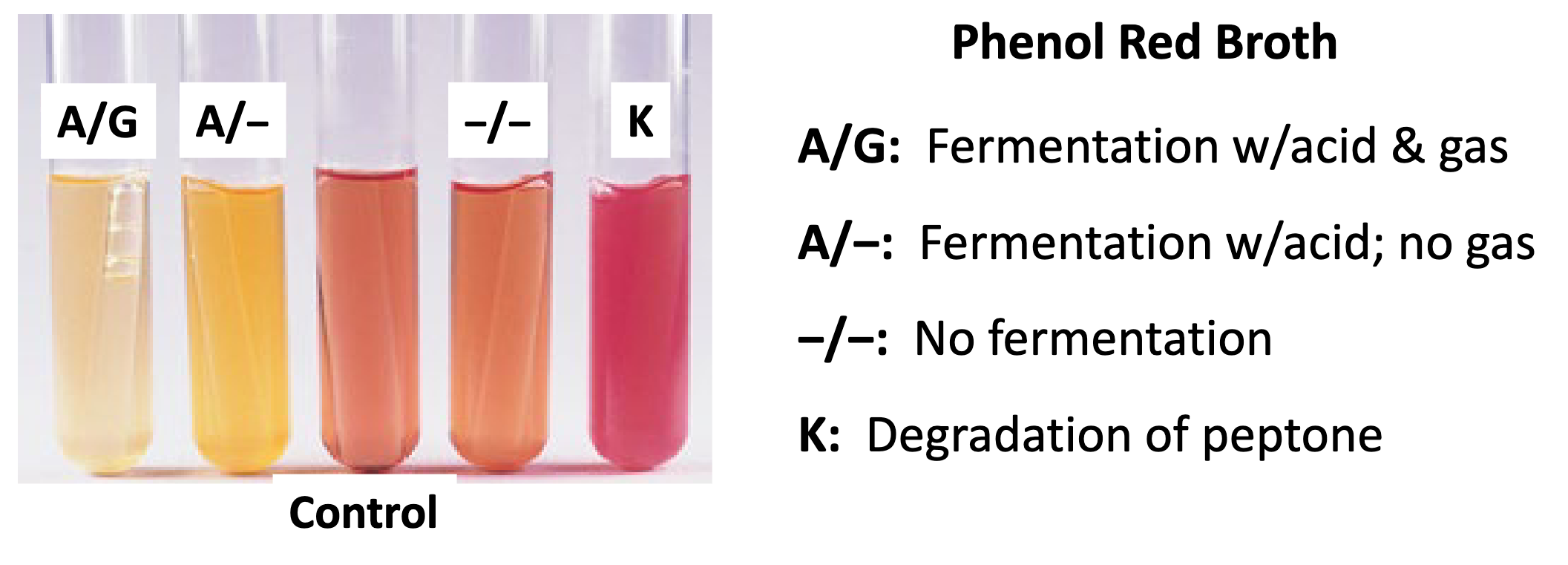
Phenol Red Glucose/Sucrose/Lactose test the ability to ___ and color results are ___
Ferment the carbohydrate = media turns yellow due to production of acidic products
Not able to ferment the carbohydrate = no color change = remains red OR turns pink due to degrading of peptone
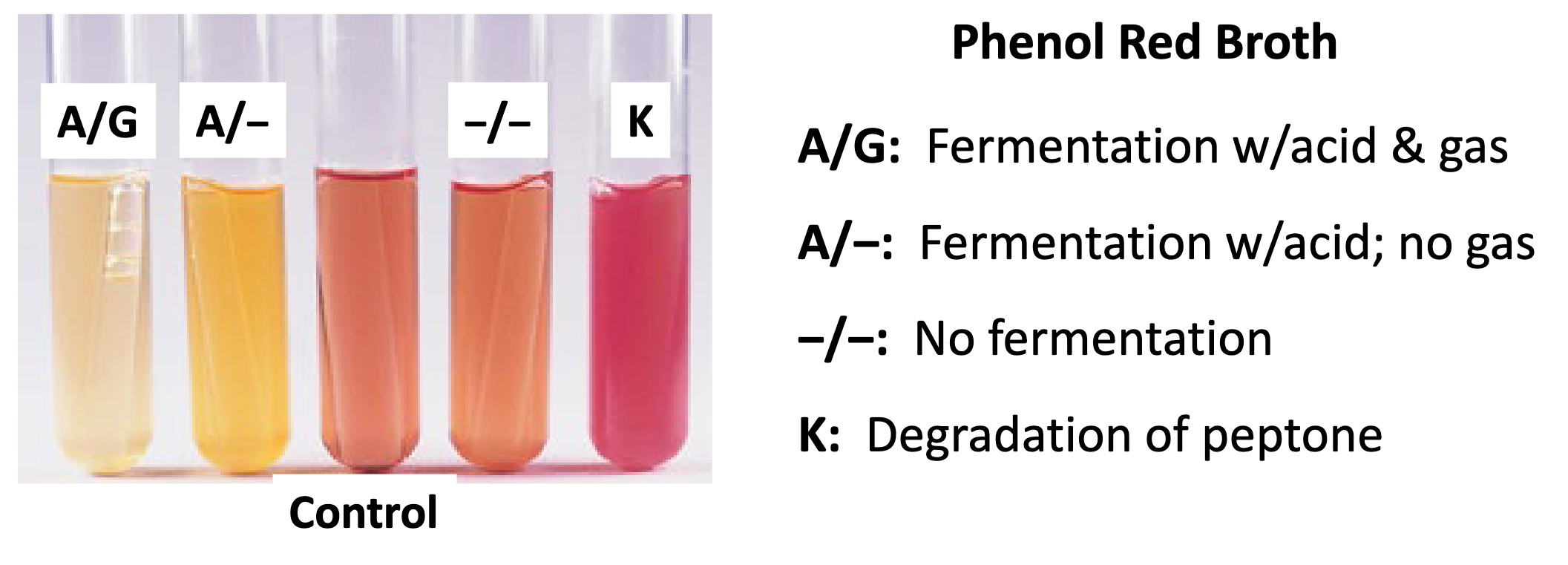
True or false:
If phenol broth is yellow this means that no fermentation occur
False - it means that fermentation did occur
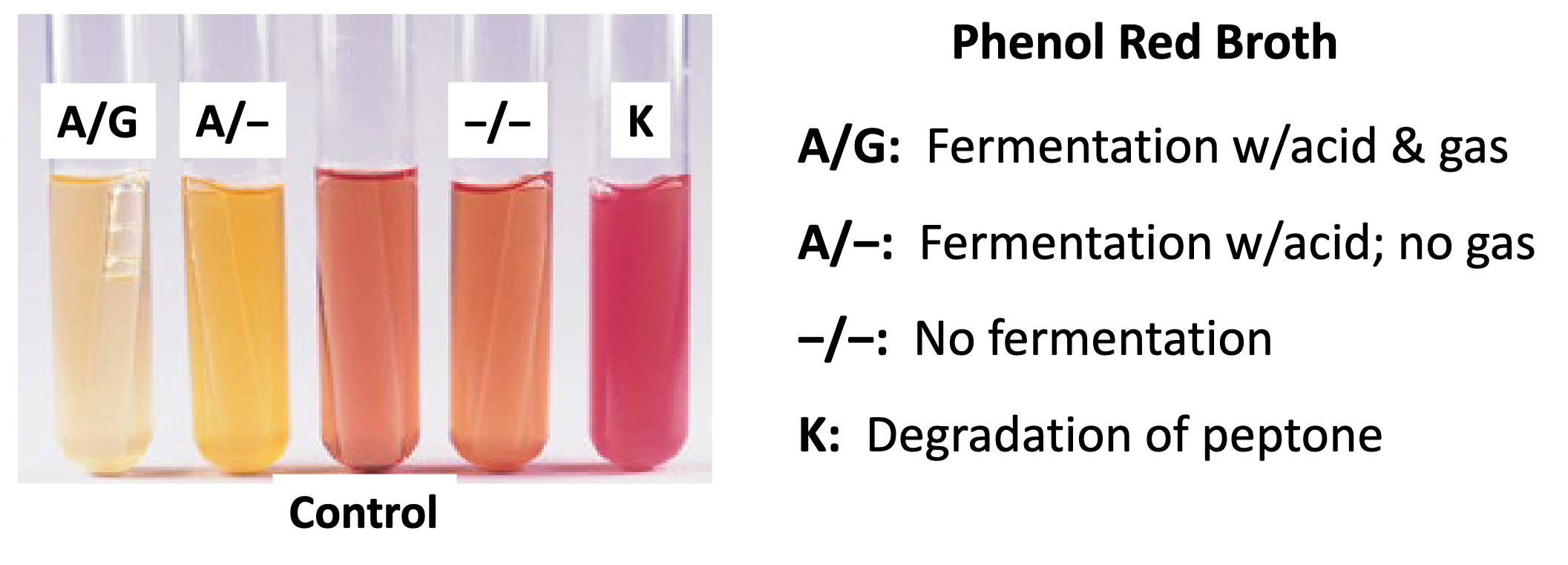
If phenol broth is rose pink this means that what?
PEPTONE was degraded
Methyl Red Voges Proskauer (MRVP) is a _____ test designed to
Combination
Distinguish between mixed acid fermentation and butanediol fermentation.
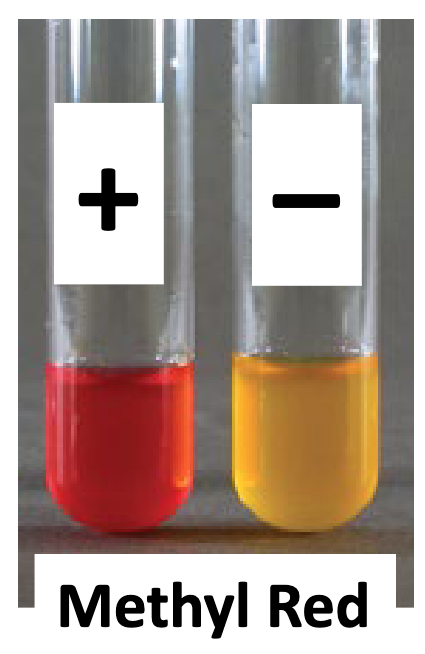
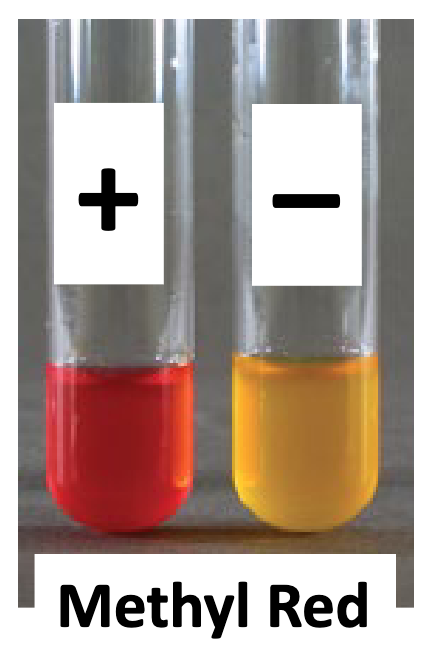
Methyl Red (MR):
occurs fast or slow?
checks for ____
needs to add ____ reagents
- occurs immediately
- checks for mixed acid fermentation that overpowers buffer and lowers pH
- need to add 3 drops of methyl red
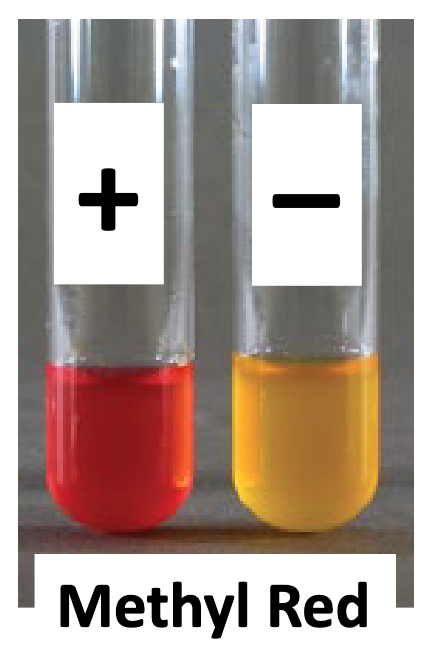
If result for Methyl Red (MR) is RED =
+ in MR test
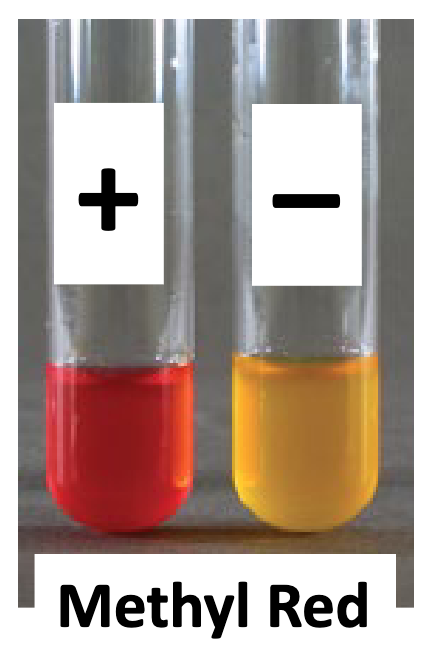
If result for Methyl Red (MR) is Yellow =
- in MR test
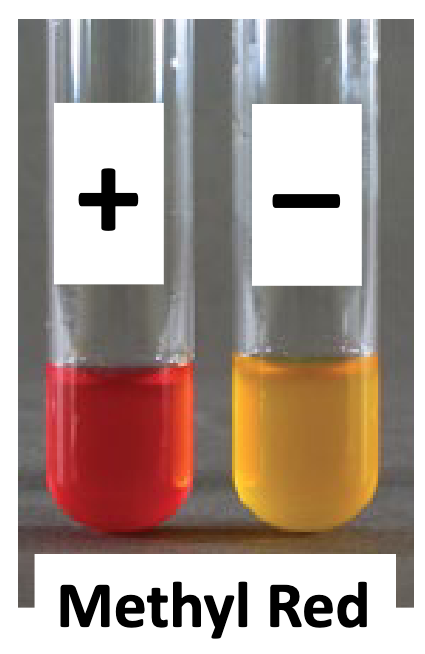
Voges-Proskauer (VP):
occurs fast or slow?
checks for ____
needs to add ____ reagents
- not immediately, instead need to wait 30 min for result
- checks for fermentation of glucose to end products of acetoin and 2,3-butanediol
- need to add 15:5 ratio of Reagent A and Reagent B to MRVP broth
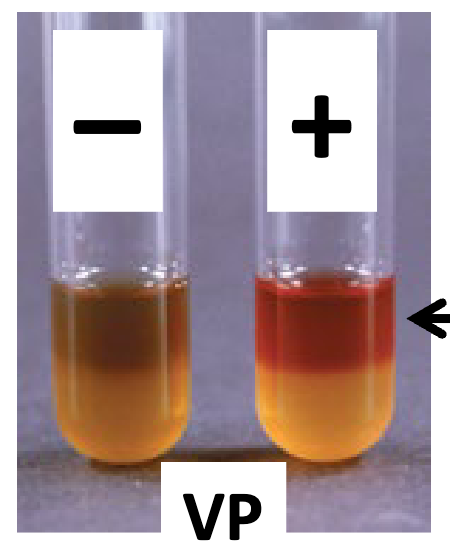
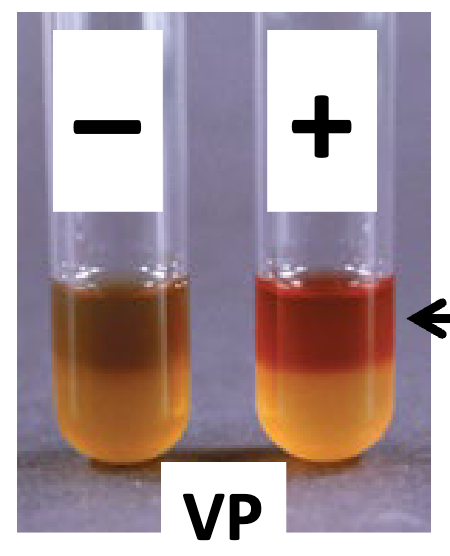
If result for Voges-Proskauer (VP) is cherry red =
+ in VP test
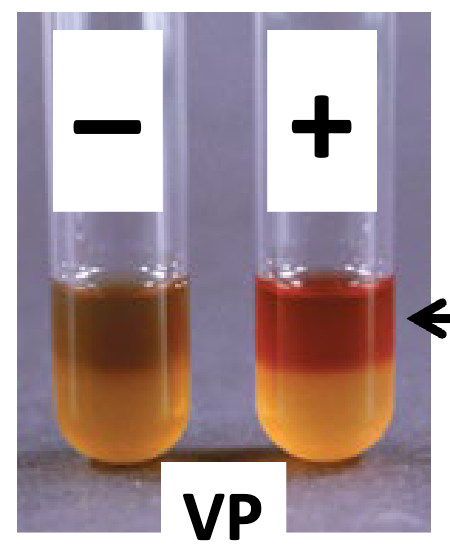
If result for Voges-Proskauer (VP) is brown yellow =
- in VP test
Which test tests for the utilization of citrate as a sole carbon source?
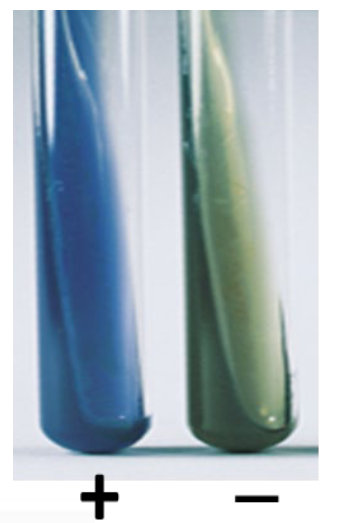
Citrate Test
Citrate test is done using what type of agar?
SIMMONS CITRATE AGAR which is a defined medium
usually in slants
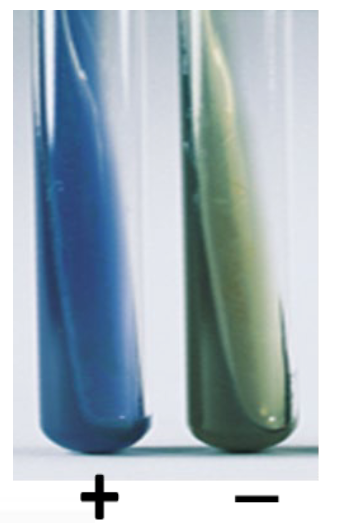
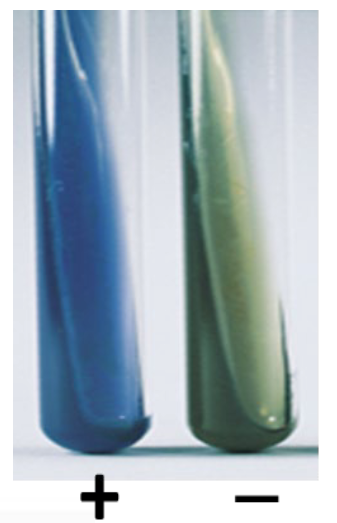
In the Citrate test, the results are as follows:
green color =
blue color =
green color = -
blue color = +
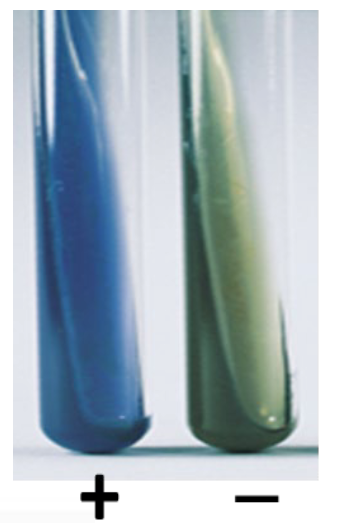
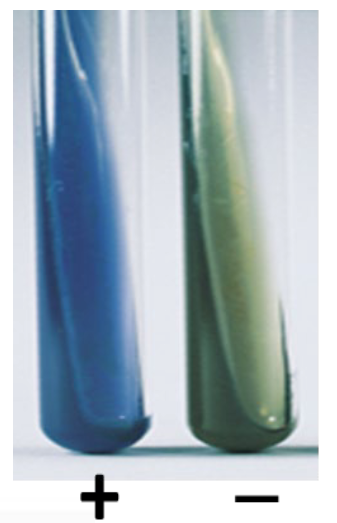
Why does citrate test produce the color blue for a positive results?
Nitrogen source ammonium phosphate is converted to ammonium ion which turns the bromothymol blue pH blue (basic)
Match the test with the proper definition
Voges-Proskauer test
A) Red color formation is positive for this following reagent addition
B) yellow color formation indicates fermentation
C) indicates a mixed acid fermenter
D) Formation of a blue color is positive
A) Red color formation is positive for this following reagent addition
Match the test with the proper definition
Citrate test
A) Red color formation is positive for this following reagent addition
B) yellow color formation indicates fermentation
C) indicates a mixed acid fermenter
D) Formation of a blue color is positive
D) Formation of a blue color is positive
Match the test with the proper definition
Methyl Red test
A) Red color formation is positive for this following reagent addition
B) yellow color formation indicates fermentation
C) indicates a mixed acid fermenter
D) Formation of a blue color is positive
C) indicates a mixed acid fermenter
Match the test with the proper definition
Phenol Red carbohydrate test
A) Red color formation is positive for this following reagent addition
B) yellow color formation indicates fermentation
C) indicates a mixed acid fermenter
D) Formation of a blue color is positive
B) yellow color formation indicates fermentation
Upon completion of an oxidation-fermentation test, you observe that your organism has produced an acid result in the aerobic tube and a neutral result in the anaerobic tube. You can reasonably conclude that the organism exhibits _____________ metabolism of carbohydrates.
A) fermentative
B) oxidative
C) both oxidative and fermentative
D) no
B) oxidative
Aerobic Tube (Yellow/Acid): The organism breaks down the carbohydrate to produce acid, but only in the presence of oxygen.
Anaerobic Tube (Green/Neutral): The organism cannot break down the carbohydrate (ferment) without oxygen.
What is the purpose of the inclusion of a Durham tube in differential culture media?
A) To allow for ease in the visualization of bacterial growth.
B) To indicate pH changes that occur during growth.
C) To visualize the production of gas during growth.
D) To stabilize the oxygen concentration in the media during incubation.
C) To visualize the production of gas during growth.
Which is applicable to a bacterium producing a positive Voges-Proskauer test?
A) it means it can break down hydrogen peroxide
B) a blue color is formed
C) it means it can ferment lactose
D) it means it produces acetoin
E) it means it is a mixed-acid fermenter
D) it means it produces acetoin
Why do organisms that have the capacity to utilize citrate as the sole carbon source tend to produce an alkaline reaction in Simmons citrate agar?
A) The conversion of citrate into pyruvate produces carbon dioxide as alkaline waste.
B) The metabolism of citrate always produces acidic waste products.
C) The organism will also utilize ammonium phosphate as a nitrogen source, resulting in alkaline waste.
D) none of the above
C) The organism will also utilize ammonium phosphate as a nitrogen source, resulting in alkaline waste.
Citrate‑positive bacteria use ammonium phosphate as their nitrogen source on Simmons citrate agar.
When they break it down, they produce ammonia, which makes the medium more alkaline and turns it blue.
Phenol red lactose broth was inoculated with a particular bacterial species. Following 24 hours incubation at 37°C, the bacteria grew and the result below was observed. An un-inoculated control is shown for comparison. What is the interpretation of this result? [The broth is turbid with red color]
A) It is a lactose fermenter
B) It is non-reactive; it cannot utilize any of the nutrients in the broth.
C) It can form gas
D) It can grow but cannot ferment lactose
E) None of the above are correct
F) Two of the above are correct
D) It can grow but cannot ferment lactose
In Phenol Red lactose broth:
Red color = neutral pH, meaning no acid was produced from lactose fermentation.
Turbid broth = growth (the organism grew using peptones, not lactose).
Yellow is positive for lactose fermentation; red means no fermentation.
Nitrate Reduction
detects for anaerobic respiration using nitrate NO3 as terminal electron acceptor which reduced to nitrite NO2 and beyond
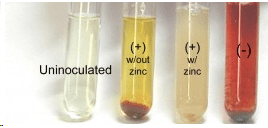
Nitrate Reduction Test broth contains...
KNO3 potassium nitrate and a durham tube for detecting gas production
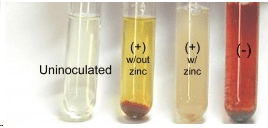
Nitrate Reduction process involves:
1. Adding EQUAL amounts of Reagent A and Reagent B (8 drops of e/a)
2. wait for 10 min for results
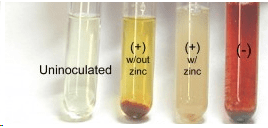
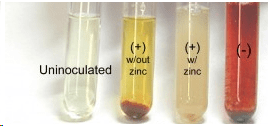
Nitrate Reduction Results Initially:
Red color = +
No red color = add Zn because it may have went beyond nitrite
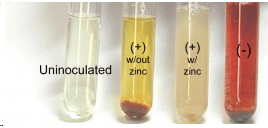
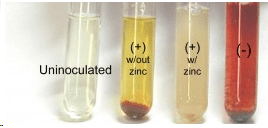
After adding Zn, nitrate reduction shows a red color, we mark it as?
Negative
the reaction was induced by Zn and not naturally occurring
After adding Zn, nitrate reduction shows no change in color, we mark it as?
Positive
reaction went beyond the nitrite and therefore showed no color after adding Zn
Urea Hydrolysis is used to ___
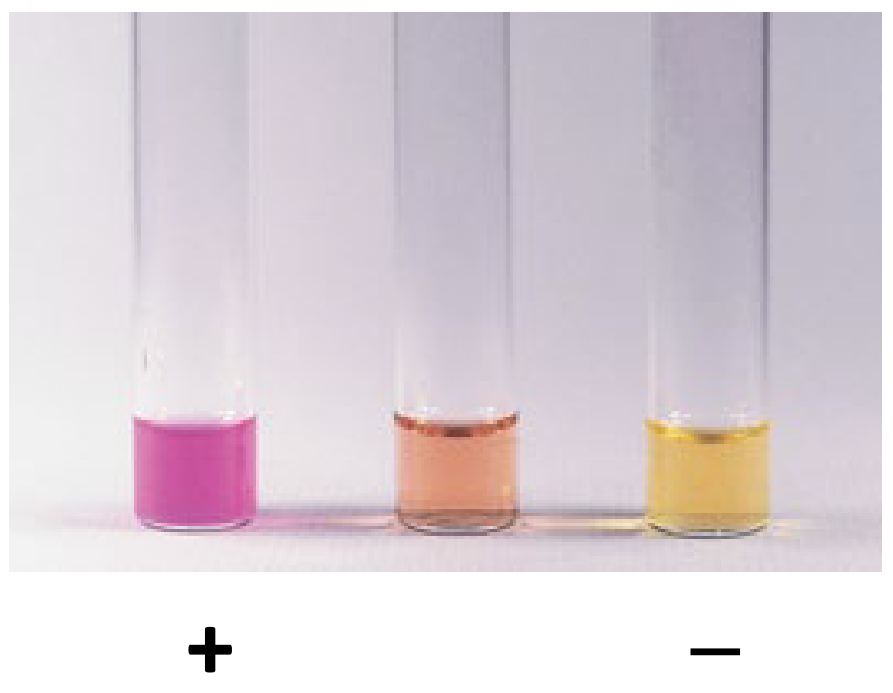
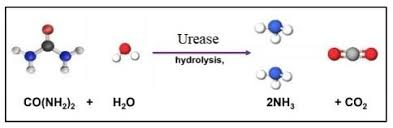
differentiate organisms based on their ability to hydrolyze urea with the enzyme urease
Urea Hydrolysis color results:
pink fuchsia = +
orange rose = moderate
yellow = -
The change of color in Urea Hydrolysis is due to ____________ production which lowers the ____
The change of color in Urea Hydrolysis is due to ammonia production which lowers the pH (basic)
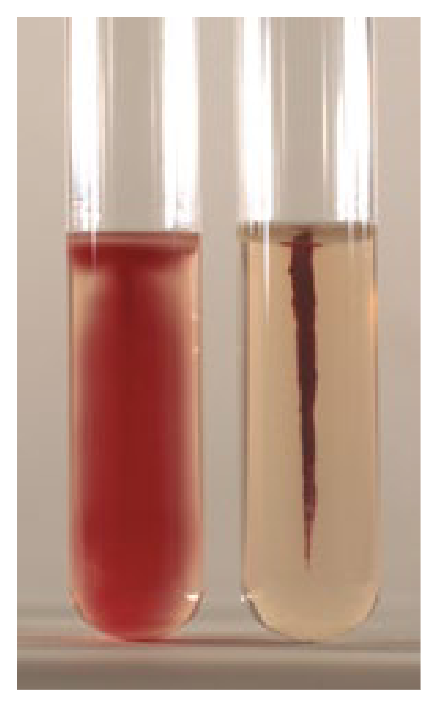
Motility test agar uses ____
a red indicator (TTC) to show motility
TTC = tetrazolium salt
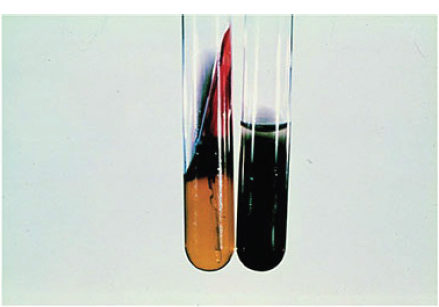
Combination Differential Media examples (2)
1. SIM
2. KIA
Compare/contrast SIM and KIA (Kligler’s Iron Agar)
(a) how are they similar – name the one similarity
(b) name two differences.
Similarity
are differential media used to identify hydrogen sulfide production through the formation of a black precipitate.
Differences
SIM tests for sulfur reduction, indole production, and motility, while KIA tests for glucose and lactose fermentation.
SIM is a semi-solid medium used to observe motility by stab inoculation, while KIA is a solid slant/butt medium inoculated by both stabbing and streaking the slant, and is used to differentiate fermentation patterns based on color changes.
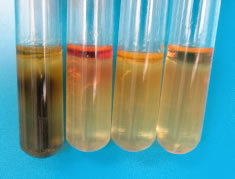
SIM show us 3 activities:
1. Sulfur Reduction
2. Indole Production
3. Motility
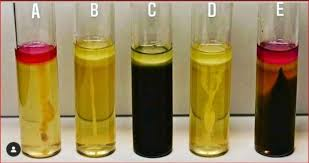
SIM test uses _____ agar
SIM agar
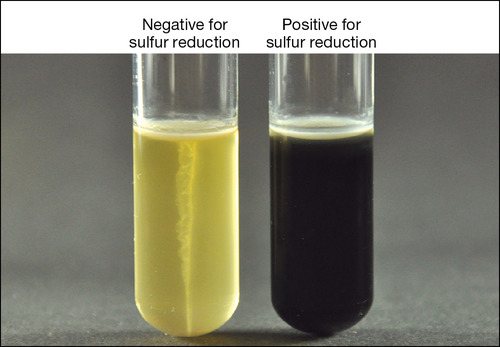
Sulfur Reduction in SIM Agar is shown by producing a _______ color
black color in SIM test is + for sulfur reduction
no color for no sulfur reduction -
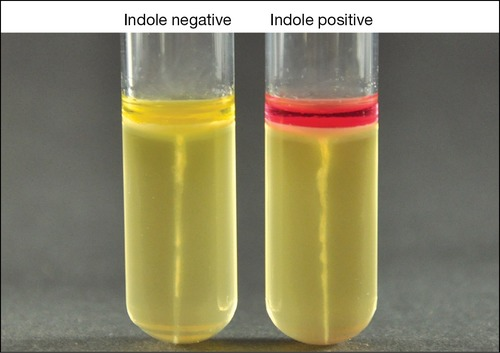
Indole Production in SIM Agar is measuring what enzyme's activity?
catabolism (break down) of Tryptophan
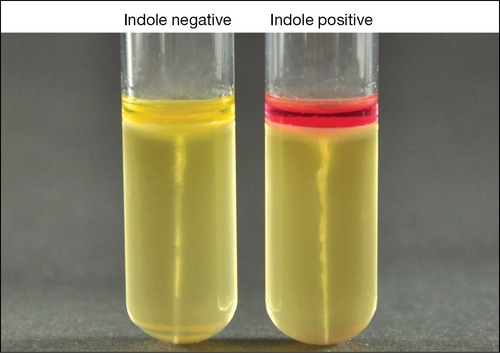
Indole Production in SIM Agar can be done using what reagent?
Kovac's Reagent to initiate immediate reaction
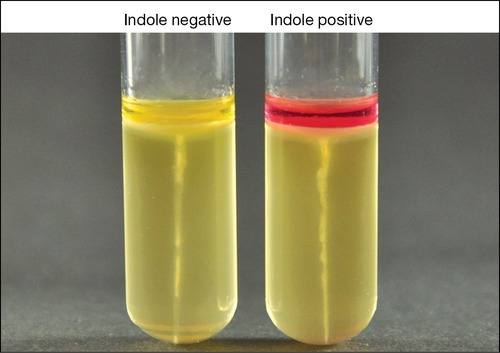
A red/hot pink in SIM Agar =
positive, Indole Production or catabolism of Tryptophan
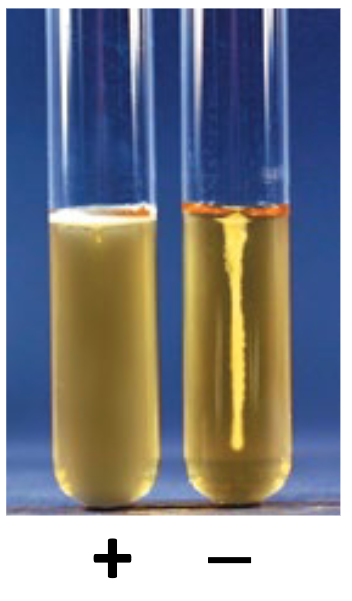
Motility will be + when
there is growth eradiating from stab and it is cloudy
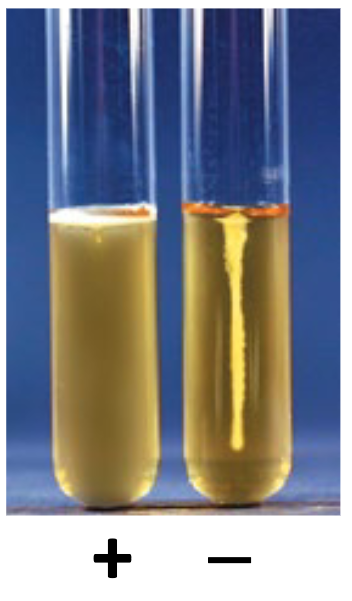
Motility will be - when
there is no cloudiness, only growth on stab site
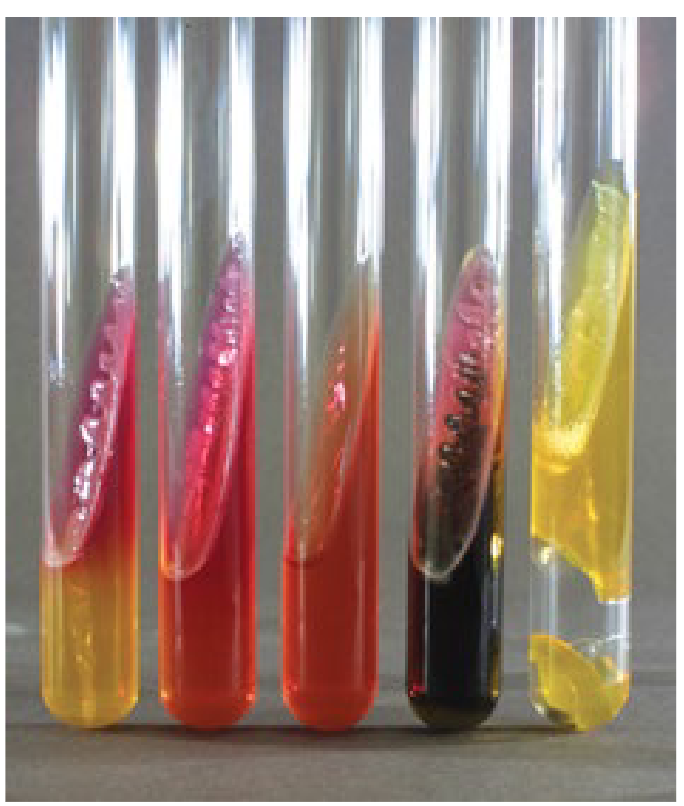
KIA test uses _____ agar
KIA agar in a slant
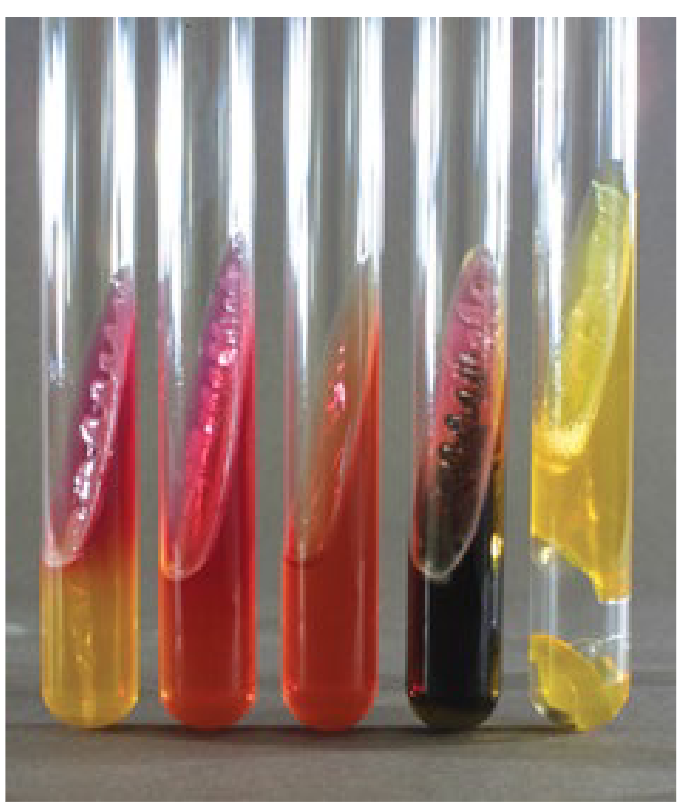
KIA tests for ___, ____, and _____.
1. lactose fermentation
2. glucose fermentation
3. sulfide production
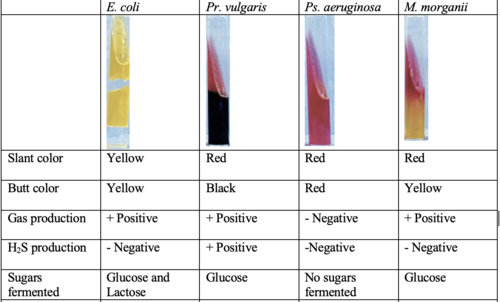
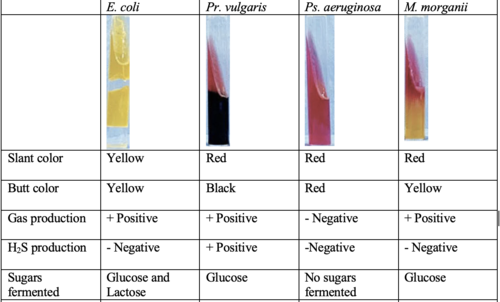
A glucose-ONLY fermenter will appear how in the KIA agar?
(K/A) red slant / yellow butt
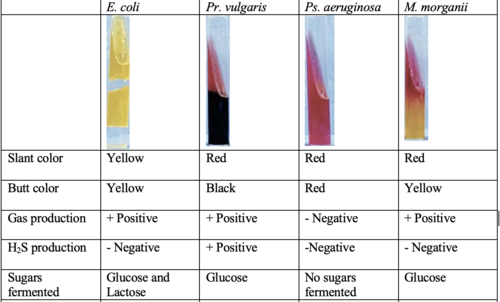
A lactose fermenter will appear how in the KIA agar?
(A/A) yellow slant / yellow butt
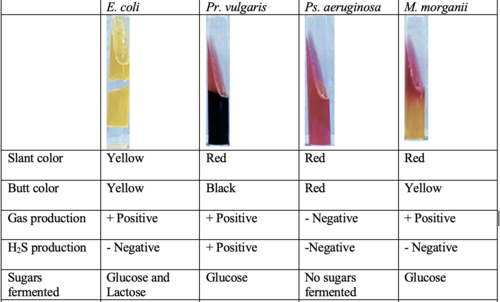
One that does NOT ferment either glucose or lactose will appear how in the KIA agar?
(K/K) red slant / red butt
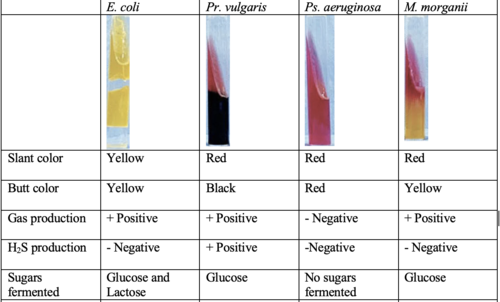
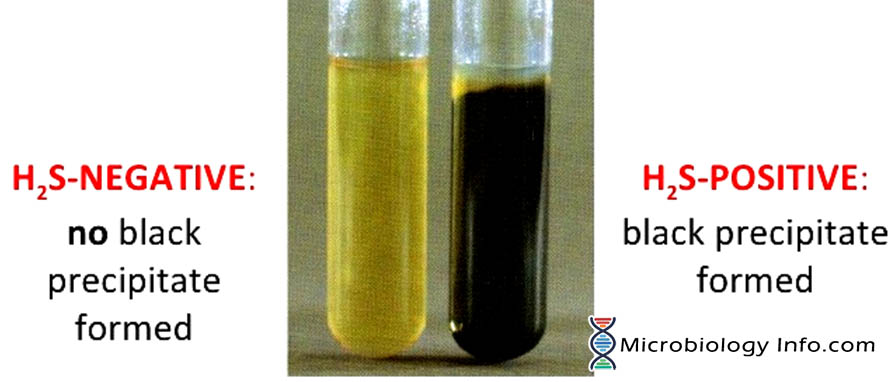
One that produces hydrogen sulfide will appear how in the KIA agar?
a black precipitate (blackening) in the butt (bottom) of the tube
cracks on the agar due to gas production
Sulfur reduction will appear how in the KIA agar?
black color +
just like SIM
The stab butt part in KIA agar is _______ and the streak slant part is _________
The stab butt part in KIA agar is anaerobic and the streak slant part is aerobic
When all the possible steps of the nitrate reduction test are complete and the culture tube still fails to produce a color change, this indicates the organism
A) is not capable of nitrate reduction.
B) cannot ferment nitrogen.
C) is capable of nitrate reduction.
D) cannot grow in nitrate broth
C) is capable of nitrate reduction.
If an organism that is incubated on a Kligler iron agar slant produces a red slant and yellow butt, this indicates that the organism
A) ferments both glucose and lactose.
B) ferments lactose but not glucose.
C) ferments glucose but not lactose.
D) does not ferment either glucose or lactose.
C) ferments glucose but not lactose.
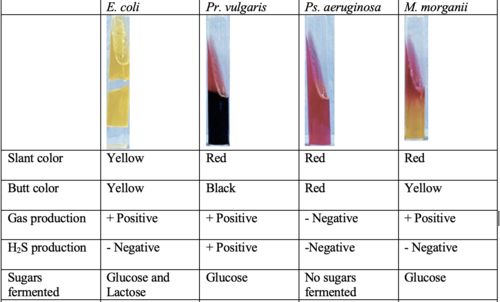
The function of the tetrazolium salt (TTC) in motility test medium is to
A) produce more vigorous growth of organisms.
B) enhance the visibility of the motility results.
C) select for the growth of motile organisms.
D) select for the growth of non-motile organisms.
B) enhance the visibility of the motility results.
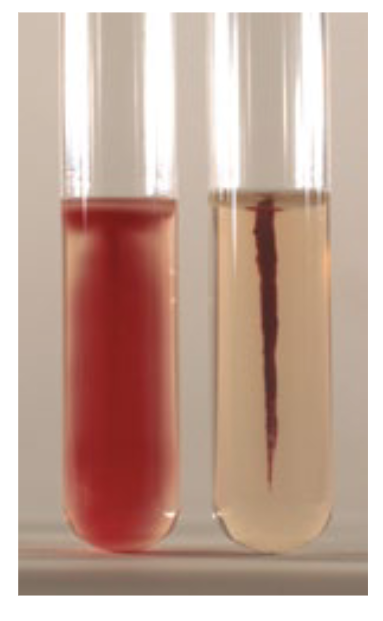
True or false - only those bacteria that are motile will produce a red color when grown in Motility Test Medium
A) True
B) False
B) False
TTC used to visualize bacterial growth, this red color indicates bacterial growth/metabolism, not just motility.
Non-motile organisms can also produce a red color restricted to the stab line
Which choice among A-D is true regarding the urea test?
A) A positive test is indicated by formation of a purple color.
B) Urea positive bacteria form ammonia and carbon dioxide as the end products of the reaction with urea.
C) A positive urea test indicates the bacterium possesses the tryptophanse enzyme.
D) The urea broth tube has a Durham tube to check for gas production.
E) None of A - D is true; all are false.
B) Urea positive bacteria form ammonia and carbon dioxide as the end products of the reaction with urea.
Which of the following choices among A-D is a false statement?
A) Sulfur reduction: can determine this in SIM, KIA, and Phenylalanine deaminase
B) SIM can determine if a bacterial type is capable of producing indole.
C) The appearance of cracks in the "butt" of an inoculated KIA medium indicate the bacteria is motile.
D) It is proper procedure when inoculating motility test medium to stab it one time with an inoculum; i.e., in and out along the same path.
E) Two of the above choices among A-D are false.
E) Two of the above choices among A-D are false.
A) Sulfur reduction: can determine this in SIM, KIA, and Phenylalanine deaminase
C) The appearance of cracks in the "butt" of an inoculated KIA medium indicate the bacteria is motile.
This test specifically determines if a bacterium can respire anaerobically using the nutrients in the growth medium.
A) urea test
B) SIM
C) nitrate reduction test
D) none of the above
C) nitrate reduction test
The nitrate reduction test specifically determines whether a bacterium is capable of performing anaerobic respiration by using nitrate (NO3-) as a terminal electron acceptor in the absence of oxygen
Disinfectant (Define)
reduce pathogens on INANIMATED objects
ex. tables, phone screens, door knobs, etc.
Antiseptic (Define)
reduce pathogens on living tissue
ex. hands, wounds, etc.
Germicides (Define)
Any substance used to reduce the numbers of pathogens
Decontamination (Define)
kills some microbes while deactivating viruses
Sterilization (Define)
kills ALL microbes and kills ALL viruses, removing everything!
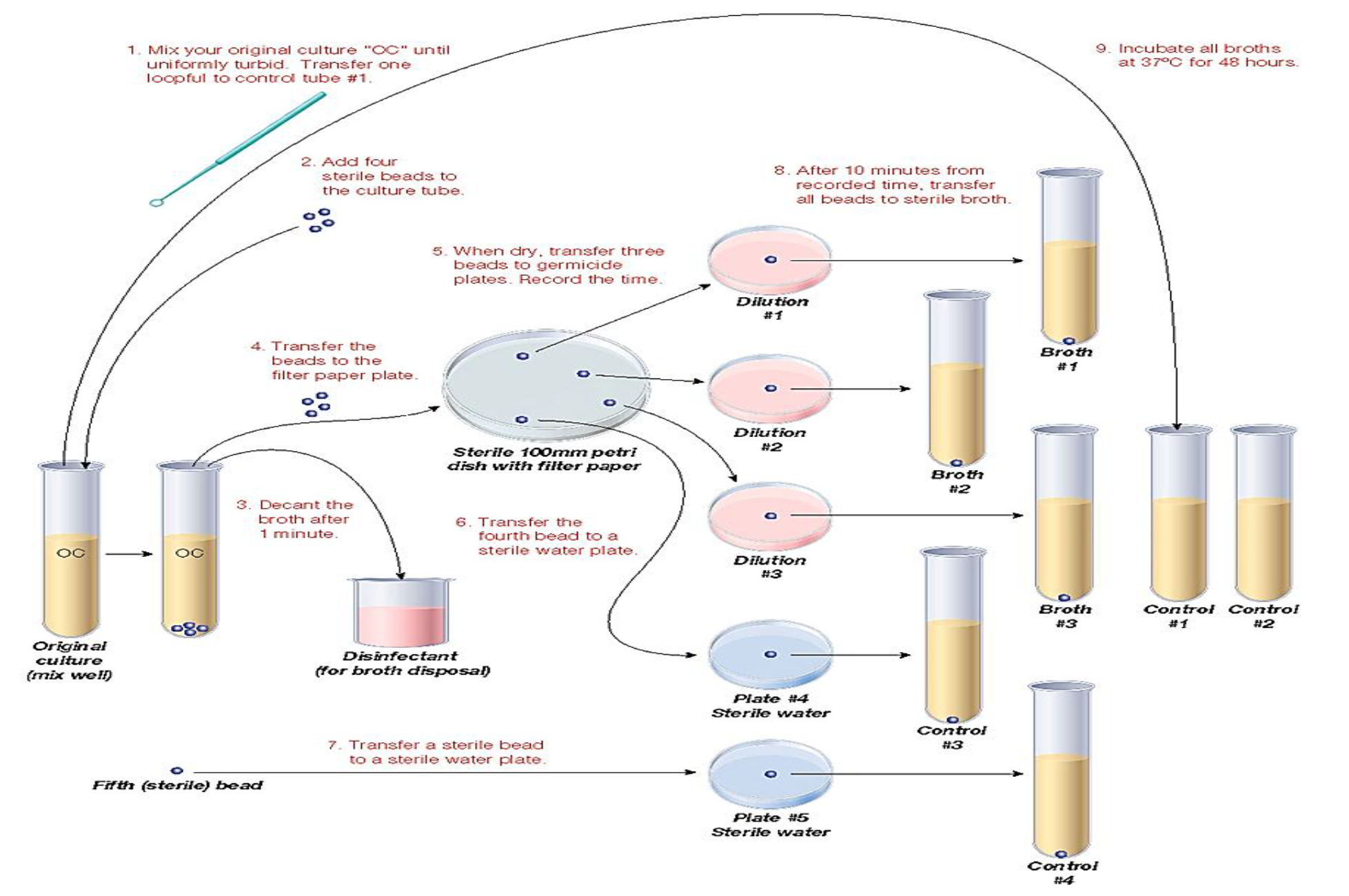
Use-dilution test
A Qualitative Method of testing germicide reagents effectiveness
What type of beads were used to be coated w/ culture?
glass beads since they are nonporous
The two strains that were test during the Chemical Germicides Lab were...
1. S. aureus (gram +)
2. E. coli (gram -)
How many controls did we have in the Chemical Germicides Lab?
4 controls in total
Purpose of Control 1
The purpose of the first control is to confirm that there were bacteria in the original culture, which can be seen by the presence of growth. If there is no growth, this means the bacteria are dead.
Purpose of Control 2
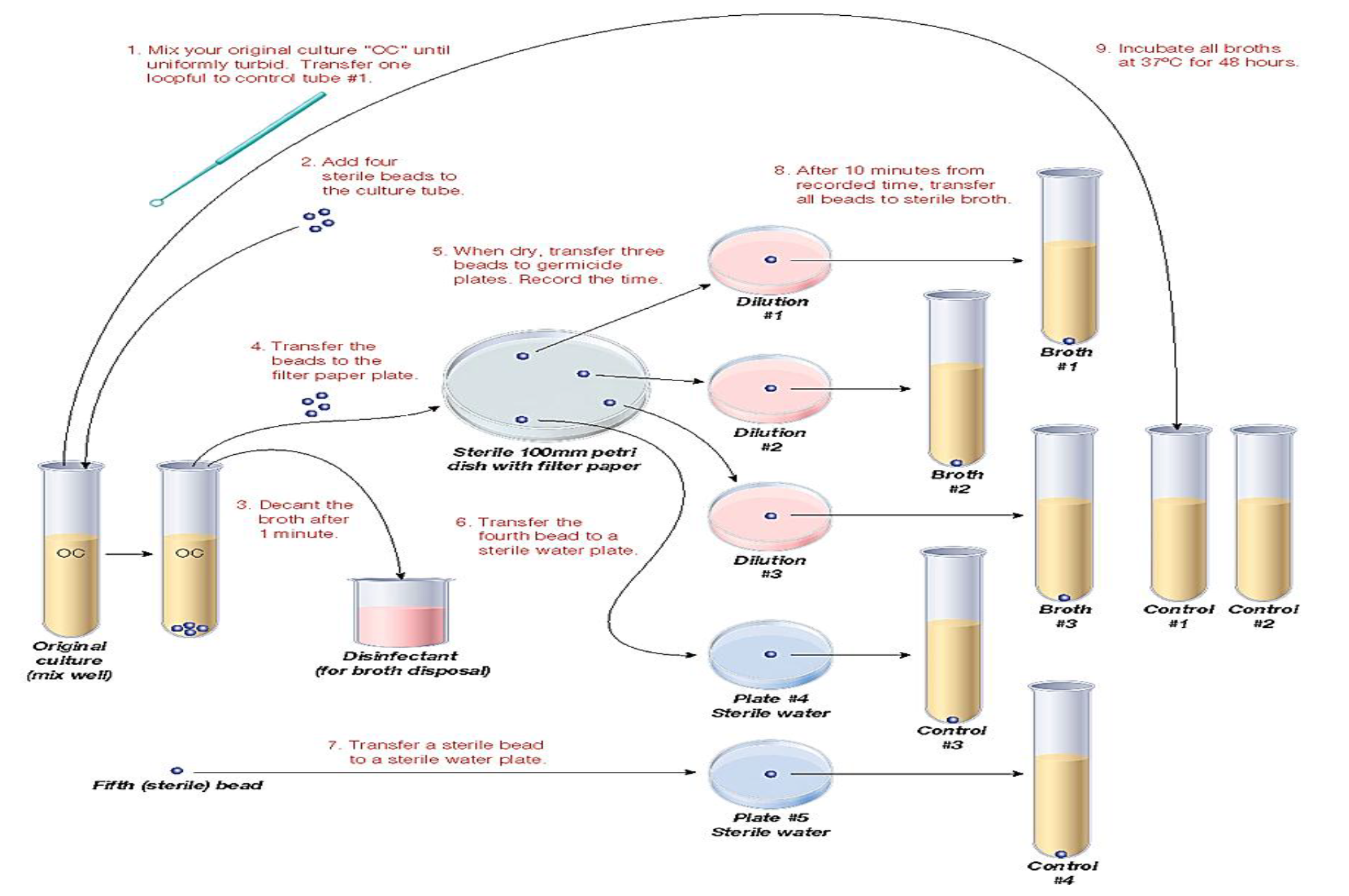
The purpose of the second control is to make sure that the broth is sterile and uncontaminated, since it was not inoculated. If there is growth, this means that the broth was contaminated.
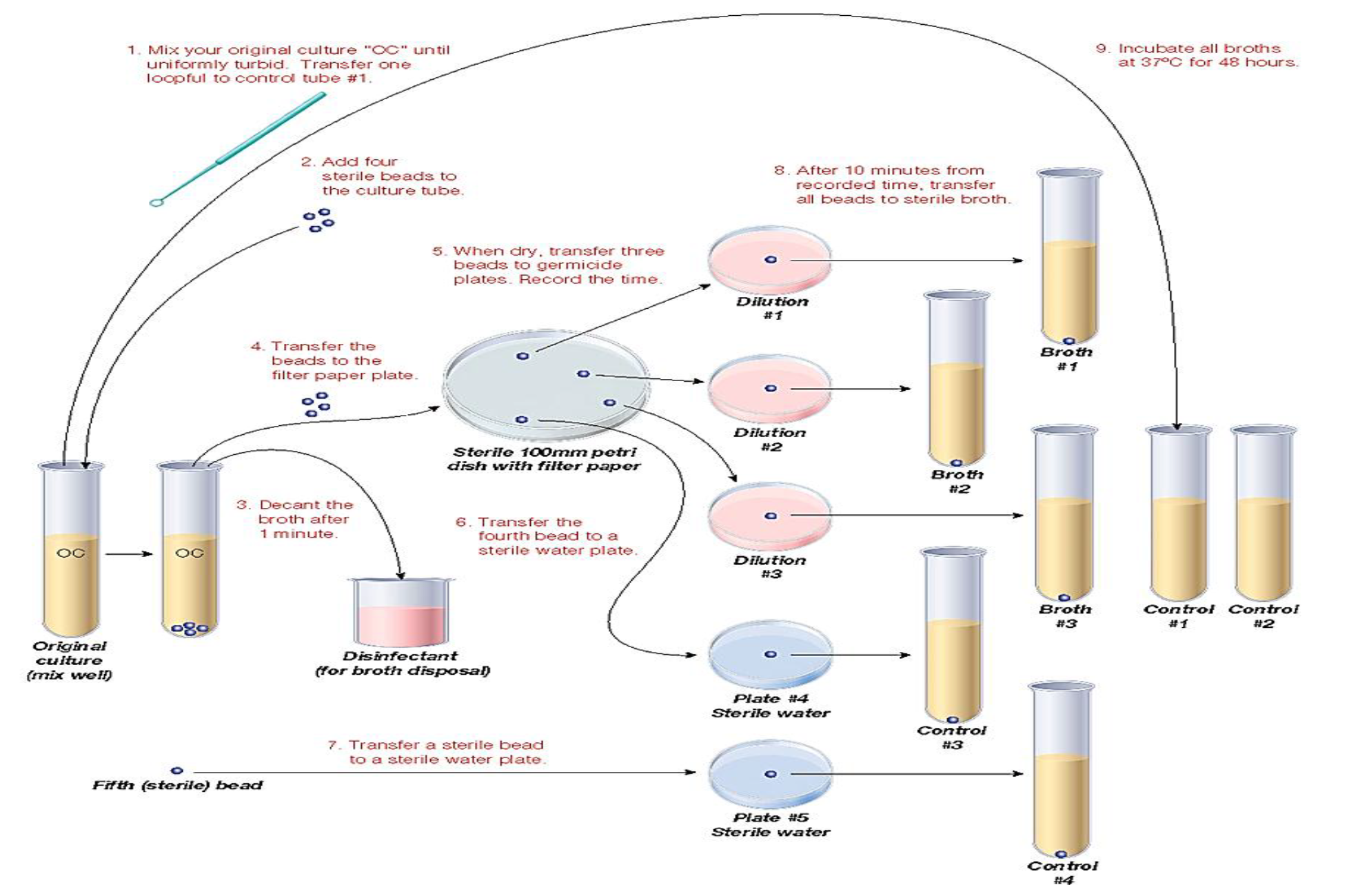
Purpose of Control 3
The purpose of the third control is to confirm that the bead is properly coated with bacteria, which can be seen by the presence of growth. If no growth is present, this means that the bead was not properly coated.
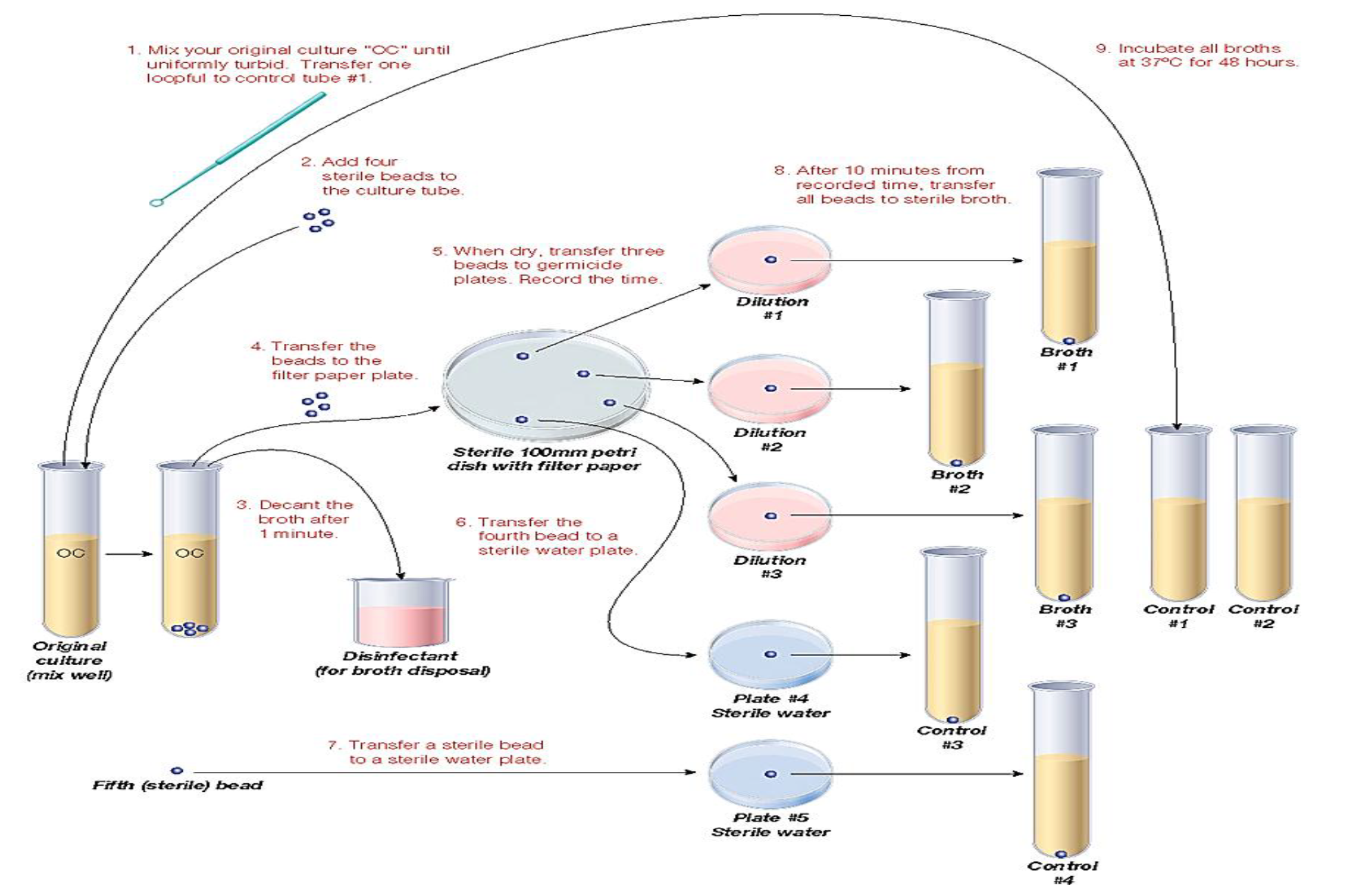
Purpose of Control 4
The purpose of the fourth control is to confirm that both the bead and water were sterile. If there is growth, this means that the bead or water was contaminated.
Which bacterial strain do you think seemed to be most resistant to the germicides and why?
E. coli is the most resistant to germicides due to its Gram-negative cell structure, which acts as a protective barrier and allows it to pump out harmful substances, form biofilms, and quickly repair damage to its DNA and proteins.
Germicides used in the the Chemical Germicides Lab:
1. Lysol
2. Fabuloso
3. Isopropyl Alcohol (IPA)
Gram-negative against germicide appeared to be....
more resistance due to outer membrane = allow them to better withstand disinfectants
Gram-positive against germicide appeared to be....
less resistance due to no outer membrane = easier entry of disinfecting agent
Technically _______ will be most effective since they are used on inanimate objects
Disinfectant
while antiseptics are not so strong since they will become too irritating for skin
What is the difference between a disinfectant and an antiseptic?
A) Disinfectants kill bacteria whereas antiseptics just inhibit the growth.
B) Antiseptics kill bacteria whereas disinfectants just inhibit the growth.
C) Disinfectants can be used on anything whereas antiseptics are only for instruments.
D) Antiseptics are used on people whereas disinfectants are used on objects.
D) Antiseptics are used on people whereas disinfectants are used on objects.
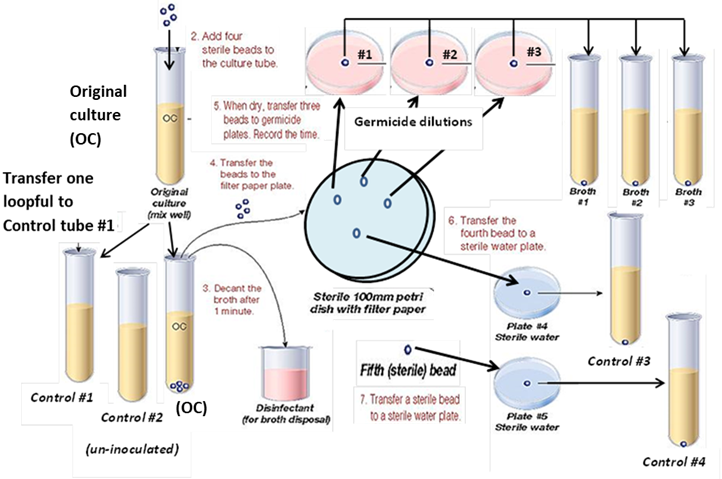
Below is the experimental protocol of Lab 10 to examine the effectiveness of specific germicides. The original culture is a 24 hour old nutrient broth culture of the test bacterium. Other test tubes contain nutrient broth to which various manipulations were carried out; four are controls.
If there is growth in the control #2 tube the experiment results cannot be interpreted. Why does growth in this tube prevent the use of the other results and interpretation of the effectiveness of the agents?
A) It indicates that the broth being used throughout the experiment was likely contaminated.
B) It demonstrates that the bacteria being used are resistant to disinfectants.
C) It demonstrates that the disinfectants were not diluted correctly.
D) It indicates that the bacteria will grow without incubation.
A) It indicates that the broth being used throughout the experiment was likely contaminated.
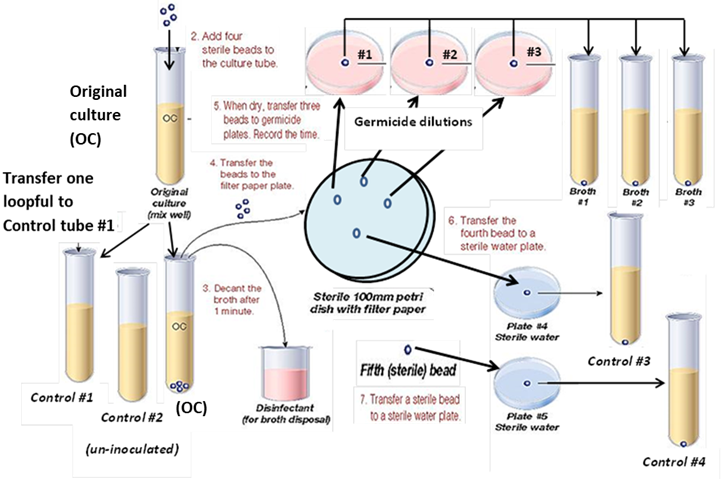
Below is the experimental protocol of Lab 10 to examine the effectiveness of specific germicides. The original culture is a 24 hour old nutrient broth culture of the test bacterium. Other test tubes contain nutrient broth to which various manipulations were carried out; four are controls.
What is the purpose of control tube #4?
A) To demonstrate the tubes being used were sterile.
B) To demonstrate that bacteria will grow in the broth.
C) To demonstrate that the beads being used were sterile.
D) To demonstrate that bacteria can grow in some disinfectants.
C) To demonstrate that the beads being used were sterile.
Of the germicides test in Lab 10, which is/are generally classified as an antiseptic?
A) Lysol
B) Isopropyl alcohol (IPA)
C) Fabuloso
D) two of the above
E) none; A, B, and C are all antiseptics
B) Isopropyl alcohol (IPA)
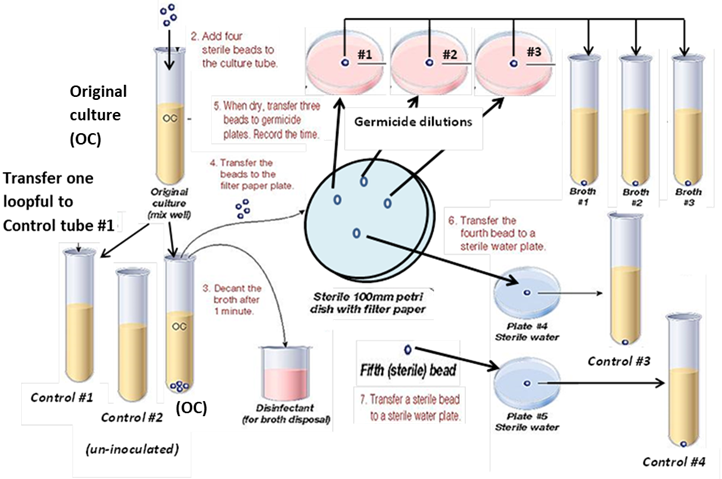
Below is the experimental protocol of Lab 10 to examine the effectiveness of specific germicides. The original culture is a 24 hour old nutrient broth culture of the test bacterium. Other test tubes contain nutrient broth to which various manipulations were carried out; four are controls.
Which control tube is used to compare to test broths 1, 2, and 3 in order to evaluate the effectiveness of the germicide?
A) Control tube 1
B) Control tube 2
C) Control tube 3
D) Control tube 4
C) Control tube 3
In the Lab 10 experiment, what was the logic in choosing Staphylococcus aureus and Escherichia coli as the test organisms?
A) One produces endospores whereas the other does not.
B) One is Gram-positive and one is Gram-negative.
C) They are both pathogens.
D) They are both highly drug resistant.
B) One is Gram-positive and one is Gram-negative.
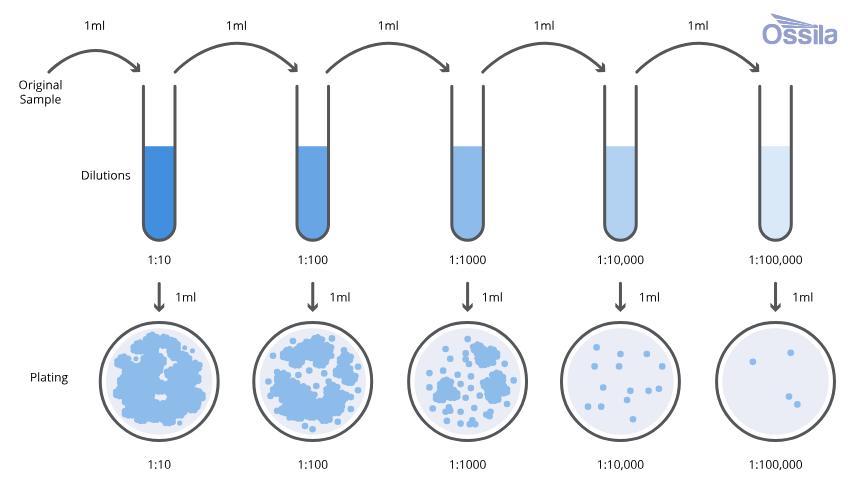
A Quantitively Technique is number of pathogens left is the...
Standard Plate Count
CFU definition
colony forming unit
standard quantitation unit of plate counts
Units used for CFU
CFU/mL
True or false:
We want a dense count of inoculum to count
False
We want a sparse count and if dense then we need to dilute, dilute, dilute! (serial dilution)
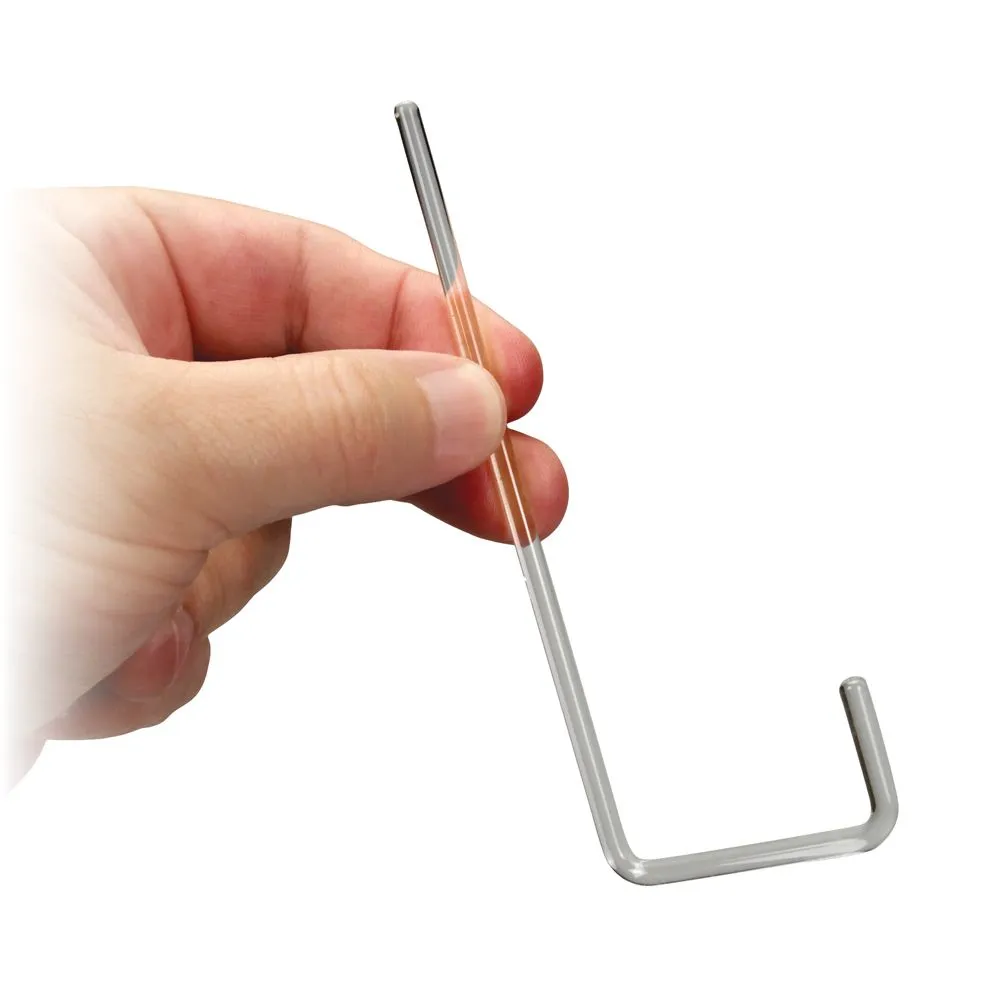
A spread plate is done to start the serial dilution process where what instrument is used to spread the inoculum all over plate?
A glass rod L shape instrument
Formula V1D1=V2D2
where V1D1 = ?
and V2D2 = ?
V1D1 = volume and dilution of broth
V2D2 = volume and dilution of complete dilution
For an undiluted sample D1=
1
formula for Original Cell Density (OCD)
OCD = CFU/(dilution of tube x amount plated)