Past Paper
 Call Kai
 Learn
Learn Practice Test
 Spaced Repetition
 Match
Match Flashcards
 Knowt Play
1/28

There's no tags or description
Looks like no tags are added yet.
Name | Mastery | Learn | Test | Matching | Spaced | Call with Kai |
|---|
No analytics yet
Send a link to your students to track their progress
29 Terms
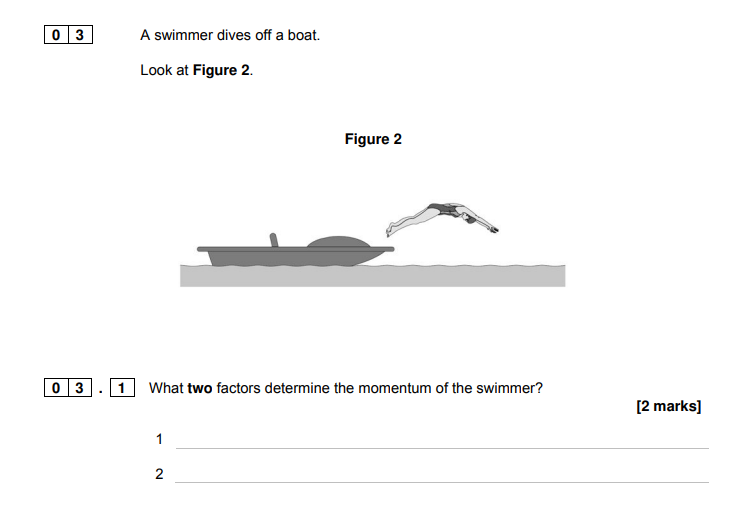
Mass
Velocity
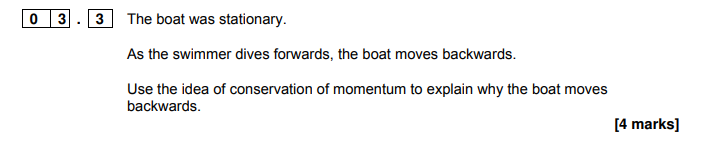
momentum before = momentum after
Before diving in the momentum of the diver and boat is zero
After diving the diver has forwards momentum
Therefore the boat has equal backwards momentum
Explain what would happen to the motion of the boat if there were more people on the boat when the swimmer dived off
The boat moves back more slowly
because there is more mass (but momentum stays the same)
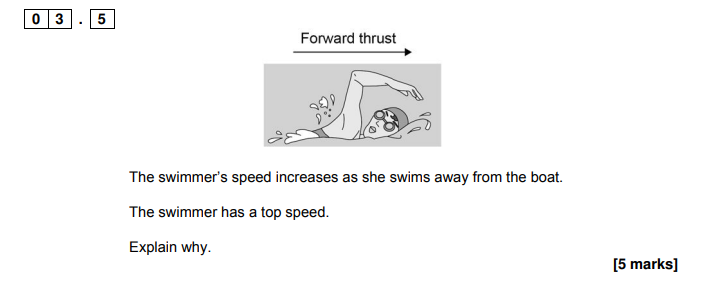
As she swims there is a drag force
As speed increases so does the drag force
She accelerates less
Drag force = thrust force or resultant force is zero
The swimmer reaches terminal velocity
Explain what would happen to a spring if the student kept adding weights?
The spring will be deformed
Because it has passed the elastic limit
Momentum before (collision) = momentum after (collision
Momentum of skater A decreases and momentum of skater B increases
Velocity of skater A decreases and velocity of Skater B increases
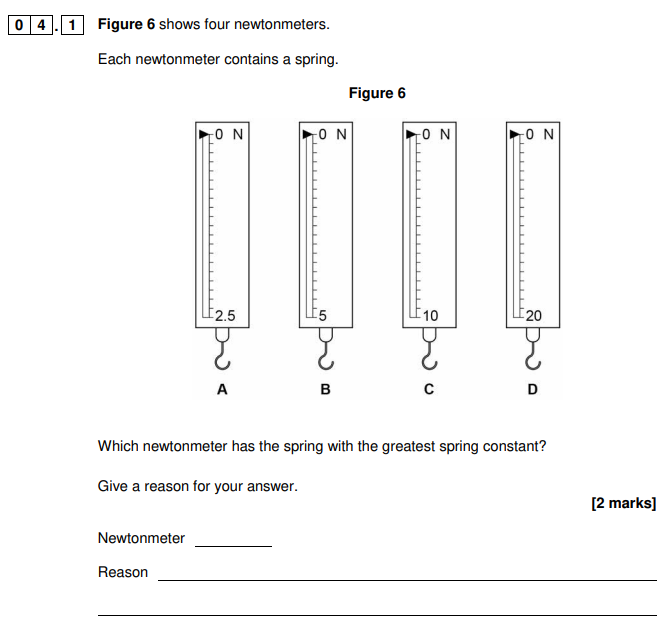
D
Needs the greatest force to extend the spring the same amount
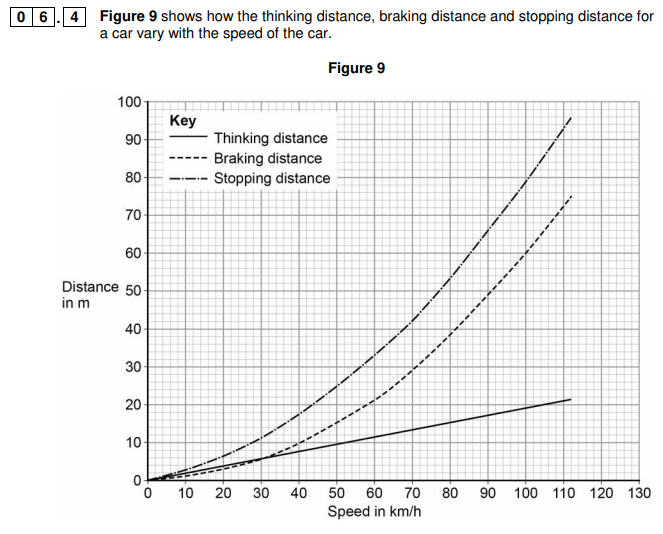
Describe the relationships shown in Figure 9. You should include factors that would affect the gradient of the lines (6 marks)
Use of drugs, alcohol, tiredness and distractions would increase the thinking distance
Thinking distance increases with speed
Thinking distance is directly proportional to speed
Use of drugs, alcohol, tiredness and distractions would increase the gradient of thinking distance
Poor brakes, poor tyres, wet / icy roads and mass would increase the braking distance
Braking distance increases with speed
Braking distance increases at an increasing rate (with speed)
Poor brakes, poor tyres, wet/icy roads and mass would increase the gradient of braking distance
Braking distance is directly proportional to speed squared
Stopping distance = thinking distance + braking distance •
Factors that increase thinking and / or braking distance would increase the gradient of stopping distance
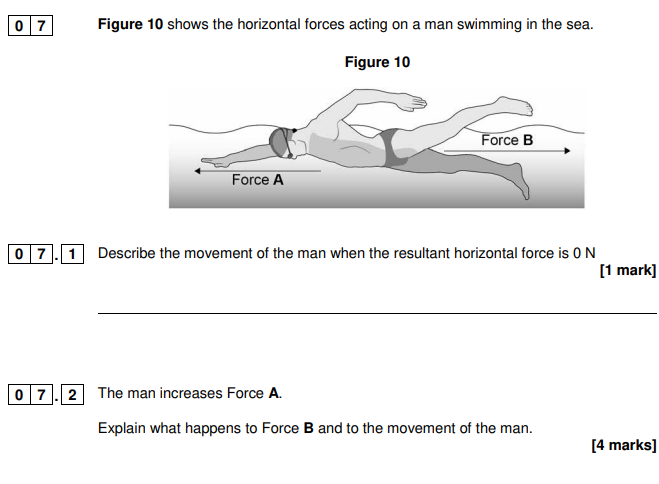
7.1 Constant velocity
7.2 The man will accelerate, so force B increases, until force B equals force A, the man moves at a higher constant velocity
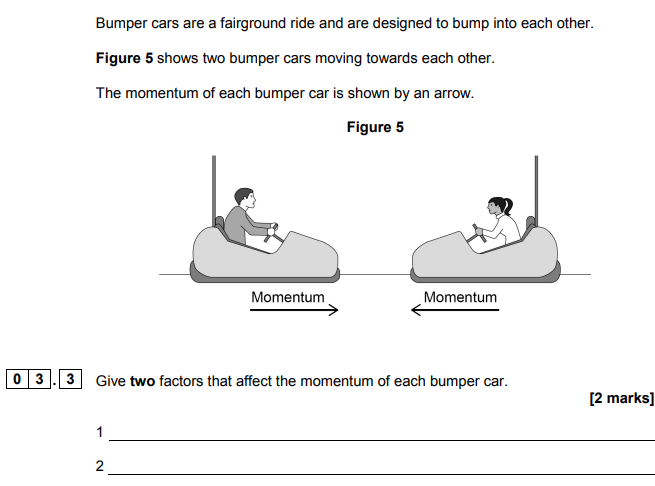
Velocity
Mass

Total momentum is zero after the collision (because the bumper cars are stationary)
Because the momentum of each car before the collision was equal (in magnitude) and opposite (in direction)
So the total momentum of the bumper cars was zero before the collision
and momentum is conserved

Springs with a low spring constant
Because they can compress by a larger amount (for a given force)
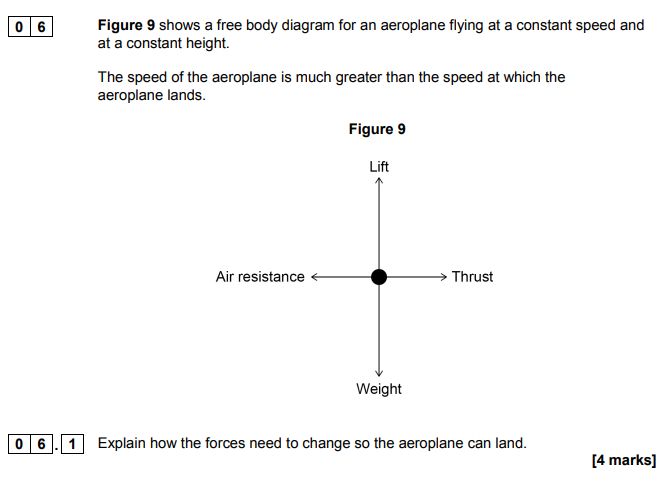
Thrust decreases so there is a resultant force in opposite direction
Lift must decrease (because weight stays the same) so there is a resultant downwards force
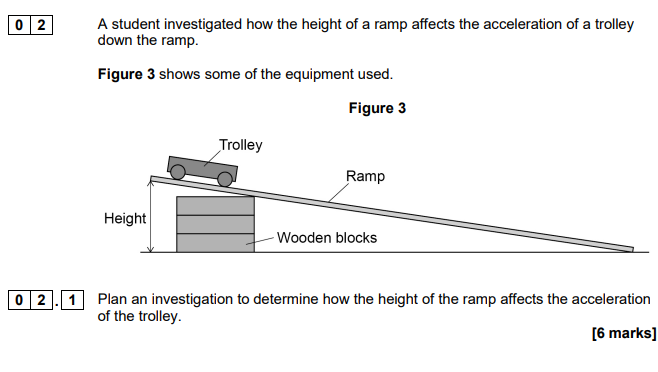
Measurements:
Place one wooden block under the ramp
Vary the height by placing a different number of wooden blocks
Measure the height of the ramp using a metre rule
Measure the distance travelled using a metre rule
Measure time taken using light gates (and computer/datalogger)
Measure time taken using a stopclock or ticker timer
Release trolley from the same position each time
Release the trolley without applying a force results
Results:
Repeat at the same height and calculate a mean
Repeat for different heights
Calculate acceleration using a = (v-u)/t or a = v2- u2 / 2s
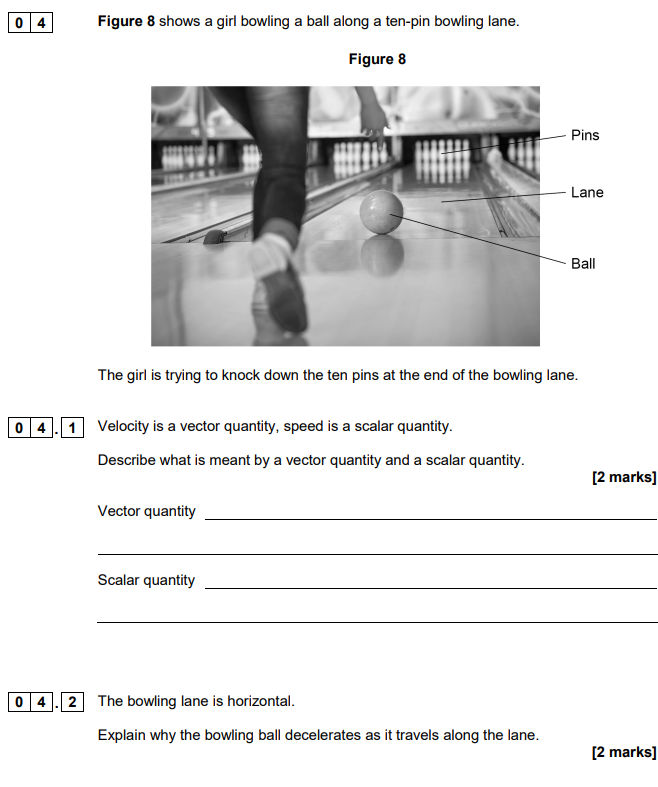
4.1 Scalar quantity has magnitude and no direction, vector quantity has magnitude and direction
4.2 Resistive force acts on the ball, so (resultant) force in opposite direction to velocity

Momentum is conserved in the collision (assuming no external forces)
Momentum of the pin increases
Therefore the momentum of the ball must decrease
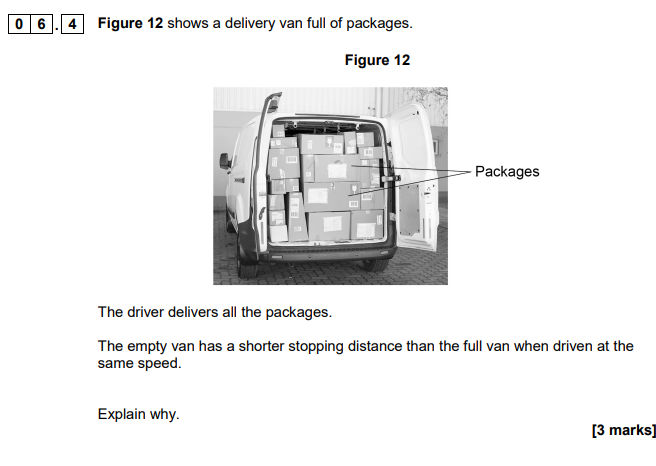
Same maximum force applied by the brakes
Because mass is less there is a greater deceleration
Braking distance is less
At maximum power the forward force of the engines is constant
As it accelerates the air resistance increases
Resultant force = force from engines – air resistance
Therefore resultant force decreases
Acceleration is directly proportional to resultant force
A train collides with a stationary carriage on a track.
Explain why the velocity of the train after the collision is less than it was before the collision. Use ideas about momentum in your answer
Total momentum is conserved in the collision
During the collision the momentum of carriage increases
So the momentum of train decrease
Since mass (of train) is constant, velocity (of train) decreases
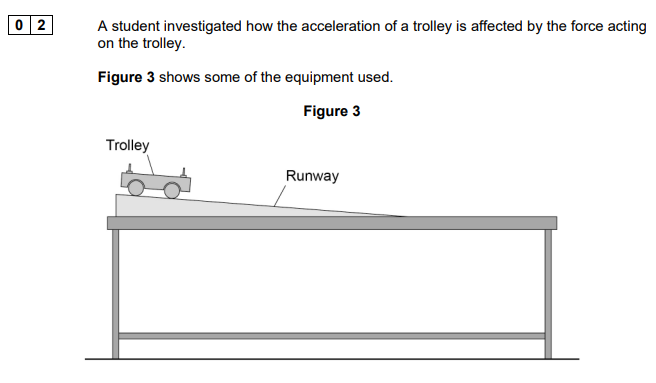
Describe a method the student could use
Clamp a pulley onto the edge of the desk
Attach a string to the trolley and place the string over the pulley
Attach a mass holder to the string
Place a slotted mass on the mass holder
Use W = mg to calculate the force
Mark the starting and finishing points of the trolley on the runway
Measure the distance between the two marks with a metre rule
Time how long it takes to travel between the two marks with a stopclock / timer
Use v = s / t and a = Δv / t
Describe what is meant by ‘inelastically deformed’
Will not go back to its original length
When the force is removed
Explain why large decelerations may be dangerous
The brakes can overheat
(so) the brakes will not work properly
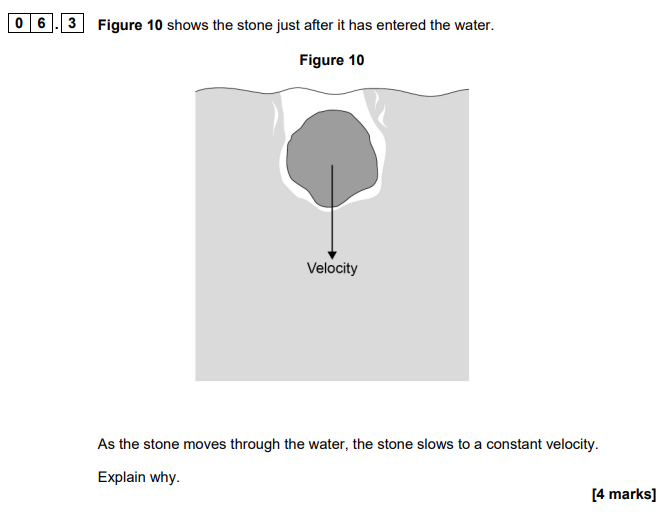
Drag is greater than weight
(so) there is a resultant force acting in the opposite direction to the velocity (causing deceleration)
As velocity decreases the drag decreases
(until) drag is equal to weight (so velocity is constant)
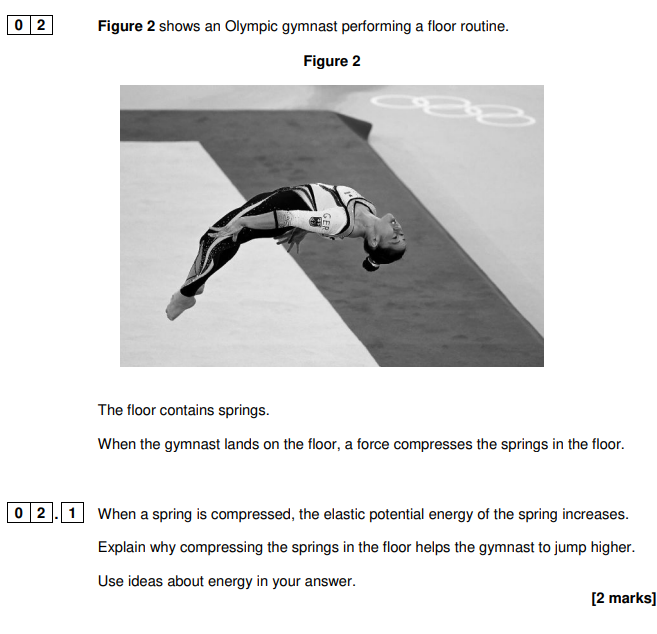
(as a spring decompresses) the spring exerts a force on the gymnast
(so) work is done on the gymnast
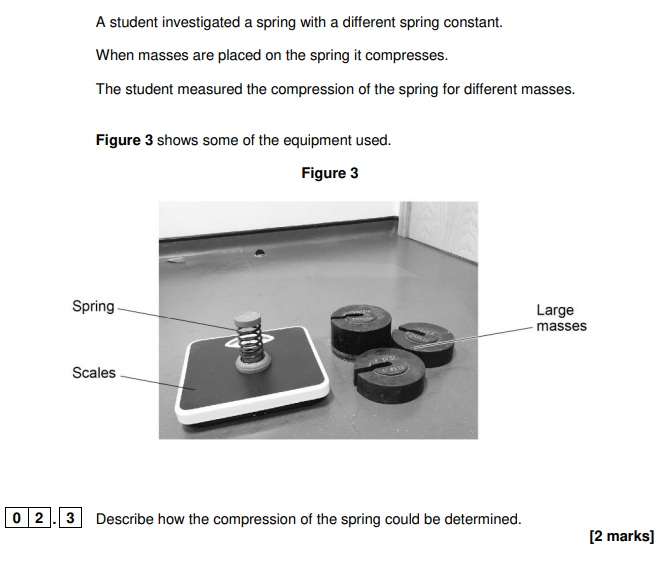
measure the original length of the spring and the compressed length of the spring (using a metre rule)
compression = original length − compressed length
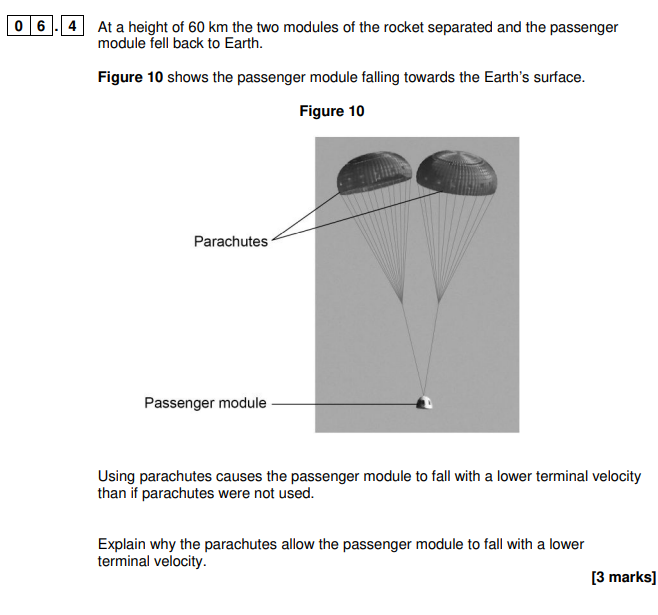
Parachutes increase the effective area
(so) there is the same air resistance at a lower speed
(so) resultant force is zero at a lower speed (with the parachutes open)
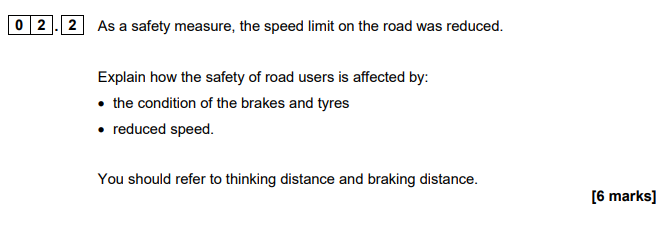
Thinking distance:
Condition of brakes and tyres does not affect thinking distance
Speed does not affect thinking / reaction time
Decreased speed decreases thinking distance
Braking distance:
Condition of tyres affects friction between tyres and road
Poor condition of tyres and brakes increases braking distance
Decreased speed decreases braking distance
Safety:
Stopping distance = thinking distance + braking distance
Poor condition of brakes and tyres increases stopping distance
Decreased speed decreases stopping distance
Decreased speed decreases the chance of the driver losing control of the vehicle
Decreased speed decreases the chance of a collision
Decreased speed decreases the risk of injury during a collision
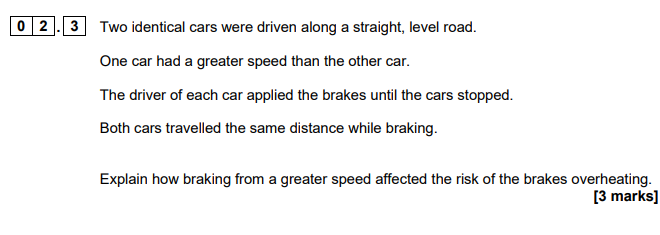
Frictional / braking force is greater (for the faster car)
(so) more work done
(so) the risk of the brakes overheating is greater