PSY 2710 Final Exam
 Call Kai
 Learn
Learn Practice Test
 Spaced Repetition
 Match
Match Flashcards
 Knowt Play
1/112

There's no tags or description
Looks like no tags are added yet.
Name | Mastery | Learn | Test | Matching | Spaced | Call with Kai |
|---|
No analytics yet
Send a link to your students to track their progress
113 Terms
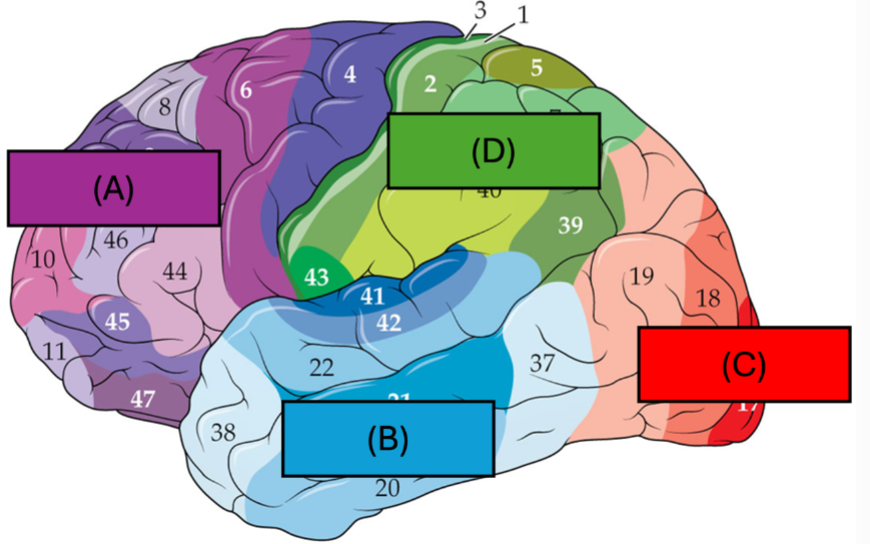
Use the following picture to label the lobes of the brain
A. Frontal
B. Temporal
C. Occipital
D. Parietal
_____ is the tendency to seek out or emphasize information that fits with our existing beliefs, while ignoring or discounting information that contradicts them.
Confirmation bias
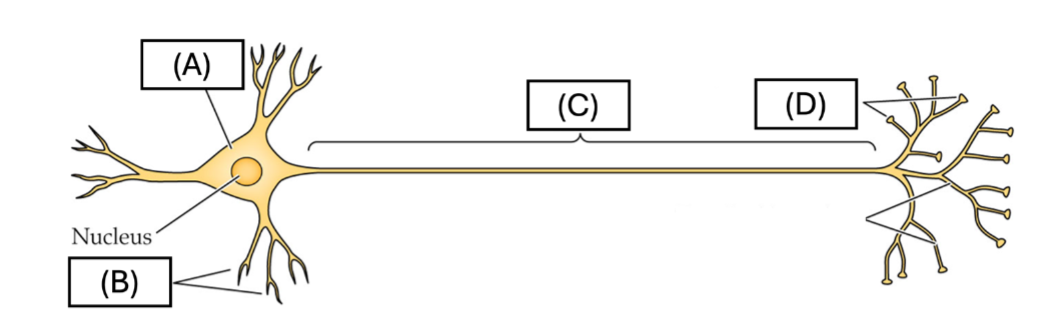
Use the following picture to label the parts of the neuron.
a. Soma/cell body
b. dendrites
c. axon
d. axon terminals
_______ are evolutionary mechanisms that, on average, enhanced the reproductive success of those creatures that possessed them.
psychological adaptions
Match each anatomical term with its correct definition
a. rostral
b. caudal
c. dorsal
d. ventral
definitions:
towards the tail end
towards the top or back
towards the mouth or front end; the “nose” axis
towards the belly or bottom
a) Rostral Towards the mouth or front end; the "nose" axis
b) Caudal Towards the tail end
c) Dorsal Towards the top or back
d) Ventral Towards the belly or bottom
Efferent nerve fibers (select all that apply):
a) carry info from the CNS to the body
b) carry info from the body to the CNS
c) are motor neurons
d) are sensory neurons
a) carry info from the CNS to the body
c) are motor neurons
_____ is the tendency to seek out or emphasize information that fits with our existing beliefs, while ignoring or discounting information that contradicts them.
confirmation bias
The ability of the brain to change its neural pathways and connections over time because of behavior changes, learning, or memory, or in response to injury or degeneration is known as:
plasticity
The uppermost section of the spine is called the:
cervical
According to the authors of the textbook, why is important to put your neurons in a brain at all?
It solves the problem of movement
There are three main ways in which neurons fire in order to encode information.
Match each method of coding with its correct definition.
Rate Coding
Local Coding
Population Coding
Definitions:
Encoding by changing the number of action potentials
generated
Encoding performed by a single neuron specialized for each particular feature
Encoding represented by the activity of a group of neurons
Rate Coding : Encoding by changing the number of action potentials generated
Local Coding : Encoding performed by a single neuron specialized for each particular feature
Population Coding : Encoding represented by the activity of a group of neurons
The limbic system controls homeostasis and consciousness.
True
Circuits in the spinal cord fire in an alternating left–right patterns to drive locomotion in animals. In effect, this is a more complex type of reflex arc, one in which motor neurons are controlled by interneurons that fatigue one side of the body and allow for it to rest while the other side moves.
central pattern generator
Damage to this area of the brain interferes with the smooth, efficient movements of body parts to their targets in the surrounding environment
cerebellum
The corpus callosum is a large bundle of fibers that allows the hemispheres of the brain to communicate with each other.
True
The hippocampus forms a close relationship with the amygdala, playing a role in learning, memory, and emotion.
True
It is estimated that the neurons of the brain make _____ synaptic connections.
100-500 trillion
Which of the following is an advantage of having populations of neurons encode stimuli rather than individual “grandmother cells?"
It permits a greater range of representation than could be achieved by a single neuron
The synapse is the space between neurons in which neurotransmitters are released and signal from presynaptic to postsynaptic membranes.
True
This type of summation occurs when EPSPs arrive close in time and their summed contributions lead to the firing of an action potential.
Temporal
Cognitive neuroscience seeks to understand the _____ underlying human thoughts and behaviors.
brain activity
Match each cranial nerve with its major function
IV: Trochlear
V: Trigeminal
VI: Abducens
X: Vagus
Functions:
Controls eye movements
Controls Chewing
Controls eye movement
A major pathway of the parasympathetic nervous system
IV: Trochlear : Controls eye movements
V: Trigeminal: Controls chewing
VI: Abducens: Controls eye movements
X: Vagus: A major pathway of the parasympathetic nervous system
Match each lobe of the brain with its main functions.
Parietal
Occipital
Temporal
Frontal
Functions:
a. This lobe of the brain is responsible for functions including processing somatosensory information and mapping the locations of visual, auditory, and somatosensory stimuli into coordinates centered on various parts of the body to help guide movements of those body parts.
b. this lobe of the brain is devoted mostly to processing visual information
c. This lobe of the brain is responsible for functions including motor control and higher-order cognitive functioning such as planning, decision-making, goal selection, and assigning value to options.
d. This lobe of the brain is responsible for functions including identification of visual and auditory stimuli, some aspects of language processing, social cue perception, and functions related to the hippocampus such as episodic memory recall and spatial navigation.
A. Parietal
B. Occipital
C. Frontal
D. Temporal
Match each nervous system with the role that it plays.
Somatic nervous system
Autonomic nervous system
Sympathetic nervous system
Parasympathetic nervous system
a. coordinates the fight or flight response
b. guides the body’s movements via the muscles
c. guides the activity of the internal organs
d. calms the body and is associated with rest and regeneration
a. Sympathetic nervous system
b. somatic nervous system
c. autonomic nervous system
d. Parasympathetic nervous system
Put the steps of a reflex arc in order from beginning to end.
An interneuron in the grey matter of the spinal column connects motor and sensory neurons
Information travels along motor nerve fibers in the hamstring
The doctor hits you with a patellar hammer
Information travels along sensory nerve fibers in the quadriceps
Step 1 : The doctor hits you with a patellar hammer
Step 2: Information travels along sensory nerve fibers in the quadriceps
Step 3: An interneuron in the grey matter of the spinal column connects motor and sensory neurons
Step 4: Information travels along motor nerve fibers in the hamstring
How might your hypothalamus try to compensate when it senses that you are dehydrated?
The hypothalamus compares the current state against ideal set points.
The hypothalamus collects information from sources such as the bloodstream, hormone, and spinal cord.
The hypothalamus outputs to the cerebral cortex, to enact goals and plans of action
The hypothalamus coordinates compensatory mechanisms, such as sending signals to increase heart rate and constrict blood vessels to maintain blood pressure.
Step 1: The hypothalamus collects information from sources such as the bloodstream, hormone, and spinal cord.
Step 2: The hypothalamus compares the current state against ideal set points.
Step 3: The hypothalamus coordinates compensatory mechanisms, such as sending signals to increase heart rate and constrict blood vessels to maintain blood pressure.
Step 4: The hypothalamus outputs to the cerebral cortex, to enact goals and plans of action.
Match each type of glial cell with one of its major functions.
Oligodendrocytes
Schwann cells
Astrocyte
Microglia
Functions:
a. Creation of myelin in the peripheral nervous system
b. Immune defense and destruction of foreign bodies
c. Repairs injuries and regulates blood flow
d. Creation of myelin in the central nervous system
D. Oligodendrocytes
A. Schwann cells
C. Astrocyte
B. Microglia
A blockage of blood supply to the brain might result in a:
stroke

Correctly label each type of neuron
bipolar neuron
monopolar neuron
multipolar neuron
A. Multipolar neuron
B. Bipolar neuron
C. Monopolar neuron
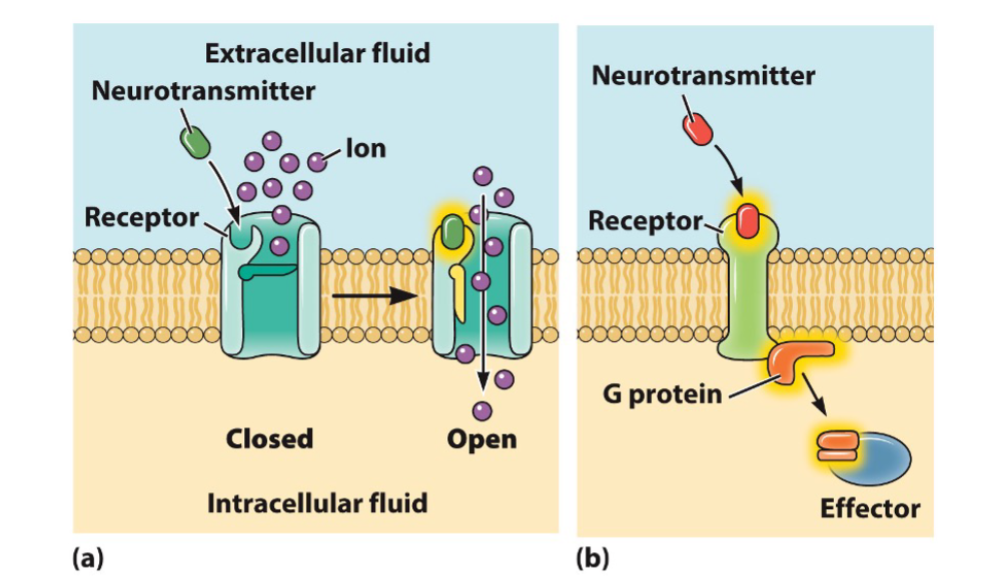
Correctly identify each receptor type
Inotropic
Metabotropic
A) Ionotropic
B) Metabotropic
A good deal of what that brain believes it is experiencing depends on its:
expectations
A neuroscientist would be interested in learning how the brain:
all of the above
A popular hypothesis for the function of sleep is:
All of the above
A scientist interested in studying ____ may use a large-group lesion study.
Any of the above
A traumatic injury, such as a blow to the head, may result in brain:
lesions
Advances in neuroscience have led to changes in how we view:
all of the above
An example of a human brain interface device is the:
retinal implant
Approximately 80% of those incarcerated in prisons are mentally ill.
False
Continued neuroscience research has the potential for:
All of the above
A spinal cord injury would have no bearing on the ability to feel pain.
False
Anterior means "toward the back."
False
Destruction of the _____, which regulates heart rate and blood pressure, is fatal.
medulla oblongata
If damage occurred to the hippocampus, we would expect to see a decreased ability to process visual stimuli
False
Making eye movements requires the _____ cranial nerve.
Oculomotor
Most neurons are unconnected to other neurons.
False
Processing emotions from sights, sounds, and smells would be handled by this limbic structure:
Anygdala
The _____, or "little brain," contains an enormous number of neurons compared to its size.
cerebellum
The anatomical word for "on the opposite side" is:
Contralateral
The anatomical word for "toward the middle" is:
Medial
The cerebral cortex controls such higher functions as:
goal planning
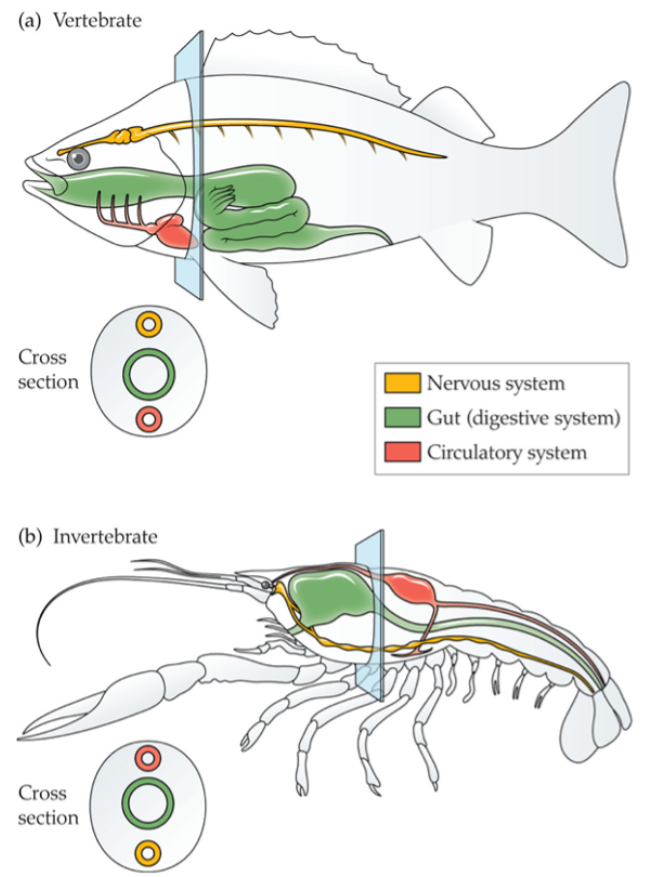
This image provides evidence for which of the following?
The vertebrate nervous system may actually be an upside-down relative of the invertebrate nervous system
Match each adult brain structure with the area from the three-zone stage that it divides from.
a. pons
b. midbrain
c. cerebellum
d. cerebral hemispheres
Zones:
mesencephalon
rhombencephalon
prosencephalon
myelencephalon
a. pons - rhombencephalon
b. midbrain - mesencephalon
c. cerebellum - rhombencephalon
d. cerebral hemispheres - prosencephalon
The dermatome that corresponds with the lumbar spine is located in the:
legs
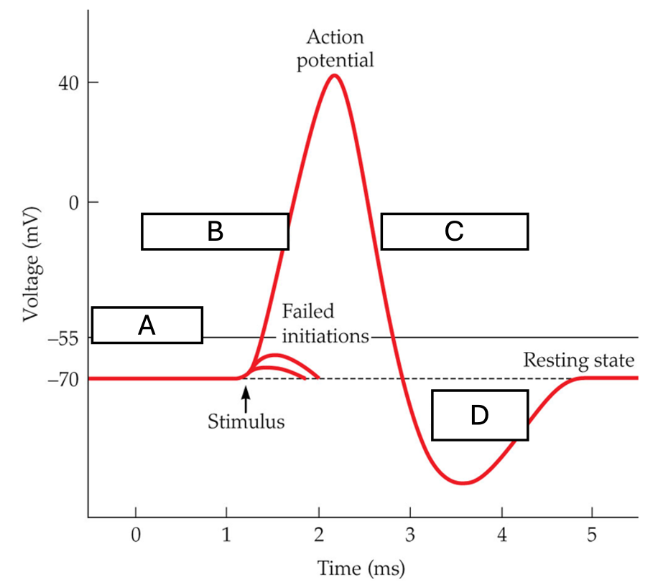
Use the following diagram to label key terms associated with the action potential
A. Threshold
B. Depolarization
C. Repolarization
D. Refractory Period
A model of motor control in which the cerebellum calculates a model of the future positions of the body and external objects for more accurate movement guidance is known as the:
forward model
Match each area of the midbrain with the role that it plays
Superior colliculus
Inferior colliculus
Periaqueductal gray matter
Reticular formation
a. organizes stereotyped forms of basic survival behaviors such as defense, aggression, and reproduction
b. processes auditory inputs and directs automatic eye movements
c. processes visual inputs and directs automatic eye movements
d. plays a central role in regulating states of consciousness
c. Superior colliculus
b. Inferior colliculus
a. Periaqueductal gray matter
d. Reticular formation
At rest, there are more ______ ions outside the cell, and more _______ ions inside the cell.
sodium; potassium
Cells that wire together fire together -- experience-dependent plasticity in which cell A repeatedly stimulates cell B, resulting in a strengthened connection between cells A and B is known as:
hebbian learning
The brain dynamically reorganizes to match its inputs. For someone who is born blind, which area of the brain would we expect to remap, for instance to handle auditory and tactile processing?
occipital lobe
When viewing these ambiguous images, we can understand which image the subject has decided on by recording neuronal activity via:
microelectrodes
A network of brain regions that is active while the brain is at rest, or engaged in self-reflection or rumination (as opposed to a specific external or cognitive task); it is the most active network of regions in the brain overall.
default network
Rather than being an accurate reflection of the events that took place, memory is full of errors and other problems. Part of these problems arise from consolidation and reconsolidation. Match each term with its correct definition.
Terms: reconsolidation and consolidation
Definitions
the process of moving information from short term memory into long term memory
A process by which a previously established memory can be made unstable once again and vulnerable to modification or rewriting, while it is being retrieved or recollected
a) A process by which a previously established memory can be made unstable once again and vulnerable to modification or rewriting, while it is being retrieved or recollected. Reconsolidation
b) The process of moving information from short-term memory into long-term memory. Consolidation
Chemical messengers that affect plasticity so that changes can occur are known as:
neuromodulators
The brain area most responsible for episodic memory is the
hippocampus
Which area of the brain stores episodic memories?
medial temporal lobe
There are several methods for localizing human brain function. Match each method with its correct definition or an example of that method.
Optogenetics, Diffusion tensor imaging, EEG of fMRI, may be conducted during neurosurgery, H.M.
a) Correlational evidence
b) Lesion evidence
c) Stimulation evidence
d) Connectivity evidence
e) Causal evidence
a) Correlational evidence - EEG or fMRI
b) Lesion evidence - H.M.
c) Stimulation evidence - May be conducted during neurosurgery
d) Connectivity evidence - Diffusion tensor imaging
e) Causal evidence - Optogenetics
Indicate what is happening in NMDA receptors during the steps of LTP.
NMDA receptors are blocked from opening by the presence of magnesium
Calcium induces secondary-messenger systems in the post synaptic cell
High frequency input causes a depolarization, which leads to magnesium leaving the receptor site and ions to flow into the NMDA receptors
a) Step 1: NMDA receptors are blocked from opening by the presence of magnesium.
b) Step 2: High-frequency input causes a depolarization, which leads to magnesium leaving the receptor site and ions to flow into the NMDA receptors
c) Step 3: Calcium induces secondary-messenger systems in the post-synaptic cell
Following his surgery, H.M. had severe anterograde and gradual retrograde amnesia. Match each of these terms to their correct definition.
Terms: retrograde amnesia and anterograde amnesia
Definitions:
an inability to retrieve episodic memories of events that occurred for a certain period of time immediately preceding a brain injury
inability to form new memories for a period of time following a brain injury
a) Retrograde amnesia - An inability to retrieve episodic memories of events that occurred for a certain period of time immediately preceding a brain injury.
b) Anterograde amnesia - Inability to form new memories for a period of time following a brain injury.
The BBB model proposes that place cells in the hippocampus are important for:
all of the above
The types of cells underlying our cognitive maps are:
place cells and grid cells
Cells within the brainstem that project up to the more anterior regions of the brain to increase arousal are part of the:
ascending reticular activating system
The stage of sleep in which dreaming occurs is known as:
REM
This area of the brain plays a key role in alertness, and its neurons fire at a high rate when alert and a slowed rate when sleeping.
reticular formation
Synchronization of neural activity is an important mechanism underlying attention and awareness. Synchronization at _____ leads to attention, while synchronization at _____ does not.
high frequencies; low frequencies
Damage to the right lateral parietal regions, lateral prefrontal regions, and medial motor regions of the brain can result in a condition in which the patient fails to attend to one side of space, known as _____.
hemineglect
Research on consciousness and awareness show activation spreading beyond sensory areas and into the _____ lobes when we are aware of and attending to a particular stimulus (select all that apply).
frontal
parietal
occipital
temporal
frontal and parietal
A final method for studying attention is via perceptual rivalry, where we show one image to one eye and another image to the other eye. When we do this, which of the following perceptions do we have?
A perception that is alternating between the two images
A second method for studying attention is via the oddball paradigm. We can use this to study both bottom-up and top-down mechanisms of attention. To study _____, we insert a novel oddball, whereas to study _____, we tell participants to ignore the novel oddball and respond to the normal oddballs.
bottom up; top down
When the cue is Posner's orienting paradigm is valid, we see a _____, whereas when the cue is invalid we see a _____
reaction time benefit; reaction time cost
Match each term with its correct definition:
Terms: inattentional blindness and change blindness
Definitions:
Failure to notice a stimulus when attention is directed elsewhere
The inability to detect differences between two stimuli
a. Failure to notice a stimulus when attention is directed elsewhere - Inattentional blindness
b) The inability to detect differences between two stimuli - Change blindness
_____ are alternating stripes in the visual cortex that represent cells responding to signals from either the left or the right eye
ocular dominance columns
_____ are protein factors secreted by a neuron's target, allowing for the survival, development, and function of neurons by driving neurons to make connections and stabilize them
neurotrophins
Given the principles of brain reorganization, the best treatment for strabismus is to:
cover the strong eye
The destruction of unneeded neurons happens via _____, in an uncontrolled fashion, and _____, in a deliberate, programmed fashion.
necrosis; apoptosis
Sperry's _____ hypothesis suggests that connections within the visual system are preprogrammed to follow chemical cues to reach their target.
chemoaffinity
Which neuromodulator is most involved in brain changes, given that it is activated by reward, punishment, and when learning a new task, but not when a task is learned?
acetylcholine
The structural changes that we see in brains as a reflection of careers and hobbies for instance, enlarged hippocampi in taxicab drivers and structural differences in the neocortex between string and piano players -- are a result of:
adaptive coding
The ability for the brain to change, and retain that new structure, is known as:
plasticity
The reason that the brain changes only when something important happens, as opposed to every time activity passes through it, is the result of diffusely released chemicals called _____, that gate these changes, allowing for changes only at appropriate times
neuromodulatory systems
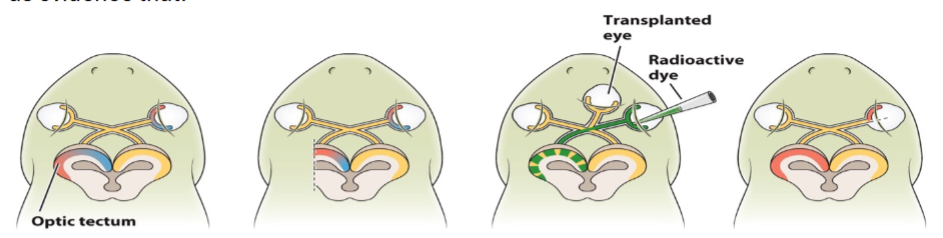
The following graphical representation of Sperry's experiments on frog's eyes gives us evidence that:
input from sensory receptors adjust themselves to available brain tissue
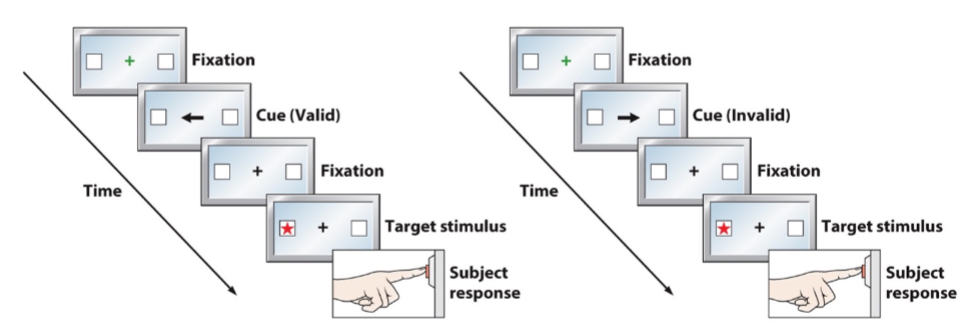
Correctly identify how we study endogenous and exogenous attention by making modifications to Posner's orienting paradigm (seen below), in which valid and invalid cues precede the appearance of a target stimulus in a box on the left- or right-hand side of the screen.
terms: endogenous attention and exogenous attention
definitions:
flashing the box itself, located in the periphery of the screen
the use of an arrow in the center of a screen to indicate which box to look at
a) The use of an arrow in the center of a screen to indicate which box to look at - endogenous attention
b) Flashing the box itself, located in the periphery of the screen - exogenous attention
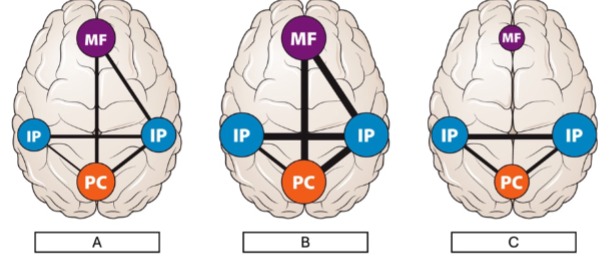
When awake, in light sleep, and in deep sleep, connectivity between brain regions changes via strengthening, weakening, and certain areas going offline. Which of the following connection patterns is indicative of deep sleep?
C
Neurons found in your skin are efferent nerves.
False
A complete removal of half of the cerebrum is referred to as a:
hemispherectomy
A forty-year-old will have little chance of becoming truly proficient in another language.
True
A long-term solution to loss of input is:
growing axons and sprouting new connections
A neuron must find a role in the larger nervous system or else it will:
die out
Adaptive coding occurs when:
brains allocate neural activity depending on the organism's needs
An application for sensory substitution devices is:
all of the above
As brain efficiency goes up, ____ goes down.
plasticity