NSE 481 Final Study Guide
 Call Kai
 Learn
Learn Practice Test
 Spaced Repetition
 Match
Match Flashcards
 Knowt Play
1/105

Earn XP
Description and Tags
This is going to fuckin masssive holy shit
Name | Mastery | Learn | Test | Matching | Spaced | Call with Kai | Chat |
|---|
No analytics yet
Send a link to your students to track their progress
106 Terms
What are the two main types of dosimeters?
Immediate Read and Delayed read/personell monitors
What is an immediate read dosimeter?
Pocket ionization chambers, solid state detectors, and handheld GM/Ionization detectors with dose accumulation function.
How do scintillators work?
An ionizing particle enters a PMT which is absorbed and re-emitted in the form of electrons.
What are delayed read/personnel monitors?
Film Badges, TLD (thermo luminscent dosimeters), OSL (optically stimulated Light-emitted dosimeters)
How does the film work in photographic dosimeters?
Radiation hits photographic emulsion and generates ion pairs near AgBr grains then converting Ag+ ions to Ag atoms.
What is the most common type of radiation dosimeter used?
Film Badges
How do film badges work?
Works by darkening of x-ray film in proportion to radiation absorbed.
How can we eliminate the increased response for energy caused by the photoelectric effect?
Use filters to eliminate it.
What are some pros and cons for using film dosimeters?
Pros: Good resolution, permanent record, cheap, small, wide dose range
Cons: Wet chemical processing (difficult), energy dependence of X-Rays, sensitive to hostile environments, blind to neutrons, and not very durable
How do TLDs work?
Captures radiation dose information in a crystal matrix and releases light when heated. The light intensity is proportional to radiation dose absorbed.
What is the most common material that TLDs are made from?
LiF and CaF2.
What kind of crystals are used for gamma spectroscopy?
NaI(Tl) or HPGe, some CZT
What is the readout cycle?
Pre-heat period, Read period, anneailng period, and cool-down period.
List some pros and cons of TLDs.
Pros: Near tissue equivalent, linear dose response, dose rate independent, good dose range, reusable, can be made into anything, can discriminate between radiations, and is durable.
Cons: Need good QA/QC to create necessary precision, signal fades over time, highly heat sensitive, sensitive to UV lights, needs to be calibrated, highly energy dependent, signal can only be read once, and they are expensive.
How do Optically Stimulated Luminescence Dosimeters work?
Releases information by laser stimulation, they are durable, have high sensitivity, only one vendor, and they have low accuracy for PICs
What kind of dosimeters can detect neutrons?
Albedo Dosimeters
What is the purpose of personnel dosimetry?
The goal is to directly measure ionizing radiation and translate it to a dose or exposure to the person wearing the dosimeter.
What are some pros and cons of an ion chamber?
Pros: Directly reads exposure, high range capability
Cons: Usually not very rugged, usually lower sensitivity
Where must personnel dosimetry be located?
Region of highest potential exposure (trunks).

What are some pros and cons of a GM detector?
Pros: Rugged and sensitive to low levels of radiation, and it’s simple and cheap
Cons: Long resolving time, dead time correction, unusable in high background, and it’s energy dependent.
What are some pros and cons for scintillation counters?
Pros: low sensitivity, cheap, low resolving time, can do beta and alpha detection
Cons: Not very rugged, tends to have energy dependence.
How do BF3 probes work?
uses 10B(n, α) 7Li reaction.
What are the release phases of a severe accident?
Coolant activity release, gap activity release, early in-vessel release, ex-vessel release, and late in-vessel release.
What documents do we reference for all of these motherfucking regulations?
10 CFR 20
How do Albedo Dosimeters work?
They use two thermal neutron senstitive detectors, one to look at thermal neutrons and one to look at the reflected neutrons.
Generally, how do pocket ionization dosimeters work?
Electro-statically charged “leaf” discharges as it is exposed to ionizing radiation. Physical impacts can affect dose readings.
What is the Radiation Chemical Yield?
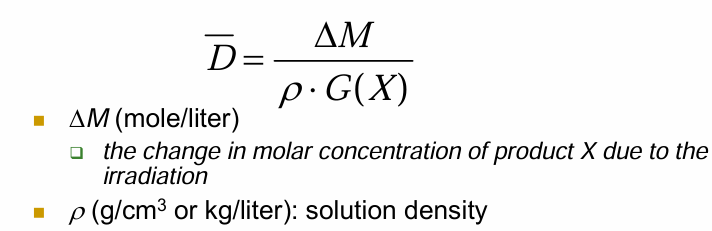
Defined as the number of chemical entities produced, destroyed, or changed by the expenditure of 100 eV of radiation energy in moles/J.
How can we calculate absorbed dose with the Radiation Chemical Yield?
What are some pros and cons of chemical dosimetry?
Pros: Absolute dosimetry is possible, covers a wide dose range, linear dose reponse vs dose in useful ranges.
Cons: Lack of storage stability prevents commercial availability, useful dose ranges too high for small source measurements, and temperature dependent.
When is dosimetry required for adult occupational exposure, pregnant workers, and minors?
10%, 100 mrem, 100 mrem respectively.
How do bubble dosimeters work?
Energy from neutrons interacting vaporizes the liquid, forming a bubble, the number of bubbles is porportional to the dose, they are also reusable, and have a flat energy response.
When would you want to use activation detectors?
Used for nuclear accidents such as criticality accidents.
Why would we want to use an electronic dosimeter?
Easily calibrated, rugged, easy to use, and has decent accuracy, but they are only sensitive to gammas.
What are the limitations of portable survey instruments?
Radiation type, tissue equivalence, energy dependence, radiation intensity, response time, counting efficiency, and directional response.
What are some basic traits that all portable survey instruments must have?
Utilize interactions of radiation with matter, energy deposition in solid, liquid, and gas, utilize electronics to measure results of radiation events, and to convert response to understandable terms.
During the coolant activity release phase, can the radioactive material in the water create a source term?
Yes. Yes it can.
How might a detector obtain tissue equivalence?
Use absorbers, restricting geometry, and use detection material of similar composition to human tissue.
for survey instrumentation, generally what is the range for response times?
1-90 seconds
What are some of the different factors for selecting proper instrumentation?
Anticipating hazards, magnitude of the hazard, and the possibility of changing conditions.
If we have an ion chamber that has a window, what will the detector detect if the window is open or closed?
Window Open: beta and gamma
Window Closed: gamma
If we wanted to detect alpha contamination using a scintillator, what of crystal do we want to use?
ZnS
For GM Detectors, what are two types of probes that are used?
Pancakes (alphas) and tubes (not alphas)
For the Gap Activity Release, how long does this phase usually last in a BWR and a PWR?
30 minutes.
What would we use if we just wanted to detect neutrons?
Use boner spheres
How often should you perform preoperational checks for survey instruments?
Before each use, whenever instrument is out of your control, and whenever the instrument is suspected of not working properly.
How can you check the condition of your survey instrument?
Physically check for damages, check the calibration date, and check the battery.
For the Early In-Vessel Release Phase, as the amount of contamination released into containment is influenced by what?
Residence time of radioactive material in the RCS during core degradation.
True/False: Fission products are typically heavy, so they are alpha emitters.
False, they are neutron rich, and such they are beta emitters.
True/False: Fission product release is highly dependent upon chemistry
True
At what phase does molten corium interact with concrete structural materials?
Ex-Vessel Release.
What is the stages for release for fission products?
Noble gasses (Xe, Kr, Ar), then the halogens and alkali metals (I, Br, and Cs), and the other metals and actinides (U, Pu).
What were some of the assumptions for the 1962 TID-14844 Calculation of Distance for Power and Test Reactor Sites
100% of the noble gases, 50% of the radioiodines, 1% of remaining fission products, and within containment and available for instantaneous release with leakage rates.
During a LOCA incident, where are most of the fission products in the fuel gap?
Most of the fission products remain in the fuel.
For the late In-Vessel Relase phase, how long does it last?
10 hours
If we want to figure out more information on an atmospheric release of raidation, what do we need?
release rate, physical characteristics of the source, and meteorlogical data at point of the release.
For Pasquill Stability Classes, what is the most stable and most unstable class?
Stable: Class F
Unstable: Class A
What are some pros and cons of the Gaussian Plume Model?
Pros: Simple, can be calculated by hand
Cons: only works with flat terrain, predictions valid within factors of 2 - 3, valid only to 10 km downwind, and much less valid for complex terrain.
What is the benefits of the 1995 NUREG/CR-1465 Accident Source Terms for Light Water Nuclear Power Plants?
Releases to contamination are time-dependent, all radiologically important elements were considered, iodine dynamics are included, and many more
How long does it take for the Vessel Release Phase to fail at the bottom head of the RPV?
10 hours.
What are the 3 Plume depletion mechanisms?
Dry deposition, washout, and rainout.
What is PAG?
Protective Action Guide, it is the projected dose to reference man, or other defined individual, from an unplanned release of radioactive material.
Name 4 IAEA Urgent Protective Actions.
Isolation
Prevention of Inadvertent Injestion
Evacuation
Shelter-in-Place
Respiratory Protection
Decontamination of Individuals and Land
Prophylaxis with Stable Iodine
Protection of Food Supply and Water
Medical Response
Protection of International Trade
Communication Plan
What is the goal of emergency preparedness?
The goal of emergency preparedness is to ensure that arrangements are in place for a timely, managed, controlled, coordinated, and effective response at the scene, and at the local, regional, national, and international level, to any nuclear or radiological emergency.
Why do we use KI tablets?
It acts as a blocking agent or prophylactic from radioactive isotopes.
Give me 3 different people who are responsible for the emergency preparedness?
Operator, owner, local emergency personnel, state emergency personnel, and international entities (IAEA)
What is the PAZ?
Precautionary Action Zone, it is the area where actions can avert radiation doses that lead to early death over 48 hours.
What is the Urgent Protective Action Planning Zone?
It is threat category I and II, and preparations made to shelter in place with environmental monitoring or other urgnet protective actions.
What is the NRC radius for plume exposure pathway and ingestion pathway?
10 miles and 50 miles respectively
Give me the IAEA emergencies
General Emergencies
Site area emergency
Facility Emergency
alert
What is the max size of the PAZ?
5 km
In the event of a loss of off-site power, cladding failure, steam generator tube failure, who is notified?
fuckin everyone and their mothers
What are the goals of RAP?
To be rapidly deployable, regionally distributed, and to assist local, tribal or military when requested.
Give me the TLDR of the Goiania accident.
Cs137 source left behind like a sad little orphan (1400 curies)
What is exposure?
Measures charge produced in a mass of air (C/kg)
True/False: For a notification of unusual event, only the NRC is notified.
True.
True/False: The EPZ should encompass those areas in which projected dose from design-basis accidents could exceed the EPA and PAGs.
True.
What is absorbed dose?
The mean energy imparted by ionizing radiation to matter: D = dε/dm
What is dose equivalent (H_T)?
The product of the absorbed dose in tissue and the radiation weighting factor
What is the Committed Dose Equivalent (H_T,50)?
The dose equivalent to organs or tissues 50 years following intake.
What is effective dose equivalent (H_E)?
The sum of the products of the dose equivalent and the tissue weighting factor.
What is the committed effective dose equivalent (H_E,50 CEDE)?
The sum of the products of the committed dose equivalent and the tissue weighting factor.
What is the Total Effective Dose Equivalent (TEDE)?
The sum of the effective dose equivalent and the committed effective dose equivalent.
What is ALI?
The annual limit on intake, it is the limit of activity that you can injest into your body. (5% per sievert whole body, 50% per sievert organ dose)
What is DAC?
The concentration of a radionuclide in air, which if breathed for one working year, would result in one ALI by inhalation.
ALI/((2000 hours in one year)*(working breathing rate))
In order to calculate total dose, what two properties do we need?
Physical properties and the number of nuclear transformations.
What are the hiarchy of controls?
Elimination, substitution, engineering controls, admin controls, PPE
Most effective —> least effective
What are the 3 main signs for radiation postings?
radioactive materials, radiation area, and high radiation area
If we wanted to design a duct system, how might we do it?
have the hood, then the prefilter, then the HEPA, then the flow meter, then the fan in that order.
True/False: For a general emergency, evacuation is not necessary.
False.
Where do we get a majority of our information for dose limits?
Hiroshima and Nagasaki
For a site area emergency, are releases expected to exceed EPA PAG exposure levels?
No.
What is the lowest level of alert?
Notification of unusual event.
ALARA is based on which primary philosophies (From Midterm 1)?
The need to justify radiation dose on the basis of benefit, the need to ensure that the benefits are maximized, and the need to apply dose limits.
The Bier VII committee noted that (From Midterm 1)?
Cancer risk is clearly significant past 10 rem, heritable effects in humans has still not been observed, and the linear no-threshold risk model still applies.
What stage of the cell cycle is believed to be where the majority of the damage to the cells takes place?
G2
When does prodromal (whole body) reactions begin to appear?
+1000 rem
When do we see hematopoietic syndrome (blood).
300-800 rads
When do we see gastrointestinal syndrome effects?
+800 rads
When do we begin to see Central Nervous System Syndrome effects?
+5000 rads
Roughly how many people were contaminated during the Goiana Incident?
250 people