Bio 1110 Ecosystems structure and dynamics + Energy + Chemicals
 Call Kai
 Learn
Learn Practice Test
 Spaced Repetition
 Match
Match Flashcards
 Knowt Play
1/44

There's no tags or description
Looks like no tags are added yet.
Name | Mastery | Learn | Test | Matching | Spaced | Call with Kai |
|---|
No analytics yet
Send a link to your students to track their progress
45 Terms
What is an ecosystem?
the level of biological organization that includes all the living organisms (biotic factors) in a particular area, interacting with their non-living physical environment (abiotic factors)
What are the two big things that move through any ecosystem?
Energy and matter(like chemicals)
Energy flows …
one way, is the fuel that keeps an ecosystem going, enters as sunlight, captured by producers and then lost overtime as its transferred
The path of matter is …
a continuous loop between the biotic (living) and abiotic (non-living) components of an ecosystem, usually starts in reservoirs like the atmosphere, water, or soil, producers fix the matter and then consumers eat them, and lastly decomposers recycle them to reservoirs
Based on the chemical composition of the major macromolecules that build up living things, what are some of the important elements that life needs?
Carbon, Nitrogen, (gemini says oxygen and hydrogen and then two additional ones are Phosphorus and sulfur)
Are ecosystems open or closed systems in terms of their energy use?
open, energy must constantly be exchanged, ecosystems cannot survive in isolation
What is the primary source of energy is most ecosystems?
sunlight, thanks to photosynthesizes we can use this energy
Is energy gathered from sunlight destroyed as it moves through an ecosystem? What happens to it?
never destroyed, only transformed into a form that is no longer useful to the ecosystem
What is the relationship between energy and biomass?
directly proportional, biomass is essentially stored energy
Define gross primary production(GPP) and net primary production
the amount of light energy converted to chemical energy per unit time, its measured in grams/m²/yr
Equate net primary production to trophic structure within a community
NPP dictates exactly how many trophic levels can exist and how many organisms can live in each
What is NPP?
Net primary production, NPP = GPP - Rsuba, tells us how much new biomass your adding to a system
What does Rsuba stand for?
energy used by autotrophs(respiration), commonly around half of the GPP, so Rsuba represents the energy plants have that is used up and cannot be used for the buildup of new biomass
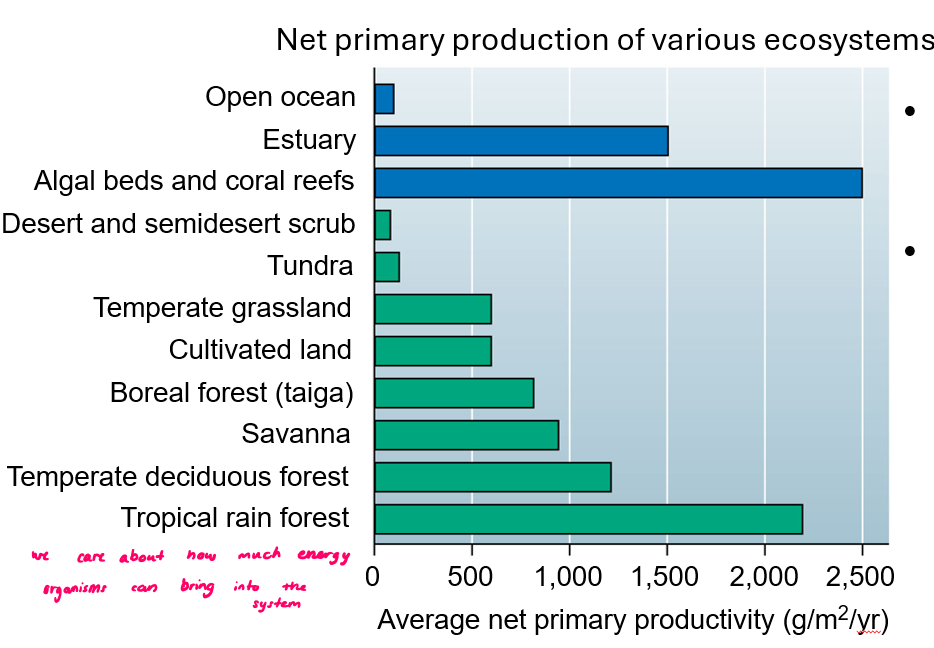
What does NPP look like across the different biomes? Describe why this pattern exists and how it relates to Liebig's Law of the Minimum
High NPP Biomes: Tropical Rain Forests, Estuaries, and Coral Reefs. These areas produce massive amounts of biomass annually
Moderate NPP Biomes: Temperate Forests and Temperate Grasslands
Low NPP Biomes: Tundra, Deserts, and the Open Ocean (per unit area)
this pattern exists because of differing temperature and moisture across the different biomes specifically which resource is the scarcest like in the desert where there is little water, more sunlight would not increase the NPP only the addition of water would increase it
What are dead zones and how are they created?
is a body of water with extremely low oxygen levels (hypoxia), the rapid inflow of nutrients that is released from dead phytoplankton overloads the area which brings in more organisms to break down the dead material (like bacteria) which requires oxygen, they use up all the O2 so fast that it depletes and takes time for it to diffuse back into the water, leaving the organisms with no O2
Limiting factor for aquatic life is …
nutrients not precipitation
NPP is highest in what parts of the ocean?
the coast, it is lowest in the open ocean
What is net ecosystem production (NEP)?
NEP = GPP = RsubT, (RsubT = total respiration of all autotrophs, heterotrophs, and decomposers)
An NEP with a positive value means …
carbon sink, more CO2 is being stored then released
An NEP with a negative value means …
carbon source, adding more CO2 back into the atmosphere
How does deforestation contribute to global climate change?
it releases all the stored O2 back to the atmosphere, cellular respiration rates of species that lived through the deforestation shoot up, it disrupts the balance between photosynthesis and respiration so it accelerates the greenhouse affect and drives global temperature increases
Forests are carbon …
sinks, so when they burn or are decomposed they return carbon to the atmosphere
Are ecosystems open or closed systems in terms of their chemical use?
Closed systems, Chemicals move from the abiotic environment (air, water, soil) into biotic organisms, and then back to the abiotic environment, matter is never destroyed just cycled through
Annual levels of CO2 are lowest in …
September and highest in April (tells us that photosynthetic rates fall in Autumn and they rise in Spring, overall, CO2 increases yearly)
How do most chemicals enter into biological systems? (What level of the food chain are they coming in?)
through the producer level of the trophic structure
Carbon comes from the atmosphere (starts as a gas)
Nitrogen comes from the soil or water which got there thanks to bacteria “fixing” it
Phosphorus entered through weathered rocks and soil
Water is absorbed through roots or from the surfaces of algae
Are gaseous cycles local or global?
global, sedimentary cycles are local
What are biotic reservoirs?
living things that hold on to matter, includes detritivores and decomposers
Decomposers can determine the rate of …
movement of matter (human activity can too)
The long term carbon cycle is drive by …
geological processes, carbon is added through volcanism and the slow oxidation of fossilized remains, carbon is removed through the burial or organic material and precipitation of CaCO2 and deposition as sediment
The slow oxidation of fossilized remains is done by …
microbes, a lot slower than how we oxidize them
Explain the overall trend in rising CO2 levels in the atmosphere since the industrial revolution. What evidence do we have that humans are causing the increase
Ice cores show that CO2 rise correlates with industrial revolution, matching direct CO2 measures in recent years, he ratio of 13C to 12C has declined from ice core samples to the present day indicating that fossil fuels are the carbon source
The short term carbon cycle is composed of …
the photosynthetic phase/the entry phase and the Respiration phase/the return
What is a greenhouse gas?
gases in the atmosphere that retain the heat the earth absorbs from the sun, CO2 is a greenhouse gas
What is the impact of having high concentrations of greenhouse gases?
More energy stays in the system than leaves it, leading to a net increase in global mean temperatures, could disrupt biomes and their NPP
Photosynthetic life can use …
ammonium (NH4+), a cation (positively charged) that can stick to soil particles and be easily taken up by plant roots through assimilation
Bacteria capture N2 and convert that gas into NH3, which then …
almost immediately picks up another H from the surrounding soil which results in NH4+
What else can turn NH3 into NH4+?
decomposers, they do this during ammonification (process where decomposers return nitrogen to the soil)
Nitrifying bacteria oxidize ammonium into …
nitrites (NO2-) and then oxidizes nitrites to nitrates which can also be used by plants in assimilation
Denitrifying bacteria convert NO3- to …
N2, and other bacteria used anammox(an anaerobic process), to convert nitrites more efficiently to N2
Primary producers assimilate PO43- …
from soil which got their through runoff and the weathering of rocks that have PO43-
How do consumers get PO43-?
from their food/the consumers that assimilate PO43-, these animals then die and brings their PO43- to the ocean through runoff or they end up in a rock layer where the phosphate is fixed
What happens to PO43- once it ends up in the ocean?
sedimentation (PO43- sinks and gets trapped in rock layers) or upwelling (currents push cold, nutrient-dense water from the bottom back up to the surface)
Once PO43- is fixed in a rock layer, it can me assimilated after weathering once …
tectonic uplift brings it back to the surface where the rocks can be eroded
Nitrogen fixation …
converts N2 to a form that can be used by plants
After consumers obtain N through their food …
decomposers return N to the soil as ammonia, where it can then be used in nitrification again