Histamine/Anti-Histamines
 Call Kai
 Learn
Learn Practice Test
 Spaced Repetition
 Match
Match Flashcards
 Knowt Play
1/46

There's no tags or description
Looks like no tags are added yet.
Name | Mastery | Learn | Test | Matching | Spaced | Call with Kai |
|---|
No analytics yet
Send a link to your students to track their progress
47 Terms
Which amino acid is decarboxylated to form histamine, and what enzyme catalyzes this reaction?
Histamine is formed by the decarboxylation of histidine, catalyzed by the enzyme histidine decarboxylase.
chemically, histamine is classified as an?
amine
While histamine can be derived from dietary sources or bacteria in the GI tract, it is mostly formed from what?
Histamine is mostly formed from the amino acid histidine.
histamine is highly concentrated where?
lung, intestinal mucosa, skin
what cell type stores histamine
mast cells, leukocytes, enterochromaffin cells, neurons
what is it called when histamine is released from mast cells
degranulation (or exocytosis)
Histamine is stored in mast cells in vesicles as a complex with which substances?
Histamine is stored in vesicles complexed with heparin or chondroitin sulfate.
what antibody is often found on mast cells
IgE
When an allergen binds to which antibodies on mast cells, leading to the release of chemical mediators, and what is this process called?
When an allergen binds to IgE antibodies on mast cells, it triggers the release of chemical mediators in a process called degranulation.
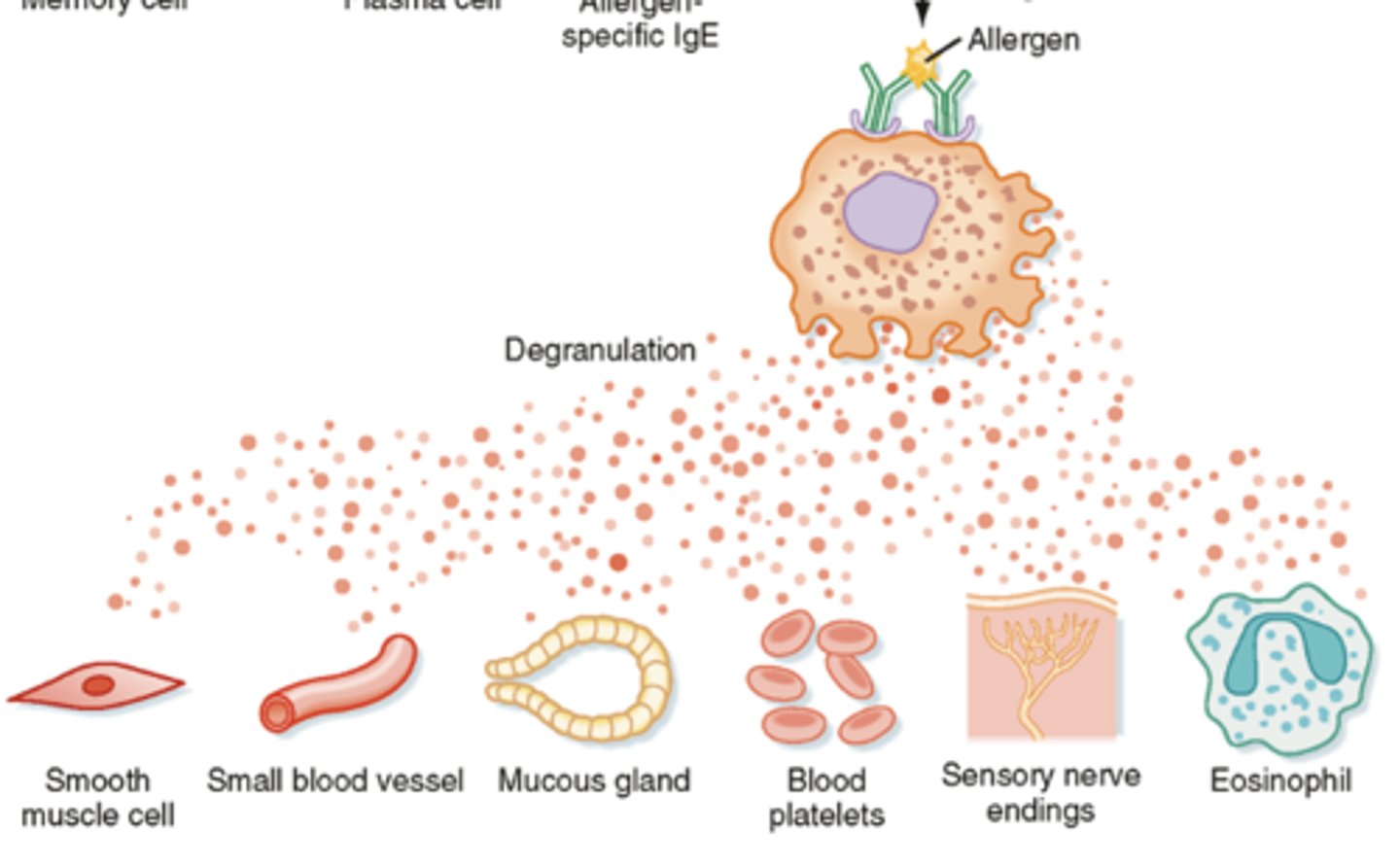
what are the main causes to histamine release
tissue injury, allergic rxns, drugs or foreign substances
if a tissue injury occurs, the initial histamine release causes?
increase in vascular permeability
what are the two generalized phases of histamine response? which stage do antihistamines work best on/in?
initial sharp phase, sustained response; initial phase
if an individual is already in anaphylaxis, will antihistamines still work?
no; they are now in the sustained phase and will need epi
can drugs induce a histamine response with prior sensitization?
no
what are common drugs that induce a histamine response
morphine, dextran, antimalarial drugs, abx
what are common foreign compounds that induce histamine repsonses
dyes, chemicals, toxins/venoms
what are the pharmacological effects of histamine on the arterioles, mj capillaries, venules
vasodilation, systemic hypotension, increased permeability (edema)
what are the pharmacological effects of histamine on the terminal vasculature
triple effect
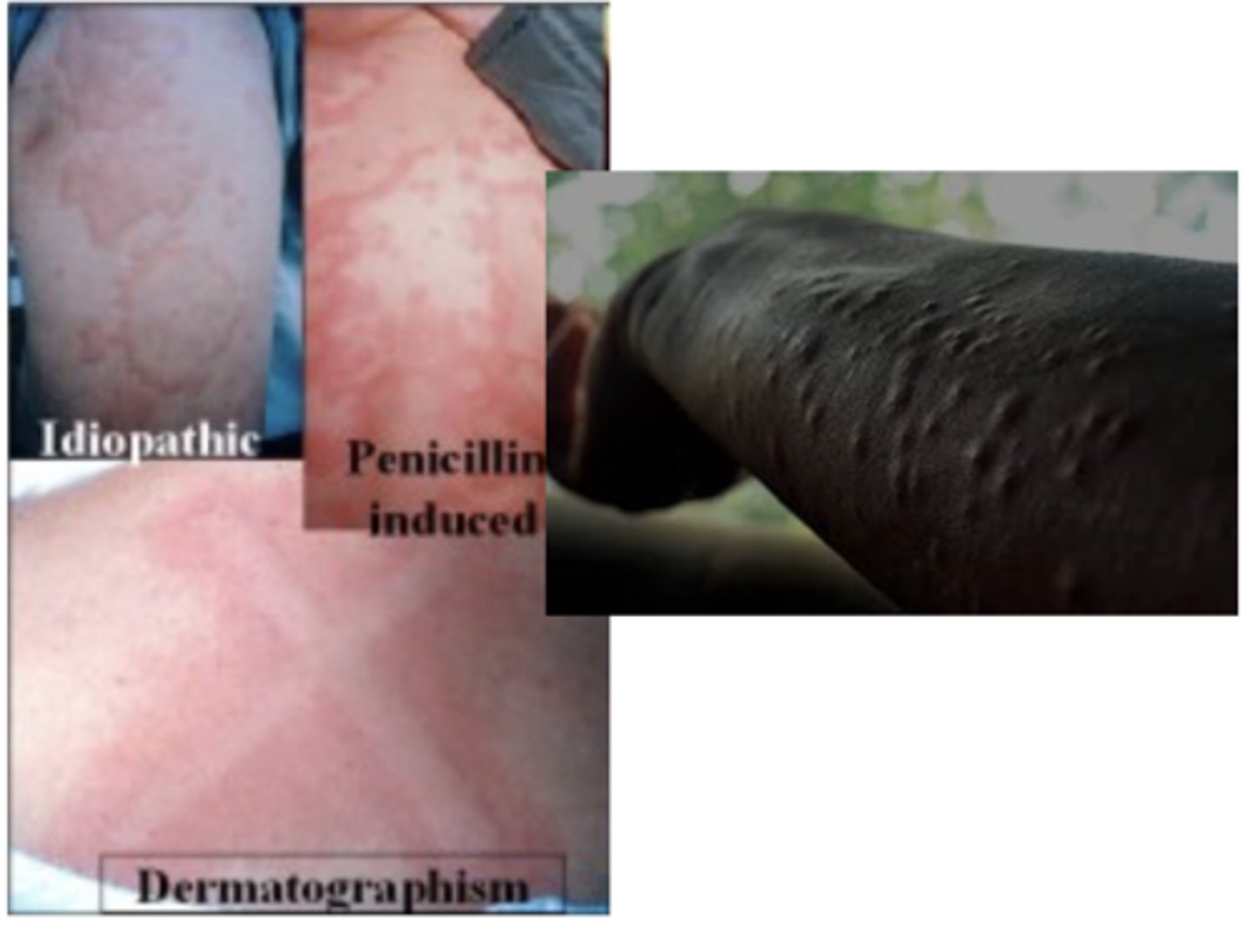
what is the triple effect? what is an example
reddening at the side of vasodilation; ex. hives
Drugs that inhibit which histamine receptor are responsible for blocking the triple response?
Drugs that inhibit the H1 receptor block the triple response.
what are the pharmacological effects of histamine on the smooth muscle of bronchioles
contraction of non-vascular smooth muscle (bronchoconstriction)
what are the pharmacological effects of histamine on the exocrine glands
increase secretions
what are the pharmacological effects of histamine on the peripheral ns
itching, pain
what type of receptors are Histamine receptors
GPCR
how many histamine receptors are there
4 (H1-4)
The H1 receptor is primarily responsible for which type of condition?
The H1 receptor is primarily responsible for allergic conditions.
what does the H1 receptor stimulate in response?
bronchoconstriction, vasodilation, separation of endothelial cells (edema), pain/itching, allergic rhinitis, motion sickness
where is the H1 receptor located
smooth muscle, endothelium, CNS, heart
location of H2 receptor
gastric parietal cells, vascular smooth muscle, neutrophils, CNS, heart, uterus
what does H2 receptor do in response to stimulation
regulate gastric acid secretion, vasodilation
location of H3 receptor
mainly CNS
anti-histamines competitively/noncompetitively block histamine
competitively
first generation H1 can/cannot cross the BBB
can
first generation H1 can be used for?
sedation
what is the major difference between H1/H2
second generation is designed to not cross the BBB with significantly decreased sedation
Antihistamines can potentiate the effects of which type of drugs?
CNS depressants
examples of CNS depressants that anti-histamines can potentiate
opioids, sedatives, narcotic analgesics, alcohol, anti-muscarinics
what histamine do we need to know for this lecture?? what is its general name
diphenhydramine; benadryl
what anti-histamine class does diphenhydramine belong to
ethanolamine
does diphenhydramine have sedative effects?
yes
what OTC drug is it often found in combination with?
Tylenol PM
diphenhydramine can also be used in what motion sickness drug?
dramamine
When taking Dramamine, which receptor does diphenhydramine block in the brain, and what condition is it responsible for?
Diphenhydramine blocks the H1 receptor in the brain, which is responsible for motion sickness
H2 receptor antihistamines are commonly used to treat which condition?
H2 receptor antihistamines are commonly used to treat acid reflux.
H2 receptor antagonists can alter the bioavailability of which substance, potentially lowering alcohol tolerance?
H2 receptor antagonists can increase the bioavailability of ethanol, which may lower alcohol tolerance.
new drugs targeting H3 receptors are likely to target?
neuronal diseases
new drugs targeting H4 receptors are likely to target?
immunomodulation