the dark side of information proliferation
 Call Kai
 Learn
Learn Practice Test
 Spaced Repetition
 Match
Match Flashcards
 Knowt Play
1/36

There's no tags or description
Looks like no tags are added yet.
Name | Mastery | Learn | Test | Matching | Spaced | Call with Kai |
|---|
No analytics yet
Send a link to your students to track their progress
37 Terms
climate change example and attention economy
Less than 20% of the population mention diet (pilot data)
Most people think littering is more important than diet (Truelove & Parks, 2012)
A meat based diet is equivalent to driving an extra 20 miles in your car a day (Weber & Matthews, 2008)
deficit-model of science communication suggests that if you were told this your beh would change, but it doesnt
inclined not to believe - have lots of info in head, find some counter evidence which disqualifies it
what is the deficit model of science communication
taught the correct thing to do and you will do it
reason you do the wrong thing is because of a deficit in understanding - so if given the correct info will believe it and act accordingly
information proliferation
the capacity to access and contribute to a growing quantity of information.
“A wealth of information creates a poverty of attention.” Herbert Simon, cog control is ability to control your own actions, have lots of info coming in, makes it difficult to know what to pay attention to
Some estimates that we produce more information in two days now than in the last five millennia.
This places information under the influence of an attention economy.
Lots of info out there, can be described in various ways, has spec effects on attention, makes it hard to know what to pay att to. everyone is competing for attention as there are so many things to pay attention to
cognitive selection
process for selecting information based on features valued by cognition. This depends on what information is searched for, attended to, comprehended, encoded, and later reproduced.
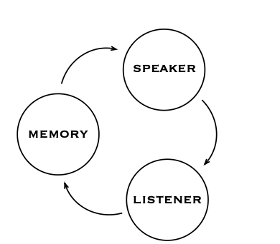
lifecycle of info in modern world
people say things, you decide what to look at/listen to
some of it makes it into memory, later reproduce this info and become the speaker
listener hears things, encodes some of it, then reproduce some of it
however it is not necessary to encode info (eg may retweet a tweet)
role of algorithms
algorithms pay attention to who’s listening and reproduce things that people are more likely to listen to
Like provocative and argumentary material so more likely to produce that
Lots of info, select some stuff, system learns what you pay attention to
If small bias in system, whole system pays more attention to certain kinds of things
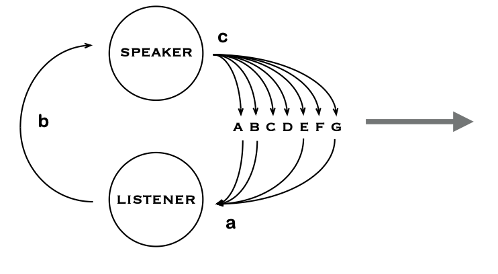
selection process
lots of things are produced by the speaker, but only some things get listened to and encoded
evolution of american english
looked at concreteness (how easily you can visualise something) - eg china would be 5 (the top) whereas essentialness would be 1 (lowest)
women slightly more concrete
concrete words are more easily recalled in memory tasks and is more interesting and easier to understand. also more readily learned by first and second language learners
found that lang is getting more concrete
why is lang getting more concrete
language competition
More competition for people’s attention means the use of more memorable words are favored, and concrete words are more memorable
more resistant to be lost from language
Speak language, listener listens and encodes, as its easy to remember will reproduce
four forces of cog selection
Selection for belief consistent info
Selection for negative info
Selection for social info
Selection for predictive info
does more information make us smarter
no
if choose what you listen to, curate what you are hearing so you only hear what you want to hear
selected info makes you more confident in what you already believe
algorithm amplifies this bias
confirmation bias
selection for belief consistent info
also known as Motivated reasoning
bias assimilation (the tendency to interpret information in a way that supports the desired conclusion - these are all self serving biases
so whenever given more info, initial position becomes stronger
confirmation bias and climate change
corner et al 2012
gave spetics and non-sceptics of climate change an article about it that was either sceptical or non-sceptical
Sceptics say irish times (pro cc) not convincing but scotsman (not cc) is.
Reverse for non-sceptics
Already have self-serving bias to not believe in those things
polarisation of capital punishment and vaccines
Lord, Ross, Lepper, 1979
presented mixed info supporting both sides
pps did not become more neutral, but more polarised
amplified what they already believed
same found for vaccine (nan and daily, 2015)
problem of self-selected info
can impair accuracy and understanding
just gain confidence in what you already know
negativity bias
selection for negativity info
people more likely to click on news articles were someone is being hurt - form of selection, drives news/social media in a specific direction
also loss aversion - fear losses more than we fear relavant gains
what could negativity bias be due to
evo selecton for survival - if someone hurts themself, want to know how so you know how to avoid it
are you more or less likely to share negative info?
more likely
social risk amplification
Humans distort info by communicating it
Hazards interact with human biases to amplify public hysteria
phd student hills and jagiello about social risk
gave people a doc to read which had different facts of antibac agents
then retold to the next person
found that when it was told over and over again it became more distorted and negative
amplified the negative aspect of info
jagiello and hills nuclear power vs food additives
same thing done but with food additives and nuclear power
then half recieve reintroduction of balanced info
this has no effect on the info reproduced
people become hyperofcused on neg consequences
when share, more likely to repeat it - neg bias built into retelling of info
examples in real world
hurricanes
ebola
covid
social bias
selection for social info
social risk ampliciation comes from other people, amplifies negativity
slt - imitate others, just watching another person led to similiar beh
social monitoring
paying attention to what other people think/do
phones promote hyper natural sm
evo bias - eg want to know what other people in the tribe are doing
many people reject what they know when confronted with people who feel differently (asch)
will also cling onto fringe beliefs when at least on other person shares those beliefs, makes them more confident in their beliefs
people turn off executive (pre-frontal) control when they get advice from other people - dont engage in effortful cog control
social herding
pps picked music and listened to a sample online
could see what other people chose (social influence) or couldnt (independent)
more unequal in independent condition - less likely to just download what other people are listening to
influence of another classroom
social influence groups less like other social influence groups
independent groups more like other independent groups
so social influece amplifies noise - noise is started with whoever is in that room
should we work separately or independently to solve hard problems
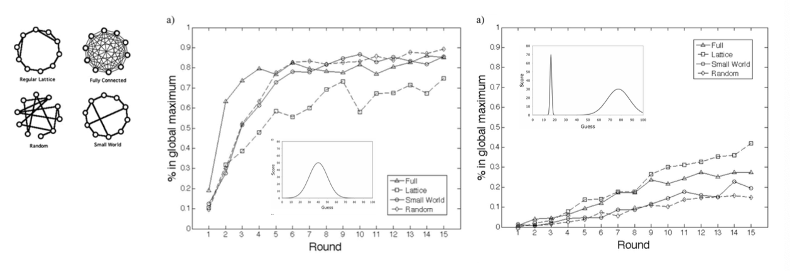
Mason, Jones, & Goldstone (2008)
too much connectivity makes harder problems harder
People are connected together in different configurations(see neighbors’ performance). They are trying to choose the best guess (a number) to get the highest score
When the problem is easy, more neighbors is good, can all talk and share info. Eg where is the toilet
When the problem is hard, fewer neighbors is better. Split up look in dif directions to find solution. Preserve independence in search, with other, if see where they look then you will also try and look there.
pattern bias
Selection for predictive information
Superstition and overfitting
replication crisis
scientific crisis that refers to the difficulty or impossibility of reproducing the results of many scientific studies.
it's a growing concern that the scientific literature is accumulating erroneous studies.
why is the replication crisis happening
product of info proliferation
if probability of success is p then probability of at least one success approaches 1 as n goes to infinity.
When a researcher tests multiple hypotheses, they correct for this using Bonferonni corrections.
But if multiple researchers test multiple hypotheses, there is no correction.
Ioannidis (2005), more researchers testing more hypotheses means an increase in the absolute number of type I (false positive) errors
Any selection bias in publishing will amplify the proportional amount of errors
consequences of each of these biases
Selection for belief consistent information—> Extremism
Selection for negative information —> Fear/Anxiety
Selection for social information —> Herding
Selection for predictive information —> Replication crisis, Risk seeking
how does info proliferation influence the evo of information
by increasing competition for attention
reducing information’s generation time - the time it takes for information to move from one mind to another.
why does misinformation have an advantage in competitive environments
it is freed from the constraints of being truthful, allowing it to adapt to cognition’s biases for distinctive and emotionally appealing information
lies proliferate faster than the truth
what is the tendency to select like-minded individuals in decision making associated with?
groupthink
what is social risk amplification particularly prominent for
dread risks - unpredictable, catastrophic, and indiscriminant risks to life and limb such as plane crashes, nuclear disasters, epidemics, and terrorism
precautionary principle
a propensity to base decisions about new technology on their potential downside risks without considering their potential benefits
mindspace article
Messenger - perceived authority of the source
Incentive - monertary usually
Reference points matter - care about final outcome?
Losses loom larger than gains
Overweight small probabilities - we are prone to overestimate the probability of unlikely but easy to imagine or recall events, such as winning the lottery.
Allocate money to discrete mental amounts - label particular benefits eg winter fuel payment. People view same money differently
Inconsistently live for today at the expense of tomorrow - prefer smaller more immediate payoffs
Norms - social and cultural
Defaults - option if no active choice is made
Salience - beh influence by what our attention is drawn to
Priming - activation of knowledge in memory makes it more accessible and therefore more influential in processing new stimuli
Affect - act of experiencing emotion
Commitment - procrastinate and delay taking decisions that are likely to be in our long-term interests
Ego - behave in a way that supports the impression of a positive and consistent self-image.