biotech - dna sequencing
 Call Kai
 Learn
Learn Practice Test
 Spaced Repetition
 Match
Match Flashcards
 Knowt Play
1/9

There's no tags or description
Looks like no tags are added yet.
Name | Mastery | Learn | Test | Matching | Spaced | Call with Kai |
|---|
No analytics yet
Send a link to your students to track their progress
10 Terms
Human Genome Project
Genome: an organism’s complete set of DNA.
Human genome contains ~3 billion base pairs.
The Human Genome Project (1998–2003) was an international effort to sequence and map all human genes.
Competing Institutions
Celera Genomics (private company headed by Craig Venter)
sequencing approach: shotgun
description of method: Randomly breaking up DNA sequences into lots of small pieces, sequencing the fragments and reassembling them by looking for regions of overlap
Public research institutions worldwide (USA, UK, France, Germany, Japan, China)
Small scale shotgun
Same as shotgun except that markers are used at regular intervals in the genome to make it easier to reassemble the sequence
Fredrick Sanger (1975)
Developed dideoxy termination sequencing method
1980 received Nobel Prize in Chemistry for sequencing method
1958 received Nobel Prize in Chemistry for his work on the structure of insulin
Dideoxyribonucleotides (ddNTP)
Di = two, Deoxy = removed oxygen Dideoxy NTPs have oxygens missing at both the 2’ and 3’ position
Polymerization Reaction
3’OH is needed to react with the phosphate group on the 5’ end of the next nucleotide to form a phosphodiester bond
ddNTP = dideoxynucleotide triphosphate
A modified DNA nucleotide that lacks a 3′-OH group
When added during DNA replication, it stops the chain
ddATP specfic type of ddNTP
What do you think will happen if you allow DNA replication to occur in the presence of both deoxyATP and dideoxyATP?
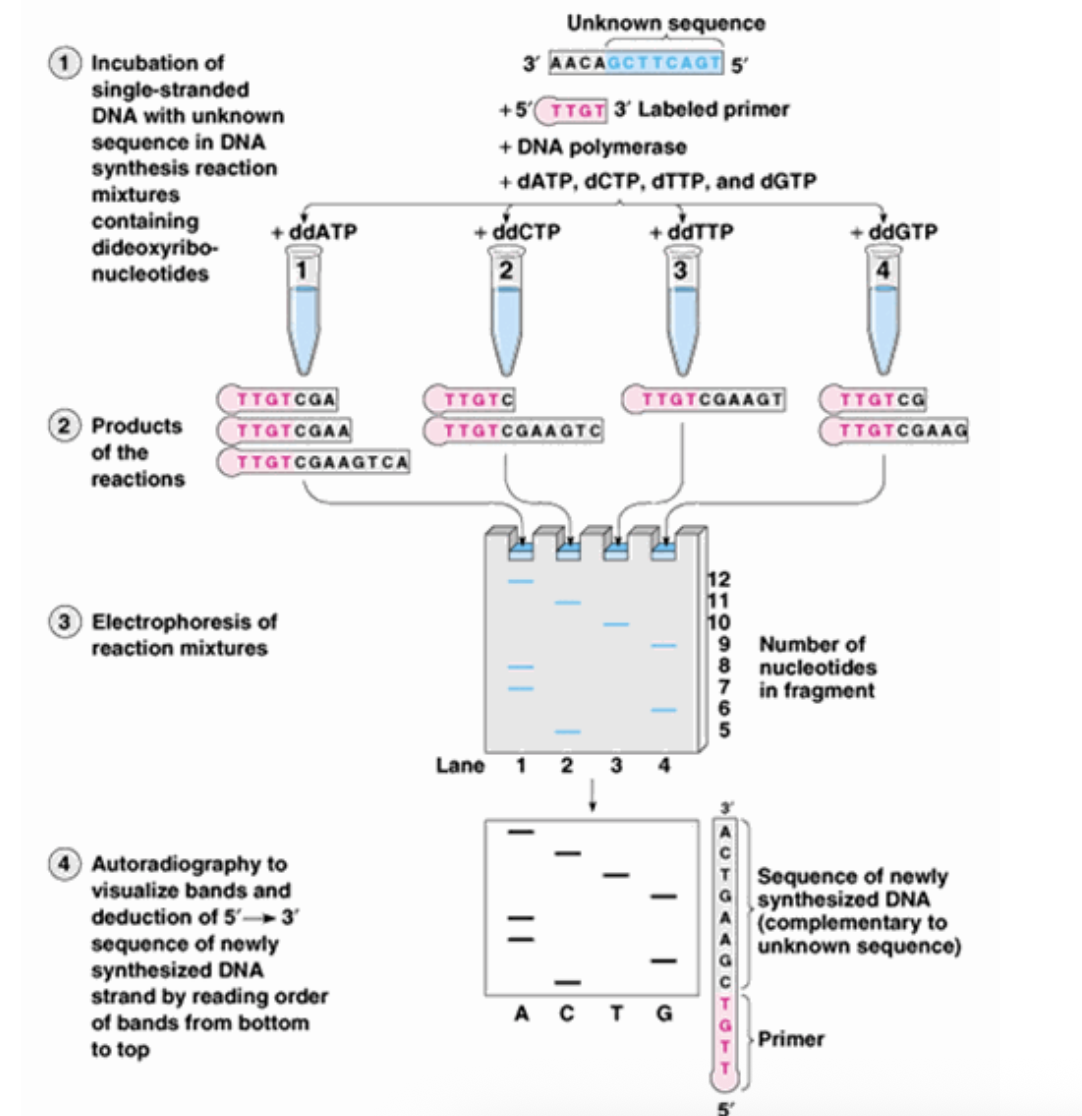
The newly synthesized strands of DNA have different lengths depending on when a ddNTP was incorporated into the strand
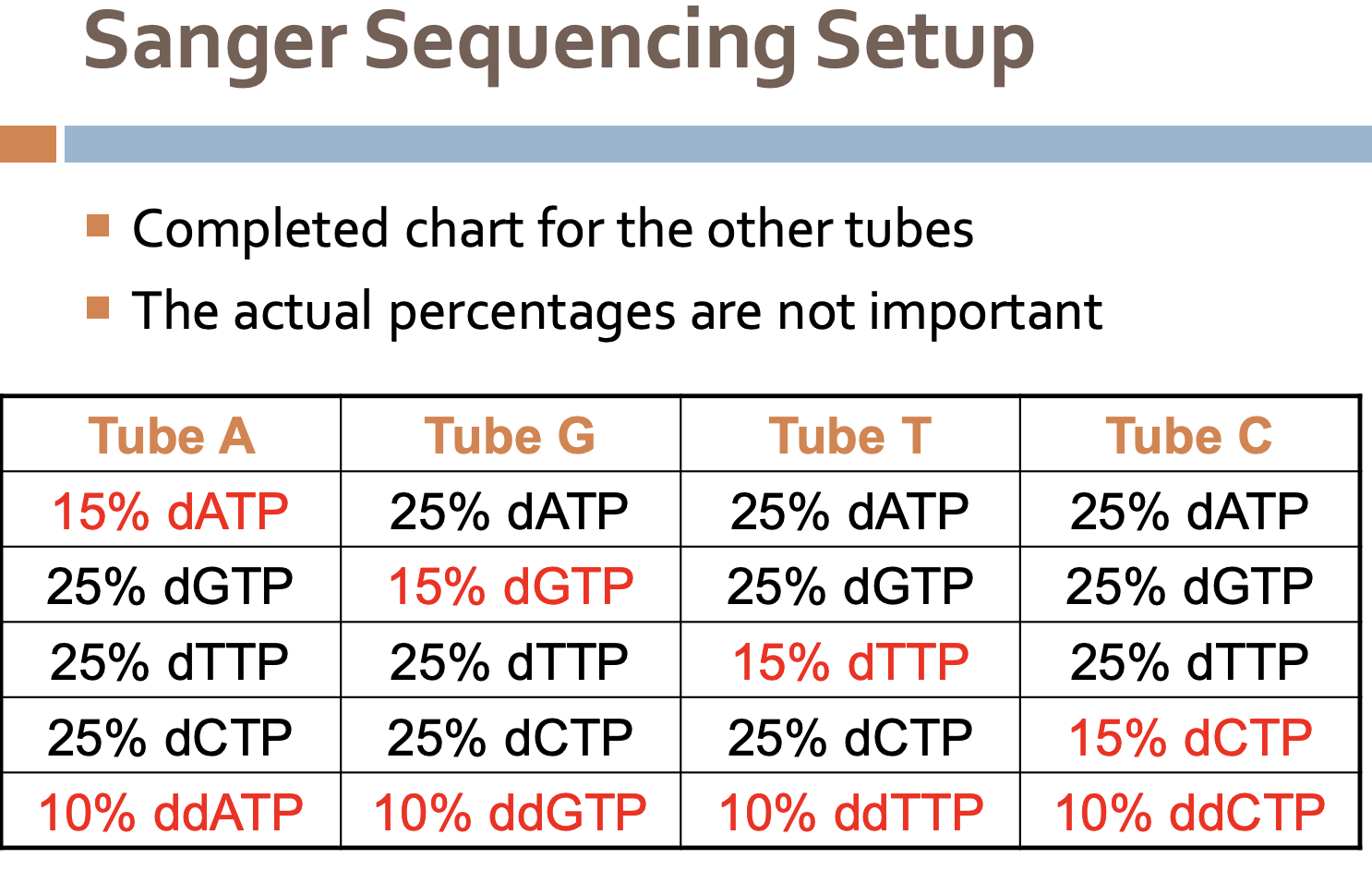
Each tube is designed to stop DNA at one specific base:
Tube A → stops at A
Tube G → stops at G
Tube T → stops at T
Tube C → stops at C
A small amount of one special “stop” nucleotide (ddATP, ddGTP, etc.) is added
dNTP (normal) → DNA keeps growing
ddNTP (special) → DNA STOPS immediately
Mostly normal nucleotides (so DNA usually keeps growing)
A small amount of ddNTP (so sometimes it stops)
👉 This creates many DNA fragments of different lengths, each ending at that base.
Sanger Sequencing Setup
Each reaction vessel only has ONE of the 4 possible ddNTPs
the strands of different lengths will be separated using gel electrophoresis onto 4 lanes, one for each ddNTP reaction
Modern sequencing
Same principle as Sanger sequencing, but simplified.
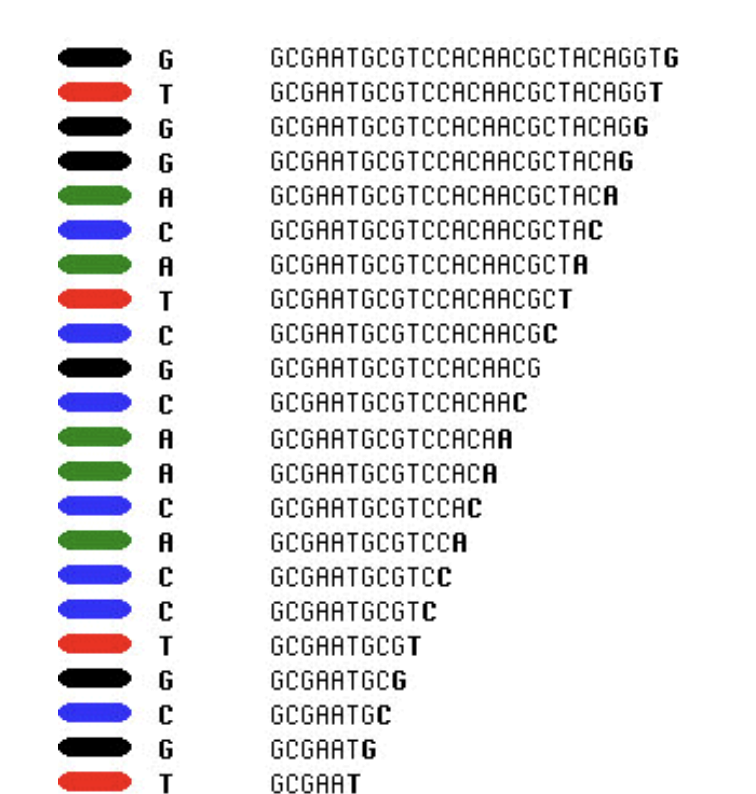
Four ddNTPs are labeled with different fluorescent dyes in one tube.
All fragments are run together in a single gel lane.
Fragments are still separate by size but show up as coloured bands
Colours have different wavelengths which can be read by a computer
Computer translates the colours into the order of the nucleotides