Microbiology Exam 2 Chapters 4,7,8
 Call Kai
 Learn
Learn Practice Test
 Spaced Repetition
 Match
Match Flashcards
 Knowt Play
1/102

There's no tags or description
Looks like no tags are added yet.
Name | Mastery | Learn | Test | Matching | Spaced | Call with Kai |
|---|
No analytics yet
Send a link to your students to track their progress
103 Terms
The atomic mass is an average weight of all known ______________________________ of an atom.
isotopes
The number of ________________________________ don’t change in an atom’s nucleus, but a different isotope of an atom is determined by the number of ________________________________ in the nucleus.
protons, neutrons
Atoms combine, forming bonds, and this makes a ____________________________________. A ____________________________________ is a specific type of molecule, in which it must contain at least two different types of atoms.
molecule, compound
Atoms can form bonds in different ways. Bonds take place between the ______________________________ of an atom, which are found in orbitals, or sometimes called shells, surrounding the atom, not in the nucleus; they carry a negative charge. The first shell can fit only _________________________ pair of electrons. Each other shell can fit _________________________ pairs of electrons. Electrons found in the most outer shell are called ______________________________ electrons, and these are the electrons that undergo bond formations.
electrons, 1, 4, valence
“Sharing of electrons”
Covalent Bond
“Transfer of electrons”
Ionic Bond
Molecules that are ____________________________________ are termed “water-loving” and will dissolve when placed into water. Molecules that are ____________________________________ are termed “water-fearing” do not dissolve when placed into water.
hydrophilic, hydrophobic
Water can form a _____________________________ covalent bond with other water molecules, because the oxygen molecule forms a partial ____________________________ charge because it holds onto the electrons a little more than the hydrogen molecules, which results in a partial ________________________________ charge on the hydrogen molecules.
polar, negative, positive
What are “Macromolecules” and what type of chemical reaction takes place to form these molecules?
Macromolecules are larger molecules that serve important biological functions within a cell. These can be made up of thousands of atoms and bonds. These molecules are typically polymers, made up of small units called monomers and mostly are formed by either condensation, or dehydration reactions.
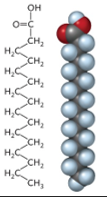
Name the Lipid molecule:
Saturated Fatty Acid
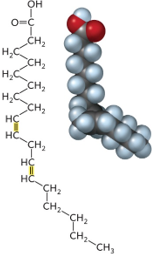
Name the Lipid molecule:
Unsaturated Fatty Acid
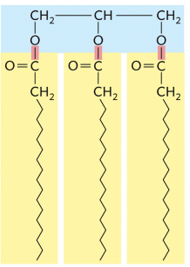
Name the Lipid molecule:
Triglyceride
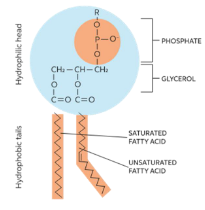
Name the Lipid molecule:
Phospholipid
The two monomer units of a lipid usually consist of a(n) ________________________________ and a(n) ________________________________. The bond that takes place between the monomer units to form the lipids is called a(n) _________________________________ bond or linkage.
fatty acid, glycerol, ester
The monomer unit of a carbohydrate is a(n) ________________________________. These form chains to form polysaccharides. The bond that takes place between the monomer units to form the polysaccharide is called a(n) _________________________________ bond.
monosaccharide, glycosidic
The three monomer components that make up a nucleotide is a ______________________________________, a ______________________________________, and a ______________________________________.
pentose sugar, phosphate base, nitrogenous base
Nucleotides form long polymer chains by performing condensation reactions using a “charged” form of a nucleotide, which is when the nucleotide has three phosphate groups instead of just one. The bond that forms between nucleotides to form long nucleic acid chains is called a(n) __________________________________ bond.
phosphodiester
In complementary base pairing in DNA nucleic acid chains, Adenine always pairs with ______________________________ and Cytosine always pairs with ______________________________.
Thymine, Guanine
The monomer unit of a protein is called a(n) __________________________________. The bond that takes place between the monomer units to form the protein is called a(n) _________________________________ bond.
amino acid, peptide
_______________________________, or sometimes called disorder, is the loss of usable energy to do work. During all energy transformations, some energy becomes lost to the system and becomes unavailable for future reactions.
Entropy
When ΔG is negative, this means the reaction is considered ___________________________________, which means the reaction is energetically favorable and no extra energy needs to be put into the system for the end products of the reaction to be made.
exergonic (spontaneous)
When ΔG is positive, this means the reaction is considered ___________________________________, which means the reaction is energetically unfavorable, and extra energy will be added to the system for the end products of the reaction to be made.
endergonic
Even when some reactions are energetically favorable, they might still produce products very slowly, because it requires high ___________________________________________________, which is the energy needed to reach the transition state of the reaction.
activation energy
A(n) ________________________________ can help aid in biological reactions to lower the activation energy of the reaction, which ________________________________ the rate at which products are produced from the reaction.
enzyme (type of catalyst), increases
The pH scale is on a _______________ scale, which means for every single scale unit change on the pH scale (i.e. a change from a pH of 4 to a pH of 5), there is a _______________ times hydrogen ion concentration difference.
logarithmic, 10
A Reduction-Oxidation reaction (REDOX) involve a transfer of ________________________________ from molecule/compound to another.
electrons
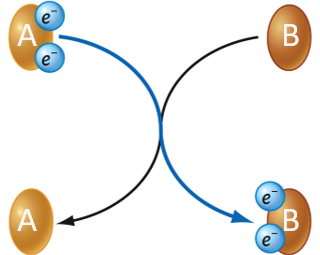
Which compound is being oxidized?
Which compound is being reduced?
A
B
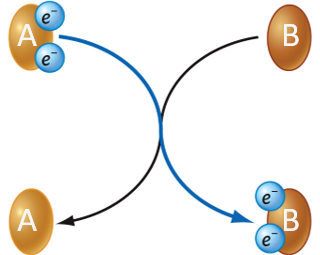
Which compound serves as the oxidizing agent?
Which compound serves as the reducing agent?
B
A
A cell membrane is made up of ___________________ layers of phospholipids. The hydrocarbon tails of the phospholipids face ___________________ because they are ___________________. The phosphate and glycerol head of the phospholipids face___________________ because they are ___________________.
2, inwards towards each other, hydrophobic, outwards towards the aqueous environments, hydrophilic
True or False: A phospholipid bilayer is a rigid, nonfluid, nondynamic structure that does not change its shape ever because it is semi-impermeable. _______________________
False
Passive Transport uses a ____________________________________ gradient and does not require _____________________ to move substrates through the cell membrane.
concentration, energy
In Passive Transport, molecules are only able to move from a _____________________________ concentration to a ____________________________________ concentration
high, low
_____________________________________ is a type of transport that increases the speed of passive transport because it uses specific ______________________________________ embedded in the membrane to carry certain nutrients across.
Facilitated diffusion, transport proteins
Active transport requires the expenditure of some form of _______________________________ to move molecules into the cell against their concentration gradient.
energy
Some mechanisms of active transport include a form called ________________________________ transport, which uses the energy derived from another molecule transfer following their concentration gradient and pairing it with the desired molecule that is being transported against its gradient.
coupled
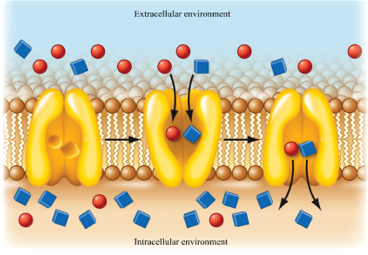
Explain in your own words how symport coupled transport works for the cell to bring in the blue squares.
The red circles are able to move into the cell (extracellular to intracellular) following their concentration gradient, ie moving from high concentration to low. The energy that is generated from that process is able to drive the transport of the blue squares against their concentration gradient, and both molecules then move into the cell together.
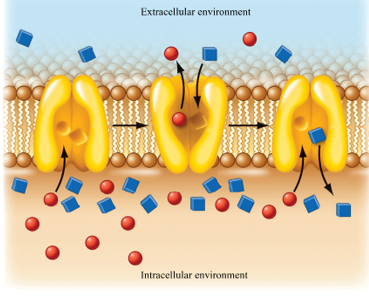
Explain in your own words how symport coupled transport works for the cell to bring in the blue squares.
The red circles concentration gradient allows them to move outside the cell (move intracellularly to extracellular environment), moving from high concentration to low. Because of this, there is enough energy to drive the blue squares into the cell against its concentration gradient, while the red circle moves out of the cell.
What are the 5 generic pieces that make up a standard ABC Transporter System and what is their role in?
2 Transmembrane proteins – form the channel for the molecule to move into the cell
2 Cytoplasmic peripheral proteins – allow for binding and the hydrolysis of ATP to ADP for energy production and to open the transmembrane channel
1 Substrate binding protein - binds to the desired molecule that particular ABC transport system specifically moves in
ABC Transporter Systems are powered by _____________________________________ hydrolysis, which is the catabolic reaction process by which chemical energy that has been stored in the high-energy phosphate bonds in adenosine triphosphate (ATP) is released after splitting these bonds, by producing work in the form of mechanical energy. The products after this hydrolysis reaction is ____________________________ , __________________________________ and __________________________________________.
adenosine triphosphate (ATP), adenosine diphosphate (ADP), inorganic phosphate, energy
_______________________________ is the process that describes the net movement of molecules moving down a concentration gradient, meaning the flow of those molecules is going to start at a high concentration, and move towards a lower concentration. When we specifically talk about the movement of water molecules in this fashion, we call it _____________________________________.
Diffusion, osmosis
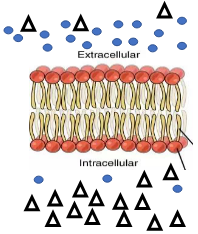
If both of these compounds met the requirements to move freely through a semi-permeable membrane, and the molecules are only going to move based on diffusion principles, which compound will move through the semi-permeable membrane into the cell?
The circles
A bacterial cell is placed into a relatively hypotonic solution. This means there is more salt (NaCl) __________________________________, and water is going to move __________________________________. This results in the cell undergoing a process called __________________________________.
inside the shell, into the cell, plasmoptysis
A reaction with a positive ΔG and requires a high activation energy, which means it takes a lot of energy to get going, will be...
endergonic and slow
In nucleic acid complement base pairing, a __________________________________ will always be bound to a __________________________________ and the and the bonds that takes place between the nitrogenous bases are __________________________________ bonds.
purine, pyrimidine, hydrogen
A solution undergoes a pH change from a pH of 5 to a pH of 2. The pH of 2 is _______ times more acidic than a pH of 5.
1,000x
Fill in the blanks with the pair of words below that make the following sentence correct:
NADH is __________ compared to NAD+ because NADH has gained __________.
reduced, electrons
Some proteins form stable, functional complexes with other proteins such as antibodies and hemoglobin, meaning at least two separate and fully formed proteins bind together and perform a specific function when joined together.
This is an example describing...
Quaternary protein structure
The type of reaction that drives the creation of our large macromolecules like carbohydrates, lipids, nucleic acids, and proteins is called a(n) __________ reaction, because after the reaction takes place, water molecules are formed as a waste product.
dehydration
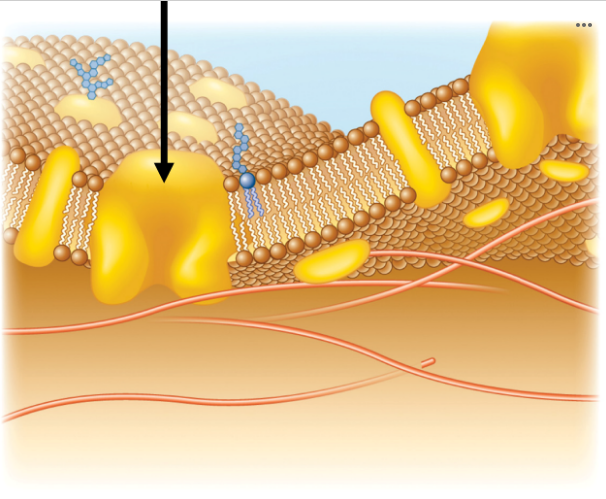
Looking at the phospholipid bilayer figure below, name the structure that the arrow is pointing to.
Transmembrane protein
Select all answer(s) that apply:
In a semipermeable membrane, only _________ will be able to diffuse across a cellular membrane.
Small uncharged polar molecules like H2O and Hydrophobic molecules like O2 or N2
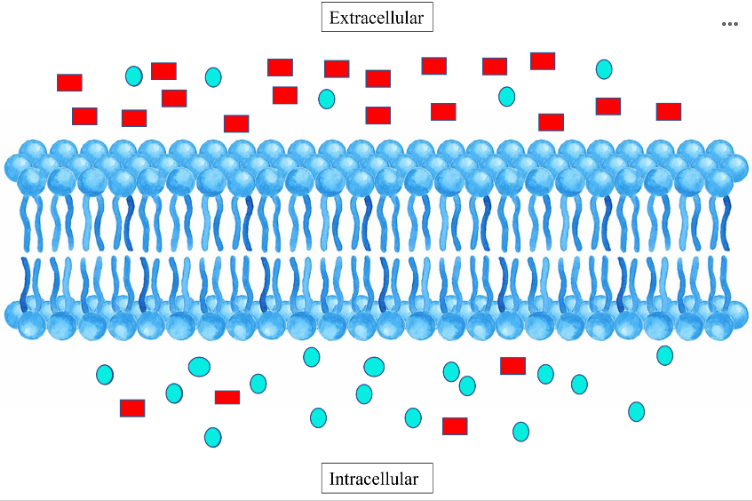
True or False: Use the image below to base your answer.
The light blue circles would be able to pass into the cell (meaning extracellularly to intracellularly) using passive diffusion.
Assume both the red squares and the light blue circles meet the requirements as molecules to be able to diffuse through a cell membrane.
False
During the creation of polysaccharides, the bond that takes place between two monosaccharides is a called a(n)...
glycosidic bond
Weak acids can...
cross cell membranes in their uncharged forms
Which of the following is true regarding saturated fatty acids?
The hydrocarbon chain of saturated fats is kinked so they do not back together tightly
The entire molecule is hydrophilic
Their carbon-carbon bonds are all single bonds
They may contain one or more double bonds between carbon molecules
They remain fluid at room temperature
Their carbon-carbon bonds are all single bonds
Molecules that are soluble in water are __________ and molecules that are insoluble in water are __________.
hydrophilic, hydrophobic
The monomer unit of a polypeptide protein is called a(n)...
amino acid
Which type of transport mechanism moves two different substances across a membrane in opposite directions?
Antiport Couples Transport
The level of protein folding that describes just the linear chain sequence of the order the amino acids is called….
Primary Protein Structure
What is the monomer unit that is used to build starch?
Glucose
Energy-releasing reactions that break down molecules known as ______________________________ are coupled, or paired, with reactions that require an input of energy in order to make larger molecules, known as __________________________________.
catabolism, anabolism
What are the three macromolecule examples that can be broken down into __________________________________, which are the smaller broken down pieces of macromolecules that enter different biochemical pathways for energy production?
1. _____________________________________________
2. _____________________________________________
3. _____________________________________________
catabolites, 1. Carbohydrates 2. Lipids 3. Protein
In glycolysis, a sugar molecule like glucose is split and ___________________________________, releasing electrons, in order to ____________________________________ energy carriers, which accept the electrons.
oxidized, reduce
Glycolysis occurs in two distinct phases. Phase one ____________________________________ energy, where phase two ____________________________________ energy.
consumes, releases
Where does glycolysis take place for prokaryotic organisms? ________________________________________
Where does glycolysis take place for eukaryotic organisms? _________________________________________
cytoplasm, mitochondrial matrix
How many molecules of ATP have to be consumed, or utilized in Phase 1 of glycolysis? __________________
2 ATP
Why do we need to use energy in phase one? ___________________________________________________________________________________________________________________________________
Glucose needs to be prepared and rearranged to be able to properly split into two 3-carbon molecules. It’s an investment the cell makes; by using two ATP to rearrange the molecule structure, the cell is able to reclaim more energy back later on in substrate level phosphorylation steps. Once the glucose molecule has been double phosphorylated, it can then be split into two 3 carbon molecules, forming two glyceraldehyde 3-phosphates (G3P).
In Phase 2, the two G3P molecules are ____________________________________, meaning they lose electrons, and in turn ____________________________________ NAD+ to NADH, which gains electrons.
oxidized, reducing
Due to this loss of electrons on G3P, it allows for a second round of phosphorylation to occur, so now each 3-carbon molecule has two phosphate groups attached to it.
Now both 3-carbon molecules are ready to generate ATP molecules: Substrate level phosphorylation occurs, meaning enzymes are able to mediate the phosphorylation of ADP to ATP a total of ______________ times, ______________ times per each 3-carbon molecules.
4, 2
Energy Put into Glycolysis (per one glucose molecule): Total Output of Energy in Glycolysis:
____________________ ____________________
2 ATP, 4 ATP 2 NADH
So once we net everything out, 1 glucose molecule produces ________________ molecules of ATP, __________________ molecules of NADH, and ________________ molecules of pyruvate during glycolysis.
2, 2, 2
One method some microbes use to end glucose catabolism is through fermentation. The main reason microbes will ferment organic substrates is to replenish the cell’s stores of _____________________________________, which is necessary to keep _____________________________________ running.
NAD+, glycolysis
In fermentation, pyruvate reclaims the electrons and becomes reduced, whereas NADH loses the electrons to become _______________________________, forming NAD+.
In the process of pyruvate gaining electrons and undergoing composition changes, it gets converted into either a(n) ______________________________________ or a(n) ______________________________________, which then gets excreted out of the cell as a waste product.
oxidized, alcohol, organic acid
True or False: Fermentation reactions, meaning the organic substrates (glucose, lactose, sucrose, mannitol, sorbitol, etc.) that can be broken down for energy, and the waste products that are produced from the fermentation reactions (alcohols and organic acids), can help humans lead to bacterial species identification, because many microbes have specific fermentation pathways that are standard for a certain species characterization.
True
Another pathway that some microbes use to end glucose catabolism is through aerobic respiration, which means after glycolysis, the pyruvates first enter the TCA cycle.
True
Prep Step (Prep for Krebs, TCA Cycle)–
Pyruvate, which is a 3 carbon molecule, loses electrons becoming ________________________ , as well as losing a carbon in the form of ________________, and becomes a 2 carbon molecule that condenses (binds together) with Coenzyme-A, to form called Acetyl-CoA.
How many pyruvates are made from glycolysis of 1 glucose molecule? ____________________
So that means there will be _______________ rounds of the prep step.
Total energy carriers made from prep step for 1 molecule of glucose: ____________ NADH
oxidized, CO2
2, 2
2
TCA Cycle (also called TCA turns, Krebs Cycle) –
· Acetyl-CoA (2 carbons) condenses with oxaloacetate (4 carbons) to make a 6-carbon molecule called Citrate. Citrate loses electrons becoming ___________________________, this ______________________________ NADH, and Citrate loses a carbon in the form of ___________. Now we have a 5-carbon molecule.
oxidized, reduces, CO2
· The 5-carbon molecule called 2-oxoglutarte. The 5-carbon molecule becomes _________________________________________, losing electrons and CO2, and ____________________________ NADH again. We now have a 4-carbon molecule.
oxidized, reducing
· Next we have a step that involves substrate level phosphorylation. The 4-carbon molecule (succinate) gets _____________________________ and transfers electrons to FAD+ to form FADH2. Water is also involved in this reaction, and this allows NAD+ to also gain electrons and become _____________________________to NADH. The energy from this REDOX reaction allows for the generation of an ATP molecule to also be produced.
oxidzed, reduced
Summary of energy created from 1 turn of the TCA cycle:
______________ NADH, ______________ FADH2, ______________ ATP
3 NADH, 1 FADH2, 1 ATP
But don’t forget! How many turns of the TCA cycle is going to occur from 1 molecule of glucose? _________
So let’s total our energy carriers to represent how much energy we create from 1 glucose molecule in TCA:
Prep Step:
_____2_______ NADH
TCA:
______6________ NADH, ______2________ FADH2, _______2_______ ATP
2 turns
Prep Step: 2 NADH
TCA: 6 NADH, 2 FADH2, 2 ATP
So based on these numbers, most of the energy after glycolysis and the TCA cycle is in the form of __________
NADH
Aerobic Respiration - ETS
The __________________________________________________ is a series of membrane-embedded enzymatic proteins that store energy from NADH and perform serial REDOX reactions in order to pump H+ ions across the membrane from teh cytoplasm, across the cell membrane into the periplasmic space, in order to create a __________________ and a __________________ to drive ATP synthesis.
electron transport system (ETS), charge gradient , concentration differential
The enzymes that make up the ETS are called _____________________________________________ because these enzymes act as both an electron acceptor and then an electron donor, with each enzyme in the ETS series becoming increasingly stronger at accepting electrons.
oxidoreductases
The flow of electrons through the ETS flows from the weakest electron acceptor, to the strongest electron acceptor. What is the order of the flow of electrons from the starting molecule (weakest electron acceptor), to the strongest electron acceptor?
1. NADH
2. NADH Dehydrogenase
3. Quinones/Quinols
4. Cytochrome Bo
5. Molecular Oxygen 02
Aerobic Respiration – ATP synthesis
The theoretical yield of ATP from one molecule of glucose is a total of _______________________ ATP molecules.
38
Now that the cell has used all of its energy carriers in the ETS, we now have our H+ gradient, also called the __________________ motive force, which is what powers the ATP Synthase enzyme system.
For every ______________________ protons, enough energy is provided to run the ATP synthase to phosphorylate one ATP molecule.
proton, 3
Within the ATP Synthase, there are ______________________ sites where ADP can be phosphorylated. In order to perform a complete turn of the entire ATP Synthase system, meaning, completing ADP to ATP phosphorylation in all 3 sites, it would take ______________________ protons to enter and flow through the Synthase.
3, 9
True or False: The proton motive force can ONLY be used for ATP synthesis, and the H+ concentration gradient cannot aid in any other cellular processes within the cell.
False
Why do cells never reach the true theoretical total yield of the maximum ATP molecules that can be created from one molecule of glucose?
The cell utilizes the proton motive force to drive and fuel other parts of cellular activity, so not all the protons that are generated from the ETS to create the proton concentration gradient go directly to the ATP Synthase. Some protons may be directed to go power the motor of a flagella for cellular motility, some protons are utilized for symport/antiport coupled nutrient transport since there is a concentration gradient of H+ to utilize, some protons are used for powering efflux pumps to remove waste or toxins from inside the cell, and some of those protons are used to maintain and stabilize protein ion channels.
Anaerobic Respiration
True or False: Oxygen (O2) is the only molecule that organisms can use to serve as the terminal electron acceptor for the ETS and energy production. _________________________________________
What are other molecules that some microbes can use to serve as the final electron acceptor?
_________________________________________________________________________
False
Nitrate, sulfate, fumerate, CO2, Ferric/ferrous iron, H2 (mainly be able to recognize that other inorganic compounds are serving as the final electron acceptor, NOT 02!)
Because oxygen is not serving as the terminal electron acceptor, we call this type of respiration ___________________________________ respiration, because it does not involve molecule O2.
anaerobic
Methanogenesis is a type of ____________________________________ which oxidizes H2 and reduced CO2 in order to form _____________________________________ (CH4).
Methane is a _____________________________________________, which significantly contributes to global warming.
lithotrophy / anaerobic respiration, methane
greenhouse gas
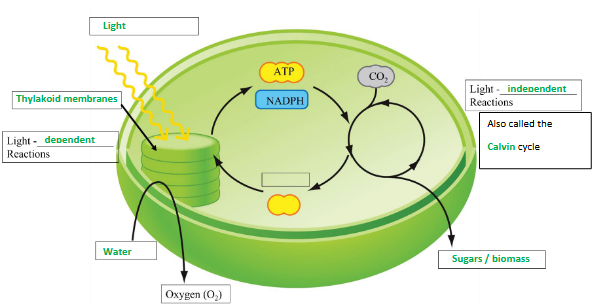
Light-dependent Reactions: Where, what goes in, what comes out?
Light-independent Reactions: Also known as ______, what comes out?
Light-dependent: Thylakoid membranes, light and water to make oxygen (O2), ATP, and NADPH
Light-independent: Calvin cycle, makes sugars / biomass
Photolysis – Z pathway and Electron Transfer
The Z-pathway is part of the light ___________________________________ reactions, and is where the energy carriers of ATP and NADPH are made, which are then utilized in the light ___________________________________ reactions in order to create sugars and biomass.
dependent, independent
The Z pathway takes place in two Photosystems: ____________ happens first, and is then followed by ____________.
Photosystem II, Photosystem I
Light strikes the chlorophyl pigments in Photosystem II in the thylakoid membranes: This creates energy needed to split _______________________ into oxygen, H+ protons, and electrons.
The photo-excited electron generated from the splitting of water is then able to enter the first set of ETS proteins, which generates energy to transfer __________________________ out of the thylakoid membrane to create a concentration gradient to drive the creation of ATP via the _____________________________________.
water, protons (H+), ATP Synthase
Once the electron moves through the first set of ETS proteins, it enters Photosystem I and is re-energized by more incoming light energy. The electron enters a second set of ETS proteins, and this is able to drive the reduction of the molecule ________________.
NADP+ to NADPH
In Aerobic Respiration, what is the strongest electron acceptor in the electron transport chain?
Oxygen
Cytochrome b
NADH
Q complexes
NADH Dehydrogenase
Oxygen
An organism runs glycolosis on 9 glucose molecules. How many net total molecules of ATP will be produced?
18
True or False: In photosynthetic bacteria, the light-dependent reactions produce sugars and the light-independent reactions produce ATP
False