Citizenship - Politics and Participation
 Call Kai
 Learn
Learn Practice Test
 Spaced Repetition
 Match
Match Flashcards
 Knowt Play
1/162

There's no tags or description
Looks like no tags are added yet.
Name | Mastery | Learn | Test | Matching | Spaced | Call with Kai |
|---|
No analytics yet
Send a link to your students to track their progress
163 Terms
What is democracy?
a system of government whereby citizens in free and fair elections choose those in charge/power.
What is direct democracy?
where the people decide on all decision-making directly
What is a referendum?
when citizens are asked to vote directly on a single issue
Give examples on referendums
1997 - Devolution Scotland and Wales
2014 - Scottish independance
2016 - EU Membership
What is representative democracy?
where people/citizens elect representatives to make decisions on their behalf
Reasons why direct democracy is better.
purest form of democracy
prevents a concentration of power
Reasons why representative democracy is better.
practical and efficient
gives citizens somebody to hold to account
experts that have more knowledge which would benfit/help the nation
What is disengagement?
Not knowing, valuing or participating in the democratic process.
What is disenfranchised?
Not being allowed to vote and therefore restricted from participating in formal democracy (being under 18, prisoners)
What is voter turnout?
The number of people that voted compared to the number of people that can vote (2019 - 67.3% 2024 - 59.7%)
What is voter apathy?
A lack of interest/concern about politics, resulting in political disengagement.
How to increase voter turnout?
people too busy to vote? - move voting on the weekend (standard in Australia)
won’t go the polling station? - make voting compulsory (standard in Australia and Belgium)
voting at inconvenient times? - utilise methods of digital democracy - e-voting (standard in Estonia)
How to overcome voter apathy?
lack knowledge in politics? - make political education mandatory
views/characteristics not represented? - increase the representativeness of parliament
don’t think political decisions affect them? - utilise methods of digital democracy (online campaigns) - more power could be delegated to UK nations and English region to allow greater localised political structures to emerge
What is digital democracy?
the use of online methods e.g. the internet to allow/encourage citizens to get involved in the political process
examples of digital democracy
E-voting
E-petitions
Party Broadcasts
Political compasses
Online campaigns
Social media channels
Value - rights
Entitlements (legal,social,political and ethical)
example - right to free elections, right to assemble
Value - duties
Duties, actions citizens SHOULD do
example - pay taxes, jury
Value - freedoms
The ability to speak, act or think as one wants
example - expression, movement, press
Value - equality
Equal treatment
example - Equality Act (2010)
Value - Rule of Law
Law applies equally to all people
What is the role and example of the Executive?
Those responsible for putting decisions and laws into effect
Example - Prime Minister, Cabinet
What is the role and example of the Legislature?
Those responsible making the law
example - Parliament
What is the role and an example of the Judiciary?
Those responsible for enforcing and interpreting the law
Example - Judges, courts
Role of Monarch?
UK - Constitutional monarchy
role is limited - mostly ceremonial
Head of State
Other roles:
appoints a Government
opens and dissolves parliament
delivers the monarchs speech (the governments draws up the content)
royal assent - final approve of a bill to become an Act of Parliament
Westminster parliament - what type of parliament is it?
Bicameral - house of lords and house of commons
Composition of the house of commons
650 MPs
Elected by General Elections
Compositions of the house of lords
800+ MPs
Unelected:
Hereditary Peer - inherited from family
Life Peer - appointed due to expertise by Government via a commitee
Spiritual Peer - appointed by being Archbishop/Senior bishops
role of the house of commons
proposes new legislation
debates government policy and legislation
votes to pass government policy and legislation
scrutiny of government - allows MPs/opposition to question the PM
holds financial privilege - has the ultimate control over money bills
roles of house of commons
scrutinise new legislation
debates government policy and legislation
revises government policy and legislation
propose new legislation on uncontroversial issues
hold debates on issues of national importance (e.g. treatment of asylum seekers)
Government definition
Those responsible for the day-to-day running of the country
UK - decided by a General Election and the leader of the party that has won becomes Prime Minister
Parliament definition
Those elected and appointed who ensure the interests of the public are considered by the Government.
They work to hold the government to account and scrutinise their work.
UK - three elements - House of Commons, House of Lords and Monarch
What are 3 ways Parliament works to scrutinise the work of the government and make it accountable?
holds debates
issues parliamentary questions
assembles commitees
What is the work of Parliament?
Questions (both house of common and lords use it):
Question time - take place in regular intervals of the week, Ministers/Lords will respond to questions from MPs/Peers
Urgent Questions - if a MP asks the Speaker to grant them an UG, a Minister has to respond to the question
Prime Ministers Question Time - every Wednesday, PM answers questions about the governments actions
Commitees (2 types):
General Committees - found in the HOC, consider the merits and demerits of draft legislation
Department Select Commitees - check and report on the government, gather evidence and report back recommendations to the government.
What is someone called when they stand in for elections and what types of candidates are there?
Candidates
A candidate will usually decide to stand to represent one of the UK’s political parties.
possible that someone can be independent but rare
who can stand for elections?
Anyone but
must be at least 18
British/Commonwealth Citizens
Cannot be a judge, police officer or a Lord Peer
How are party candidates selected (MPs)?
A candidate selects a party
they must then seek endorsement - must be supported by existed members and pay £500 fee
then, start to campaign - meet residents, hold hustings, run online campaigns
How is a government formed?
A political party first need to win a majority in the House of Commons (326 seats min)
the leader of the political party with most seats becomes Prime Minister after approval from the Monarch
What happens if a majority is not gained in an election?
A Hung Parliament is formed.
What is a Coalition government?
Where two parties join together to secure a working majority in the House of Commons
e.g. 2010 - Conservatives and LibDeb
Political Spectrum
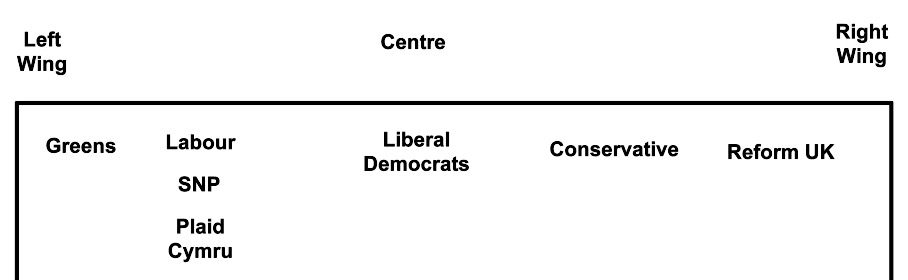
How is the government organised?
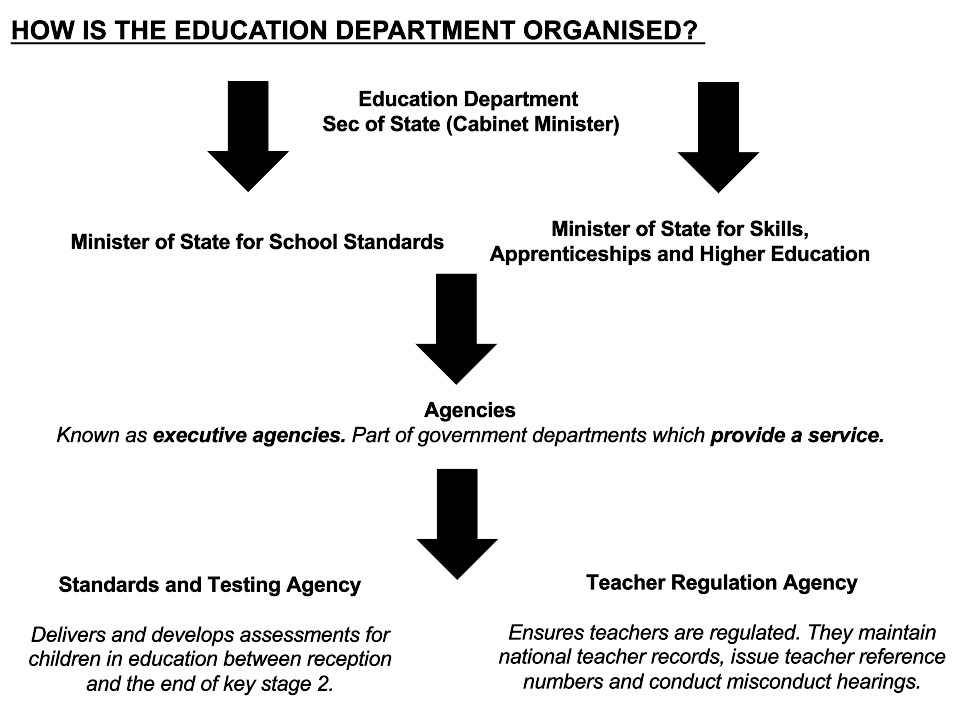
organised into departments
each department is responsible for a particular area of policy/management
departments are overseen by a Minister/Secretary of State and are supported by Ministers of State/Junior Ministers who take a specific for an area/issue within their department
non-government ministerial departments - NOT overseen by a government minister, headed by senior civil servants
usually have a regulatory or inspection function - Ofqual and Ofsted
What is an agency?
A part of government department which provides government services
e.g. Driving License Agency, Environment Agency
How is the education department organised?
What is the Civil Service?
They help the government of the day develop and implement its policies as effectively as possible
This is done by undertaking practical and admin work e.g. issue benefits and staff prisoners
They are politically impartial and independent.
They are overseen by the Cabinet Secretary.
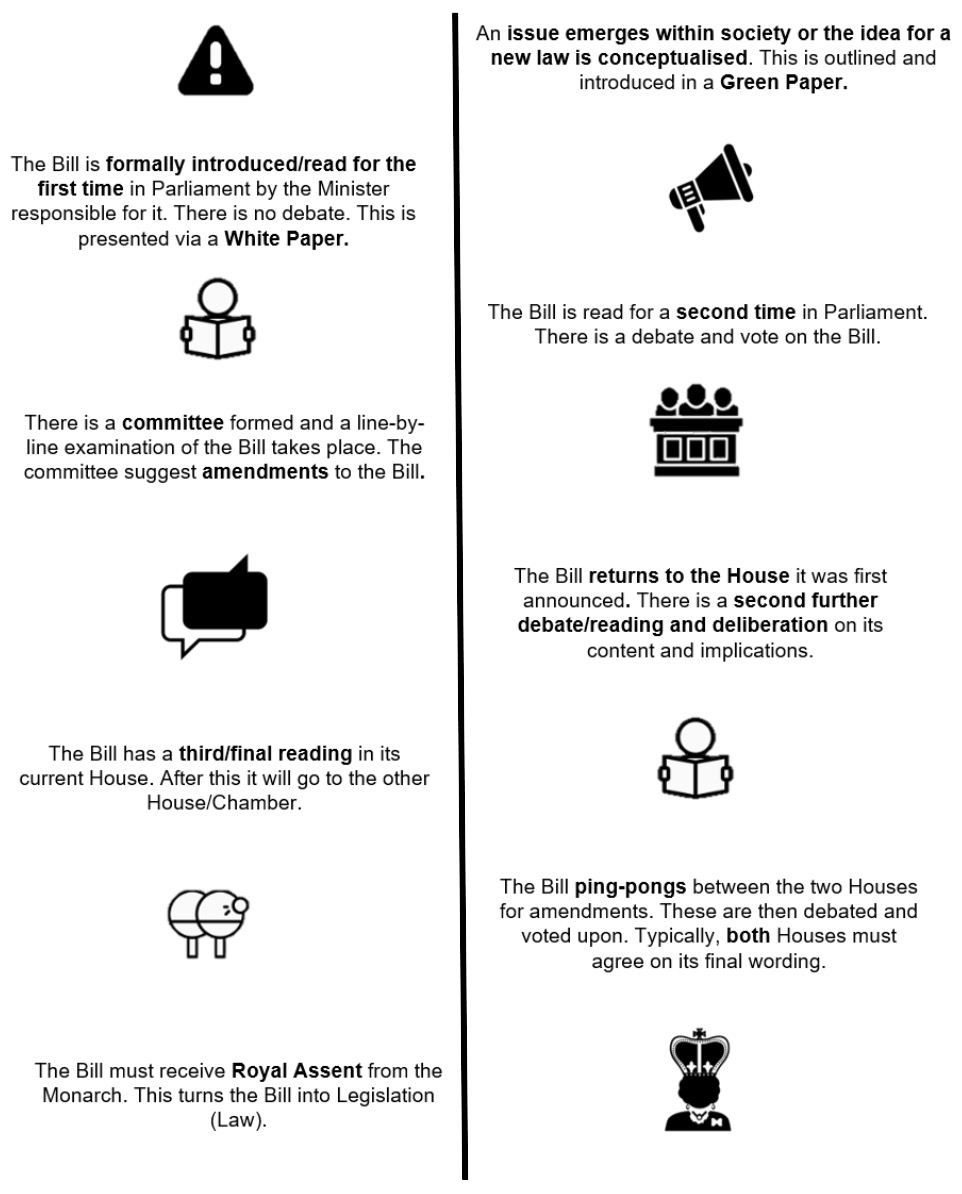
What is the legislative process?
What are the different types of bill?
Public Bills - laws proposed by the government
Private Member’s Bills - laws proposed by individual MPs or Lords
Private Bills - laws proposed on behalf of organisations
What is the Supreme Court and what is its role?
It is the final court of appeal in the UK for civil and criminal cases
cases need to be of the greatest public or constitutional importance and affect the whole/significant portions of the population
Work of the Supreme Court - instrumental in the development of law within the UK - can set new legal rules (precendants)
Their aim to clarify the meaning of law when uncertainty
heard by 12 supreme judges - Justices - selected based on merit - selected by the senior law officers whose work is independent from the government.
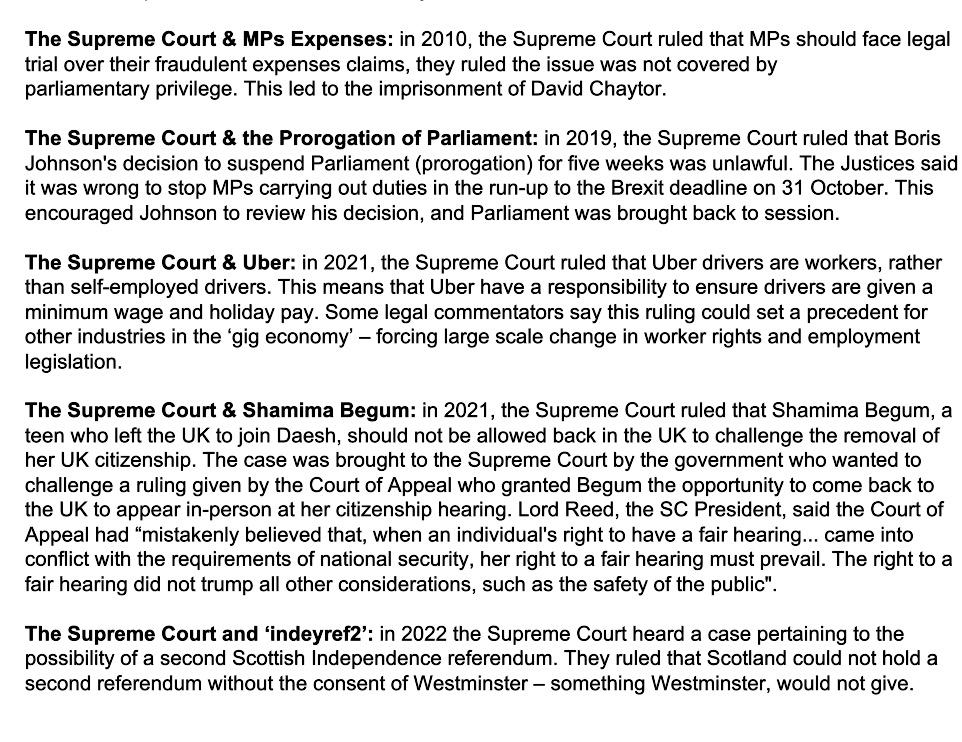
What are some example the Supreme court has dealt with?
What is the Prime Minister’s roles and power within Parliament?
Roles - head of government and leader of country
Powers:
appoint the cabinet
Power of Patronage - appoint life peers to the Lords
What is the Cabinet’s roles and power within Parliament?
Definition - 20 MPs who are selected by the PM to lead on specific policy areas and oversee gov. departments & other gov. responsibilities
Roles:
Devise and implement policy on specific areas
Advise and warn the PM on decisions
Powers:
can implement on specific areas
act as ‘final court of appeal’ if disputes between gov. departments
What are Minister’s roles within Parliament? Examples?
can be members of cabinet
Roles:
take individual ministerial responsibility for the policy, actions and conduct of their department
answer questions during question time within the Commons/Committees about the department’s work/policy
Examples - Secretary of state for Education, Secretary of state for health
What is the role of a Junior Minister?
they support the devising and implementation of policy on specific areas within their government department
answer questions during question time within the Commons/Committees about the department’s work/policy
What is the definition and roles of MPs? Examples?
Definition - somebody elected by a constituency to represent them in the House of Commons
Roles:
represent constituencies by meeting, discussing and solving problems by holding surgeries
they take part in policy debates
Examples - Connor Rand
What is the definition and roles of the Civil Service? Examples?
Definition - individuals employed by the government who develop and implement policy and run government services
are politically impartial
Roles:
undertakes operational delivery of gov. policy by providing departments administrative, professional, specialist and technical support/expertise
provides service to the UK public (pay benefits/pensions, issue driving licenses, official statistics and run prisions)
Examples - Cabinet, Secretary, National Crime Agency, Office for National Statistics
What is the Black Rod? What is their role?
A senior official in the House of Lords - responsible for controlling access to the Lords and organising major ceremonial occasions
Roles:
Opening of parliament - bangs on the door of the HOC 3 times and summons MPs to hear the Monarch’s speech
Organises access and maintains order in the HOLs
What is the Speaker and what is their role?
A member elected from the House of Commons/Lords - Chair debates in the House (a speaker in a house)
Maintain order and ensure parliamentary rules are followed
Roles:
Calls MPs/Peers to speak in Commons/Lords debates
Maintain order during debates - revoke comments, asking members to be quiet
What is the Whip and what is their role?
Those appointed within a political party to inform and organise members and the day-to-day business of Parliament
work in BOTH Commons and Lords
Roles:
Inform the party about the party business
ensure party loyalty and discipline, members to support and vote along party lines
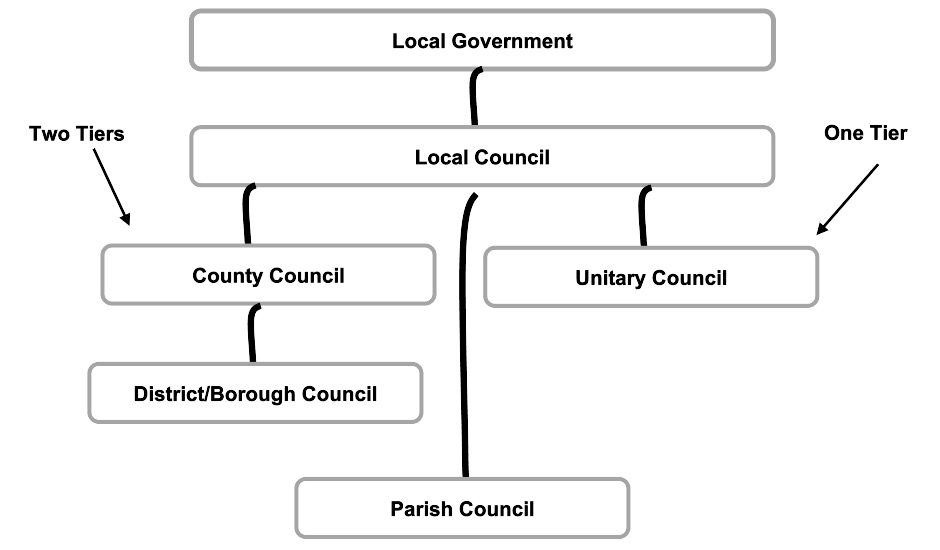
What is local government? What types are there?
A local council is an example of a form of local government
Two tiers are more common than unitary councils
What are combined authorities?
2 or more local councils combined to colla
They are overseen directly by Metro-Mayors, work with local councils to improve services in local areas e.g. transport
Example - Greater Manchester Combined Authority (GMCA)
What is a county and what services does a county council do ?
Definition - A large geographic area e.g. Surrey County
County Councils - responsible for services across/impact entire country
Example of services - Education, Social Care, Transport
What is a District/Borough council and what services does a District/Borough council do?
Definition - A smaller geographic area within a county e.g. Manchester City Council
responsible for services which are smaller and localised
Example of services - Rubbish collection, housing, leisure
What is a Unitary council and what services does a Unitary council do?
Definition - A large, typically city/metropolitan area e.g. Trafford
responsible for delivering all services across the area
Example of services - Education, housing, rubbish collection
What is a Parish council and what does a parish council do?
Definition - A small area and very localised area e.g. Handford Parish Council
Example of services - Allotments, clocktowers, christmas lights
used to be based on the church parish
Who runs local councils?
local councilers are the elected officials of the Local Council
they are elected every 4 years but can be done differently across councils
What are local councilers?
Employed members of local government
they assist councillors putting their policy into pratice
they don’t necessarily change where council control does
What does a local councillors do?
Represent citizens of elected ward - listen to the view of residents and help them to overcomes issues in their locality
will advocate and propose policy on behalf of residents at local councils meetings
Develop Council Policy - they do this to make the best use of local resources and income
Councillors may become members of the local cabinet and direct specific policy areas
Act as Regulator - hear/read plans for property and licensed premises
must consider the impact of approving or denying plans on the local area and those they represent
What is devolution and what are some examples?
Definition - the transfer or delegation of power to a lower level, especially by central government to local or regional administration.
Examples - central gov. in Westminster to Welsh Sennedd (Parliament), Northern Ireland Assembly and Scottish Parliament
What is the Scottish Parliament?
name of government - scottish government
leader of gov - John Swinney (first minister)
governing political party - Scottish National Party (SNP)
name + location of gov. building - Holyrood, Edinburgh
no. of representatives - 129 (73 Constituency members + 56 regional members)
What is the Welsh Parliament?
name of government - Senedd Cymru (Welsh Parliament)
leader of gov - Eluned Morgan (first minister of Wales)
governing political party - Labour
name + location of gov. building - Senedd Building, Cardiff
no. of representatives - 60 members (40 constituency members + 20 regional members)
What is the Northern Ireland Assembly/Parliament?
name of government - Northern Ireland Assembly
leader of gov. - Michelle O’Neil (first minister)
governing political party - Sinn Féin
name + location of gov. building - Stormont, Belfast
no. of representatives - 90
What is Reserved Power?
the issues that are still legislated by Westminster for all nations of the UK
Examples - defence, foreign policy, immigration etc.
What is Devolved Power?
the issues that are legislated by individual nations of the UK
examples - health, education and local government
What are some arguments supporting with Devolution?
gives nations control over key devolved services - can tailer them to their specific circumstances/needs using local expertise and knowledge
e.g. COVID-19 response were given differently from each nation due to their differing infection rates in their country
allows nations to focus on the promotion of its culture & heritage - can develop specific culture, heritage and tourism policies to promote their nation individually - helps tourism which helps the economy
e.g. Welsh language, Scottish history
helps citizens engage with politics - makes local/regional officers more accountable and responsive to particular issues or needs
there are still many elements of UK governance reserved by Westminster
e.g. united agreement on foreign policy, Brexit - all nations left even though Scotland and Northern Ireland voted to remain
UK is still represented internationally as a whole by UN, Commonwealth etc.
What are some arguments disagreeing with Devolution?
could confuse citizens about the powers/laws within their nation
e.g. COVID-19 - different countries had different rules which led to confusion and difficulty, esp. when travelling to one nation to another
creates extra expense for governments - from buildings to employing costs when it could be used for other purposes
is it fair? - each country adopts a different approach to different issues
e.g. different education system (Scotland have no HE tution fees), diff. voting systems
strongly challenges the notion of ‘national identity’ - impact feelings of belonging and identity within the UK
How are devolution nations funded?
primarily funded by Block Grants - money given by the Westminster Treasury
Every year, the Barnett Formula is used to adjust/change the funding level, which is based on pop. sizes and spending in England on issues which are devolved
also collect some tax from citizens to fund services
What is some of the history of ireland?
spilt into two - republic of Ireland (independent nation and part of EU) and northern Ireland (one of the nations in the UK)
most recent history - ‘The Troubles’ - a period of conflict in Northern Ireland - lasted about 30 years (late 60s to 1998)
The troubles was ended by the ‘Belfast/Good Friday Agreement’ - signed 10th April 1998
division from religion(since the 17th century):
Catholics - generally hold nationalist views - wants an independent Ireland free from the British
Protestants - identify themselves as British and Unionist
Brexit - issues have emerged like trade and the Northern Ireland Protocol was introduced but quickly became unsatisfactory
led to the suspension of the Northern Ireland Assembly in Feb. 2022
March 2023 - the Windsor Framework was suggested to try and overcome trading issues and restart the Northern Ireland Assembly
What has been the impact of Devolution in England?
devolution in England has been transferred and decentralised power form central Westminster to local regions
much of the power has been given/transferred to regional metro-mayors - elected every 4 years
What’s the role of a Metro-Mayor?
they oversee Combined Authorities - which coordinate the delivery of some services across a regional area
Examples - transport, housing and health + social care
this means that budgets can be targeted to meet the demand and needs in that region
Give some impacts of city/regional devolution in Manchester.
Metro mayor of Manchester - Andy Burnham
has taken control of the £6 Billion health + social care budget and has invested in mental health e.g. Daily Mile, improving oral health, improving stroke care
bus fares has reduced by 50% to encourage greater usage in public transport and helping the cost of living crisis
addressed homelessness - invested into programs like ‘Bed Every Night’ and ‘Housing First”
What is the ‘English votes for English laws’ debate?
the call for legislation which only impacts England to be voted and scrutinised on and by English MPs only
would bring comparability between devolved nations as English MPs don’t vote on matter only regarding Scotland, Northern Ireland or Wales
placed in 2015 but removed in 2021
What is the definition of voting?
the expression of an opinion and/or an act of collective decision making
Who can and cannot vote in elections?
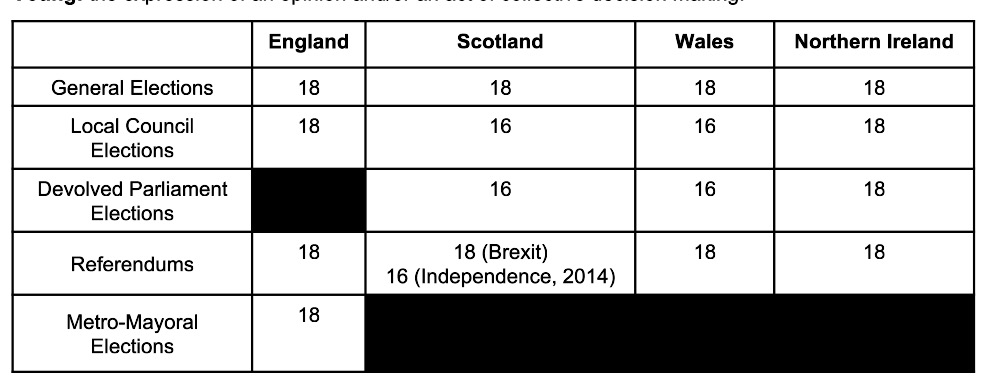
What are the arguments to support the voting age being lowered to 16?
right to vote is a basic human right
have more political education in school - which means that they have more knowledge and understanding than 16/17 year olds in the past
can increase political participation - will increase voter turnout which would lead to a fairer and more representative reflection of society
16-17 year olds are affected by the decisions made first hand - e.g. education policy, geopolitical relations, maybe jobs etc.
What are the arguments to disagree the voting age being lowered to 16?
if given to 16 year old, what about 14 year olds? - where do we stop with the minimum requirement
many young people still do have access to this education - many won’t approach voting with maturity and seriousness
young people can be easily influenced by adults and mis/disinformation in the media
there is no way to determine if the voter turnout will increase - the voter turnout between 18-24 is very low (less than half in 2024 general election)
What are the arguments agreeing with prisoners voting?
voting is a basic human right and that shouldn’t be taken away from prisoners - crime and prison reform are usually manifesto topics so those facing issues themselves should have a say
evidence to show that criminal justice system is institutionally racist - disenfranchising prisoners would reduce the voice and political input of some sections of society more than others
encourages prisoners to engage with social issues - gives them an opportunity to raise their voices and reform society and therefore having less people commit crime
What are the arguments disagreeing with prisoners voting?
it is part of being imprisoned - prison should take liberty and franchise away from criminals as part of their punishment
they’ve cause harm to society - why should they vote?
What are the arguments agreeing with citizens required to pass a test to vote?
ensures voters are informed and engaged in political issues/debates - the results would be from serious consideration rather than voting with no proper knowledge
rights citizens enjoy come with restrictions and requirements - e.g. driving tests, citizenship tests, why not voting
voting opportunities require a high level of knowledge to make informed decisions - like passing a test
What are the arguments for disagreeing with citizens required to pass a test to vote?
places more barriers on voting, potentially decreasing voter turnout and increasing voter apathy - voting is a right not a privilege
will take large amounts of bureaucracy, time, money to implement - elections are already complex and taxes would have to contribute in this which is not fair to the tax payer
how would the test be? - what would be it about?
What is the economy?
where goods and services create wealth
measure by Gross Domestic Product (GDP)/Gross National Income (GNI)
What is meant by a ‘healthy/growing economy’?
GDP is growing - the country’s output is high e.g. manufacturing and service sector etc.
employment is high - more people are working - creates taxes for government and likely to have high levels of consumer spending as they have disposal capital to spend
What is meant by a ‘declining/recessive economy’?
GDP is declining - the country’s output is low e.g. lack of demand for manufacturing or the service sector cannot operate
employment is low - many people do not have jobs - gov. collect less taxes and there’s lower levels of consumer spending as they don’t have disposable capital
How does the government raise money?
through a tax system - public money
this would carry out their manifesto pledges, allow for services to run and make improvements across society
What are taxes?
compulsory contribution to the state by its citizens and businesses via income, profits and products
What is Income Tax?
a tax paid on earnings, after you’ve met your personal allowance
collected by the national government
What is National Insurance?
a tax paid on earnings that qualifies you for certain benefits including maternity pay and state pension
collected by national government
What is Value Added Tax (VAT)?
a tax paid on buying goods and services- typically 20%
some things are excluded e.g. children’s clothing, charity fundraising etc.
collected by national government
What is Excise Duties?
a tax paid by buying specific goods e.g. cigarettes, alcohol, biofuels
collected by national government
What is Corporation Tax?
a tax paid of the profits of a business
collected by national government
What is Council Tax?
a tax paid on domestic properties (places where you live)
this goes to fund local services
collected by local government
What is Business Rates?
a tax paid of commercial properties (places used for work)
collected between local and national government but some local governments take 100%