Pharmacology - Part 4.1 - DRUGS THAT ACT IN THE CNS
 Call Kai
 Learn
Learn Practice Test
 Spaced Repetition
 Match
Match Flashcards
 Knowt Play
1/59

There's no tags or description
Looks like no tags are added yet.
Name | Mastery | Learn | Test | Matching | Spaced | Call with Kai |
|---|
No analytics yet
Send a link to your students to track their progress
60 Terms
The Central Nervous System (CNS) consists of the ________.
a. Brain and spinal cord
b. Heart and lungs
c. Brain and peripheral nerves only
d. Muscles and bones
a. Brain and spinal cord
The CNS is referred to as “central” because it ________.
a. Controls digestion
b. Combines information of the entire body and coordinates organ activity
c. Produces hormones
c. Produces hormones
d. Stores oxygen for the body
b. Combines information of the entire body and coordinates organ activity
The Blood-Brain Barrier (BBB) is a ________.
a. Hormonal pathway
b. Tightly packed layer of cells lining blood vessels in the brain and spinal cord
c. Muscle surrounding neurons
d. Protective bone structure only
b. Tightly packed layer of cells lining blood vessels in the brain and spinal cord
The primary function of the Blood-Brain Barrier (BBB) is to ________.
a. Increase blood flow to muscles
b. Prevent entry of toxins while allowing nutrients to enter
c. Produce neurotransmitters
d. Enhance digestion
b. Prevent entry of toxins while allowing nutrients to enter
In pharmacology, the BBB prevents entry of ________.
a. Most drugs from the blood
b. Oxygen into the brain
c. Nutrients into the CNS
d. Electrical signals between neurons
a. Most drugs from the blood
Neurons are also known as ________.
a. Nephrons
b. Nerve cells
c. Muscle fibers
d. Endocrine cells
b. Nerve cells
Neurons function to ________.
a. Digest nutrients
b. Send and receive signals from the brain
c. Produce red blood cells
d. Store calcium
b. Send and receive signals from the brain
Cell body neuron’s core
a. Soma
b. Axons
c. Dendrites
a. Soma
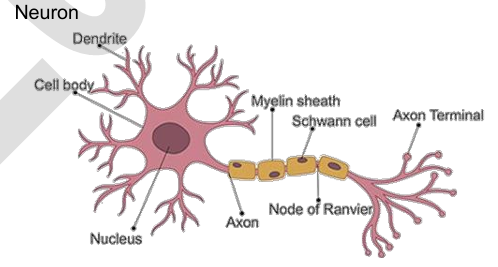
Carries genetic information, maintains neuron's structure, and provides energy to drive activities
a. Soma
b. Axons
c. Dendrites
a. Soma
allow neurons to send electrical signals to other cells
a. Soma
b. Axons
c. Dendrites
b. Axons
receives signals
a. Soma
b. Axons
c. Dendrites
c. Dendrites
Nerve cells pass messages one to another and it is achieved through
a. chemical impulses
b. electrical impulses
c. both
c. both
[NEUROTRANSMITTERS]
Neurotransmitters are ________ responsible for transmission of signals.
a. Exogenous chemicals
b. Endogenous chemicals
c. Hormones only
d. Enzymes only
b. Endogenous chemicals
[NEUROTRANSMITTERS]
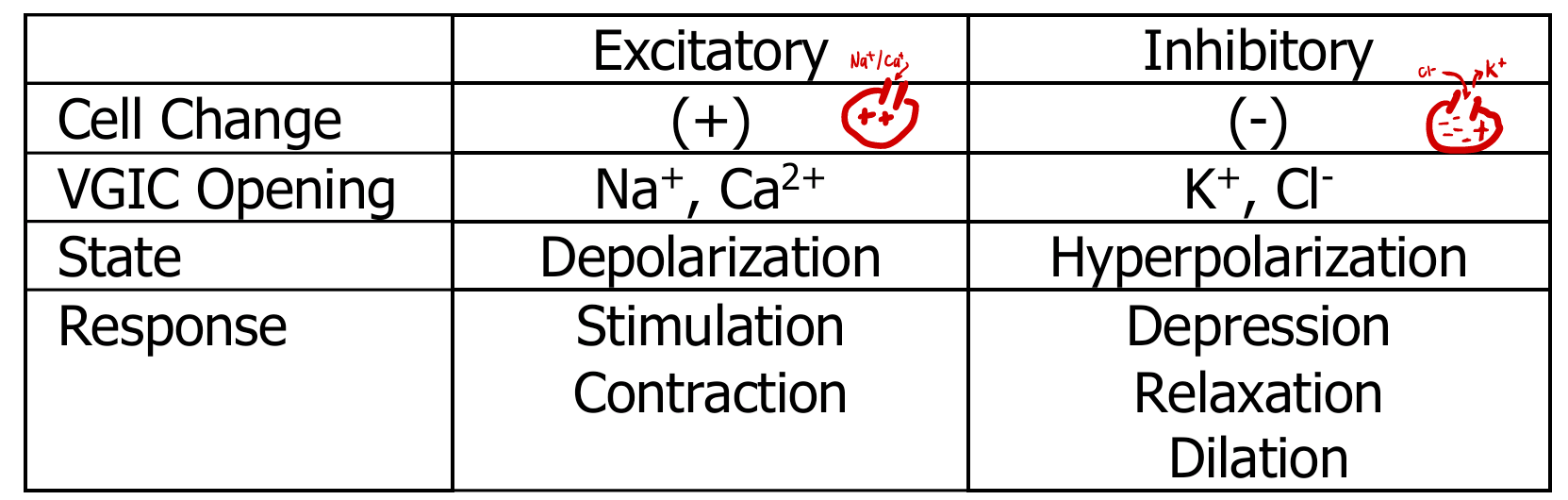
_______ neurotransmitters fire action potentials.
a. Inhibitory
b. Excitatory
c. Sedative
d. Blocking
b. Excitatory
[NEUROTRANSMITTERS]
_______ neurotransmitters decrease the chances of neurons to fire action potential
a. Inhibitory
b. Excitatory
c. Sedative
d. Blocking
a. Inhibitory
[NEUROTRANSMITTERS]
Inhibitory NT, Excitatory NT, or Both
____a. Serotonin
____b. Dopamine
____c. Acetylcholine
____d. GABA
____e. Glycine
____f. Glutamate
____g. Opioids
____h. Norepinephrine
Both_____a. Serotonin
Inhibitory _b. Dopamine
Both_____c. Acetylcholine
Inhibitory _d. GABA
Inhibitory _e. Glycine
Both_____f. Glutamate
Inhibitory _g. Opioids
Both_____h. Norepinephrine
[NEUROTRANSMITTERS]
GABA
a. Glycine Amino Binding Agent
b. General Action Brain Activator
c. Glutamate Amine Binding Acid
d. Gamma Amino Butyric Acid
d. Gamma Amino Butyric Acid
[NEUROTRANSMITTERS]
_______ is considered the major inhibitory neurotransmitter of the brain.
a. Dopamine
b. GABA (Gamma Aminobutyric Acid)
c. Serotonin
d. Glutamate
b. GABA (Gamma Aminobutyric Acid)
GABA= Brain
[NEUROTRANSMITTERS]
GABA binds to ________.
a. Adrenergic receptors only
b. GABAᴀ or GABAʙ receptors
c. Muscarinic receptors
d. Histaminic receptors
b. GABAᴀ or GABAʙ receptors
[NEUROTRANSMITTERS]
The GABAᴀ receptor is a(n) ________ receptor.
a. Metabotropic
b. Ionotropic
c. Adrenergic
d. Dopaminergic
b. Ionotropic
GABAᴀ = Ionotropic = opens Cl- channels
GABAb = Metabotropic = opens K+ channels or closes Ca2+channels
[NEUROTRANSMITTERS]
Activation of the GABAᴀ receptor opens ________.
a. Na⁺ channels
b. K⁺ channels
c. Cl⁻ channels
d. Ca²⁺ channels
c. Cl⁻ channels
GABAᴀ = Ionotropic = opens Cl- channels
GABAb = Metabotropic = opens K+ channels or closes Ca2+channels
[NEUROTRANSMITTERS]
The GABAʙ receptor is a(n) ________ receptor.
a. Ionotropic
b. Metabotropic
c. Nicotinic
d. Histaminic
b. Metabotropic
GABAᴀ = Ionotropic = opens Cl- channels
GABAb = Metabotropic = opens K+ channels or closes Ca2+channels
[NEUROTRANSMITTERS]
GABAʙ receptor activation opens ________ or closes Ca²⁺ channels.
a. Na⁺ channels
b. K⁺ channels
c. Cl⁻ channels only
d. H⁺ channels
b. K⁺ channels
GABAᴀ = Ionotropic = opens Cl- channels
GABAb = Metabotropic = opens K+ channels or closes Ca2+channels
[NEUROTRANSMITTERS]
Fast inhibitory postsynaptic potentials (IPSPs) are blocked by ________.
a. GABAʙ receptor antagonists
b. GABAᴀ receptor antagonists
c. Dopamine receptor antagonists
d. Serotonin receptor antagonists
b. GABAᴀ receptor antagonists
Fast = GABAᴀ antagonists
Slow = GABAʙ antagonists
[NEUROTRANSMITTERS]
Slow inhibitory postsynaptic potentials (IPSPs) are blocked by ________.
a. GABAᴀ receptor antagonists
b. GABAʙ receptor antagonists
c. Muscarinic antagonists
d. Adrenergic blocker
b. GABAʙ receptor antagonists
Fast = GABAᴀ antagonists
Slow = GABAʙ antagonists
[NEUROTRANSMITTERS]
Glutamate is classified as a(n) ________.
a. Inhibitory neurotransmitter
b. Excitatory amino acid (EAA)
c. Hormone
d. Neuromuscular blocker
b. Excitatory amino acid (EAA)
[NEUROTRANSMITTERS]
Stimulates EAA receptors (NMDAR & AMPAR)
a. GABA
b. Glutamate
c. Ach
d. Glycine
b. Glutamate
[NEUROTRANSMITTERS]
Glutamate is thought to be important in ________.
a. Blood clotting only
b. Learning, memory, and other brain functions
c. Gastric secretion only
d. Muscle paralysis
b. Learning, memory, and other brain functions
[NEUROTRANSMITTERS]
_______ is imported into the glutamatergic neuron and converted into glutamate.
a. Glycine
b. Glutamine
c. Glutamic Acid
d. Histidine
b. Glutamine → Glutamate (by enzyme Glutamase)
[NEUROTRANSMITTERS]
Glutamate is concentrated in the ________.
a. Vesicular glutamate transporter
b. Blood-brain barrier
c. Myelin sheath
d. Axon terminal
a. Vesicular glutamate transporter
[NEUROTRANSMITTERS]
Upon release into the synapse, glutamate interacts with ________ on the postsynaptic neuron.
a. GABAᴀ and GABAʙ receptors
b. NMDAR and AMPAR
c. Nicotinic receptors only
d. Histamine receptors only
b. NMDAR and AMPAR
[NEUROTRANSMITTERS]
Binding of glutamate to NMDAR and AMPAR stimulates opening of ________.
a. K⁺ and Cl⁻ channels
b. Na⁺ and Ca²⁺ channels
c. H⁺ channels only
d. Mg²⁺ channels only
b. Na⁺ and Ca²⁺ channels = depolarization = excitatory
[NEUROTRANSMITTERS]
Some glutamate enters the glutamate transporter and is converted to ________.
a. Histamine
b. Glutamine
c. Dopamine
d. Serotonin
b. Glutamine
[NEUROTRANSMITTERS]
The enzyme responsible for converting glutamate back to glutamine is ________.
a. Glutamase
b. Glutamine synthetase
c. Acetylcholinesterase
d. Monoamine oxidase
b. Glutamine synthetase
[NEUROTRANSMITTERS]
After conversion, glutamine is transported to the ________ neuron to be converted again into glutamate.
a. Postsynaptic
b. Motor
c. Presynaptic
d. Sensory
c. Presynaptic
[NEUROTRANSMITTERS]
Dopamine produces inhibitory effects through activation of ________.
a. Na⁺ channels
b. K⁺ channels
c. Cl⁻ channels only
d. H⁺ channels
b. K⁺ channels
Stimulates K⁺ channels= hyperpolarization = inhibitory
[NEUROTRANSMITTERS]
Dopamine may inhibit neuronal activity by inactivation of ________.
a. Na⁺ channels
b. K⁺ channels
c. Ca²⁺ channels
d. Cl⁻ channels
c. Ca²⁺ channels
Blocks Ca²⁺ channels= hyperpolarization = inhibitory
[NEUROTRANSMITTERS]
The main dopamine receptor subtype in basal ganglia neurons is ________.
a. D₁ receptor
b. D₂ receptor
c. D₃ receptor
d. D₄ receptor
b. D₂ receptor
[NEUROTRANSMITTERS]
Norepinephrine produces excitatory effects through activation of ________.
a. α₂ and β₂ receptors
b. α₁ and β₁ receptors
c. D₂ receptors only
d. GABA receptors
b. α₁ and β₁ receptors
excitatory = α₁ and β₁
inhibitory = α₂ and β₂
[NEUROTRANSMITTERS]
Norepinephrine produces inhibitory effects through activation of ________.
a. α₂ and β₂ receptors
b. α₁ and β₁ receptors
c. D₂ receptors only
d. GABA receptors
a. α₂ and β₂ receptors
excitatory = α₁ and β₁
inhibitory = α₂ and β₂
[NEUROTRANSMITTERS]
Can cause excitation or inhibition of CNS neurons depending on the receptor subtype activated
a. Serotonin
b. Norepinephrine
c. Dopamine
a. Serotonin
[NEUROTRANSMITTERS]
Targets of CNS drug action: respond to changes in membrane potential
a. Voltage-gated ion channels
b. Ligand-gated ion channels
a. Voltage-gated ion channels
[NEUROTRANSMITTERS]
Targets of CNS drug action: aka ionotropic receptors
a. Voltage-gated ion channels
b. Ligand-gated ion channels
b. Ligand-gated ion channels
[NEUROTRANSMITTERS]
EPSP stands for ________.
a. Excitatory post-synaptic potential
b. Electrical post-synaptic pathway
c. Excitatory presynaptic potential
d. Enhanced synaptic process
a. Excitatory post-synaptic potential
[NEUROTRANSMITTERS]
EPSPs are commonly associated with activation of ________.
a. Ionotropic receptors
b. Metabotropic receptors only
c. Dopamine receptors only
d. Muscarinic receptors only
a. Ionotropic receptors
[NEUROTRANSMITTERS]
IPSP stands for ________.
a. Inhibitory post-synaptic potential
b. Ionic post-synaptic pathway
c. Increased post-synaptic process
d. Inhibitory presynaptic pathway
a. Inhibitory post-synaptic potential
[NEUROTRANSMITTERS]
________ is a mechanism that reduces neurotransmitter release before signaling occurs in the postsynaptic neuron.
a. Excitatory transmission
b. Presynaptic inhibition
c. Depolarization only
d. Ionotropic activation only
b. Presynaptic inhibition
[NEUROTRANSMISSION]
Where the synthesis, storage, metabolism & release occur
a. Pre-synapse
b. Synaptic cleft
c. Post-synaptic
a. Pre-synapse
[NEUROTRANSMISSION]
Where most of the enzymes found
a. Pre-synapse
b. Synaptic cleft
c. Post-synaptic
b. Synaptic cleft
[NEUROTRANSMISSION]
Majority of the receptors located
a. Pre-synapse
b. Synaptic cleft
c. Post-synaptic
c. Post-synaptic
[NEUROTRANSMISSION]
Sites of CNS drug action
(Basahin nalang)
Drugs may alter:
The action potential in the presynaptic fiber
Synthesis of transmitter
Storage
Metabolism
Release
Reuptake
Degradation
Receptors for the receptors
Receptor-induced decrease or increase in ionic conduction
[NEUROTRANSMISSION]
Which of the following is a mechanism of neurotransmitter termination?
a. Reuptake
b. Diffusion and degradation
c. Metabolism by COMT or MAO
d. All of the above
d. All of the above
[NEUROTRANSMISSION]
Neurotransmitters may be terminated by ________ and degradation.
a. Diffusion
b. Muscle contraction
c. Bone remodeling
d. Vasoconstriction
a. Diffusion
[NEUROTRANSMISSION]
Neurotransmitters may terminate through metabolism by ________.
a. Acetylcholinesterase
b. COMT or MAO
c. Lipoxygenase
d. Cyclooxygenase
b. COMT or MAO
[NEUROTRANSMISSION]
Neurotransmitters can be terminated through ________ into neurons.
a. Reuptake
b. Vasodilation
c. Depolarization
d. Cytoprotection
Reuptake
[NEUROTRANSMISSION]
Reuptake inhibitors
a. Increase NT levels in the synapse
b. Decrease NT effects
c. Prevents depolarization causing inhibitory effect
a. Increase NT levels in the synapse
[NEUROTRANSMISSION]
MAO inhibitor
a. Increase NT levels in the synapse
b. Decrease NT effects
c. Prevents depolarization causing inhibitory effect
a. Increase NT levels in the synapse
[NEUROTRANSMISSION]
Receptor blocker
a. Increase NT levels in the synapse
b. Decrease NT effects
c. Prevents depolarization causing inhibitory effect
b. Decrease NT effects
[NEUROTRANSMISSION]
Na channel blocker
a. Increase NT levels in the synapse
b. Decrease NT effects
c. Prevents depolarization causing inhibitory effect
c. Prevents depolarization causing inhibitory effect