Cognition ch.7
 Call Kai
 Learn
Learn Practice Test
 Spaced Repetition
 Match
Match Flashcards
 Knowt Play
1/42

Earn XP
Description and Tags
Week 4
Name | Mastery | Learn | Test | Matching | Spaced | Call with Kai |
|---|
No analytics yet
Send a link to your students to track their progress
43 Terms
Cognition
Mental processes associated with perceiving, making sense of, and using information
3 primary components: attention, memory, executive function
Attention
Efficiently using cognitive resources to take in information needed
to accomplish a task
Automatic and Controlled Processing
Unintentional, done without conscious awareness, does not interfere with other mental activity
Automatic tasks are highly familiar and practiced (controlled tasks can
become automatic with practice)
Selective Attention
Sorting out and focusing on relevant sensory stimuli
A component of nearly everything we do
Distracters can be external or internal
Filter theory vs. attenuation theory
Selective Attention Strategies
Remove irrelevant stimuli, enhance and intensify important
information, auditory and visual cues, address internal distractions like
anxiety and auditory hallucinations
Divided Attention
Ability to pay attention to more than one task at a time
o How does this work?
▪ Alternating
▪ Automatic vs. controlled
▪ Coordinated execution
Divided Attention Strategies
Separate tasks, work towards making one or more tasks automatic, practice doing two tasks together
Vigilance
Ability to sustain attention through time
o Fatigue is a significant barrier to vigilance
o Quality of attention can decrease over time
Vigilance Strategies
Incorporate breaks, slow down presentation of info, make stimulus easy to detect, schedule difficult tasks when individual is well rested
Semantic Memory
Facts
o Tends to be created and forgotten easily
o Methods for remembering
▪ Shallow rehearsal = repeating information
▪ Deep processing = finding meaning in facts
Episodic Memory
Events that have happened to you
organized temporally
Procedural memory
How to do something
Takes longer to create
Less susceptible to errors
OTPs help people establish procedural mems
Short Term Memory
Held for a matter of seconds or minutes
o Lost in about 20 seconds if not rehearsed
o Most adults have capacity for about 7 items
o Can recall more by chunking info and remembering as 1 item (e.g., a phone number
Long Term Memory
Accumulation of information during a lifetime
Capacity unknown
Memory Strategies
Chunk items together
Creare mnemonics
Ask questions about the information
Apply information to oneself
Use memory aids
Executive Function
Controlled, conscious efforts
Working Memory
Short-term memory storage and active manipulation of new information
o Holding several bits of info at once to process
o Not used to memorize or remember but accomplish a temporary activity
o Strategies: simplify tasks, use devices to assist in manipulation of info
Concept Formation and Cetegorization
Putting things into groups
o Concrete vs. Abstract Concepts
o Concepts are grouped into categories
o Mostly done implicitly but may need to be made explicit for people with cognitive impairments
o How do concepts and categories apply to daily life activities?
o Strategies: cue sheet with categories and exemplars, real world experiences
Schemas
Mental representations that structure related concepts
Scripts
Kinds of schemas that describe a sequence of events for a familiar activity
Helps us to integrate information and organize memories
Strategies
Write out or use pictures to show steps, create simple maps with steps,
order objects in sequence, repeatedly practice the sequence
Problem Solving Steps
Can happen implicitly but made explicit for people with cognitive impairment
1. Recognize the problem
2. Understand the problem
3. Identify strategies or solutions
4. Evaluate the strategies
5. Select and carry out a strategy
6. Evaluate the outcome
Problem Solving Strategies
Provide and practice problem-solving heuristics, prevent or eliminate
common problems
Decision Making
Heuristics - rule of thumb that helps with quick decision making
Representativeness
Availability
Anchoring and adjustment
Decision Making Strategies
Limit options, teach about biases in decisions-making, teach to step back and think through decisions, ask other for input
Functional Cognition
The application of cognition within the context of everyday activities
o What OTPs are most concerned with, because assessing the components is not necessarily predictive of function
o Functional cognition collectively considers all the components, strategy use, habits and routines, and the environment
Metacognition Strategies
Create questions to ask before engaging in a task, have individual
evaluate their performance after a task
Cognition Assessments
Allen Cognitive Level Screen
Cognitive Performance Test
Contextual Memory Test
Do-Eatg
Executive Function Performance Test
Menu Task
Multiple Errands Test
Weekly Calendar Planning Activity
Allen Cognitive Level Screen
Used with adults with psychiatric disorders, dementia, or disruption in cognition
o LACLS used when there is a visual impairment
• Measures global cognition and affects on occupational performance
• Administration time= 10-20 min
• Leather lacing task that involves following verbal and/or visual directions
Dynamic Lowenstein Occupational Therapy Cognitive Assessment
Used for adults with brain injury or psychiatric conditions
• Measures orientation, perception, visual motor abilities, thinking, and ability to learn
• 28 subtests that include paper-and-pencil and motor tasks
• Administration time= 30-45 min
Do-Eat
Used with children ages 5-8 (chronological or behavioral)
• Measures task performance, sensory motor skills, and executive function
• 3 tasks: make a sandwich, prepare chocolate milk, fill out a certificate of performance
• Administration time= 20 min
Executive Function Performance Test
Used with adults with neurological or psychiatric conditions
• Measures executive function and capacity for independent functioning/level of assistance needed
o Initiation
o Organization
o Sequencing
o Judgment
o Safety
• Administered in a setting with cooking space
• Administration time= 60-90 min
• 4 subtests: cooking, telephone use, medication management, and bill paying
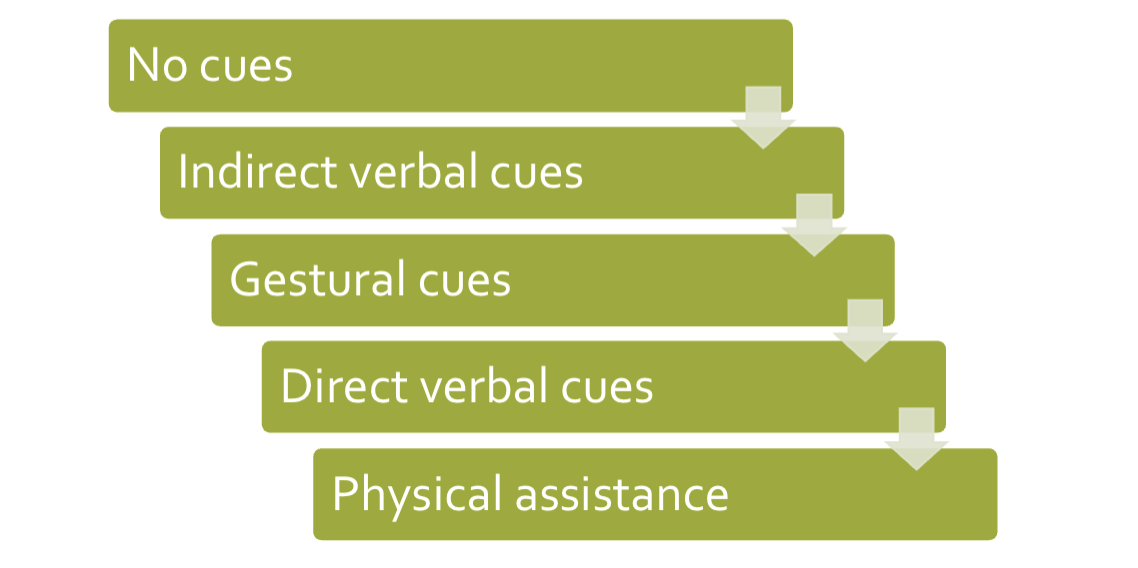
EFPT Cue Chart
No Cues
Indirect Verbal Cues
Gestural Cues
Direct Verbal Cues
Physical Assistance
Multiple Errands Test
Used for adults with brain injury, stroke, or psychiatric conditions
• Measures executive function in a natural environment
o Rule breaks
o Inefficiencies
o Task failure
o Interpretation
• Administered in a shopping center (MET) or hospital (MET-R)
• Administration time= 30-45 min
• Person is given rules to follow while performing tasks like making a purchase, finding out information about a service, or getting to an identified location at an identified time
Remediation vs. Compensatory
Remediation = improving a skill
Compensatory = adapting the environment, task, or adopting compensatory strategies
Cognitive Remediation
Improving or restoring specific cognitive skills
• Neuroplasticity = the brain can adapt and change
• Repetition + Rehearsal
• Activities target areas of impairment
o Just-right challenge
o Increase in difficulty
• Evidence for use with schizophrenia, eating disorders, and mood disorders
• Can only be generalized when used in conjunction with other interventions that target occupational participation and performance
Dynamic Interactional Approach
Considers the interplay of the person, activity, and environment with a focus
on functional information processing capacity
• Interventions target processing strategies and self-monitoring skills
• Attends to an activity’s familiarity, directions, distinctive features, degree of
detail, contrast, background, context, amount, and arrangement
• Facilitates generalization by applying a strategy across different activities
• Developed for people with TBI but also used with schizophrenia and ADHD
Cognitive Adaptation
Strategies to adapt the environment or task to compensate for impairments
• 1st step: activity analysis and environmental assessment
• Cognitive Adaptation Training makes task and environmental modifications based on apathetic vs. disinhibited behaviors
• Task adaptations: Using pre-measured or pre-chopped ingredients when cooking
• Environmental adaptations: Using a calendar to organize appointments
CO-OP: Cognitive Orientation to Daily Occupational Performance
Uses problem-solving strategies for acquiring motor-based skills
• Four step strategy
1. Goal – What do you want to do?
2. Plan – How will you do it?
3. Do – Carry out the plan
4. Check – Did it work? Does it need to be modified?
• Developed for children with developmental coordination disorder but applied for ADHD, developmental disabilities, and neurological conditions
Metacognitive Reflection and Insight Therapy: MERIT
Focused on the therapeutic relationship as a means for addressing everyday problems
1. Agenda
Insertion of therapist’s mind
Eliciting the narrative episode
Defining the psychological problem
2. Process elements
Reflecting on the therapeutic relationship
Reflecting on progress
3. Superordinate elements
Stimulating self-reflection and awareness of others
Stimulating mastery
Cognitive Disabilities Model
An adaptive approach (when a remediation is not reasonable)
• Preceded by a thorough evaluation to determine cognitive level
• Intervention focuses on creating the best fit between the person and their
occupations/environment
o Can do (cognitively realistic)
o Will do (interesting and desirable)
o May do (supported by the environment)
• Cognitive levels may be related to other cognitive measures, social competence, and community living status
• Frequently used by OTPs to create groups based on cognitive level
Cognitive Disabilities for Dementia
Revision of Cognitive Disabilities Model that applies to dementia
• Allen Cognitive Levels are reconceptualized to align with the decline associated with
dementia
• Each level is associated with one’s ability to participate in ADLs and IADLs and type
of assistance required
• Intervention focuses on maximizing strengths and creating an enabling environment
Errorless Learning
Used for people who have difficulty learning new information, recognizing
mistakes, and adjusting performance based on feedback (e.g. Alzheimer’s
disease, schizophrenia, intellectual and learning disabilities)
Training is structured so mistakes are minimized or eliminated
1. Task is broken down into simple components
2. Training starts with simple task with high likelihood of success
3. Increasingly difficult tasks are added with the addition of prompts and
guided instruction until proficiency is reached
4. Performance at each level is overlearned using repetition, success, and
positive reinforcement