YEAR 12 ATAR CHEMISTRY- Semester 1 Exam
 Call Kai
 Learn
Learn Practice Test
 Spaced Repetition
 Match
Match Flashcards
 Knowt Play
1/85

There's no tags or description
Looks like no tags are added yet.
Name | Mastery | Learn | Test | Matching | Spaced | Call with Kai |
|---|
No analytics yet
Send a link to your students to track their progress
86 Terms
A primary standard must:
- Be obtainable in a very pure form and have a known formula
- Be stable so that it does not alter during weighing by picking up or losing moisture, or reacting with air (deliquescent, hygroscopic)
- Have reasonably high molecular mass to minimise weighing errors
- React according to known chemical equations
- HCl, H2SO4, NaOH or KOH are not suitable as primary standards as they are not available in a suitably pure form
Give examples of primary standards
- E.g. anhydrous sodium carbonate (Na2CO3) and oxalic acid (H2C2O4·2H2O)
What is a good indicator for a strong acid and a weak base?
methyl orange
What is a good indicator for a strong acid and a strong base?
- bromothymol blue
What is a good indicator for a weak acid and a strong base?
- phenolphthalein
Describe the colour change of bromothymol blue in basic and acidic conditions
- Yellow in acidic conditions and blue in basic conditions, at a pH of 7 in neutral conditions it is green
Describe the colour change of methyl orange in basic and acidic conditions
- Red in acidic conditions and yellow in basic solutions
When does methyl orange indicator change points between?
- Changes colour between pH 3.1 and 4.4, between these values the indicator is orange
Describe the colour change of phenolphthalein in basic and acidic conditions
In acidic solutions it is colourless and in basic solutions it has a pink colour
What is the pH range of phenolphthalein?
- Changes colour over the pH ranges 8.3-10.0
What is the pH range of bromothymol blue?
6.0-7.6
What is uncertainty?
the range of values within which true values lie
What is confidence interval?
the amount of uncertainty associated with a sample estimate
Is pure water a strong or weak electrolyte?
- it is a weak electrolyte
System
the chemical reaction
Surroundings
everything else; or the rest of the universe that the system reacts with
Open chemical system
Can exchange matter and energy between the system and the surroundings
Give some examples of open systems
- E.g. evaporation (physical change), melting of a glacier (physical change), combustion (chemical change), acid + carbonate (chemical change)
Closed Chemical System
- No exchange of matter
- Can exchange energy between the system and the surroundings
Give some examples of closed chemical systems
- All aqueous solution/liquid systems are closed systems e.g. HCl and NaOH and the products
What type of reactions occur in closed systems?
- Reversible reactions occur in closed systems
Isolated system
- No heat exchange of heat from the system or surroundings
- No exchange of matter from the system or surroundings
What is a suitable solution for a salt bridge?
KNO3
When does blue litmus paper turn red?
- under acidic conditions
When does red litmus paper turn blue?
- under basic conditions
What is the equations of a buffer?
HA + H2O <-> A- + H3O+
List three ways the rate of reaction can be determined
1. measuring the change in mass
2. measure the change in temperature
3. measure the change in pressure
In an open system what can be exchanged with the surroundings?
- heat energy and matter
In a closed system what can be exchanged with the surroundings?
- only heat energy
What is equilibrium established in a gas/liquid system?
- when the rate of evaporation is equal to the rate of condensation
When is equilibrium established in a saturated solution?
- equilibrium is established in a saturated solution as the rate of dissolving is equal to the rate of crystallisation
Advantages of the Bronsted Lowry model
- not restricted to aqueous solutions
- reactions between two gases can be an acid-base reaction
Disadvantages of the bronsted Lowry model
- cannot be applied to the reaction between acidic and basic oxides
What are amphiprotic substances
- substances that can donate or accept protons (they can behave as either acids or bases)
What is a polyprotic acid?
acids which can donate more than one hydrogen atoms per molecule of acid
Disadvantage of arrhenius theory?
- restricted to aqueous solutions
Give the ionic equation for a strong acid and give the bronsted-lowry approach for this question
- HA(aq) --> H+(aq) + A-(aq)
- Bronsted-lowry: HA(aq) + H2O(l) --> A-(aq) + H3O+(aq)
NOTE: weak acids would be written with a double arrow as they only partially ionise
What is the solubility of group II metal hydroxides? How does this effect the strength of the bases?
- they tend to have low solubility
- they are still strong bases because to the extent to which these solids dissolve, they fully dissociate
Give 4 examples of strong bases
- KOH (potassium hydroxide)
- Ba(OH)2 (barium hydroxide)
- Na2O (sodium oxide)
- Ca(OH)2 (calcium hydroxide)
Give the equation for an acid base reaction
HA + B- <-> A- + HB
What is the expression for the ionisation of water, Kw
Kw= [H3O+][OH-]
At 25 degrees, Kw=[1 x 10^-7][1 x 10^-7] = 10^-14
When is a solution neutral?
when [H3O+]=[OH-]
is the self ionisation of water endo or exothermic?
- it is endothermic
How are salts formed?
- they are formed of neutralisation reactions
What does the positive ion of the salt come from and where does the negative ion of the salt come from?
- the positive ion comes from the base and the negative ion comes from the acid
anions of monoprotic acids e.g. HCl are...
neutral e.g. Cl
Cations of strong bases are...
neutral e.g. Na from NaOH
anions of weak acids are...
basic
anions of polyprotic acids e.g. H2PO4 are...
acidic
- EXCEPT FOR: the hydrogen carbonate ion
Is the ammonium ion acidic or basic?
- acidic as it hydrolyses in water to form an acidic ion
What do buffers consist of?
- weak acid and its conjugate base in equimolar amounts
Give some examples of common buffer solutions
- CH3COOH/CH3COO-
- HCO3-/H2CO3
- H2PO4-/HPO4 2-
List three ways to make a buffer solution
1. add equimolar amounts of a weak acid and the salt of its conjugate base
2. add weak acid to a strong base
3. add weak base to a strong acid
List the equations involved in maintaining blood pH
HCO3- + H3O+ <-> H2CO3 + H2O (buffer system)
H2CO3 + H2O <-> 2H2O + CO2 (not a buffer system)
What is the general equation of an indicator?
- HIn(aq) + H2O(l) <-> In-(aq) + H3O+(aq)
What is the equivalence point?
- when stoichiometrically equivalent amounts of acid and base have reacted i.e. neither acid or base remain in the conical flask
What is the end point of the titration?
- when the indicator changes colour permanently for the first time to signal the equivalence point has been reached and the titration is to be stopped
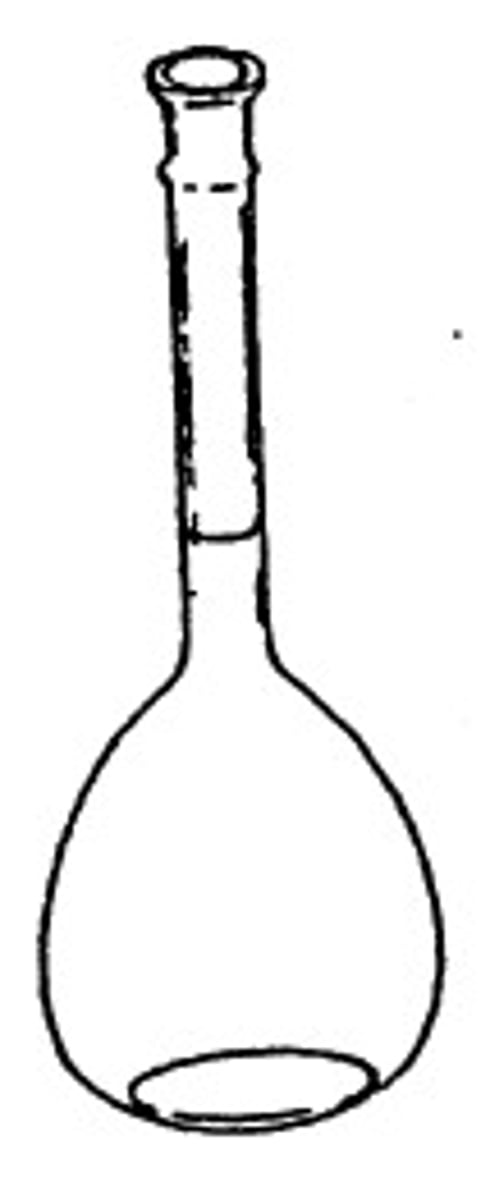
What is the volumetric flask used for?
- holds a fixed, accurately known volume of solution
- used to prepare standard solutions or perform dilutions
What is a burette used for?
- accurately delivers a variable volume of solution

What is a pipette used for?
- accurately delivers a fixed volume of solution (aliquot)
Where is the titration carried out?
- carried out in a conical flask
What is a conical flask used for?
- contains an aliquot of the other reagent and indicator
What is a standard solution?
- solution with known concentration
What are two ways in which a primary standard can be prepared?
- primary standard- dissolve a known mass of primary standard in water in a volumetric flask
- secondary standard- use a standard solution in a titration to calculate the concentration of an unknown; this becomes a secondary standard
Give two examples of primary standards
- anhydrous sodium carbonate (Na2CO3)
- oxalic acid dehydrate (H2C2O4.2H2O)
What does anhydrous mean?
- no water present in the compound
What is the endpoint of a titration?
the point where the indicator changes colour
What are concordant results
titres within 0.20ml of each other
What is the volume of one single drop from the burette
0.05ml
What is a titre?
- a variable volume of solution that is added from the burette into the conical flask until the endpoint of titration has been reached
What is an aliquot?
- an accurately measured volume of solution with known concentration
What is a random error?
- an error that follows no regular pattern
What is a systematic error?
- errors that produce a constant bias in a measurement that cannot be eliminated by repeating the measurement
List three uncertainties associated with the pipette, the burette and the volumetric flask in volumetric analysis
- 20mL pipette (+-)0.03mL
- 50mL burette (+-)0.02mL for each reading
- 250mL volumetric flask (+-) 0.3mL
List 2 uncertainties associated with the top loading balance and the analytical loading balance
- 100g capacity top loading balance (+-)0.001g
- 60g capacity anaytical balance (+-) 0.0001g
Give two uncertainties associated with a measuring cylinder or a graduated beaker
- 50mL measuring cylinder (+-)0.3mL
- 50mL graduated beaker (+-) 5mL
List 3 mistakes that could occur during an acid-base titration
- misreading the numbers on a scale
- mistakenly using a pipette of incorrect volume
- spilling a portion of a sample
How can random errors be reduced?
- take multiple measurements of the same quantity then calculating the average
- (in volumetric analysis the average of three concordant titres is used to reduce random error)
How can systematic errors be eliminated or minimised?
- they can be eliminated or minimised through calibration of apparatus and the careful design of the procedure
What is a secondary standard solution?
- a solution whose concentation is found by titration
Explain the titration process
1. a carefully measured volume of a solution (aliquot) is added to a conical flask
2. a variable volume of another solution (titre) is then carefully added from a burette into the conical flask until the reaction between acid + base is complete
3. an indicator colour change signals the end point of titration
Give some examples of systematic errors in titrations
- a faulty balance
- a 20.0mL pipette that delivers 20.2mL
- some of a substance or solution being left in the original container, such as a beaker, when being transferred into a new container
- an unsuitable indicator being used
- the mass of the primary standard being inflated because it has not been dried properly and contains some water
- a person reading a scale on the burette with a constant parallax error
Give some examples of random errors that can occur during titrations
- difficultly in judging the fraction between two 0.1mL scale markings on a burette
- difficulty in judging where the meniscus sits on the line when using a pipette to measure a volume
- inherent uncertainty in the last value after the decimal place in the measurement of the mas of a primary standard on an analytical balance
What is the Humphry Davis theory?
- suggested that the acid properties of a substance were associated with hydrogen and not oxygen
- suggested that acids react with bases to produce salt and water
What is the Arrhenius theory?
- acids are substances that produce hydrogen ions in solution and bases are substances that produce hydroxide ions in solution
What is the bronsted-lowry theory?
- acids are proton donators and bases are proton acceptors identified the hydronium ion as more accurate in aqueous solutions than hydrogen
- introduced the concept of acid-base pairs