Topic 2 physics
 Call Kai
 Learn
Learn Practice Test
 Spaced Repetition
 Match
Match Flashcards
 Knowt Play
1/51

There's no tags or description
Looks like no tags are added yet.
Name | Mastery | Learn | Test | Matching | Spaced | Call with Kai |
|---|
No analytics yet
Send a link to your students to track their progress
52 Terms
What is electrical current?
The flow of electrical charge around a circuit (amps, A)
What is potential difference?
The difference of electrical potential between two points (volts, V)
What is resistance?
A measure of how difficult it is for current to flow through a component (ohms, Ω)
What is charge?
causes particles (electrons) to experience a force around an electrical field
Circuit symbols
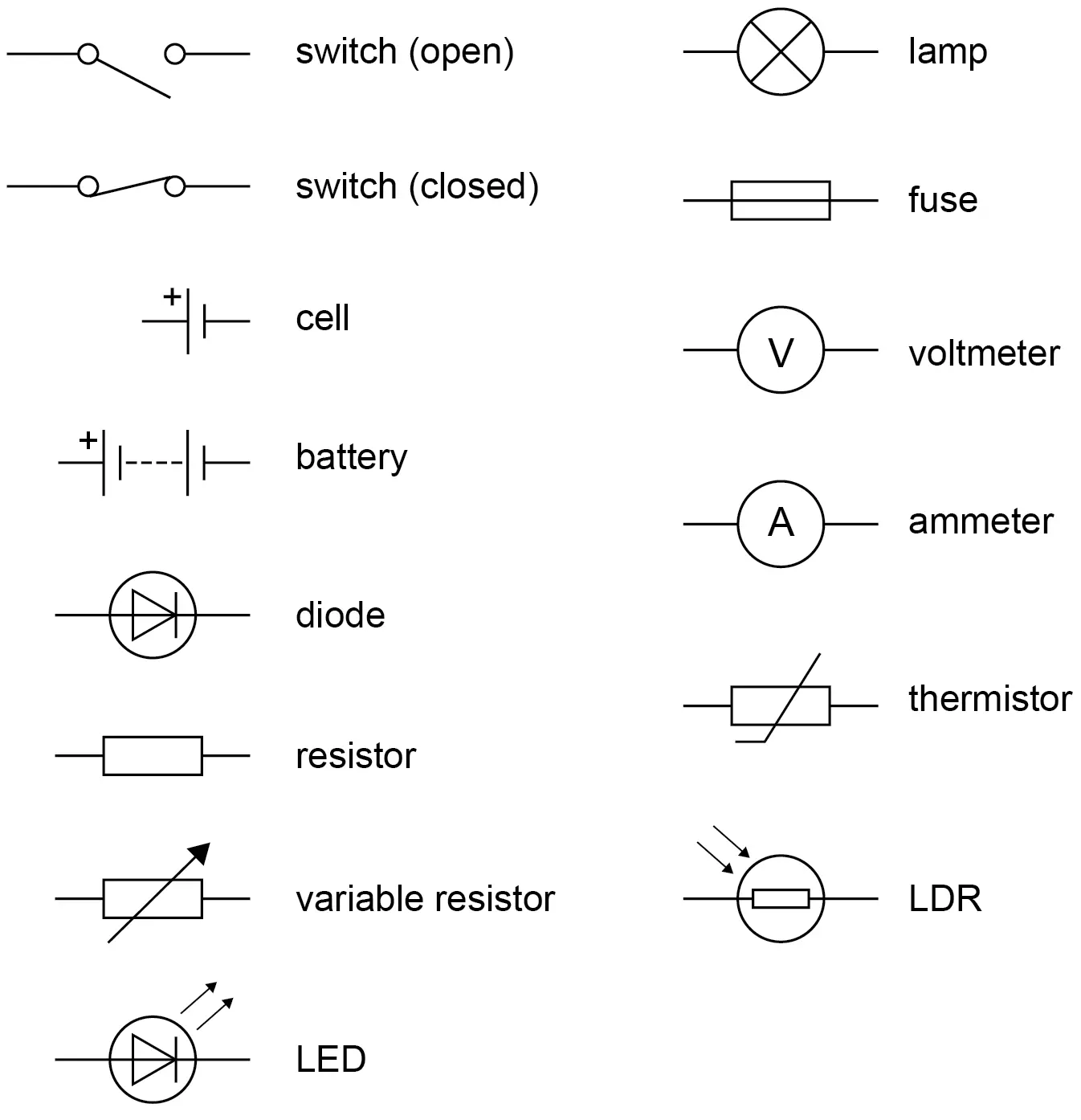
Role of components in a circuit
Closed switch - allows current to pass through, completes the circuit
Open switch - no longer completes the circuit
Resistor - limits the flow of electrical current
Variable resistor - modifies resistance
Voltmeter - measure p.d (added to parallel circuits)
Ammeter - measure current
Fuse - breaks the current if there’s too much current flowing
Diode - only allows current to flow in one direction
LED - emmits light
LDR (light dependent resistor) - resistance changes in repsonse to the amount of light it receives, increase in light decreases resistance
Thermister - dependent on temperature, high temperature low resistance
What is a series circuit?
A single loop - if one component breaks, the circuit is broken so current cannot flow and all components stop working
Electrons flow from the negative end of the cell to the positive end
Conventional current - positive to negative
The electrons carry energy from the cell
They pass this energy to the components in the circuit such as the lamp
In the lamp, the electrical energy is transferred to light energy and thermal energy
When the electrons return to the positive end of the cell, they are carrying less energy than when they left the negative end
Potential difference, current and resistance in a series circuit
Potential difference:
The total p.d of the power supply is shared between the components
The p.d around the circuit add up to the equal source of p.d
Vtotal = V1 + V2 + …
Current:
The same current flows through all components
The size of the current is determined by the total p.d of the cells and the total resistance of the circuit
I1 = I2 = …
Resistance:
Total resistance of the circuit is the sum of the resistances of the components
Rtotal = R1 + R2 + …
What is a parallel circuit?
More than one loop - if a component breaks, the other components will still work
Potential difference, current and resistance in a parallel circuit
Potential difference:
The p.d across each component is the same because all components get the full source of p.d
V1 = V2 = …
Current:
The total current through the whole circuit is the sum of the currents through the separate components
Itotal = I1 + I2 + …
Resistance:
The total resistance of two resistors is less than the resistance of the smallest resistor
Rtotal < R1 or R2 or …
Resistance in series and parallel circuits
Adding a resistor in a series circuit decreases the total current but increases the total resistance
Adding a resistor in a parallel circuit increases the total current but decreases the total resistance
More components in a parallel circuit = lower total resistance
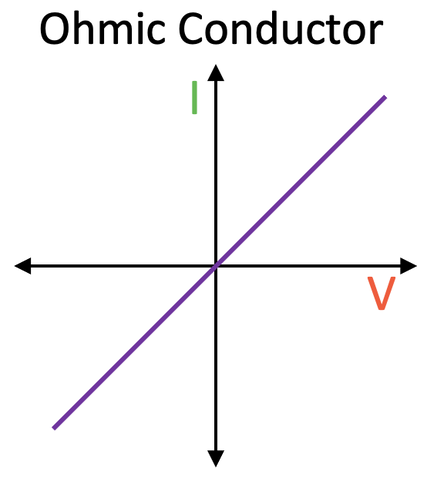
What is an ohmic conductor?
A conductor (e.g wire or resistor) where current is directly proportional to potential difference at constant temperature
The resistance stays constant
The I-V graph is a straight line through the origin
Which components have non-constant resistance?
Their resistance changes with current or conditions:
Filament lamp
Diode
Thermistor
LDR (Light Dependent Resistor)
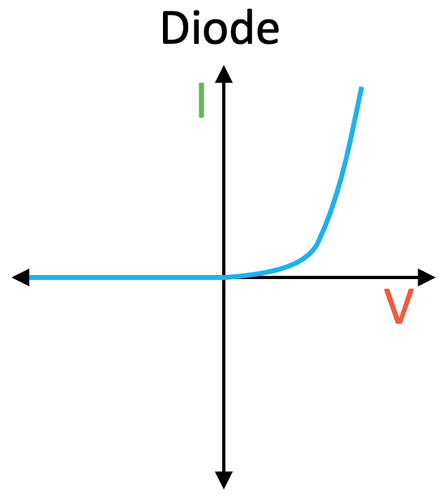
How does a diode work?
Current flows in one direction only
The diode has a very high resistance in the reverse direction
I-V characteristics start flat, then curve up
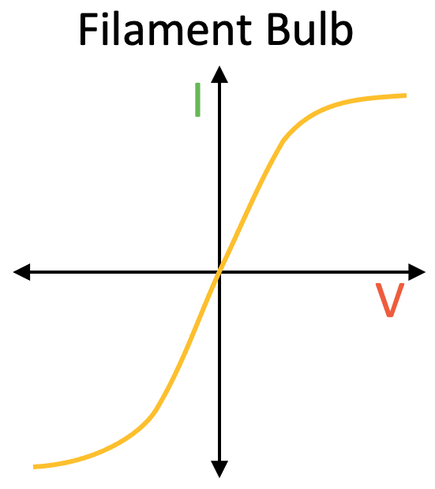
Why does the resistance of a filament lamp increase?
As current flows through the filament, the wire heats up (temp increases)
The heat increases the resistance as less current can flow per unit of p.d
The I-V characteristics get shallower - the graph is a curve
Resistance practical
Resistance tells you the potential difference required to drive a current through a component
The greater the resistance of the component, the smaller the current for a given potential difference
1) Attach a crocodile clip to the wire, level with 0cm on the ruler
2) Attach the second crocodile clip to the wire 10cm away from the first clip and write down the lenth
3) Close the switch, then record the current through the wrie and the p.d acroos it
4) Open the switch, then move the second crocodile clip another 10cm along the wire. Close the switch nad record the new length, current and p.d
5) Repeat this for different lengths on the wire
6) Use the measurements of current and pd to calculate the resistance for each length of the wire (V = IR)
7) Plot a graph of resistance against the wire length and draw a line of best fit
Investigating I-V characteristics practical
1) Begin to vary the variable resistor
2) Take several pairs of readings from the ammeter and voltmeter to see how the pd across the component varies as the current changes
3) Swap over the wires connected to the battery, so the direction of the current is reversed. Use same method to take more readings of p.d and current
4) Plot graph of current against p.d for the component
What type of current is mains electricity in the UK?
Mains electricity is alternating current (AC)
TURD AND LURD
TURD:
Temp, UP, Resistance, Down
LURD:
Light, UP, Resistance, Down
What are the frequency and potential difference of UK mains electricity?
Frequency - 50 Hz
Potential difference - 230 V
What is direct potential difference?
Direct potential difference produces a direct current that flows in one direction only
E.g. batteries and cells
What is alternating potential difference?
Alternating potential difference produces a current that continuously changes direction
What is the difference between direct current (DC) and alternating current (AC)?
In direct current, the current flows in only one direction - produced by using direct potential difference
In alternating current, the direction of the current is constantly changing - produced when you use alternating potential difference
What are the three wires in a mains cable and their colours?
Live – brown
Neutral – blue
Earth – green and yellow stripes
What does the live wire do?
Carries the alternating potential difference of 230 V from the mains supply
This is the dangerous wire
What does the neutral wire do?
Completes the circuit by carrying away current - electricity in from the live wire and out through the neutral wire
P.d of 0 volts
What does the earth wire do?
Protects the other wires and for safety - stops the appliance case becoming live (could happen if the live wire became loose), we would get an electric shock if we touched the casing
Provdes an alternative pathway for the current to flow away through the earthwire rather than passing through us
Normally 0 V and no current flows
Why does the live wire pass electricity to the neutral or sometimes the earth wire?
The live wire is at about 230 V, while the neutral and earth wires are at 0 V
This difference in potential difference causes a current to flow from the live wire to the neutral wire in a complete circuit
The earth wire only carries current if there is a fault
What happens if a person touches a live wire?
Humans are at a potential difference of 0 V
So if someone touches the live wire, a large current to flow, resulting in an electric shock
Why can the live wire still be dangerous when a switch is open?
The live wire is still connected to the 230 V supply
Humans are at 0 V
So if someone touches the live wire, a large current to flow, resulting in an electric shock
Why is connecting the live wire to earth dangerous?
It creates a large current because of the big potential difference (230 V)
This can cause electric shock, overheating, or fire
What are wires made out of and why is this useful?
Wires are made out of copper to conduct electricty
Also coated in a layer of insulating plastic for safety
What is electrical power?
Power is the rate at which electrical energy is transferred
Measured in watts (W)
Shows how fast energy is used or transferred in a device
What is an LDR and how does it work?
LDR = Light Dependent Resistor
Resistance is dependent on light intensity
Resistance decreases as light intensity increases
Used in automatic lighting - street lights that switch on when it gets dark, burglar detectors
What is a thermistor and how does it work?
Thermistor = Temperature Dependent Resistor
Resistance decreases as temperature increases
Used in thermostats or temperature sensors to control heating devices
How does a moving charge transfer energy in a circuit?
A moving charge (electric current) transfers energy because it does work against components in the circuit
Electrical appliances are designed to transfer energy to components when current flows
Example: How does a kettle transfer energy?
Energy is transferred electrically from the mains AC supply to the thermal energy store of the heating element
Example: How does a battery-powered fan transfer energy?
Energy is transferred electrically from the battery to the kinetic energy store of the fan’s motor
What does the power rating of an appliance tell you?
Maximum rate of energy transfer
Shows how much energy is transferred per second
Measured in watts (W)
How does power rating affect electricity usage and cost?
Lower power rating→ transfers less energy in a given time → cheaper to run
Higher power rating→ transfers energy faster → appliance may work quicker, but costs more per second
What does a fuse do?
A fuse is a safety device in a circuit
It breaks the circuit if the current gets too high
Contains a thin wire that heats up and melts during a surge, stopping current flow
How do you choose the correct fuse rating?
Fuse power rating should be a few amps above the rating of the appliance
Too low → fuse blows unnecessarily
Too high → appliance may overheat before fuse blows
Advantages and disadvantages of fuses
Advantages - simple + cheap
Disadvantages - melts permanently after one surge → must be replaced
What is a circuit breaker?
Breaks the circuit if current gets too high, like a fuse
Advantages and disadvantages of circuit breakers
Advantages - does not permanently break → can be reset easily (reusable)
Disadvantages - More expensive than fuses
Why are surges dangerous?
A surge can loosen live wires inside an appliance
The live wire may touch the metal casing
If someone touches the casing, they can get an electric shock
How does double insulation prevent electric shocks?
Covers the entire appliance in plastic casing so there are no exposed metals parts
Even if a live wire touches the casing, the person cannot get a shock
What is the National Grid?
A network of cables and transformers connecting power stations to homes and businesses
Transfers electrical energy over long distances efficiently
What is the purpose of a step-up transformer?
Increases the potential difference
Higher voltage → lower current for the same power (current decreases)
So less energy lost as heat in the transmisssion cables
What is the purpose of a step-down transformer?
Reduces the voltage to a safe level for domestic use
Typically around 230 V in the UK
Why is the National Grid efficient?
Electricity is transmitted at high voltage and low current, reducing heating losses in cables
Transformers allow voltage to be stepped up for transmission and stepped down for safe use
Minimises wasted energy
IMPORTANT
Current and potential difference are only directly proportional when the RESISTANCE is CONSTANT
Usually More Current = More Heat: As you increase the voltage, current increases (to get more current through a component, you must supply more voltage to push it)
The only exception - the only time voltage drops while current increases is inside a power supply (like a battery)