Biology 1010 Exam 5 Review
 Call Kai
 Learn
Learn Practice Test
 Spaced Repetition
 Match
Match Flashcards
 Knowt Play
1/42

Earn XP
Description and Tags
Ch. 37, 38, 39, 40 + cumulative
Name | Mastery | Learn | Test | Matching | Spaced | Call with Kai |
|---|
No analytics yet
Send a link to your students to track their progress
43 Terms
Ecology
The study of the relationships that organisms have with each other and with the environment
Population
A group of interbreeding organisms of one species occupying a location at the same time
Community
Includes all of the populations, representing multiple species, that interact in a given area
Ecosystem
A community plus its nonliving environment, including air, water, minerals, and fire
Habitat
The physical location where the members of a population normally live
Population Density
The number of individuals of a species per unit area or unit volume of habitat
Population Distribution
Patterns describe how individuals are scattered through the habitat space
Random
Uniform
Clumped
Population Dynamics
The study of the factors that influence changes in a population’s size
Immigration
The movement of individuals into a population
Emigration
Occurs when individuals leave
Birth Rate
The number of new individuals produced per individual in a defined time period
Age Structure
Distribution of age classes in a population, helps determine its birth rate
Death Rate
The number of deaths per unit time, scaled by the population size
Life Table
A chart that shows the proportion of surviving individuals at each age
Survivorship Curve
A graph of the proportion of surviving individuals at each age
Per Capita Rate of Increase (R)
The difference between the birth rate and the death rate
Exponential Growth
The number of new individuals is proportional to the population’s size
J-Shaped Curve
Emerges when exponential growth is plotted over time
Environmental Resistance
The combination of external factors that keep a population from reaching its maximum growth rate.
Carrying Capacity
The maximum number of individuals that the ecosystem can support indefinitely
Logistic Growth
The early growth of a population may be exponential, but growth slows and eventually ceases as the population’s size approaches the habitat’s carrying capacity
S-Shaped Curve
Depicts the leveling off a population in response to environmental resistance
Density-Dependent Factors
Conditions whose growth-limiting effects increase as a population grows
Biotic
Living, density-dependent limits are mostly a result from interactions with living organisms
Density-Independent Factors
Exert effects that are unrelated to population density
Abiotic
Nonliving, most density-independent limits are abiotic
Life History
Includes all events of an organism’s life from conception through death
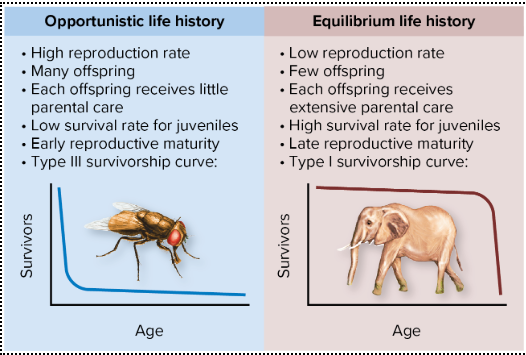
Opportunistic Life History
Individuals tend to be short-lived, reproduce at an early age, and have many offspring that receive little to no care
Equilibrium Life History
Individuals tend to be long-lived, to be late maturing, and to produce a small number of offspring that receive extended parental care
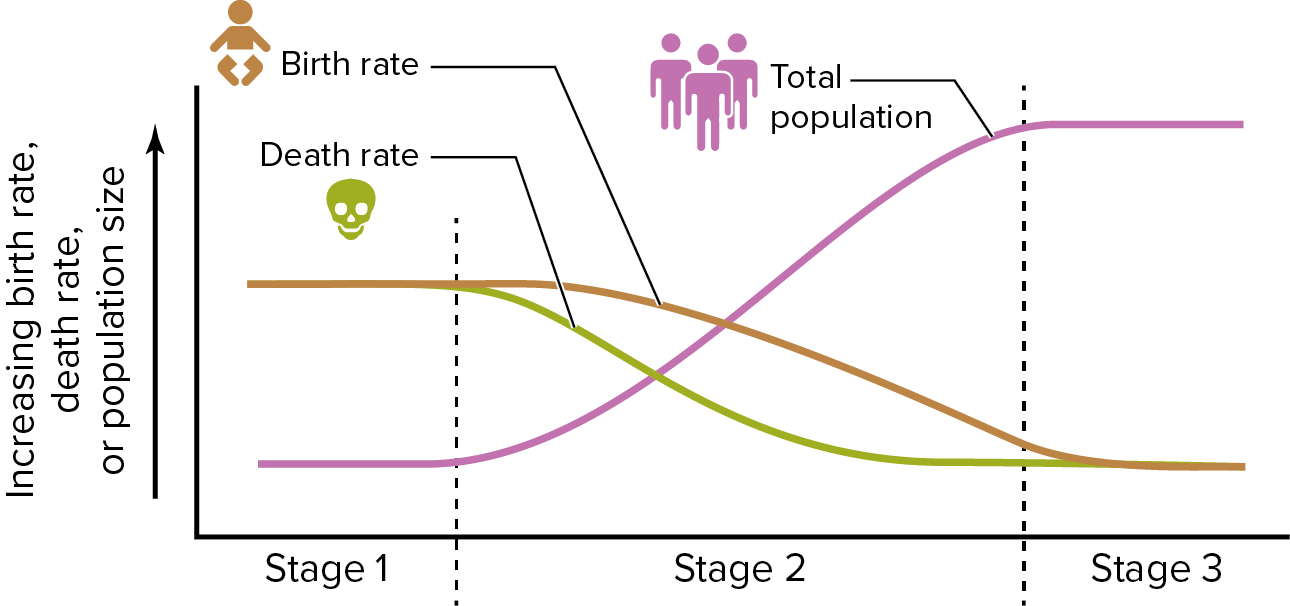
Demographic Transition
Birth rates and death rates shift from high to low
Ecological Footprint
Measures the amount of land area needed to support a person’s or a country’s overall lifestyle
Niche
All resources a species uses for survival, growth, and reproduction
Competition
Occurs when two or more organisms vie for the same limited resource, such as shelter, nutrients, water, light, or food
Competitive Exclusion Principal
Two species coexist indefinitely in the same niche
Resource Partitioning
Multiple species use the same resource in a slightly different way or at a different time
Symbiosis
Two species share a close relationship in which one typically lives in or on the other
Mutualism
A symbiosis relationship that improves the fitness of both partners
Commensalism
A type of symbiosis in which one species benefits but the other is not significantly affected
Parasitism
One species acquires resources at the expense of a living host
Herbivore
An animal that consumes plants
Carnivore
Eats meat
Predator
A carnivore that kills and eats other animals called prey