RM2 - qualitative research
 Call Kai
 Learn
Learn Practice Test
 Spaced Repetition
 Match
Match Flashcards
 Knowt Play
1/67

There's no tags or description
Looks like no tags are added yet.
Name | Mastery | Learn | Test | Matching | Spaced | Call with Kai |
|---|
No analytics yet
Send a link to your students to track their progress
68 Terms
What is the primary goal of qualitative research?
To understand the world from the participant’s point of view, focusing on experiences, knowledge, understanding, meaning, and explanations.
What types of research questions are best suited for qualitative methods?
‘How’ and ‘why’ questions, rather than ‘how many?’ questions. Qualitative methods explore, understand, interpret, and map.
Name three qualitative data collection methods.
Observation, interviews, and focus groups.
Describe participant observation.
Immersion of the researcher in a social setting, where the researcher lives/participates as a member of the group under study.
What is the Hawthorne effect, and how can it be minimized in observational studies?
The Hawthorne effect refers to behavioral changes due to the awareness of being observed. It can be minimized through good planning and reassuring confidentiality/anonymity.
What are the key skills for conducting effective interviews?
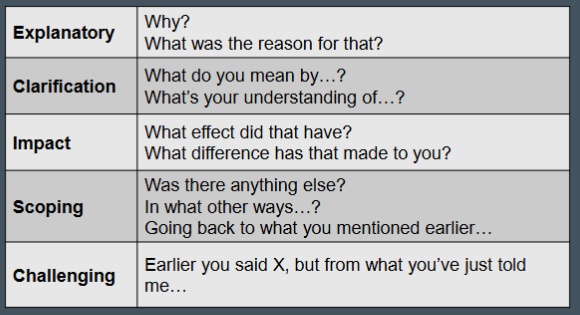
Active listening, asking open questions, and using probing questions.
What is the purpose of probing questions in an interview?
To elicit more detailed information from participants, uncovering complexity and depth in their responses.
What is a topic guide in the context of qualitative interviews?
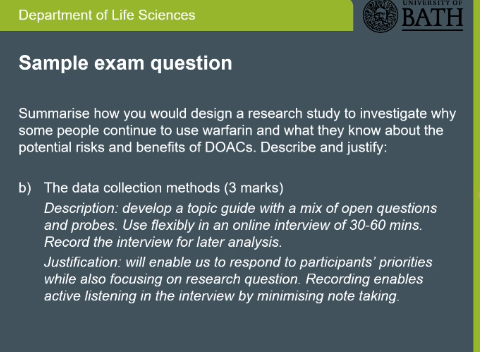
An agenda for conducting the interview, outlining topics and issues to cover while remaining flexible and interactive.
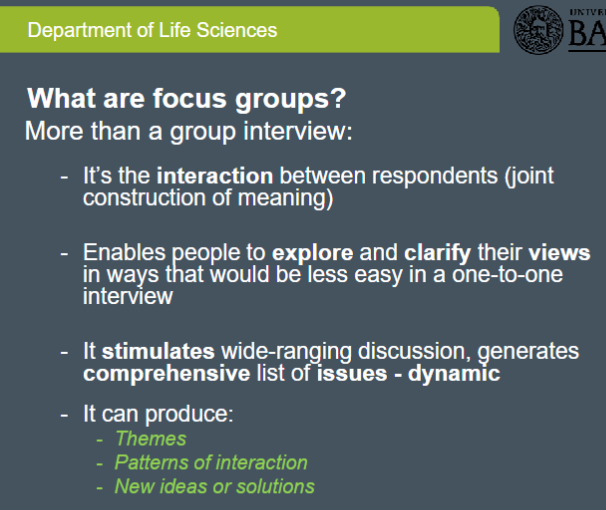
What are focus groups and what is their primary benefit?
Focus groups are group discussions that enable participants to explore and clarify their views through interaction, generating a comprehensive list of issues and new ideas.
What is the typical size of a focus group?
Typically between 6 to 8 participants.
What are some ethical considerations specific to focus groups?
Potential for participants to get upset or angry, the inability to guarantee confidentiality, and the possibility of participants discussing the content afterwards.
What is purposive sampling?
A non-random sampling method where participants are deliberately selected based on specific criteria relevant to the research question.
What is 'saturation' in qualitative sampling?
Saturation is the point when no new information or themes are observed in new interviews/focus groups, indicating that the sample size is sufficient.
What is a sampling frame in qualitative research?
Describes the range of characteristics you want to include in your sample, based on the aims of the study and the literature.
Which interview style is participant-led and allows open-ended responses?
Semi-structured or unstructured interviews.
What is the purpose of a topic guide in qualitative interviews?
To outline topics and issues, ensuring flexibility and focus during the interview.
What is a focus group
A moderated discussion where participants interact and explore issues collectively.
How do focus groups differ from standard group interviews?
They involve interaction between respondents, enabling joint meaning-making.
What are some benefits of conducting focus groups?
They generate themes, patterns of interaction, and new ideas.
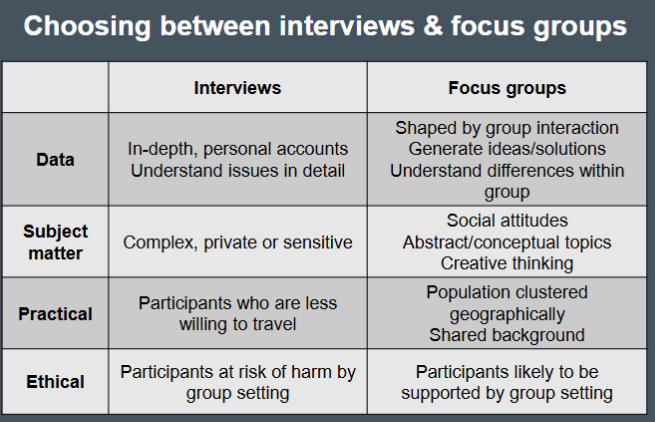
When might a researcher prefer using an interview over a focus group?
When topics are complex, private, sensitive, or when individual views need in-depth exploration.
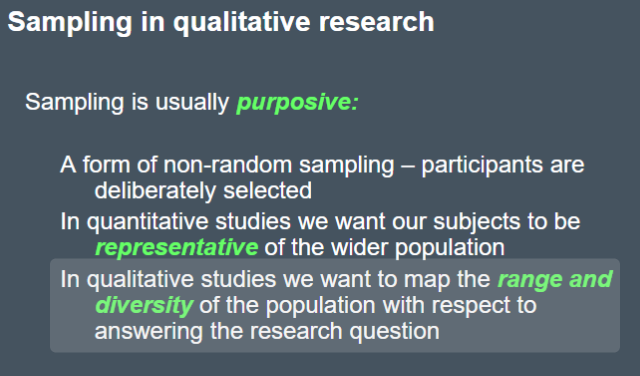
How is sampling typically done in qualitative research?
Through purposive sampling, selecting participants deliberately to cover a range of perspectives.
How does purposive sampling differ from random sampling?
It targets specific individuals to explore diversity, not representativeness.
What are common sample sizes in qualitative research?
Fewer than 50 interviews or 6-12 focus groups, with data collection continuing until saturation.
What is meant by 'saturation' in qualitative sampling?
The point when no new themes or information emerge from additional data.
Why are qualitative samples usually small?
To allow detailed analysis and because the aim is depth, not counting or generalization.
What makes qualitative data collection tools key in research?
Their design influences how well you can explore the research questions.
Why is reflexivity important for qualitative researchers?
To be transparent about how their own preconceptions influence data collection and analysis.
What practical problems might researchers face when collecting qualitative data?
Challenges like gaining access, building trust, managing bias, and handling complex data.
How can researchers ensure the quality of qualitative data collection?
By using well-designed guides, pilot testing, and maintaining reflexivity.
What role does language play in qualitative interviews?
Using respondents’ language helps capture authentic meanings and reduces jargon.
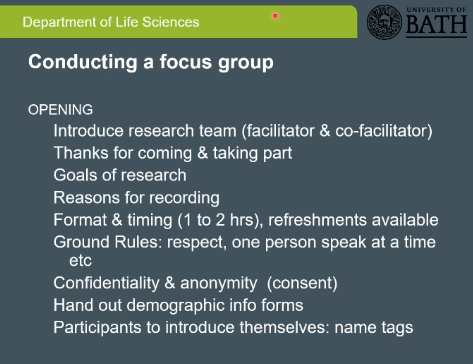
What should be included in an introduction when conducting a focus group?
Research purpose, confidentiality, recording info, ground rules, and participant introductions.
What ethical considerations are important in qualitative research?
Informed consent, confidentiality, and minimizing harm to participants.
What is the main conclusion regarding the use of qualitative methods?
They are suited for exploring different types of questions that focus on understanding, not counting, with sampling emphasizing diversity over representativeness.
What is the primary purpose of qualitative research, and how does it differ from quantitative research?
The primary purpose of qualitative research is to understand experiences, meanings, and perspectives through words and descriptions. Unlike quantitative research, which focuses on numerical data and measurement, qualitative research explores the depth and richness of social phenomena.
What types of research questions are most suitable for qualitative data collection?
Qualitative data collection is most suitable for "how" and "why" questions that explore understanding, perceptions, behaviors, and social processes, rather than "how many" or "how much" questions.
Name and briefly describe three common qualitative data collection methods.
Observation: Watching and recording behaviors in their natural context.
Interviews: One-on-one conversations, which can be structured, semi-structured, or unstructured, to explore individual perspectives.
Focus Groups: Guided group discussions to explore collective views and interactions on a topic.
What is purposive sampling in qualitative research, and what is its main goal?
Purposive sampling involves deliberately selecting participants to capture diverse perspectives relevant to the research question. Its main goal is to map a range of views and ensure depth of understanding, not representativeness.
What is meant by saturation in qualitative sampling, and why is it important?
Saturation is the point when no new themes or information emerge as data collection continues. It ensures that data gathered is sufficiently comprehensive to understand the research phenomenon and prevents unnecessary data collection.
What is non-participant observation in qualitative research?
????Non-participant observation involves the researcher observing the setting without actively participating or interfering in the social environment, allowing for discreet and objective data collection without influencing the behaviors being studied.
What is the Hawthorne effect, and how can it impact qualitative research?
The Hawthorne effect occurs when participants alter their behavior because they are aware they are being observed. It can threaten the validity of data collected through observation, but good planning and reassurance of confidentiality can help minimize its impact.
what is differnce between participant and non particiapnt research?
The researcher actively immerses themselves in the setting, often participating in the activities of the group being studied. This approach provides an insider perspective and is common in ethnography.
The researcher observes from outside the natural activity, not engaging in the activities of the group. This allows for a more detached viewpoint.
non participant research is usually overt or covert?
non participant research is usually overt.
non particiapnt research?
The researcher does not take part in the activities of the group or setting being studied. Instead, they simply observe what is happening from a distance, without engaging in the group's normal activities.
Usually, overt: everyone knows the researcher is observing.
Sometimes, covert: participants are unaware they are being watched (though this has ethical implications).
non participant research simply put is….
the researcher observes without participating.
They watch and listen but don't join in or become part of the group's activities.
The group being studied may know they are observed (overt), or may not know (covert).
what are limitations of qualitative research
hawthorne effect
observer bias = you may see what you want to see, may become tired/bored
assimilating into the group (adopting the norms of the group)
What is a common behavioral issue that can affect qualitative research data collection?
Participants may change their behavior if they know they are being observed, due to the Hawthorne effect or observer effect.
What is observer bias, and how can it impact qualitative research?
Observer bias occurs when the researcher sees what they want to see or interpret data subjectively, potentially affecting the validity of the findings.
How can the researcher's involvement influence qualitative data?
The researcher may inadvertently assimilate into the group or adopt group norms, which can affect objectivity and authenticity of data.
Why is researcher fatigue a concern in qualitative data collection?
The researcher may become tired or bored, leading to decreased attentiveness and potential bias in recording or interpreting data.
What practical challenge is associated with qualitative research?
Qualitative data can be extensive and complex.
makes analysis time-consuming
more difficult compared to quantitative data.
What are the main types of interviews used in qualitative research?
The main types are structured, semi-structured, and unstructured interviews.
How do structured interviews differ from semi-structured or unstructured interviews in qualitative research?
Structured interviews are researcher-led with standard questions and minimal variation, often with closed questions, whereas semi-structured or unstructured interviews involve open-ended questions that allow participants to express attitudes, views, and experiences in a more flexible manner, often participant-led.
what are examples of open questions?
what are your views on?
how oftne?
when?
how do you feel about ?
tell me more about what you think about?
why?
what is good practice for how to ask questions in qualitative?
mainly open questions
closed questions only for specific purpsoes= following an open question to clarify details
neutral non leading questions
short and clear questions
use the patients terminology, switch from community pharmacy to chemist if they use chemist
avoid summarising what partipciant said, becuaes you are already recording what they have said
dont use “right” or “okay” because this makes it seem you are interested in what they have replied to the question and so they talk more about that question because youve shown interst in their response.
what is best style of questioning to use for qualitiative information gathering?
open probing questoins
examples of probes
what are focus groups?
how many researchs is ideal in focus groups?
2
one to conduct or moderate and is responsible for running the session and steering discussion and the second research is the co-facilitator, they don’t take part in the discussion and take notes or assist the lead researcher.
what are strengths of focus groups?
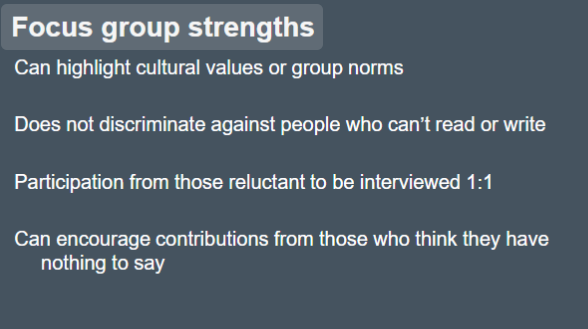
what are weaknesses of focus groups?
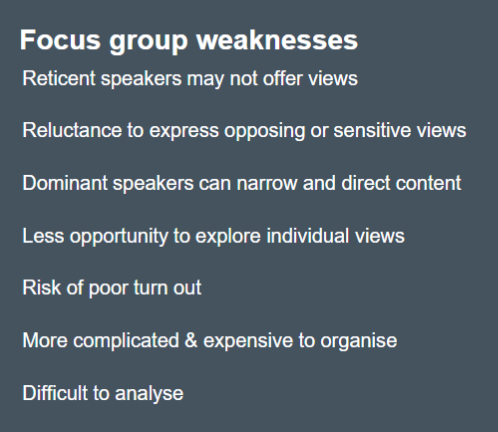
how do you decide between interviews or focus groups? what are differences between the two?
what are the types of sampling in research?
purposive = individuals that fulfil certain conditions
representative = findings applied to wider population
convenience = easily accessible and ready to participate.
which sampling type os normally used in qualitative?
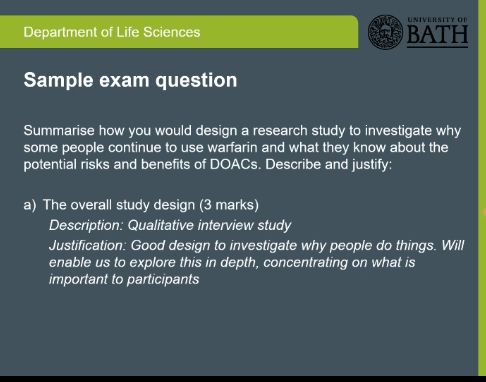
sample exam quesion
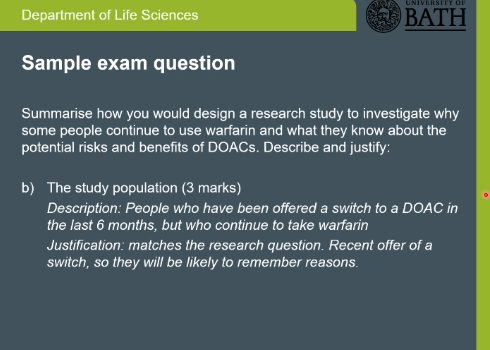
sample exam question 2
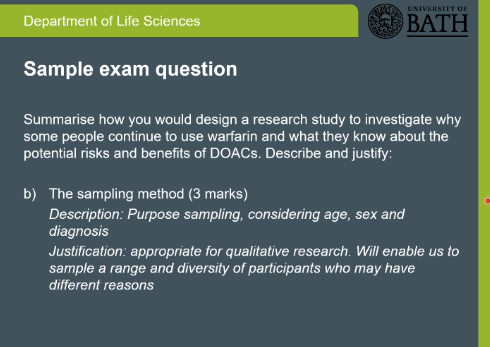
sample exam question 3
exam question 4