Week 6 Solid State Chemistry
 Call Kai
 Learn
Learn Practice Test
 Spaced Repetition
 Match
Match Flashcards
 Knowt Play
1/26

There's no tags or description
Looks like no tags are added yet.
Name | Mastery | Learn | Test | Matching | Spaced | Call with Kai |
|---|
No analytics yet
Send a link to your students to track their progress
27 Terms
conductivity formula
sigma= number of electrons x charge of electrons x mobility of electrons
conductivity and temperature
in metals, increasing temp decreases conductivity
in insulators, increasing temp very slightly increases conductivity
in semiconductors, increasing temp greatly increases conductivity
resistivity and temperature
resistivity decreases with temperature
phonon
a lattice vibration quantum particle
at 0K, all phonons are frozen
at high temperature, phonon-electron collisions are the source of resisitivity
they are also responsible for the heat capacity of materials
normally there is only a small fraction of electrons in the conduction band, even in good conductors
how to get close to 0K
liquid nitrogen gets you to 85K
liquid helium can get between 4K and 0.2K depending on the method and isotopes used
Resistivity at 0K
even at near absolute zero, metals still show some slight resistivity
they need to be purified to get rid of this
mercury was the easiest to purify and it was found to be the first super conductor with 0 resistivity
can all metals be superconductors
no not all metals can be semiconductors
ferromagnetic materials cannot be superconductors
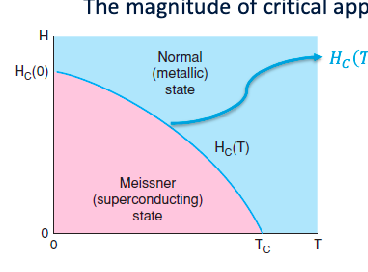
what can change superconductivity
magnetic fields
changing the temperature to a higher one
The 3 core concepts of BCS Theory
superconducting state must have a band gap
the process of super conduction must involve multiple electrons
The crystal lattice interacts and is involved in the process
Core 1
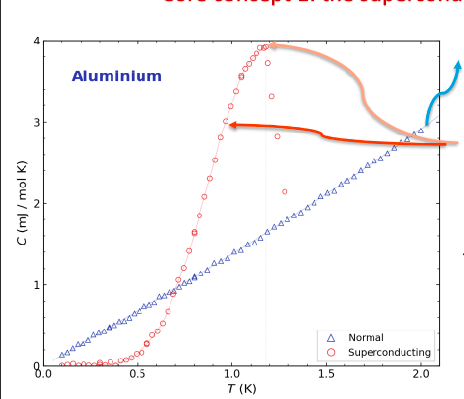
the heat capacity of a SC needs to be measured
in a normal meta, the curve is a linear straight line
in a superconductor, the curve goes up exponentially and once critical temperature is reached, it drops again
this is similar to how a semiconductor would behave, indicating super conductors must have some sort of very small band gap
Core 2
the band gap that opens is very small (in the meV region)
the closer we get to Tc, the small the gap gets until it vanishes
this behaviour is similar to bond breaking
band gap can be measured using microwaves
Core 3
changing the isotope abundance changes Tc
this should not happen
this indicates that the lattice and phonons are actively involved in determining Tc
𝑇𝑐 ∝ 𝑀−𝛽, where beta is= 0.5 and M is the mass of the isotope
Cooper pairs
a pair of electrons that exists due to indirect e-e interactions from the lattice
act like bosons which are a type of quantum particle
bosons are immune to pauli exclusion principle
cooper pairs are what allow superconductors to attract with no resistance we believe
the reason SC do not work above Tc and under magnetic fields is because you break the cooper pairs
cooper pairs have spin and down so a magnetic field breaks them beause it wants them to be both spin up which is not possible
How are cooper pairs formed
at the very low temperatures, as the electron moves through the lattice, it slightly distorts the lattice and phonons, leaving behind a very rich positive charge which attracts a second electron, creating and moving as pairs
The Meissner Effect
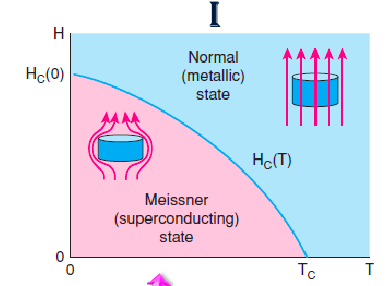
super conductors have perfect diamagnetism
this means that they perfectly repel external magnetic fields
all cooper pairs collapse into a quantum state and create screening currents that cancel out applied magnetic field
this causes a material to float
Type I SC
no magnetic field can pass through
has a single critical magnetic point (after which material is no longer a SC)
usually are most elemental SC
Type II SC
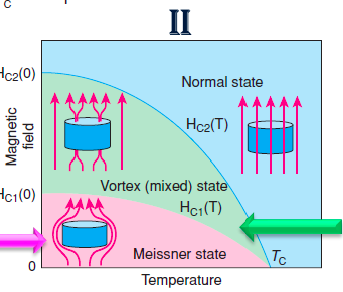
there is a vortex which allows some of the magnetic field to pass through but not actually affect the material
has higher Hc and Tc that type I
mobility of vortex can be blocked by defects
most alloys and doped materials are type II
high temp SC can only be type II
there are a few elemental SC that are type II
have 2 Hc
High temperature SC
are generally made from a rare earth metal (2-x), an alkali metal (x), and copper oxide
no one knows how they actually work
Tc bigger than 100K
eg. YBaCuO or LaBaCuO
it seems unlikely that they form cooper pairs as at higher temperature cooper pairs become too unstable
Cuprate superconductors
arranged in different sheets which works well due to the variable oxidation states of copper
CuO4 is a 2D layer and acts as an electron sink
CuO5 is a 3D layer and acts as a storage point for charge carriers so the SC can work
cuprate SC are highly defective in oxygen
the more layers of copper oxide there are, the higher Tc is
adding holes to SC
the most common way of doping
helps increase Tc
adding holes allows for electron to finally be able to move more freely around the lattice and form cooper pairs
adding electrons to SC
extra electrons help ease/break the static arrangement
this helps in creating more cooper pairs
adding electrons however does not increase the Tc of SCs
Why adding holes and electrons is a sensitive process
there is a very small range for doping the material either with holes or electrons that actually works
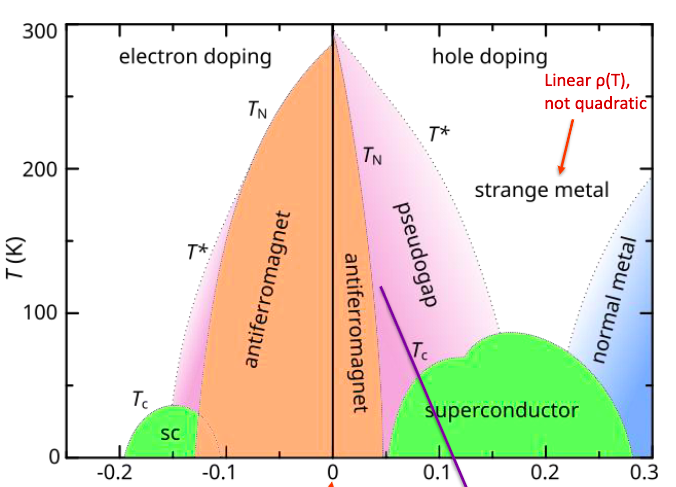
Resonance valance bond theory (RVB) of HT SCs
assumes electrons in unpaired Cu orbitals will pair with neighboring oxygen electrons and move
Instead of staying in one fixed pair, the electrons exist in a "superposition"—meaning they are constantly switching which neighbor they are paired with. This creates a fluid-like state of shifting pairs.
there is no external force or "glue" pulling them together.
When you "dope" the material (add holes), these pre-existing pairs that were "stuck" suddenly gain the room to move around, creating the superconducting current.
Magnetic spin fluctuation exchange
one electron creates a magnetic ripple in the material, and a second electron drops into that ripple.
This magnetic partnership allows the electron pairs to glide through the crystal lattice entirely friction-free, enabling high-temperature superconductivity.
this theory divides electrons into subsystems which is controversial
Electromagnets
there is no current resistance
current needs to be increased slowly
there is quench protection which is there in the case that parts of the material slowly become non superconductive and all the excess energy releases causing an explosion
The material has to be winded in small coils to
maximise the high-current area
high magnetic fields produced
magnetic levitating trains
this concept is being developed in japan
the lack of friction could allow for speeds up to 600K an hour
Superconducting NbTi magnets are cooled to 4 K on the train tracks and are used for both levitation and propulsion
Superconducting QUantum Interference Devices (SQUID)
consists of a superdonducting loop interupted by this insulating josephson junctions
the device is used to measure incredibly thin magnetic fields and is in things such as brain imaging (EEG) and quantum computers
cooper pairs cause uniform wave across the loop