SPM pt. 2
 Call Kai
 Learn
Learn Practice Test
 Spaced Repetition
 Match
Match Flashcards
 Knowt Play
1/83

Earn XP
Description and Tags
Additional cards to review
Name | Mastery | Learn | Test | Matching | Spaced | Call with Kai |
|---|
No analytics yet
Send a link to your students to track their progress
84 Terms
Quality Planning
Identifying which quality standards are relevant to the project and how to satisfy those standards
Quality Control
Monitoring specific project results to ensure that they comply with the relevant quality standards, while identifying ways to improve overall quality
Quality Assurance Process
Concerned with defining or selecting the quality standards
Quality Standard
set of rules for ensuring quality
Product Standard
A specific criteria or benchmark to evaluate the quality of products or services, ensuring they meet established guidelines and requirements.
Process Standard
Define the porocesses that should be followed during software development
Unit Test
Used to test each individual component to ensure it is defect-free, performed before integration testing
Integration Testing
Ensures that the subsets of the overall system work together correctly, occurs between unit testing and system testing
System Testing
Tests the entire system as one entity. Ensures entire system working correctly
User Acceptance Testing
Testing performed by end users prior to accepting the delivered system. Ensures system fits the needs of the users of the system.
Quality Planning Template
1) Product overview 2) product plan 3) quality goals 4) process description 5) document and coding standards 6) risks and risk management
Review
common project management technique for monitoring and control of targeted project aspects or artefacts
Code Inspection
This form of inspection is conducted on a code artefact using a checklist based on the coding standard.
Acceptance Criteria & BDD Syntax
Given [condition], when [something happens], then [result]
Acceptance-Test Driven Development (ATDD) Cycle
Write acceptance criteria
Write acceptance tests
Implement code
Run acceptance tests
Refractor
Three Laws of Test-Driven Development
You are not allowed to write any production code unless it is to make a failing unit pass
You are not allowed to write any more of a unit test than is sufficient to fail; and compilation failures are failures
You are not allowed to write any more production code than is sufficient to pass the one failing unit test
Documentation process standards
How documents should be developed, validated and maintained
Document Standards
Concerned with document identification, structure, presentation, changes highlighting, representation and interchange
Capability Maturity Model Integration (CMMI)
Describes the key elements of an effective software development process and an approach for software companies to move from an ad-hoc, immature process to a mature developed process.
Organizations characterized being at level from 1-5 based on the processes they follow.
5 Levels of Capability Maturity Model Integration (CMMI)
Initial
Repeatable
Defined
Managed
Optimizing
McCall Quality Model
Based on Operation, Revision and Transition
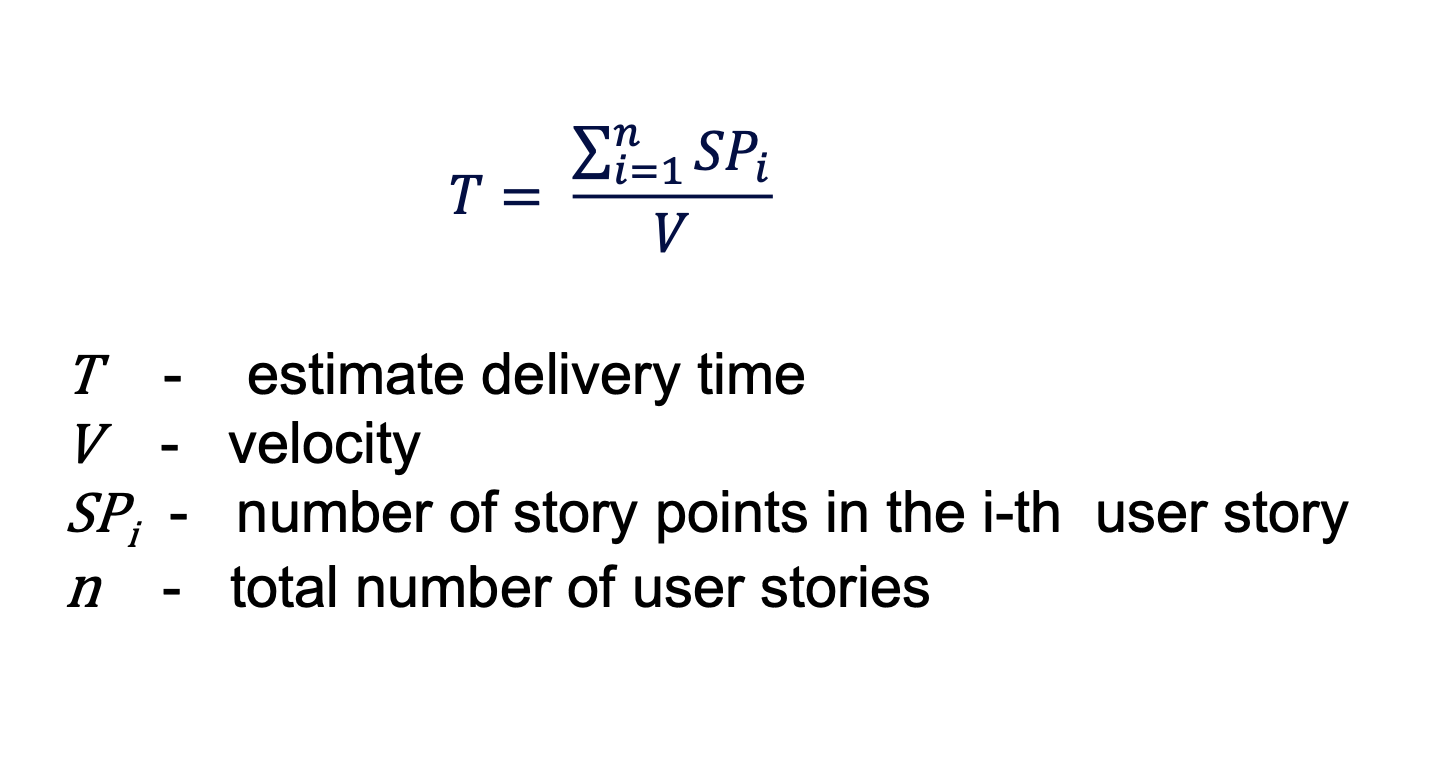
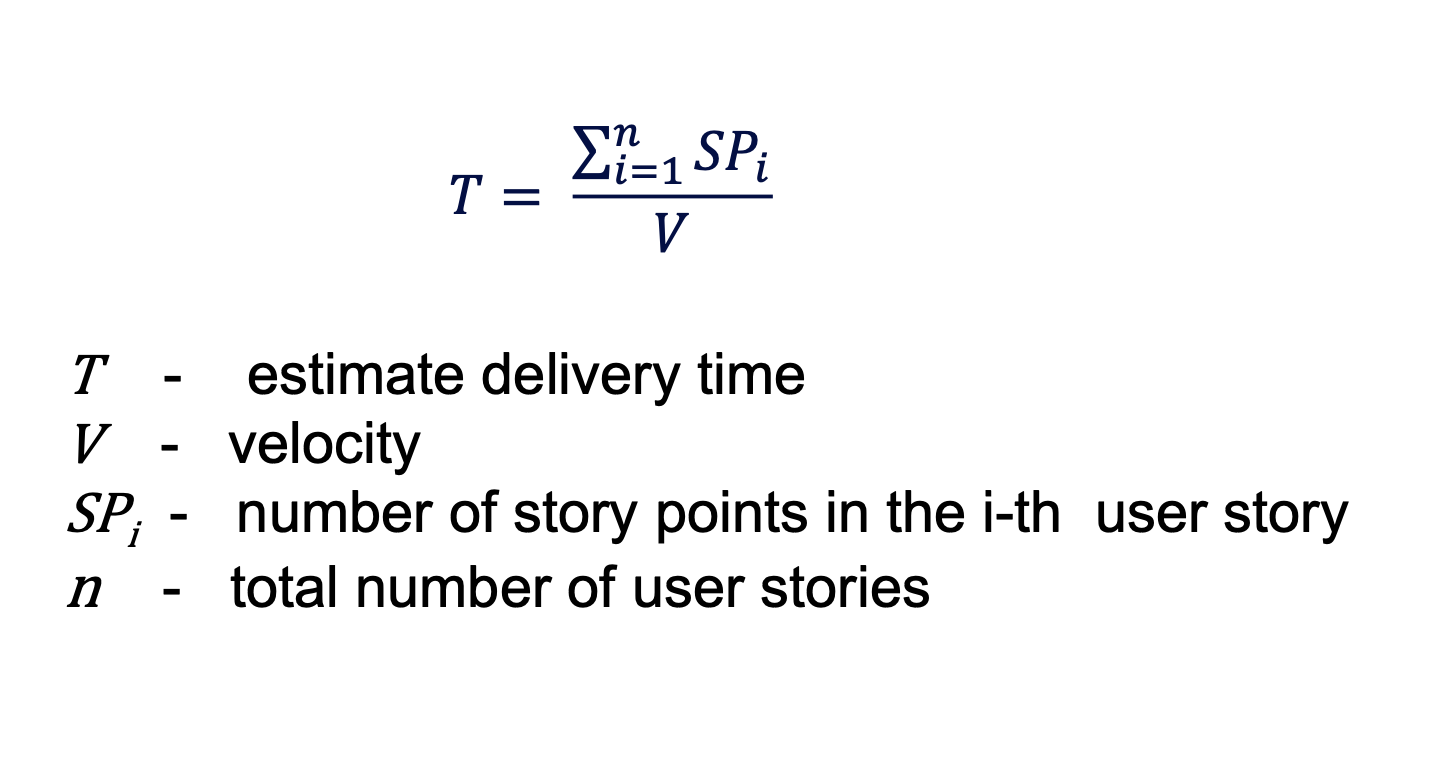
Estimated Delivery Time Calculation
Sum of all story points / velocity
Velocity Calculation
Number of story points completed / time period over which they were completed
5 Steps to Product Backlog
Write the User Stories
Write Acceptance Criteria per User Story
Prioritize the User stories
Add Story points
Definition of Done
User Story Format
As a [user role] I want to [goal action] So that [reason/benefit]
3 C’s for User Stories
Card, Conversation, Confirmation
Epic
A large user story that will take more than one or two sprints to develop and test. They are split into smaller user stories so that a story can be completed within a sprint.
User Role
Collection of defining attributes that characterize a population of users and their intended interactions with the system.
“Must Have'“ MoSCoW
Requirements that have to be included in the delivered scope in order for it to be a success. If even one “MUST” requirement is not included, the project delivery should be considered a failure.
“Should Have'“ MoSCoW
Requirements are critical to the project and will generally all need to be delivered for a successful project.
“Could Have'“ MoSCoW
Requirements are often seen as nice-to-haves
“Won’t Have'“ MoSCoW
Requirements are either the least-critical, lowest-payback items, or not appropriate at this time.
Story Points
Rate the relative effort of work to completed user stories and other stories currently being estimated. They are drawn from abstract scales (no units).
Analysis Paralysis
Spending too much time attempting to develop detailed estimates or delaying making commitments until all of the information required to make decision has high level of certainty.
Cavalier Approach
Not worrying about managing uncertainty and risk at all and just starting the project with no planning at all, or assuming that whatever uncertainty and risk is inherent in the project will be discovered and somehow work itself out as the project succeeds.
T-shirt Sizes
Story point estimation tool using t-shirt sizes XS, S, M, XL, XXL.
Definition of Done
It is universally applicable and is a comprehensive checklist of necessary, value-added activities that assert a feature's quality, not its functionality.
DoD at various levels
Product backlog, sprint, release
Story Points
A relative measure of the size of a user story
Project Management Plan (PMP) 2 parts
Project information, project governance
Stakeholder Analysis steps
1. Stakeholder Identification
Understanding Stakeholder Interests
Assessing Stakeholder Influence
Prioritizing Stakeholder Engagement
Managing Stakeholder Relationships
Stakeholder Identification
Identifying all individuals, groups, or organizations who may be affected by, or have an interest in the project, whether directly or indirectly.
Understanding Stakeholder Interests
Examining stakeholders' interests, objectives, expectations, and concerns regarding the project to ensure their needs are addressed.
Assessing Stakeholder Influence
Evaluate the level of influence or power each stakeholder holds over the project's outcomes, decision-making processes, or resources.
Prioritizing Stakeholder Engagement
Prioritize stakeholders based on their importance, level of influence, or degree of impact on the project's success.
Managing Stakeholder Relationships
Proactively manage relationships with stakeholders by anticipating their reactions, addressing potential conflicts, and fostering open communication and collaboration.
5 Levels of Stakeholder Engagement
Unaware
Resistant
Neutral
Supportive
Champion/Leading
Information included in stakeholder analysis
• Names and Organisations of Key Stakeholders
• Their Role on the Project
• Unique Facts about Each Stakeholder
• Level of Interest in the Project
• Influence on the Project
• Suggestions and Strategies for Managing Relationships with each Stakeholder
Autocracy Team
The boss hands out orders, team members carry them out
Anarchy Team
There is no boss, but nobody knows what to do
Democratic Team
make all decisions collaboratively
Collaborative Teams
Effective teams tend to have a fairly flat structure where team members may have different responsibilities.
Members make decisions within their area of expertise, so all teammates participate in decision-making to some extent
Distributed Teams
Team distributed across geographic locations, relying on communication technology.
Teamicide factors
Defensive management
Bureaucracy
Physical separation
Fragmentation of time
Quality-reduced product
Phony deadlines
Clique control
Communication Plan
Assist in managing and coordinating key communication messages
Defines what will be communicated, channels, when info is distributed, owner, resources, needs of stakeholder, confidential information, flow of communication, constraints, templates or escalations
Risk Management Process
Plan, identify, analyse, respond (planning), monitor
SWOT Analysis Strengths
characteristics of the business or project that give it an advantage over others
SWOT Weaknesses
characteristics that place the business or project at a disadvantage relative to others
SWOT Opportunities
elements in the environment that the business or project could exploit to its advantage
SWOT Threats
elements in the environment that could cause trouble for the business or project
Risk Analysis
Identify each identified risk’s probability and impact
Risk Assessment
Prioritize risks so that an effective risk strategy can be formulated
Risk Analysis Qualitative Steps
Estimate risk probability (P)
Estimate risk impact (I)
Compute risk exposure (P*I Score)
Identify root cause
Waterfall steps
requirements, analysis, design, implementation, maintenance, retirement
Incremental steps
project requirements, analysis, design, development, testing, deployment, release # (repeat)
Successful Project
project is completed on-time and on-budget, with all features and functions as initially specified
Challenged project
completed and operational but over-budget, over the time estimate or offers fewer features and functions than planned
Failed project
project is cancelled at some point during the development cycle
Top 4 factors contributing to software project success
Executive sponsorship
Emotional maturity
User involvement
Optimisation
Project characteristics
Introduce CHANGE to the organisation
TEMPORARY, it has a defined beginning and end
CROSS-FUNCTIONAL, cuts across organisational boundaries
Deals with the UNKNOWN
UNIQUE
They all vary in SIZE
Questions Project Schedule Answers
How long will the system take to develop
How much will it cost
Project Schedule Contents
Duration & dependencies for each task
People and physical resources required for each task
Milestones and deliverables
Project timeline
Developing Project Schedule Steps
Breakdown task into small chunks
Identify interdependencies between broke-down tasks and develop a task network
Estimate effort and the time allocation for each task
Allocate resources for tasks and validate effort
Develop project schedule
Dependencies caused by
Task needing a work product of another task
Task need resources used by another task
Types of task dependencies
Finish-to-start: Task A must finish before Task B can start
Start-to-start: Task A must start before Task B can start
Finish-to-finish: Task A must finish before Task B can finish
Start-to-finish: Task A must start before Task B can finish
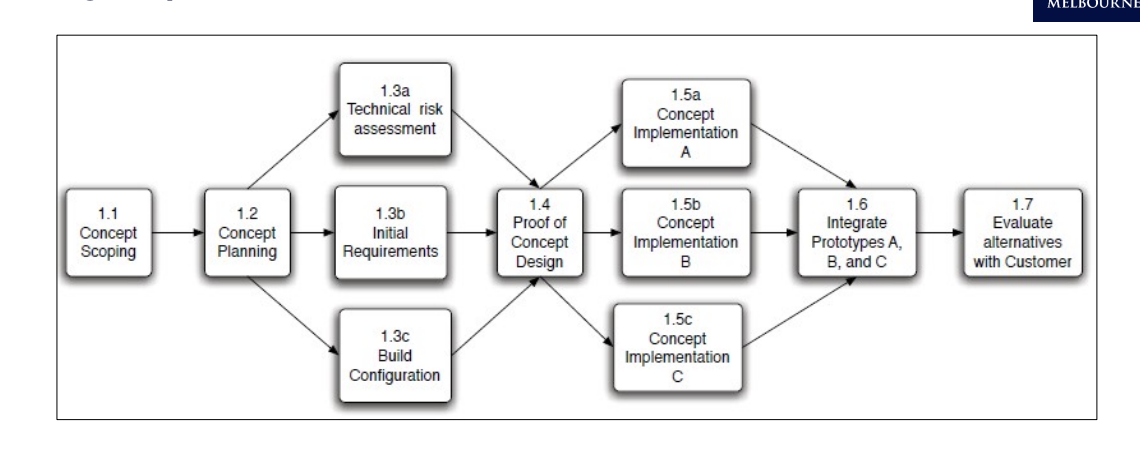
Task Network
graphical representation of the task flow of a project, useful for depicting inter-task dependencies and determining critical path
person-months
The time in months for a single person working full time to complete the task.
Number of personnel calculation
Effort / Time duration (if effort of person-months and time are known)
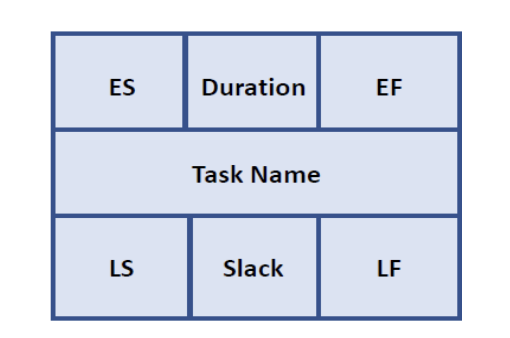
Component in PERT Chart
Earliest start time (ES)
Latest start time (LS)
Earliest finish time (EF)
Latest finish time (LF)
Slack time
Crashing the project scheudle
Shortening the total duration of the project by shortening the critical path. By removing the dependencies between activities in the critical path; or
Shortening the duration of activities in the critical path
Schedule variance calculation
SV = EV – PV
Expressed in currency units (e.g., dollars). A positive value indicates ahead of schedule; negative means behind.
Schedule Performance Index Calculation
SPI = EV / PV
A ratio (i.e., a fraction). An SPI > 1 indicates better-than-planned schedule performance; SPI < 1 means worse.
Cost Variance Calculation
CV = EV – AC
Expressed in currency units (e.g., dollars). A positive value indicates under budget; negative means over budget
Cost Performance Index Calculation
CPI = EV/AC
< 0 project performing poorly, >0 project performing well