L2 - Insects associated with decomposition of body
 Call Kai
 Learn
Learn Practice Test
 Spaced Repetition
 Match
Match Flashcards
 Knowt Play
1/22

There's no tags or description
Looks like no tags are added yet.
Name | Mastery | Learn | Test | Matching | Spaced | Call with Kai |
|---|
No analytics yet
Send a link to your students to track their progress
23 Terms
What do files (diptera) do when they find a body?
egg laying rather than feeding
•the acidic tissues of a fresh corpse cannot be digested by flies.
What neutralises the acidic tissue/fluid of a corpse?
•Activity of
– bacteria,
–and the excretions of fly larvae feeding on exuded fluid
Makes it attractive to:
Blowflies
fresh flies
house flies
What are pioneer flies?
= first to arrive
Blowflies - Calliphoridae
House flies - Muscidae
Why do diptera arrive before beetles?
•Have great powers of dispersal
•Rapidly discover bodies
•usually ahead of the beetles in colonisation of body.
What do •Calliphoridae (blowflies) and Muscidae (house flies) & larvae feed on?
feed on bodies fluids
enter through natural openings/ wounds - feed over whole body as tissue decays
Why are calliphoridae important?
Primary insects most commonly associated with corpse
invade minutes after dead
colonise the body more rapidly & greater numbers than other
most accurate info regarding PMI
3 main genus of family calliphoridae
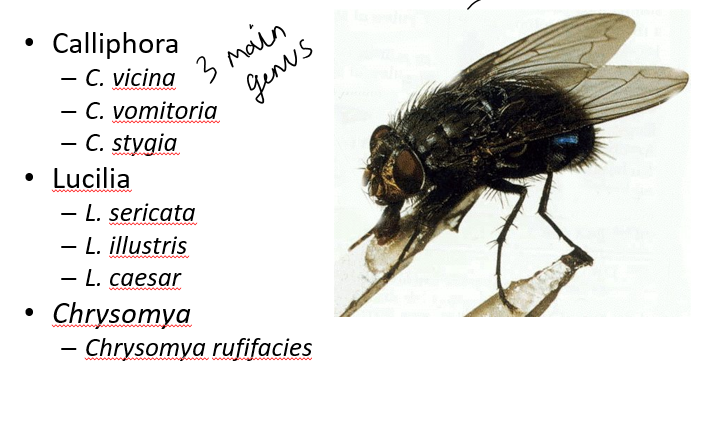
slide 11
What are the biomarkers that attract blowflies?
•Bacteria break down tissues and cells, releasing fluids into body cavities.
•Anaerobic putrefactive processes produce various gases incl. hydrogen sulphide, methane, cadaverine and putrescine as by-products.
•The build up of gas resulting from the intense activity of multiplying bacteria results in purging of fluids from cells and blood vessels
How far away can blowflies pick up scents ?
20km from birth place
Life cycle of blowflies
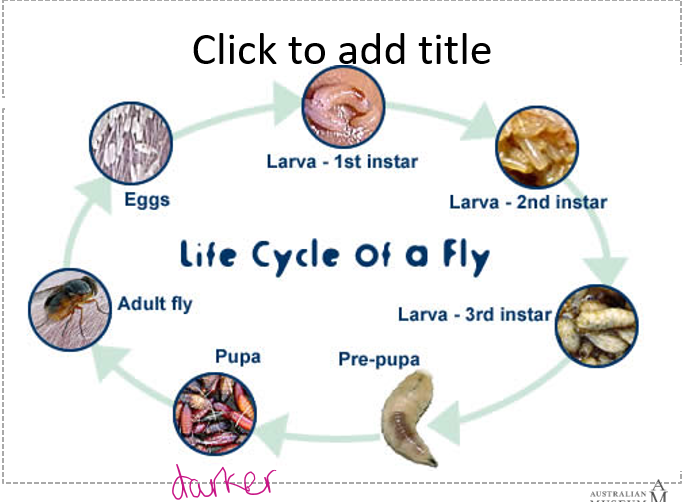
How would you identify blowfly eggs?
are pale yellow or white in colour
2 mm long
laid in clumps that resemble miniature rice balls.
maggot becomes lethargic
In warm weather how long would it take for maggots to consume a body?
Can consume 60% of body in less than a week
What is first oviposition?
When eggs first laid
How can oviposition be used as an indication of trauma?
When found at sites other than body orifices
Location of insects on body can tell us where maggots start to feed
What do maggots do when they move throughout a body?
Secrete bacteria, digestive enzymes
tear tissue with mouth hooks
make conditions beneficial to bacteria
What happens when the rate of decay increases?
–and the smells and body fluids that begin to eminate from the body attract more blowflies, flesh flies, beetles and mites.
What are later arriving flies and beetles?
Predators feeding on maggots + decaying flesh
What do parasitoid wasps do?
Lay eggs inside maggots & pupae
How do maggot masses heat a corpse?
Through intense digestive activities
How much do maggot masses heat a corpse?
53 degrees
What does a maggot mass benefit from? What does this lead to?
communal heat
shared digestive secretions
leads to:
increased rate of putrefaction & digestion
Where does a maggot mass migrate to when it gets too hot?
to the edge to cool down