Basal Ganglia and Movement
 Call Kai
 Learn
Learn Practice Test
 Spaced Repetition
 Match
Match Flashcards
 Knowt Play
1/18

There's no tags or description
Looks like no tags are added yet.
Name | Mastery | Learn | Test | Matching | Spaced | Call with Kai |
|---|
No analytics yet
Send a link to your students to track their progress
19 Terms
Cerebral Cortex
basal ganglia deals with challenging motor functions
basal ganglia has no direct output to LMNs
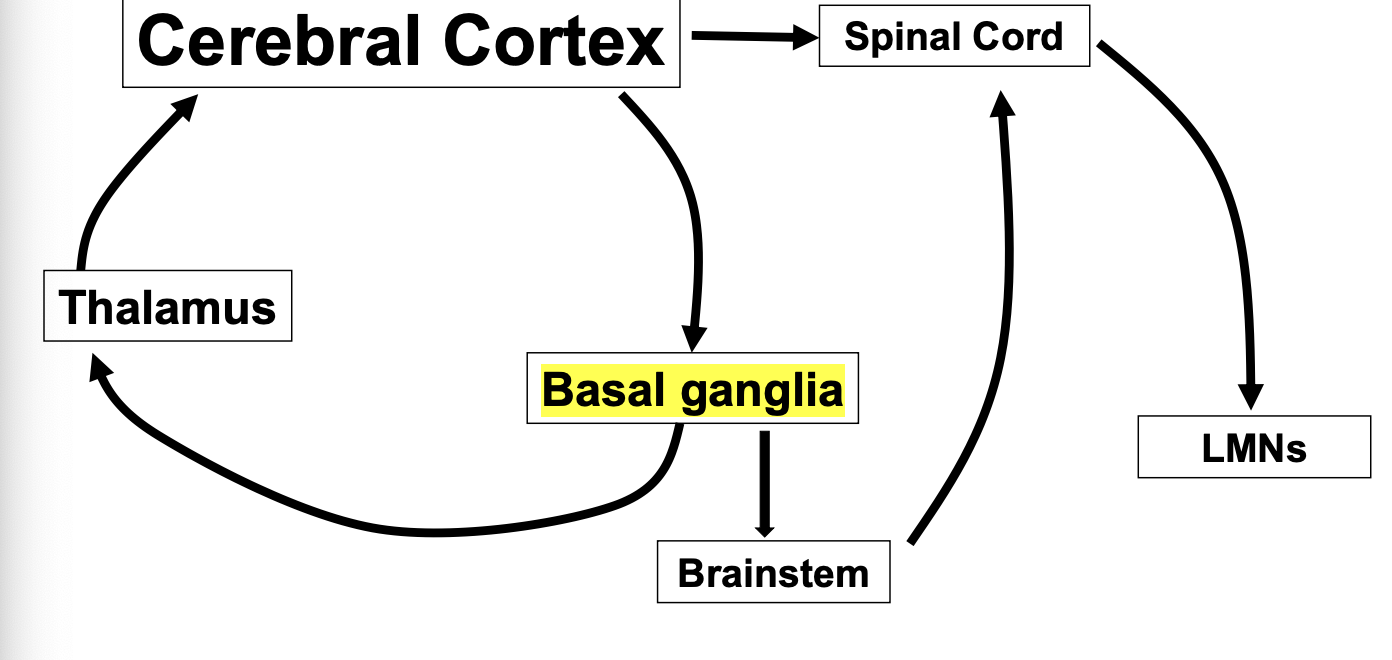
Basal Ganglia: main function
motor output circuit regulation
compares proprioceptive information & movement commands
regulates muscle force, muscle contraction & tone, and multi-joints movements
regulates sequencing of movements
semi-automatic & synergistic movements:
locomotion, postural adjustment, ar swing during walking
Basal ganglia circuitry loops associated with the control of other systems:
goal-directed behavior circuit:
decision making, planning, and choosing actions
social behavior circuit
recognizing social cues, regulating self-control
emotion (limbic)/motivation circuit
regulating emotional expressions, motivation, and addiction
oculomotor circuit
decision making about spatial attention and eye movements
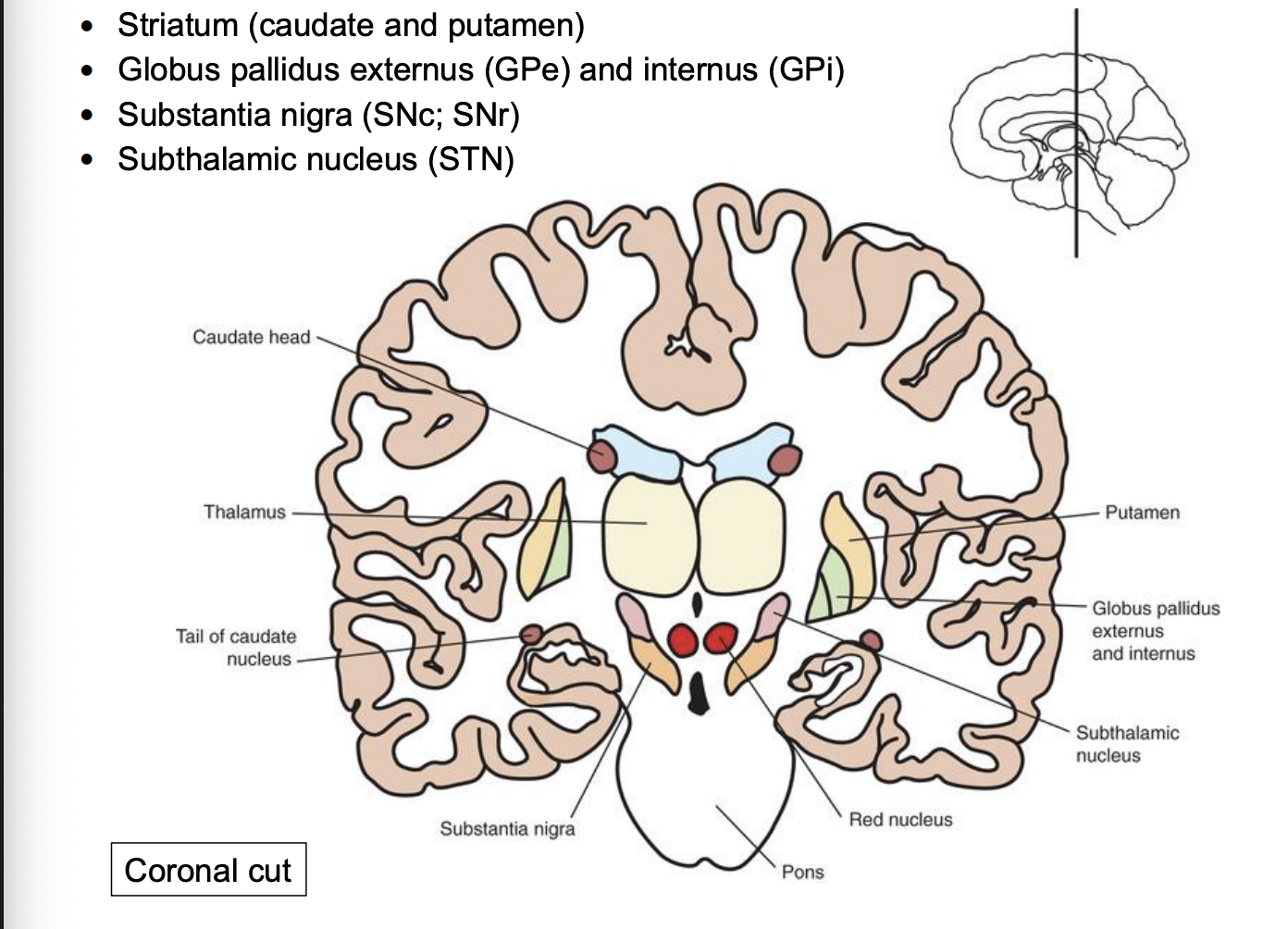
Basal Ganglia includes:
striatum: caudate & putamen
globus pallidus externus (GPe)
globus pallidus internus (GPi)
substantia nigra compacta (SNc)
substantia nigra reticularis (SNr)
subthalamic nucleus (STN)
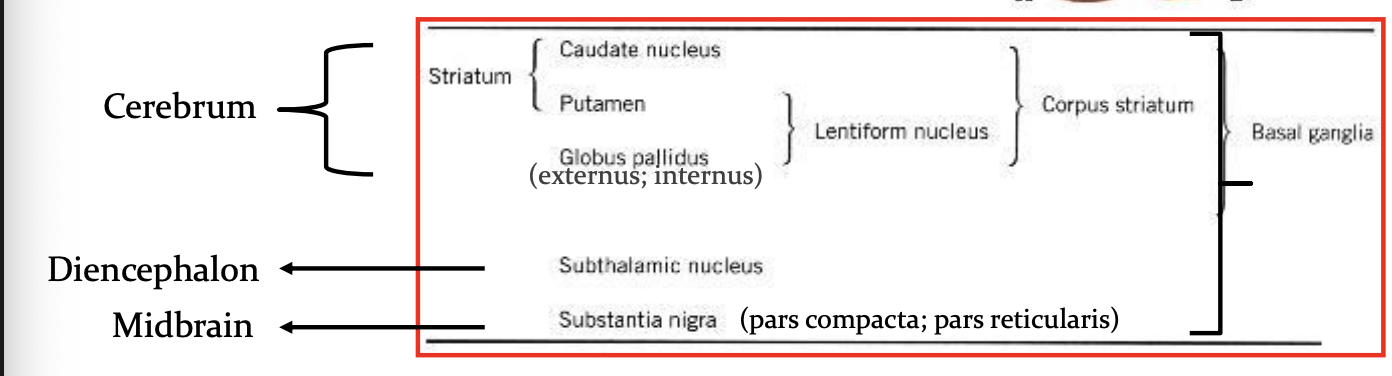
Basal Ganglia Brain photo
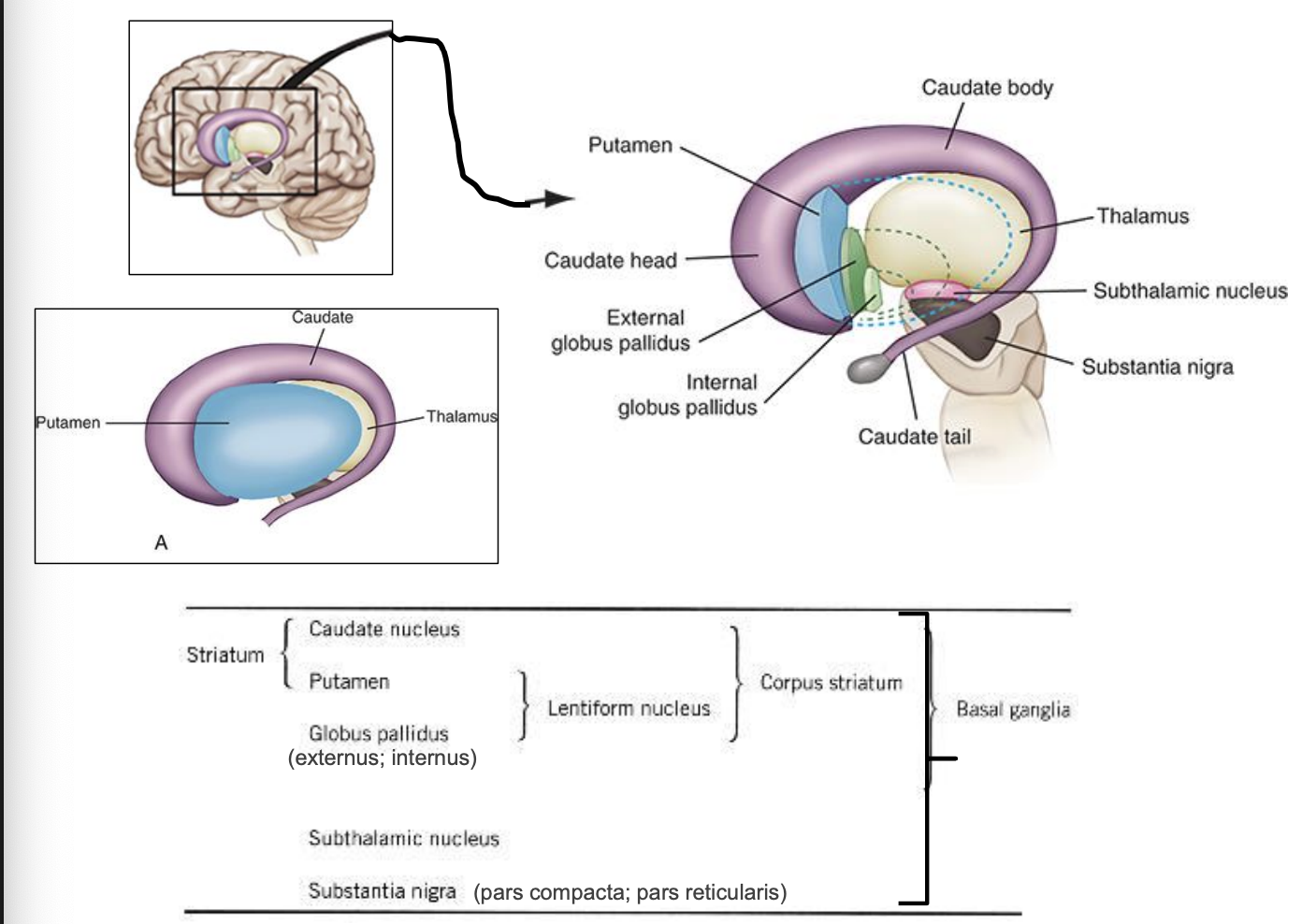
Coronal cut
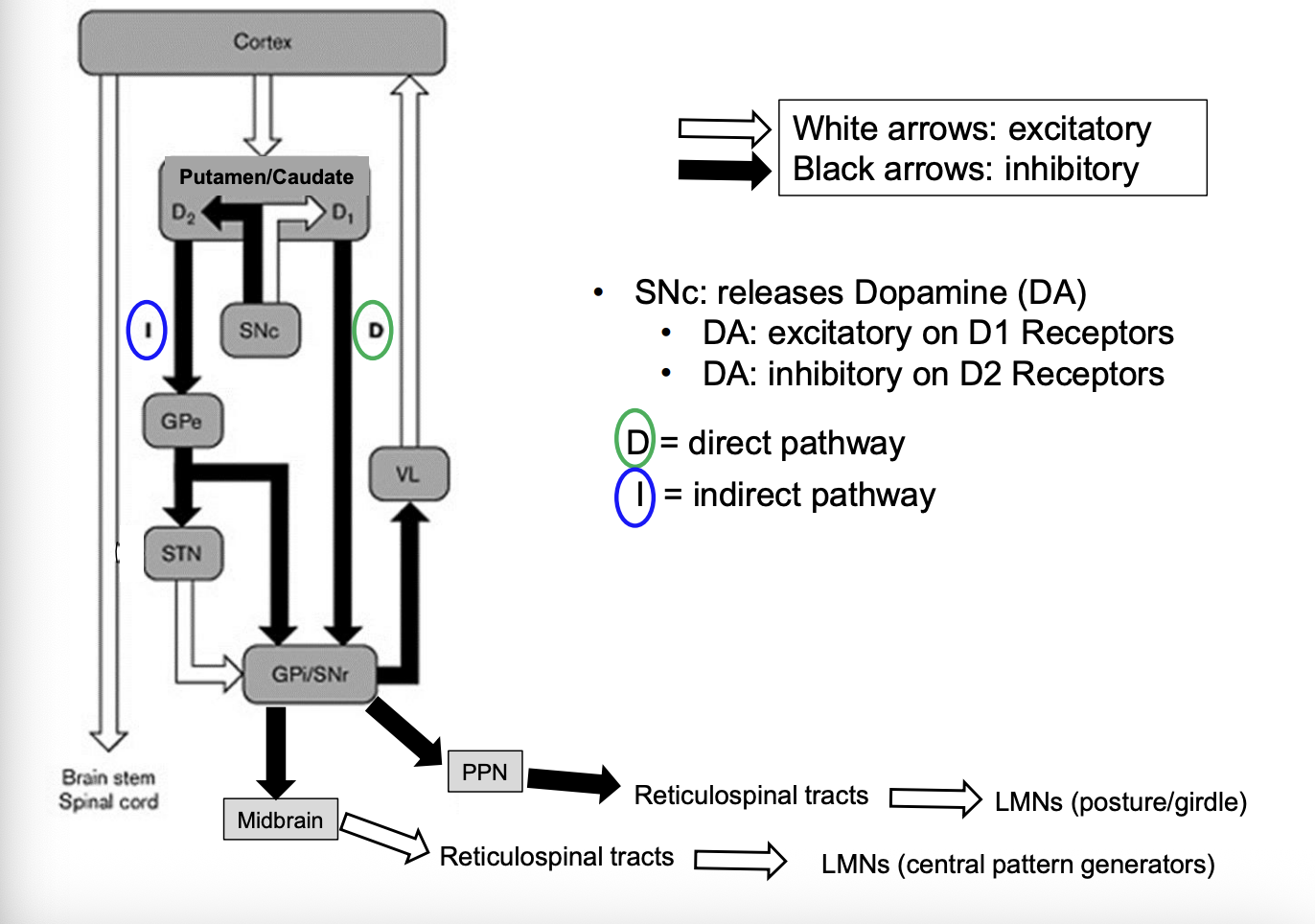
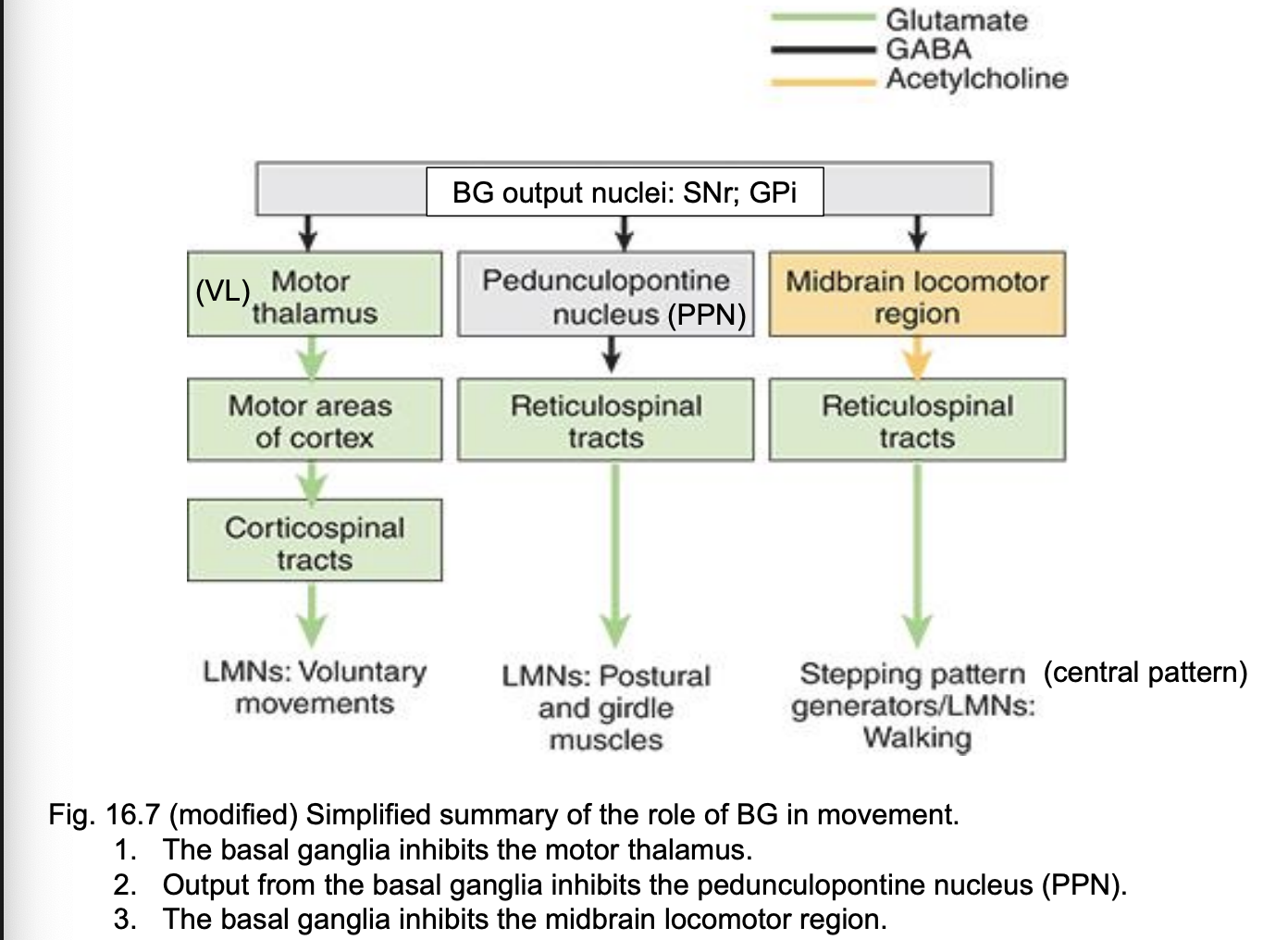
Basal Ganglia Motor Circuit — Overview
has NO DIRECT output to LMNs
SNr and GPi = output nuclei of the basal ganglia
from output nuclei of BG, motor control on LMN is done via 3 routes:
via motor thalamus (then to UMN to CTX)
controls voluntary muscle activity
via the pedunculopontine nucleus (PPN)
regulates contraction activity of postural and girdle muscls (via reticulospinal tracts)
via midbrain locomotor area
regulates rhythmic lower limb movements: walking, running (via stimulation of reticulospinal tracts)
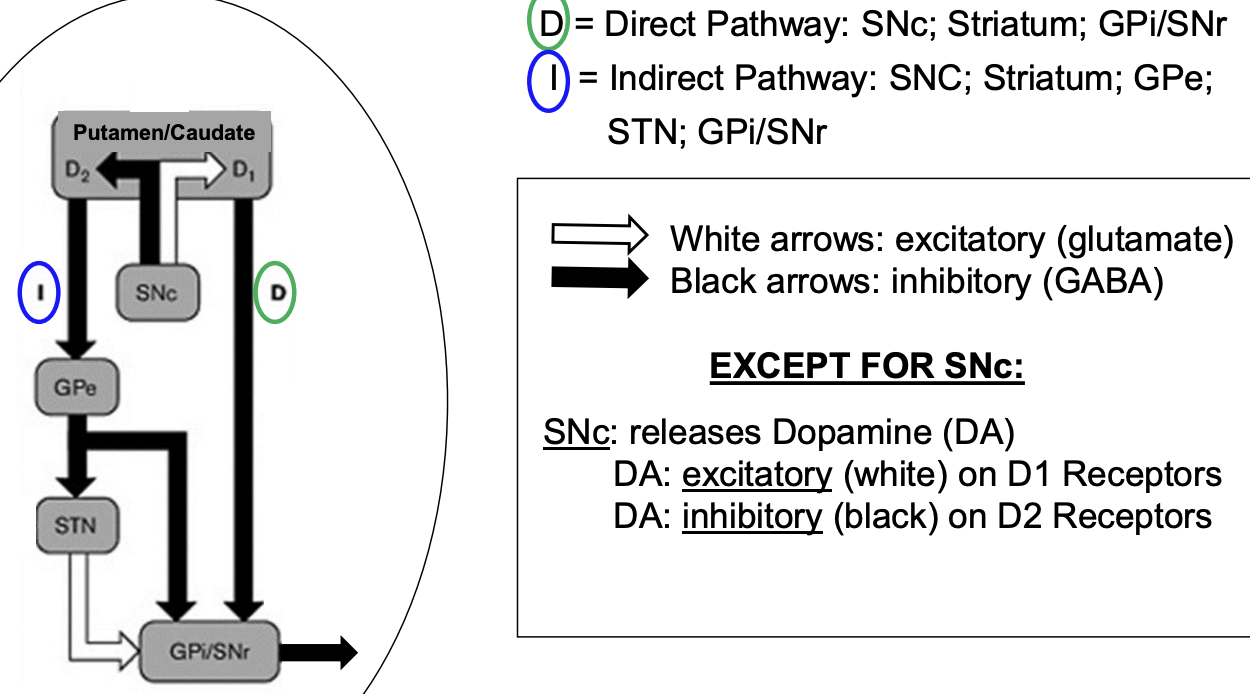
Internal Basal Ganglia Motor circuits (pathways)
has two main internal feedback loops that work in parallel with the cerebral cortex
direct pathway
indirect pathway
Internal Feedback loop of BG — Direct & Indirect pathways
BG output nuclei affect VL, PPN, and Midbrain
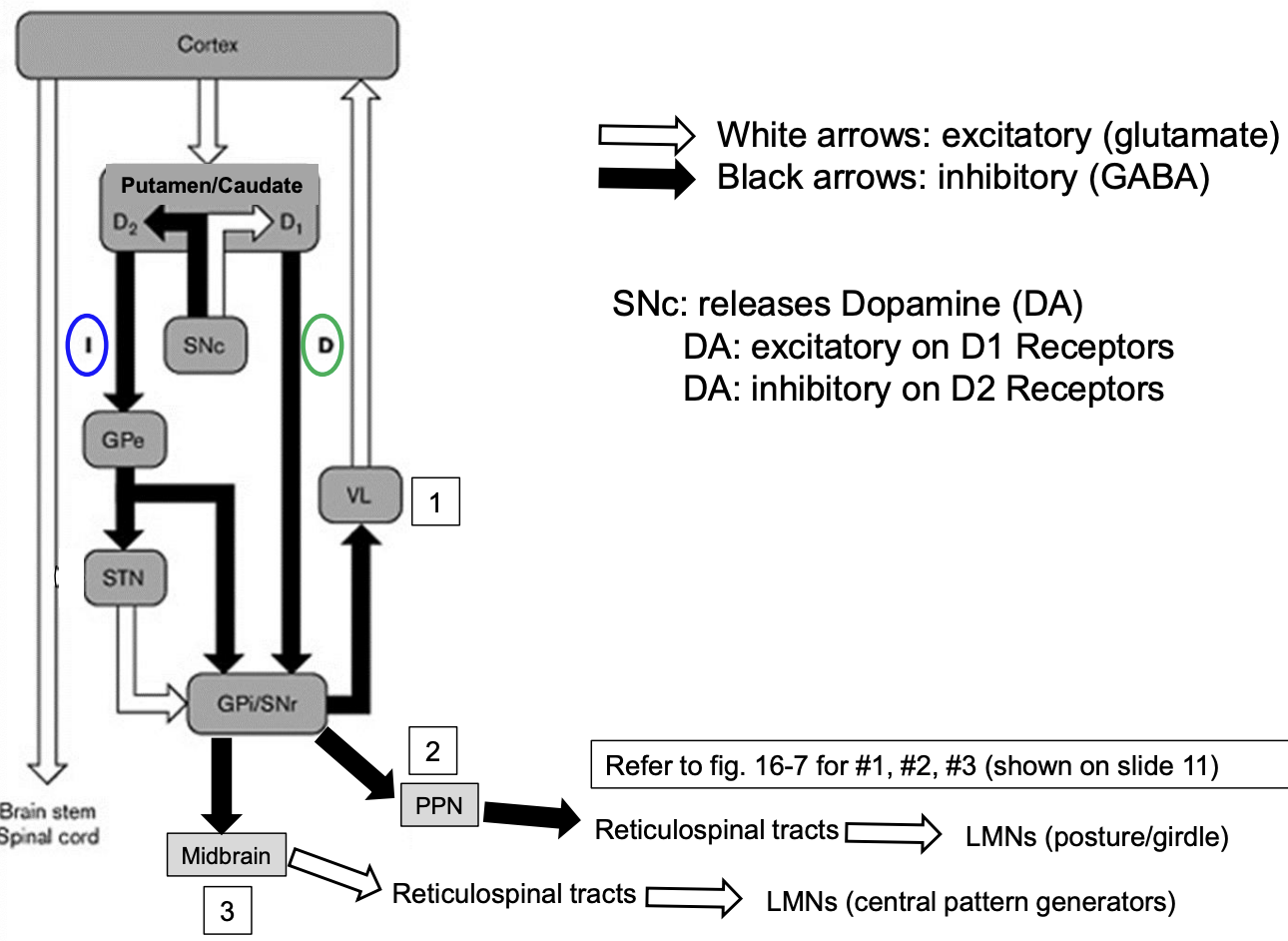
Basal Ganglia Pathways
has two main feedback loops
direct pathway
indirect pathway
stimulation of:
the direct pathway increases the excitatory effect on the cortex, through the thalamus, and therefore facilitates movement
the indirect pathway decreases the excitatory effect on the cortex, through the thalamus, and therefore suppresses movement
Simplified Overview
the direct (GO) pathway facilitates specific movements while at the same time:
the indirect (STOP) pathway suppresses unwanted (competing) movements
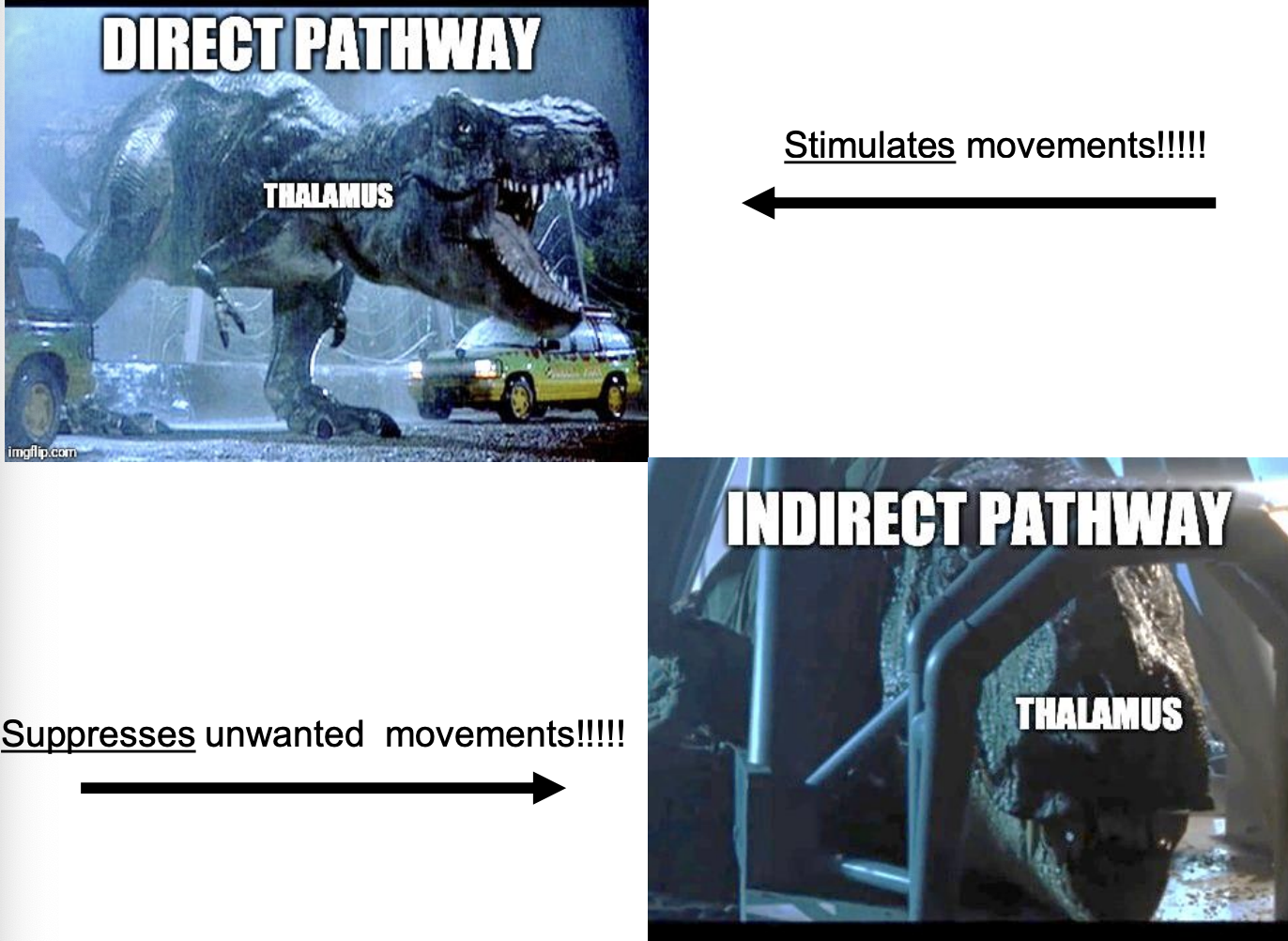
Full direct pathway
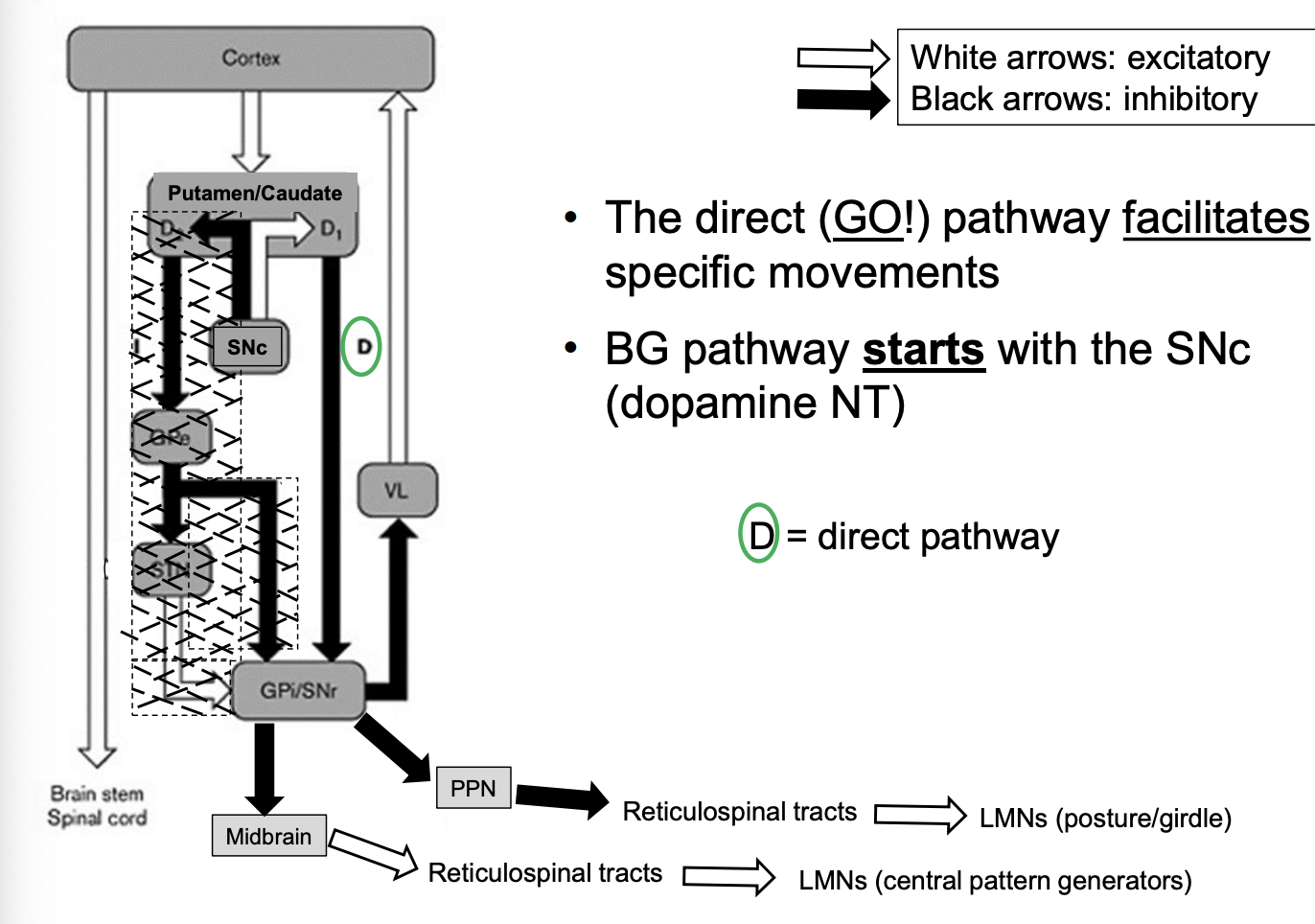
Direct Pathway starting with SNc
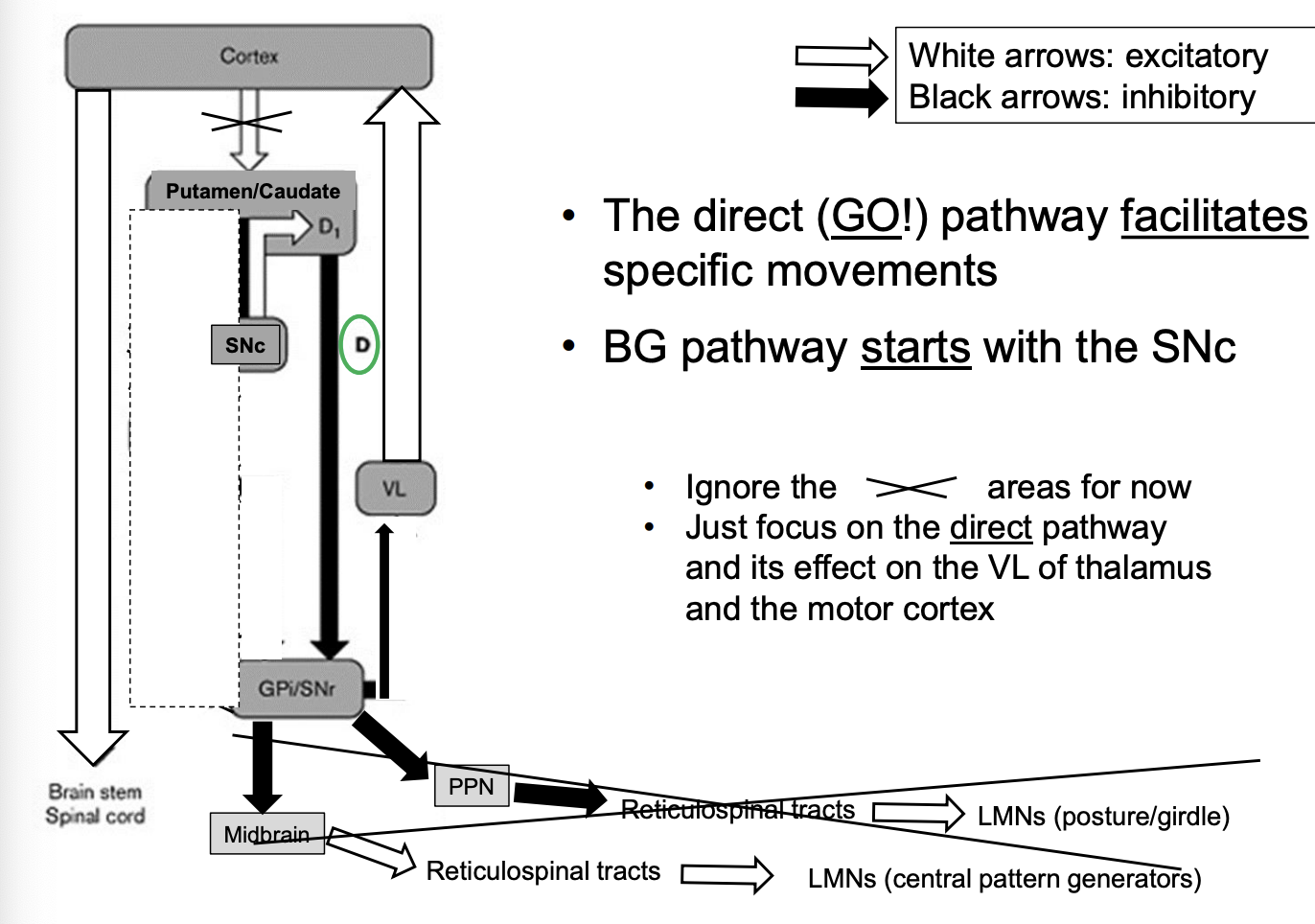
In the direct pathway:
SNc releases Dopamine to stimulate the D1 receptors in the striatum (Putamen & Caudate)
D1 receptors stimulate the striatum to release GABA onto its target: GPi/SNr.
This will cause a decrease in activation (stimulation) of the GPi/SNr
GPi/SNr also uses GABA as its neurotransmitter
Therefore GPi/SNr will release less GABA resulting in:
decreased inhibition from GPi/SNr to VL of thalamus
that results in VL of thalamus to release more of its Neurotransmitter: Glutamate
that causes the VL of thalamus to increase its activation on the cerebral cortex.
This will trigger an increase in stimulation output from the cerebral cortex to the spinal cord LMNs
Indirect pathway
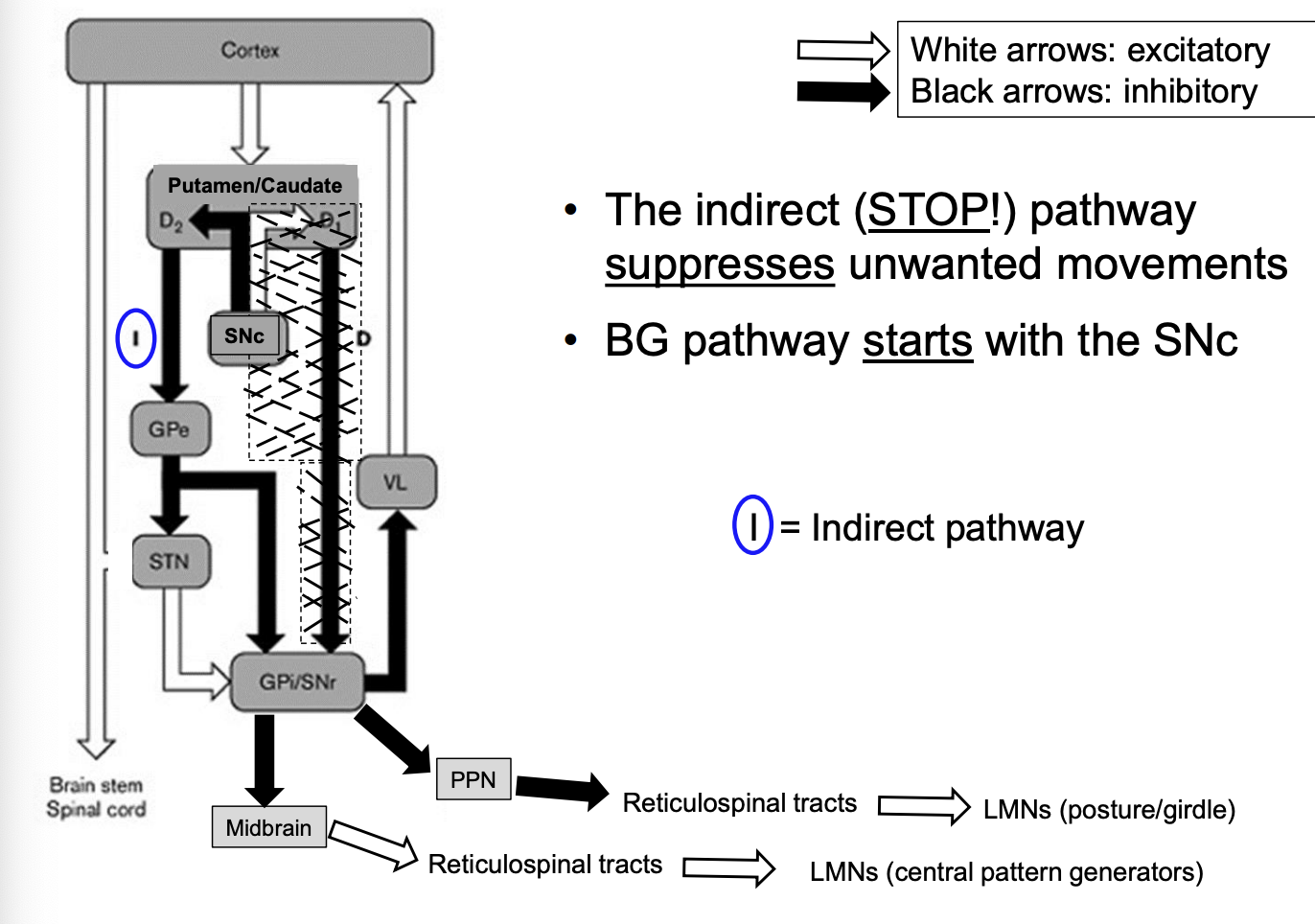
Indirect pathway starting with SNc
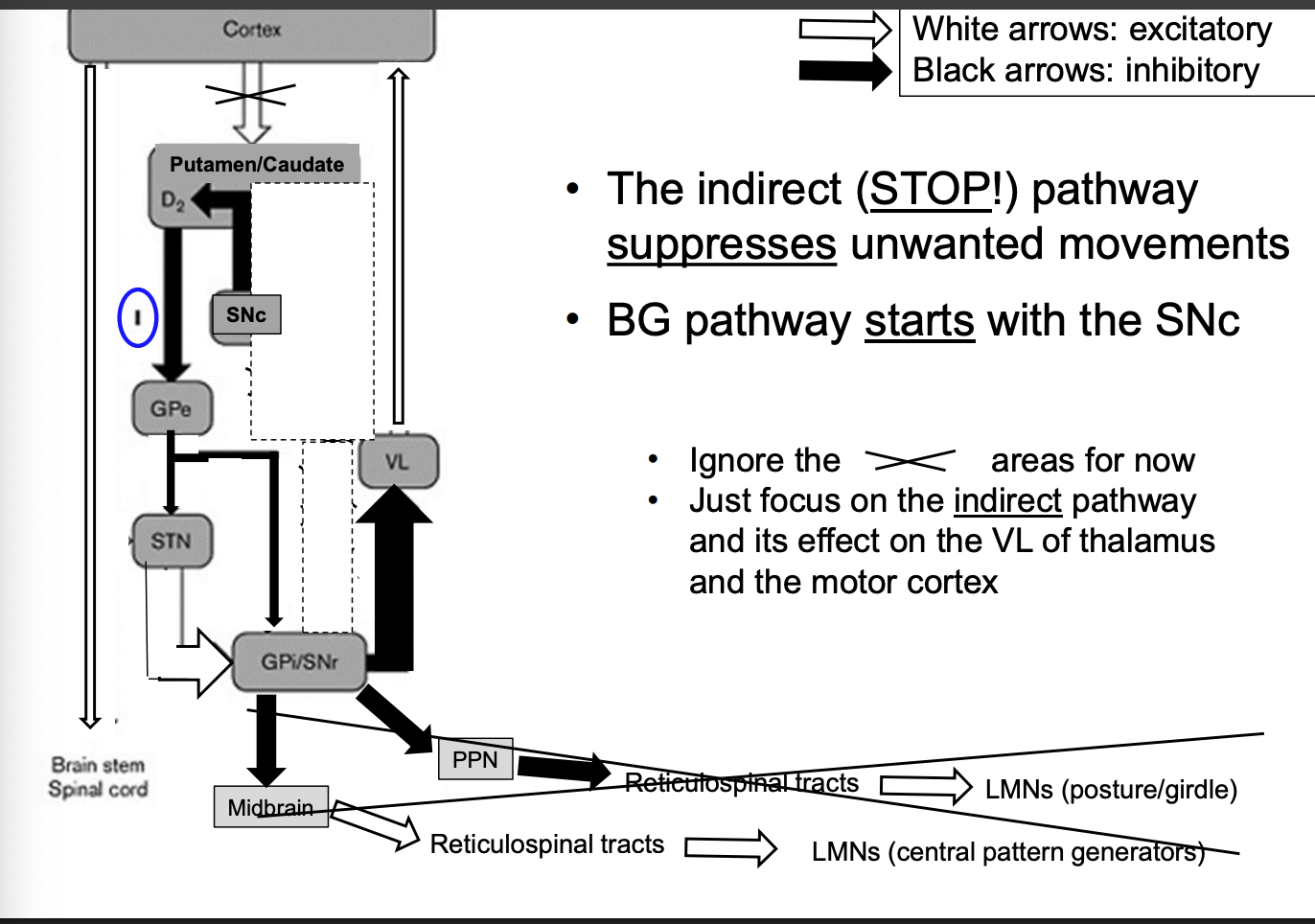
In the indirect pathway
SNc releases Dopamine to inhibit the D2 receptors in the striatum (Putamen & Caudate)
D2 receptors stimulate the striatum to release GABA onto its target: GPe
This will cause a decrease in activation (stimulation) of the GPe
GPe also uses GABA as its neurotransmitter
Therefore, GPe will release less GABA.
less GABA from GPe to Subthalamic nucleus (STN):
causes STN to release more of its neurotransmitter: glutamate onto its target: GPi/SNr
This results in stimulation of GPi/SNr to release more GABA
less GABA from GPe to GPi/SNr
causes GPi/SNr to release more GABA
Therefore both #1 and #2 (from previous slide) will cause GPi/SNr to release more GABA.
This will increase its inhibition onto the VL of the thalamus
The VL will release less Glutamate and therefore it will decrease its activation on the cerebral cortex.
This will result in a decrease in stimulation output from the cerebral cortex to spinal cord LMNs.
Normal BG — Showing BOTH Direct & Indirect Pathways