[PCOG-LEC-FIN-02-PT2] PEPTIDE HORMONES & THE ENDOCRINE SYSTEM
 Call Kai
 Learn
Learn Practice Test
 Spaced Repetition
 Match
Match Flashcards
 Knowt Play
1/31

Earn XP
Description and Tags
THIS FLASHCARDS IS ABOUT [PCOG] ENDOCRINE SYSTEM - BIOSYNTHESIS OF CATECHOLAMINE HORMONES.
Name | Mastery | Learn | Test | Matching | Spaced | Call with Kai |
|---|
No analytics yet
Send a link to your students to track their progress
32 Terms
Endocrine System
This is the collection of glands that produce hormones that regulate metabolism, growth and development, tissue function, seksual function, reproduction, sleep, mood and among other things.
Metabolism
Growth and Development
Tissue and Seksual Function
Reproduction
Sleep and Mood
What are the (5) Things that the Endocrine System regulates?
Hint: Met-GD-TiRS
Excessive or Diminished Activity
Disturbance in the function may take the form of ______ activity or ________ activity of the Endocrine System.
Diseases
Any disturbance of the functions, either due to excessive activity (hyperfunction) or diminished activity (hypofunction), it would cause hormonal imbalance leading to?
Adrenal Glands
Thyroid Glands
Pituitary Gland
Pancreas
Parathyroid Hormone + Calcitonin
Gastrointestinal Hormone
The Endocrine System consists of (6)?
Hint: ATP-PPG
Posterior
Anterior
The pituitary gland is divided into two called?
Thyroid Glands
Calcitonin is produced in the?
Adrenal Glands
Part of the Endocrine System:
A pair of small glands situated over the superior medial aspects of each kidneys. Embryologically, histologically, and functionally of two (2) distinct glandular entities that are grossly combined into one organ.
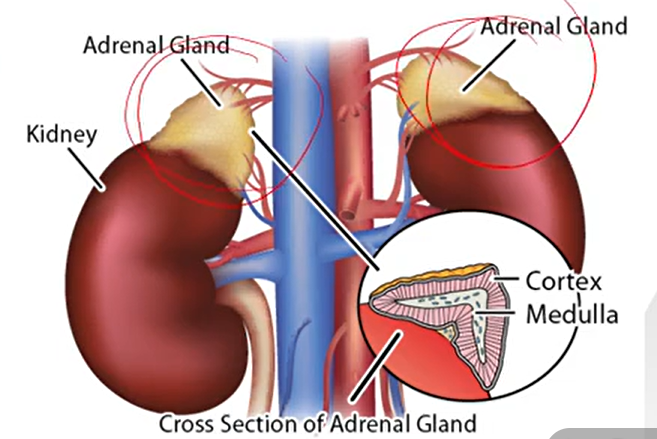
Superior medial aspect of each kidneys
Where are the adrenal glands situated?
Eustachius
Adrenal Glands was first described by who?
Suprarenals
What is the other term for adrenal glands?
Adrenal Cortex
Adrenal Medulla
The adrenal glands are composed of (2) Distinct Glandular Entities. What are they?
Steroid Hormones
The adrenal cortex secretes what hormones?
Epinephrine
Norepinephrine
The adrenal medulla secretes what hormones (2)?
Adrenal Medulla
Epinephrine and Norepinephrine
Sympathomimetic amines
The (1)__________ is not essential for life, and no specific deficiency or disease is associated with its absence. The therapeutic use of (2)________ and ________ is mainly based on the pharmacology of (3)________ amines, rather than on the principle of hormone replacement, unlike other hormones.
Adrenal Cortex
What is the most essential glandular entity of adrenal glands?
Epinephrine
Norepinephrine
Dopamine
What are the (3) Hormones of Adrenal Glands?
Hint: END
Tyrosine
What is the precursor for Catecholamine Hormones?
3,4-Dihydroxyphenylalnine (DOPA)
After tyrosine, there is?
3,4-Dihydroxyphenylalnine
DOPA stands for?
Tyrosine
DOPA
Dopamine
Norepinephrine
Epinephrine
What is the sequence of the Biosynthesis of Catecholamine Hormones (5)?
Hint: TDD-NorEp
Info
Tyrosine is oxidized by the enzyme tyrosine hydroxylase (rate-limiting step) to form L-DOPA.
L-DOPA is then decarboxylated by L-DOPA decarboxylase, producing dopamine.
Dopamine synthesis is inhibited by carbidopa.
The dopamine is then stored in the vesicular monoamine transporter (VMAT), which is inhibited by reserpine.
Once inside the vesicle, dopamine is converted to norepinephrine through the action of the enzyme dopamine β-hydroxylase.
Norepinephrine is the major sympathetic neurotransmitter.
In the adrenal medulla, norepinephrine is further converted to epinephrine by the enzyme Phenylethanol-N-methyltransferase (PNMT).
Tyrosine
What is the starting amino acid in catecholamine synthesis?
Tyrosine hydroxylase
What is the rate-limiting enzyme that converts tyrosine into L-DOPA?
L-DOPA
What is the product formed from tyrosine by tyrosine hydroxylase?
L-DOPA decarboxylase
Which enzyme converts L-DOPA to dopamine?
Carbidopa
What drug inhibits the formation of dopamine from L-DOPA?
Vesicular monoamine transporter (VMAT)
What transporter stores dopamine inside vesicles?
Reserpine
What drug inhibits VMAT?
Dopamine B-hydroxylase
Which enzyme converts dopamine to norepinephrine?
Norpeinephrine
What is the major sympathetic neurotransmitter produced?
Phenylethanol-N-methyltransferase
Which enzyme converts norepinephrine to epinephrine in the adrenal medulla?