Business - Chapters 31, 32, 33 and 35: Economy
 Call Kai
 Learn
Learn Practice Test
 Spaced Repetition
 Match
Match Flashcards
 Knowt Play
1/49

Earn XP
Description and Tags
Scarcity and Choice, Economic Resources, Demand and Supply, Taxation and Economic Indicators
Name | Mastery | Learn | Test | Matching | Spaced | Call with Kai |
|---|
No analytics yet
Send a link to your students to track their progress
50 Terms
Economics
A social science that studies how people with limited resources make decisions to satisfy their needs and wants
Economic resources
Economic resources are the factors or inputs used to produce and distribute goods services and wealth. These resources help us to meet our needs and achieve our goals.
Utility
If deciding between two or more alternatives, you should choose the one that offers the greatest benefit or satisfaction from our limited resources
Factors of Production
The economic resources used tp
Land
Labour
Capital
Enterprise
What choices have to be made about the production of goods
> What will be produced
> How it will be produced
> Where it will be produced
> Who will receive the goods and services produced.
Economy
The system used to produce and use goods and services in a country or region
Public Sector
Part of the economy that is owned and controlled by the government. It provides service that aren’t provided by the private sector
Private Sector
Businesses owned by private individuals that produce and sell goods with an aim of making a profit
Centrally Planned economy
An economy where the government has a lot of control over economic resources and decision making. (North Korea, Cuba)
Free market economy
An economy where private individuals control resources, own businesses and make decisions on what resources will be produced. (USA, Singapore, Switzerland)
Mixed Economy
An economy that combines elements of a free market and centrally planned economy. (Ireland)
Third Sector
Social enterprises and not-for-profit organisations such as charities
market
A place where buyers and sellers connect with each other to trade or exchange goods and services
Factor Markets
Where the factors of production are bought and sold (property market, stock market, etc.)
Demand
The quantity of a product that buyers are willing to purchase at a given price
Effective Demand
A willingness to buy, backed up by an ability to pay
Consumer Behaviour Assumptions
Consumers are rational
Consumers have to make choices to get the most out of their limited resources
Consumers will try to get the most utility as possible
Law of diminishing marginal utility
The benefit or satisfaction that a consumer receives from consuming a good or service decreases over time.
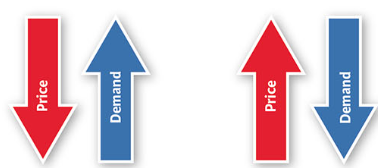
Relationship between demand and price
When price is reduced, demand will increase
When price increases, demand will fall.
Demand schedule
Shows the number of goods demanded by customers at different price levels.
Substitute Good
A product that can be used instead of another good
Demand Curve
A graph that illustrates the expected demand for a product at various price levels
Complementary good
A product that is used with another product (Xbox and Controller)
Reasons a Demand Curve could shift:
Price of substitute goods
Price of complementary goods
Fads and Fashion
Advertising
Government Regulations
Changes in population
Normal Good
One that will be in greater demand when the buyer’s income rises.
Inferior Good
One for which there will be less demand when the buyer’s income rises. For example,consumers with extra income may buy premium brands rather than own-brand products.
Supply
Refers to the quantity of a product that producers are willing to sell at a given price.
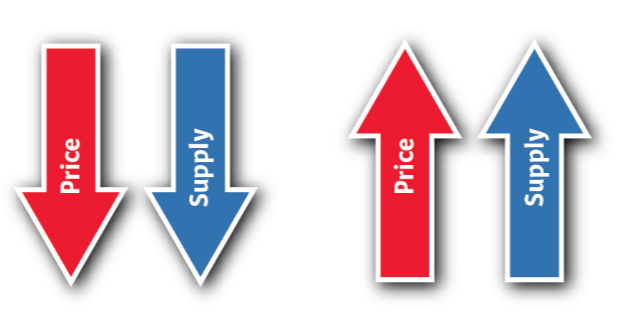
Relationship between supply and price
Supply will increase when the selling price increases
Supply will decrease when the selling price decreases.
Supply Curve
A graph that illustrates the quantity of a product that a seller is willing and able to supply at a series of price points.
Reasons a Supply Curve could shift:
Environmental Conditions
Price of other Goods
Technology
New suppliers
Quotas
A limit on the number of goods made available for sale
Equilibrium
In the marketplace, supply and demand interact until a balanced position is reached.
Market Equilibrium
The price point at which the quantity supplied equals the quantity demanded.
Taxation
A compulsory payment made by individuals and organisations to the government and used to fund public services.
Revenue (org)
The state body responsible for collecting all taxes in the Republic of Ireland.
Principle of a fair Tax System
Equality
Certainty
Economy
Convenience
Convenience in a tax system
It should be easy for each person to pay their taxes when they fall due.
Economy in a tax system
The cost of collecting a tax should be less than the amount that will be collected.
Certainty in a tax system
The amount of tax that a person must pay should be clear and predictable.
Equality in a tax system
The amount of tax that a person has to pay should be related to their ability to pay – in other words, those who earn more should pay more.
The shadow/black economy
Refers to illegal economic activity where people try to hide income or wealth from being recorded in order to avoid tax.
The purpose of taxation
Financial reasons: Using taxation as a source of income to fund government spending.
Social reasons: Using taxation to try to improve society and people’s lives.
Legal reasons: Complying with the law of the land.
Ethical reasons: Using tax in ways that are just and fair toall.