Introduction to malignant disease
 Call Kai
 Learn
Learn Practice Test
 Spaced Repetition
 Match
Match Flashcards
 Knowt Play
1/6

There's no tags or description
Looks like no tags are added yet.
Name | Mastery | Learn | Test | Matching | Spaced | Call with Kai |
|---|
No analytics yet
Send a link to your students to track their progress
7 Terms
Causes of cancer
•“The enemy from within”
•Driven by mutated genes and their encoded proteins
•Mutations can be caused by:
damage to DNA caused by oxygen free radicals e.g. small scale damage in kinase b-raf, the mutation changes the amino acid and this is a mutation that is found in a number of malignant cancers.
errors introduced during DNA replication or ineffective DNA repair e.g. non homologous recombination can lead to significant changes to the DNA.
errors introduced during cell division
environmental factors e.g.
- UV radiation
- Carcinogens e.g. smoking; asbestos
- Infections e.g. human papilloma virus
Inflammation
•If they are introduced into the germline cells they can be inherited and have the potential to cause cancer in future generations.
The link between infection, inflammation and cancer
•Approximately 16% of cancers worldwide are related to infectious agents or infection-associated chronic inflammation
•Some viruses are able to activate cell division (oncogenic)
•Hepatitis B virus and hepatitis C virus (HBV and HCV), are associated with hepatocellular carcinoma
•The Herpes viruses - Epstein-Barr virus is associated with Burkitt's lymphoma, nasopharyngeal carcinoma, and a subset of gastric carcinoma
•Papillomaviruses (HPV) strains are associated with anogenital cancers, some head and neck cancers and skin cancers
•Viruses with oncogenic potential require cofactors for cancer progression - typically including inflammation and imbalance of normal microflora (dysbiosis)
The link between infection, inflammation and cancer
•There is one example of a bacteria with class 1 carcinogen status - Helicobacter pylori
•Associated with gastric carcinoma and lymphoma
•The mechanisms of gastric carcinogenesis induced by H. pylori have been shown to require
•multidecade exposure to the bacterium
•coupled with an initial inflammatory response, including IL-1β production by H. pylori infected dendritic cells
•epithelium injury and atrophy
•reduction in parietal cell acid secretion
•intestinal transformation of cells (metaplasia) → essentially cells differentiate into precancerous cell type.
Link between injury -
sterile chronic inflammation and cancer
•Tumour formation has also been linked to chronic inflammation caused by injury rather than infection:-
•
•Mechanical e.g. chronic use of urinary catheters is associated with bladder carcinoma
•Chemical e.g. exposure to asbestos which is associated with lung cancer and mesothelioma.
•Due to inherited mutations e.g. secondary pancreatitis due to mutated gene.
How can chronic inflammation result in cancer?
Proposed mechanism 1
•
Production of reactive oxygen and nitrogen species that induce the formation of DNA cross-links, single- or double-strand breaks that can drive:-
•genomic instability
•mutations within oncogenes and tumour suppressor genes leading to either activity or inactivity of these genes.
Proposed mechanism 2
•
Cancer-associated inflammation leads to immunosuppression of an anti-cancer immune response
Proposed mechanism 3
Macrophages and monocytes cause remodelling of tissue promoting proliferation - changes in gene expression mediated by transcription factors e.g. NF-κB which induces the expression of:-
•Bcl-2 and Bcl-xL (anti-apoptosis proteins)
•Cyclin D (cell proliferation)
•VEGF (angiogenesis / cell invasion)
Tumour classification
Tumors are classified according to location -> either blood or tissue
Leukaemia → Production of blasts / leukaemia cells (undifferentiated white blood cells). An abnormal mass of tissue that usually does not contain cysts or liquid areas.
Solid Tumour → 3 types
Sarcomas which are cancers arising from connective or supporting tissue such as bone or muscle. Carcinomas that are cancers arising from the body’s glandular or epithelial cells. Lymphomas are cancers of the lymphoid organs such as the lymph nodes the spleen and the thymus. Hodgkins disease normally involves peripheral lymph nodes while non Hodgkins lymphomas have a widespread distribution.
•Benign - usually encapsulated
•Malignant - has ability to invade tissue and undergo metastasis
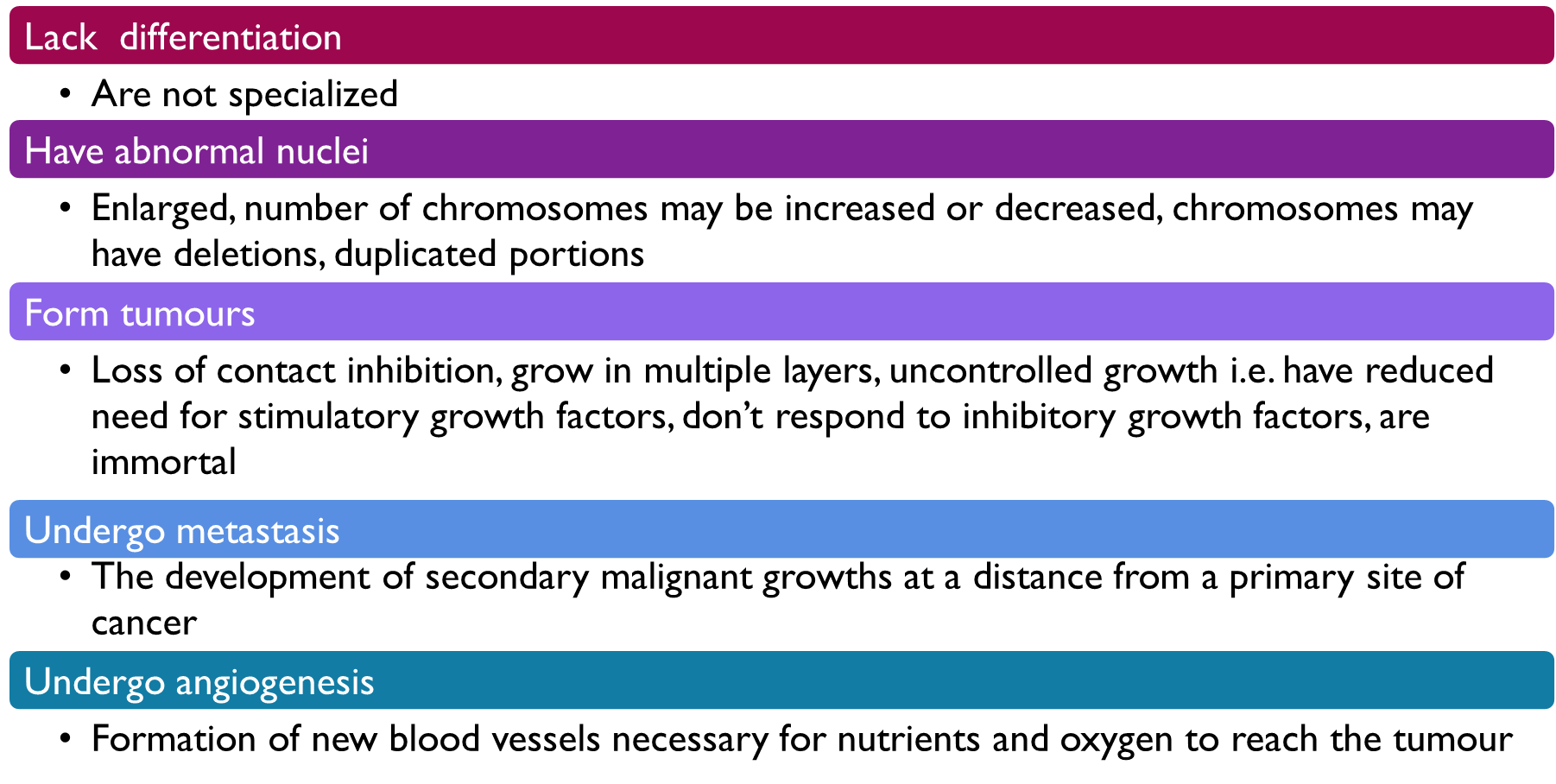
Characteristics of malignant solid tumour cells
•