2.5 Economic growth
 Call Kai
 Learn
Learn Practice Test
 Spaced Repetition
 Match
Match Flashcards
 Knowt Play
1/7

There's no tags or description
Looks like no tags are added yet.
Name | Mastery | Learn | Test | Matching | Spaced | Call with Kai |
|---|
No analytics yet
Send a link to your students to track their progress
8 Terms
Economic growth
An increase in real GDP in an economy in a year caused by an increase in AD or an increase in LRAS.
Actual growth vs potential growth
Actual growth: the percentage increase in a country’s real GDP and it is usually measured annually.
Caused by increases in AD (using spare capacity to increase real GDP)
Potential growth: the long run of expansion of what the economy could produce if resources were fully employed.
Caused by increases in LRAS (increase in productive capacity of the economy)
The importance of international trade for (export-led) economic growth
Countries can specialise where they have a comparative advantage, which increases world output and lowers average costs.
country relies on the economic state of other countries, since these are the consumers of their goods and services. If there is a recession in a major export market, exports will fall and so will economic growth.
A country has comparative advantage when it can produce goods and services at a lower opportunity cost than another.
It will initially increase AD, so will only bring about short term growth. However, it will encourage firms to invest and therefore bring about long term growth by improving the supply-side of the economy
Characteristics of booms+recessions
Boom | Recession |
|---|---|
-faster growth(more output) -higher demand for imports -low unemployment -inflation(possibly) -more tax revenue + profits -high business + consumer confidence | -negative growth(less output) -declining AD -high unemployment -low demand for imports -deflation -less tax revenue + profits -low business + consumer confidence |
Recovery: rising consumer + business confidence, higher house prices, higher investment
Caused by shocks in the economy:
Demand side: sudden rise in interest rates, sudden cut in gov. spending, sudden strength in exchange rate (less net exports)
Supply side: natural disasters, sudden increase in raw material prices, sudden increase in wages.
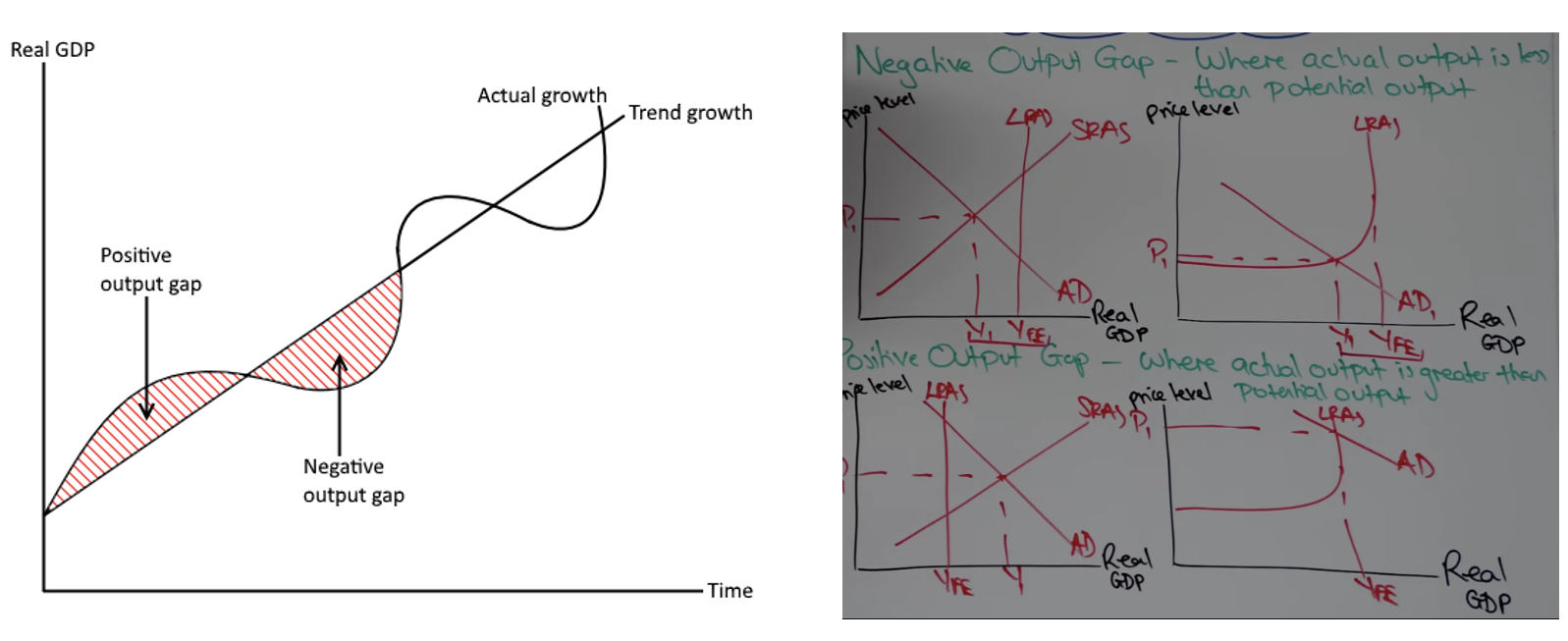
Positive + negative output gaps
Positive output gap: occurs when actual output is greater than potential output
-if productivity is growing
-puts upward pressure on inflation
Negative output gap: when actual output is less than potential output.
-puts downward pressure on inflation
-lots of spare capacity in economy
Difficulties with measuring output gap
in emerging markets, data is not always reliable+available in a timely matter due to incorrect measurements of GDP
initial estimates of GDP may be changed/ corrected- this results in inaccurate output gap estimates e.g. actual output is higher than estimated
uncertain productivity growth- estimating potential output is difficult due to changing technological advancements, labour force quality e.g. output may be lower after a recession than anticipated
informal economy- not captured in GDP statistics- underestimates actual output
Solving negative output gaps
-evaluation for impact of shifting AD/ AS on economic performance.
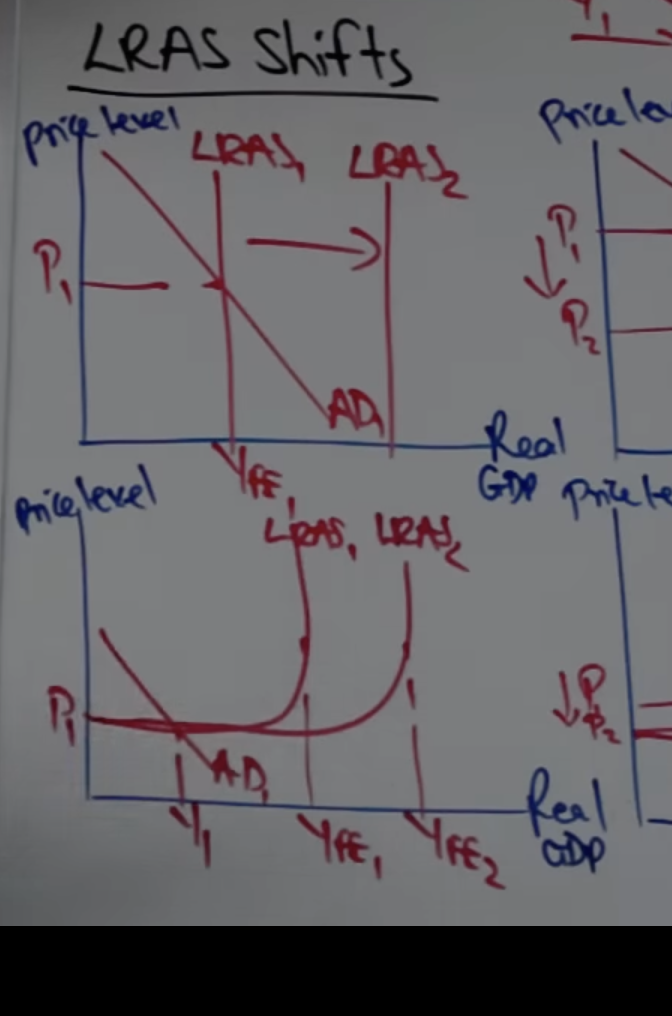
Supply side policies to shift LRAS right will not solve negative output gaps. If economy is in recession, increasing supply doesn’t have an affect on demand.
Demand side policies allows AD to increase to full employment.
Benefits and costs of economic growth on :
consumers
firms
government
current + future living standards
Consumers: more employment→more income→better standard of living + decreased level of unemployment.
Firms: demand for goods + services ↑ → more revenues + profits → increased confidence → increased profits + confidence leads to more investment by firms (accelerator effect).
Government: more income tax revenue due to increase in employment + income → more corporate tax revenue due to increase in profits + income, less spending on welfare benefits like unemployment benefits→improvement in gov. budget.
COSTS:
Current account deficit: incomes rise, more imports
Higher demand pull inflation
High income inequality: e.g. one sector dominance
Environmental costs: cause negative externalities in production, casing welfare loss
Evaluation
Sustainable growth- no inflation + environmental costs
Inclusive growth- no income inequality, everyone benefits from growth