Cycles of Nutrients

0.0(0)
Studied by 0 people
call kaiCall Kai
learnLearn
examPractice Test
spaced repetitionSpaced Repetition
heart puzzleMatch
flashcardsFlashcards
GameKnowt Play
Card Sorting

1/64

encourage image

There's no tags or description

Looks like no tags are added yet.

Last updated 1:14 AM on 4/11/26
Name
Mastery
Learn
Test
Matching
Spaced
Call with Kai

No analytics yet

Send a link to your students to track their progress

65 Terms

1
New cards

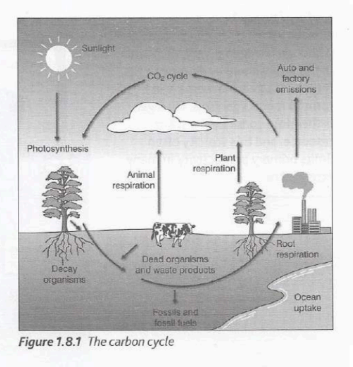
What are the two main functions of carbon?

It is a structural component of organic molecules, and it is an important element in chemical energy storage.

2
New cards

What reaction includes carbon?

Photosynthesis

3
New cards

How does carbon affect the atmosphere?

As carbon exists as carbon dioxide in the atmosphere, this gas is a greenhouse gas which traps heat on earth

4
New cards

What is anthropogenic activity?

Human activities that alter natural environments, especially by increasing greenhouse gases like CO₂ and CH₄, leading to changes such as global warming, pollution, and habitat loss.

5
New cards

How are fossil fuels made?

When dead organisms are buried in the ground over millions of years they become fossil fuels.

6
New cards

What reaction is responsible for returning carbon into the air?

aerobic resiration

7
New cards

Aerobic equation

C6H12O (aq) + O6 (g) = 6CO2 (g) + 6H2O (l)

8
New cards

What is combustion?

a process that releases carbon dioxide into the atmosphere when fossil fuels such as coal, wood and hydrocarbons are burnt.

9
New cards

When does carbon fixation occur?

Carbon fixation occurs during the process of photosynthesis when plants remove carbon dioxide from the atmosphere to make carbohydrates. Sunlight provides the energy for this reaction

10
New cards

Photosynthesis Equation

6CO₂ (g) + 6H₂O (l) = C₆H₁₂O₆ (aq) + 6O₂ (g)

11
New cards

The equation when carbon dioxide is very soluble and large amounts are removed from the atmosphere when it dissolves in the oceans:

CO₂ (g) + H₂O (I) = HCO₃⁻ + H⁺ (aq)

12
New cards

The role of organism in the carbon cycle

Three examples

13
New cards

Carbon Cycle diagram

knowt flashcard image
14
New cards
<p>The role of nitrogen</p>

The role of nitrogen

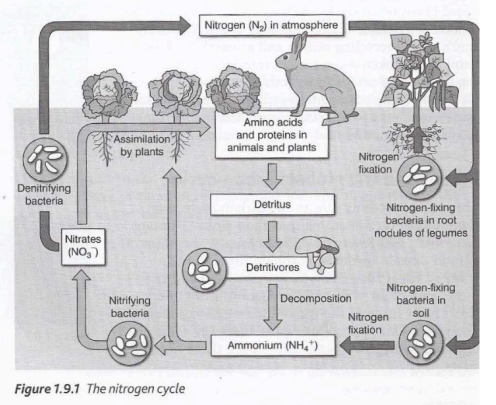
Nitrogen is essential for living organisms because it is needed to make amino acids, peptides, polypeptides, and proteins. Green plants (producers) cannot use atmospheric nitrogen directly, so it must first be converted from dinitrogen gas (N₂) into ammonia (NH₃). Plants then use nitrogen to form proteins, which are passed to consumers through feeding.

Nitrogen exists in both inorganic forms (e.g. ammonia, nitrates) and organic forms (e.g. amino acids and nucleic acids). It is continuously recycled in ecosystems through processes such as nitrogen fixation, nitrification, ammonification, and denitrification, which are mainly carried out by microorganisms.

15
New cards

Nitogen Fixation

Nitrogen fixation is the process that converts atmospheric nitrogen (N₂) into ammonia (NH₃) or ammonium ions (NH₄⁺). It is a multi-step process catalysed by the enzyme nitrogenase.

It is carried out by free-living bacteria such as Azotobacter, symbiotic bacteria such as Rhizobium in root nodules of legumes, and cyanobacteria such as Nostoc.

16
New cards

Lightning may also fix atmospheric nitrogen

During lightning, high-energy discharge causes nitrogen (N₂) to react with oxygen (O₂), forming nitrogen oxides. These dissolve in rainwater to produce weakly acidic solutions, adding nitrates to the soil.

17
New cards

Lighting equation

  1. N₂ + 2O₂ → 2NO₂ + H₂O → 2HNO₃

  2. N₂ + O₂ → 2NO + H₂O → 2HNO₂

18
New cards

Nitrification

Nitrification is a series of oxidation reactions in which ammonium compounds are converted into nitrates, releasing energy used by bacteria.

Nitrite-forming bacteria (e.g. Nitrosomonas) convert ammonia (NH₃/NH₄⁺) into nitrites (NO₂⁻). Another group of bacteria (e.g. Nitrobacter) convert nitrites into nitrates (NO₃⁻).

Nitrates are the main form of nitrogen absorbed by plants. After absorption, they are converted into ammonium and then used to form amino acids, peptides, polypeptides, and proteins.
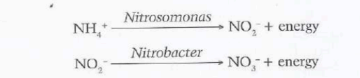
<p>Nitrification is a series of oxidation reactions in which ammonium compounds are converted into nitrates, releasing energy used by bacteria.</p><p>Nitrite-forming bacteria (e.g. <em>Nitrosomonas</em>) convert ammonia (NH₃/NH₄⁺) into nitrites (NO₂⁻). Another group of bacteria (e.g. <em>Nitrobacter</em>) convert nitrites into nitrates (NO₃⁻).</p><p>Nitrates are the main form of nitrogen absorbed by plants. After absorption, they are converted into ammonium and then used to form amino acids, peptides, polypeptides, and proteins.</p>
19
New cards

Denitrification

Denitrification is the process where denitrifying bacteria convert nitrates (NO₃⁻) into nitrogen gas (N₂) and nitrous oxide (N₂O), releasing them back into the atmosphere.

This is carried out by bacteria such as Pseudomonas and Thiobacillus. It commonly occurs in waterlogged soils where oxygen levels are low and there is a high amount of decomposing organic matter.

<p>Denitrification is the process where denitrifying bacteria convert nitrates (NO₃⁻) into nitrogen gas (N₂) and nitrous oxide (N₂O), releasing them back into the atmosphere.</p><p>This is carried out by bacteria such as <em>Pseudomonas</em> and <em>Thiobacillus</em>. It commonly occurs in waterlogged soils where oxygen levels are low and there is a high amount of decomposing organic matter.</p>
20
New cards

Humans and the Nitrogen Cycle

Humans affect the nitrogen cycle by adding or removing nitrogen from ecosystems. The use of nitrogen-based fertilisers increases nitrogen levels in soil and contributes to increased nitrogen fixation. Cultivation of leguminous crops also raises populations of nitrogen-fixing microorganisms in the soil.

Burning fossil fuels releases nitrogen oxides (NO, NO₂), nitrous oxide (N₂O), and ammonia (NH₃) into the atmosphere. In addition, agricultural runoff increases nitrate levels in water bodies, leading to eutrophication, which reduces oxygen levels and harms aquatic organisms.

21
New cards

Important Role of Phosphorus

Phosphorus is an essential element found in energy-rich compounds such as ATP, which is important in cellular energy transfer. It is also a key component of nucleic acids (DNA and RNA), making it vital for genetics.

In vertebrates, about 80% of phosphorus is found in bones and teeth. Phosphorus is often a limiting nutrient in aquatic ecosystems, so its availability affects productivity.

Excess phosphorus in water promotes algal blooms. When algae die, their decomposition by bacteria reduces oxygen levels, leading to water pollution and harm to aquatic life.

22
New cards

Phosphorus cycle and Importance

Sedimentary cycle involving movement of phosphate between rocks, soil, water, and organisms | Required for ATP (energy transfer), DNA/RNA (genetics), and bones/teeth in vertebrates
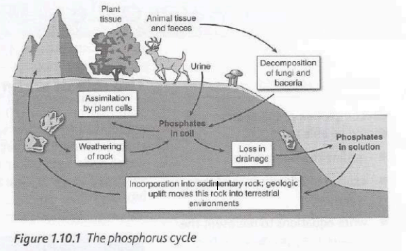
<p>Sedimentary cycle involving movement of phosphate between rocks, soil, water, and organisms | Required for ATP (energy transfer), DNA/RNA (genetics), and bones/teeth in vertebrates</p>
23
New cards

The largest reservoir of phosphorus

Sedimentary rocks are the largest store of phosphorus
24
New cards
Weathering and release
Rocks release phosphate ions (PO4³⁻) into soil and water through weathering
25
New cards
Plant uptake
Plants absorb phosphates and incorporate them into tissues
26
New cards
Animal uptake
Animals obtain phosphorus through feeding on plants/other animals
27
New cards
Return to soil
Excretion (urine/faeces) and decomposition return phosphates to soil
28
New cards
Decomposition role
Fungi and bacteria break down organic matter releasing phosphate
29
New cards
Sedimentation
Long-term storage of phosphate in ocean sediments
30
New cards
Geological uplift
Sedimentary rocks are exposed on land, continuing the cycle
31
New cards
Human impacts on phosphorus cycle
Fertilisers, mining of phosphate rock, superphosphate production, deforestation, detergents
32
New cards
Agricultural runoff
Excess phosphates washed into water bodies causing eutrophication
33
New cards
Eutrophication
Excess nutrients (especially phosphates) cause rapid algal growth and ecosystem imbalance
34
New cards
Algal bloom
Rapid increase in algae due to nutrient enrichment
35
New cards
Decomposition of algae
Bacteria break down dead algae and consume dissolved oxygen
36
New cards
Oxygen depletion (anoxia)
Loss of dissolved oxygen in water leading to aquatic organism death
37
New cards
Fish kills
Aquatic organisms die due to lack of oxygen
38
New cards
Toxic gas production
Anoxic conditions produce hydrogen sulphide (H₂S), ammonia (NH₃), and thioalcohols (RSH)
39
New cards
Thioalcohols
Organic compounds containing sulphur instead of oxygen causing foul odours
40
New cards
Ammonia toxicity
Un-ionised ammonia (NH₃) is highly toxic; ionised ammonia (NH₄⁺) is less toxic
41
New cards
Effect of pH
High pH increases toxic NH₃; low pH increases NH₄⁺
42
New cards
Environmental effects of eutrophication
Reduced biodiversity, altered species composition, and ecosystem imbalance
43
New cards

Physical effects of eutrophication

Increased turbidity reduces light penetration affecting photosynthesis in aquatic plants
44
New cards

Productivity effects of eutrophication

Reduced oxygen lowers fish yield and overall ecosystem productivity
45
New cards

Recreational impact of eutrophication

Decline in water quality reduces recreational use of water bodies
46
New cards
Water (role)
Covers ~70% of Earth's surface; essential for life and must be continuously recycled and purified
47
New cards
Water cycle (hydrological cycle)
Continuous movement of water between atmosphere, hydrosphere, lithosphere, and biosphere in solid, liquid, and gas states
48
New cards
Main driving force
Solar energy (sun heats water causing evaporation)
49
New cards
Evaporation
Process where liquid water changes to water vapour due to heat
50
New cards
Evapotranspiration
Combined water loss from evaporation and plant transpiration
51
New cards
Transpiration
Water absorbed by plant roots and released from leaves as water vapour
52
New cards
Condensation
Cooling of water vapour in the atmosphere to form clouds or fog
53
New cards
Cloud formation
Tiny water droplets form when water vapour condenses around particles in air
54
New cards
Advection
Movement of water vapour/clouds through the atmosphere; redistributes water globally
55
New cards
Precipitation
Water returns to Earth as rain, snow, sleet, or hail when clouds are saturated
56
New cards
Interception
Precipitation caught by vegetation and re-evaporated before reaching ground
57
New cards
Runoff
Water flowing over land or through channels into rivers, lakes, and oceans
58
New cards
Surface runoff
Water moving over land surface into water bodies
59
New cards
Channel runoff
Water moving through rivers and streams
60
New cards
Infiltration
Process where water enters soil and moves downward
61
New cards
Percolation (groundwater flow)
Downward movement of water through soil and rock to form aquifers
62
New cards
Groundwater flow
Movement of stored water underground through aquifers back to rivers/oceans
63
New cards
Water storage locations
Oceans, rivers, lakes, groundwater, ice caps, atmosphere, organisms
64
New cards
Water cycle importance
Regulates climate, redistributes freshwater, supports ecosystems, and purifies water naturally
65
New cards
Natural purification
Infiltration and percolation filter water as it moves through soil and rock layers