Diversity of Life OAT
 Call Kai
 Learn
Learn Practice Test
 Spaced Repetition
 Match
Match Flashcards
 Knowt Play
1/104

There's no tags or description
Looks like no tags are added yet.
Name | Mastery | Learn | Test | Matching | Spaced | Call with Kai |
|---|
No analytics yet
Send a link to your students to track their progress
105 Terms
Taxonomy def
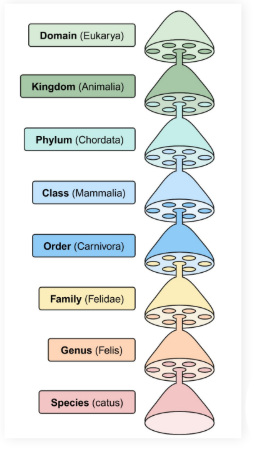
Taxonomy: The science of classifying organisms
Uses a series of classifications that get increasingly more specific
Classifications:
Domain
Kingdom
Phylum
Class
Order
Family
Genus
Species
Dear
King
Phillip
Came
Over
For
Great
Sex
Thank you Dr. Minchella
Domains
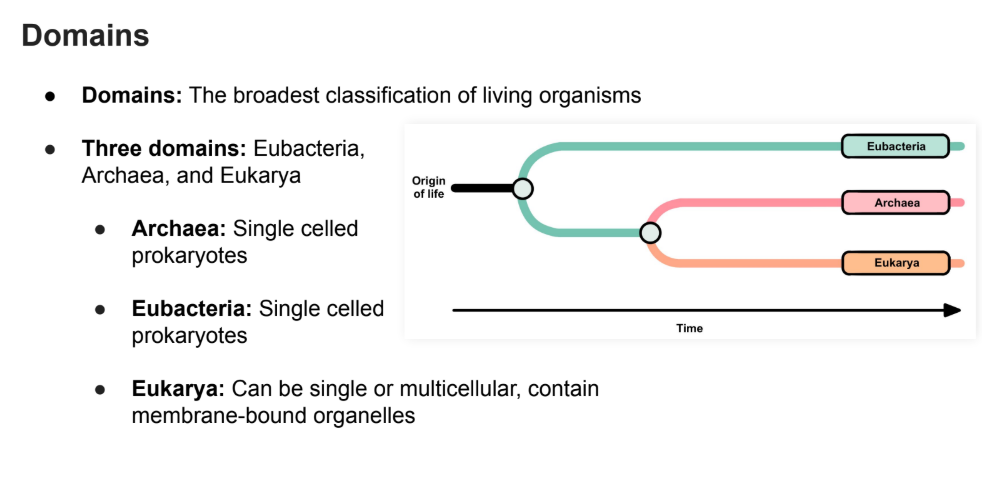
Def
Name them
Broadest Classification of organisms
Archaea
Eubacteria
Eukarya
Archaea
Single celled prokaryotes
Eubacteria
Single celled prokaryotes
Eukarya
Can be single or multicellular, contain membrane bound organelles.
Kingdoms
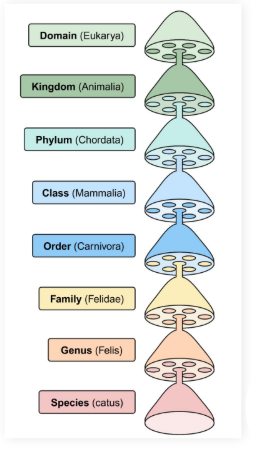
Kingdoms: The second broadest classification of living organisms
The six kingdoms:
Archaea
Eubacteria
Protista
Fungi
Plantae
Animalia
Kingdom Monera
Outdated classification that grouped Archaea and Eubacteria together based on their lack of membrane-bound organelles
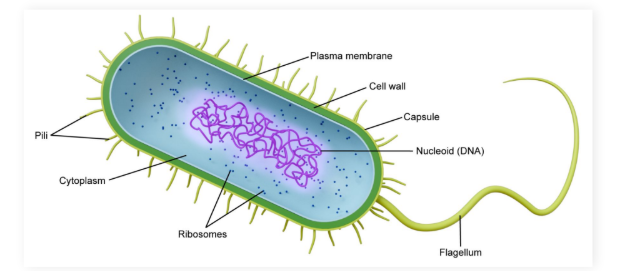
Prokaryotes
Characteristics (organelles)
What can they be classified as
Organisms without membrane bound organelles
Genetic material housed in the nucleoid region
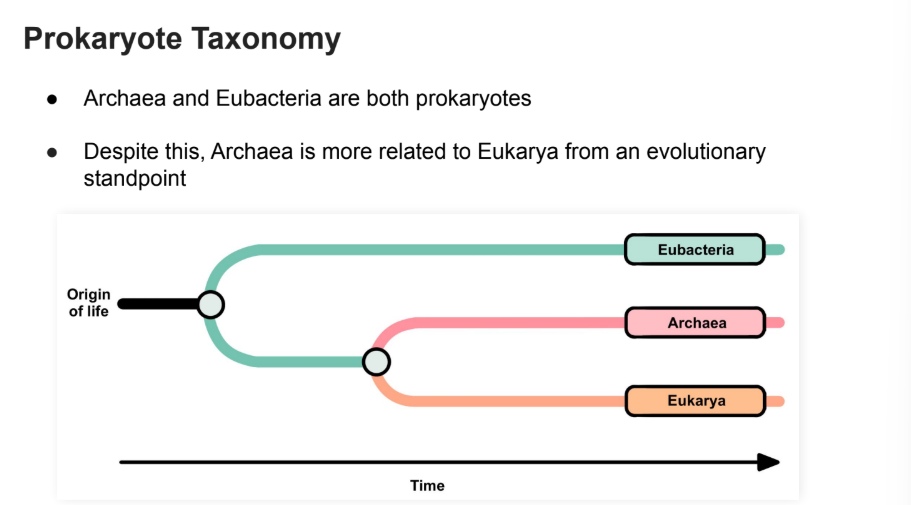
Prokaryotes are either Archaea or Eubacteria
Between Archaea and Eubacteria, which one is more related to Eukarya
Archaea is more related to Eukarya
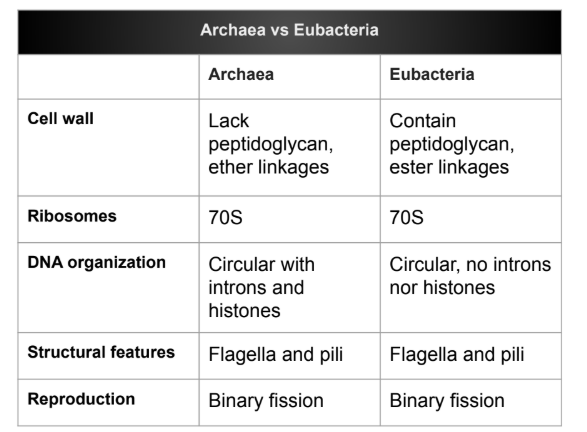
Archaea vs Eukbacrteria
Cells Walls
Ribosomes
DNA organization
Flagella and Pili
Reproduction
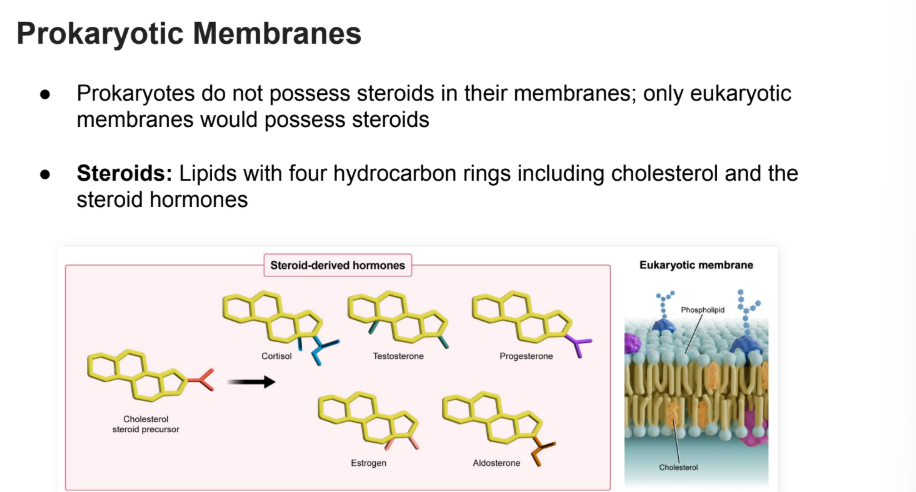
Prokaryotic Membranes
Made of steroids. Only eukaryotes process membranes.
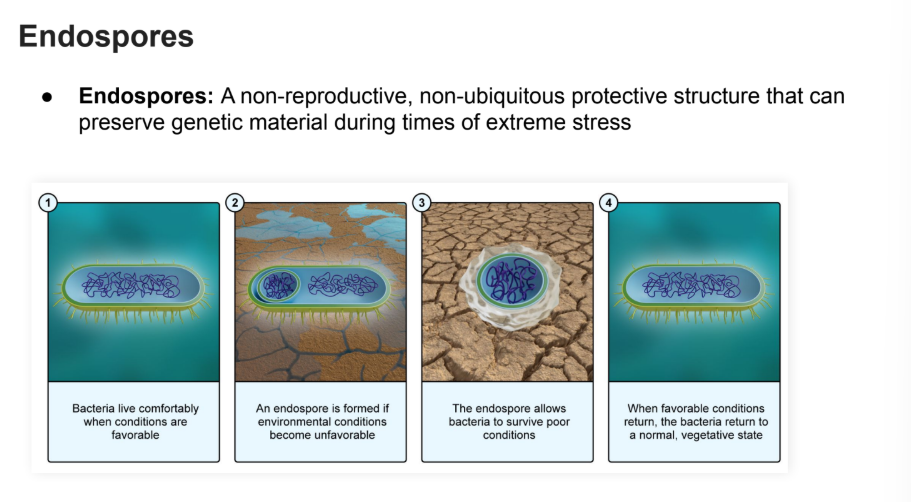
Endospores
Non-reproductive, non-ubiquitous protective structure that can preserve genetic material during times of extreme stress.
IT IS LIKE A LITTLE PROTECTIVE COAT IT CAN HIDE INTO
Extremophiles
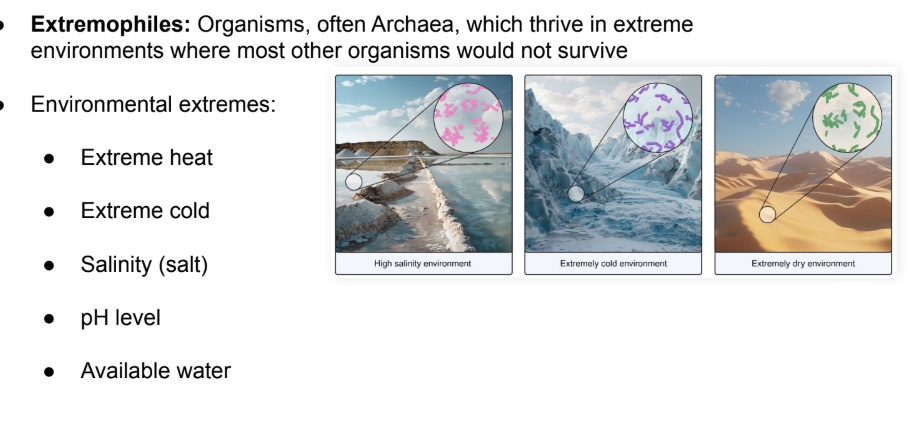
Extremophiles: Organisms, often Archaea, which thrive in extreme environments where most other organisms would not survive
Environmental extremes:
Extreme heat
Extreme cold
Salinity (salt)
pH level
Available water
Cells Wall Compostion
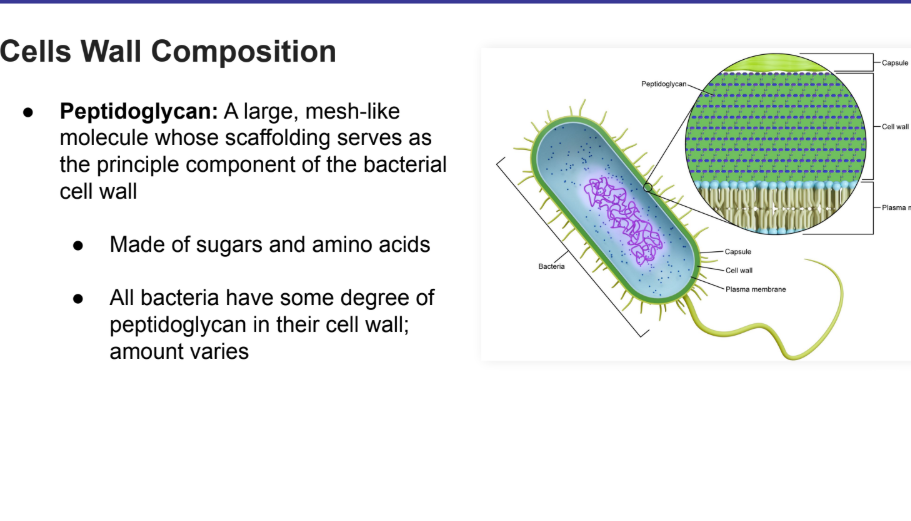
What is it made of in bacteria?
Peptidoglycan: A large, mesh-like molecule whose scaffolding serves as the principle component of the bacterial cell wall
Made of sugars and amino acids
All bacteria have some degree of peptidoglycan in their cell wall; amount varies
Capsule
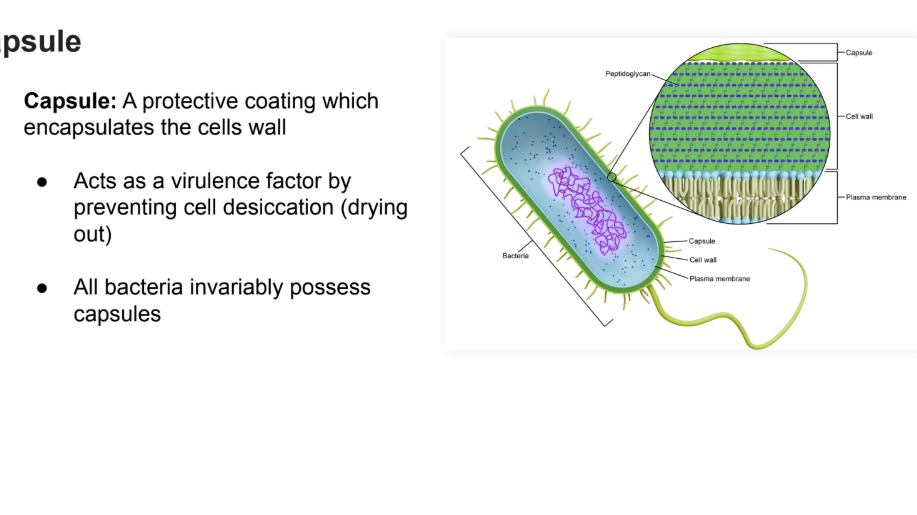
Capsule: A protective coating which encapsulated the cells wall.
Acts as a virulence factor by preventing cell desiccation (drying out)
All bacteria invariably possess capsules
Gram Staining
Staining method used to differentiate bacteria based on cell walls
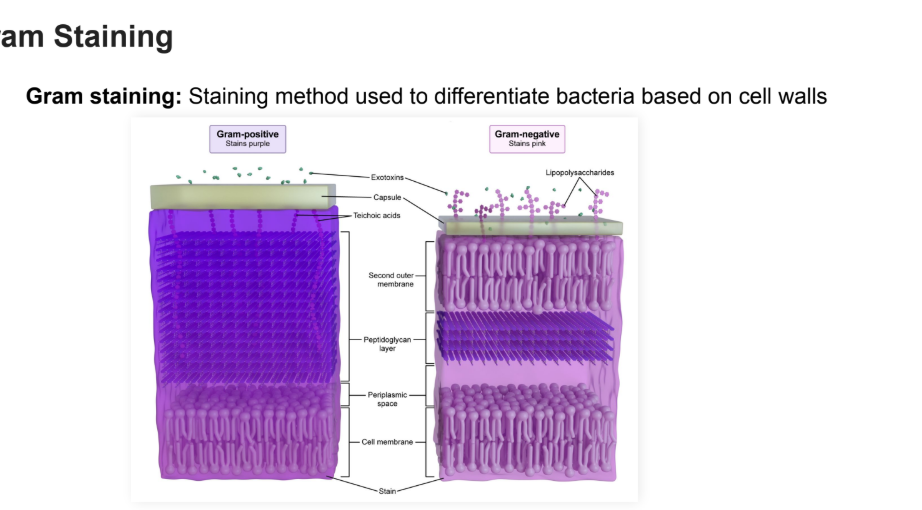
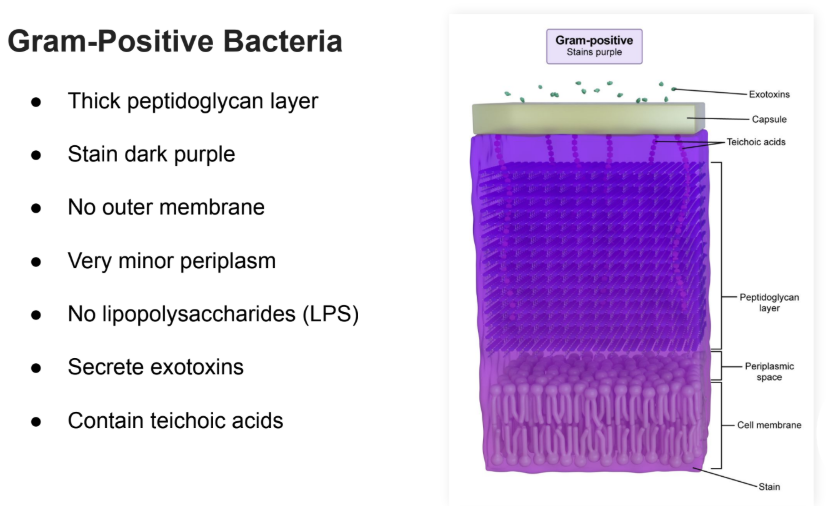
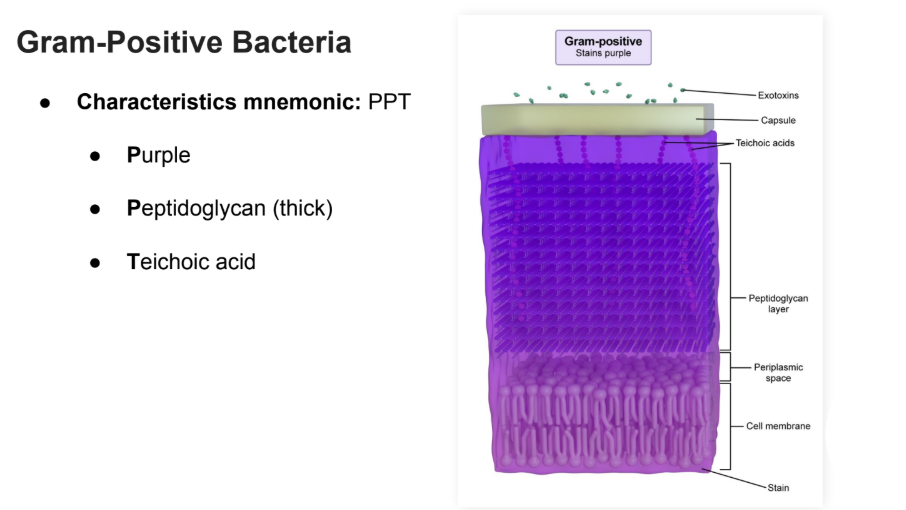
Gram Positive Bacteria
Thick peptidoglycan layer
Stain dark purple
No outer membrane
Very minor periplasm
No lipopolysaccharides (LPS)
Secrete exotoxins
Contain teichoic acids
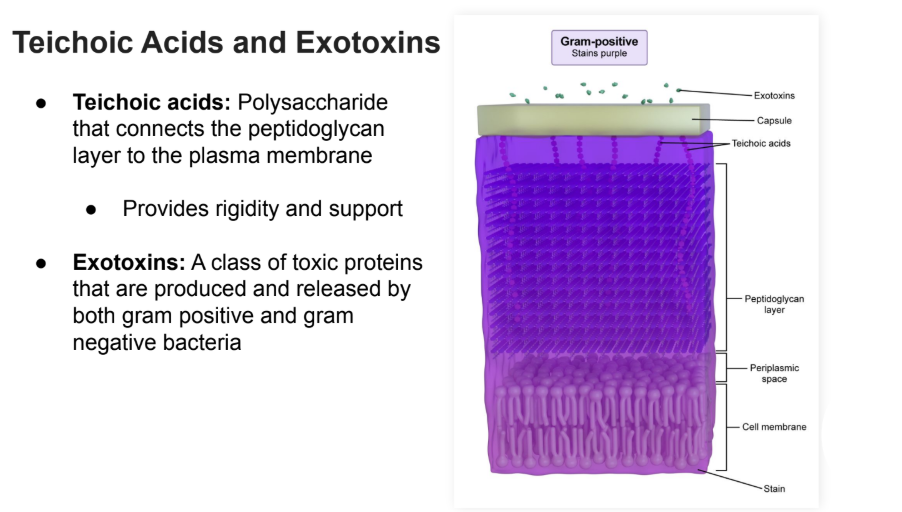
Teichoic Acids
Teichoic acids: Polysaccharide that connects the peptidoglycan layer to the plasma membrane
Provides rigidity and support
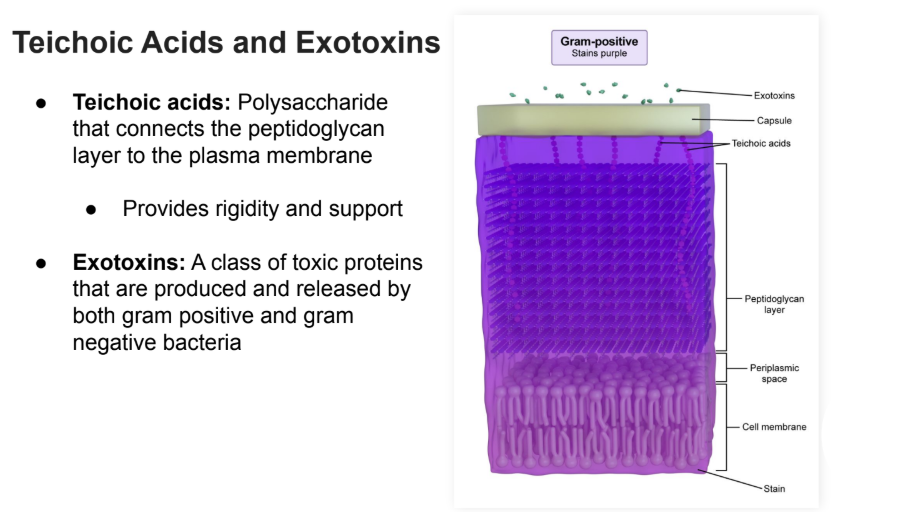
Exotoxins
A class of toxic proteins that are produced and released by both gram positive and gram negative bacteria
Characteristics of gram positive bacteria
PPT
Purple
Peptidoglycan
Teichoic Acid
Gram Negative Bacteria
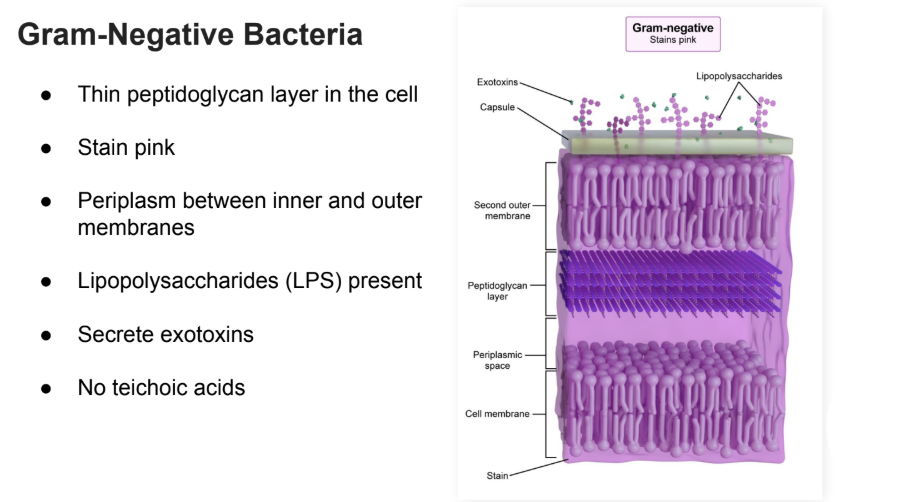
Thin peptidoglycan layer in the cell
Stain Pink
Periplasm between inner and outer membranes
Lipopolysaccharides (LPS)
Secrete Exotoxins
No teichoic acids.
Lipopolysaccharides
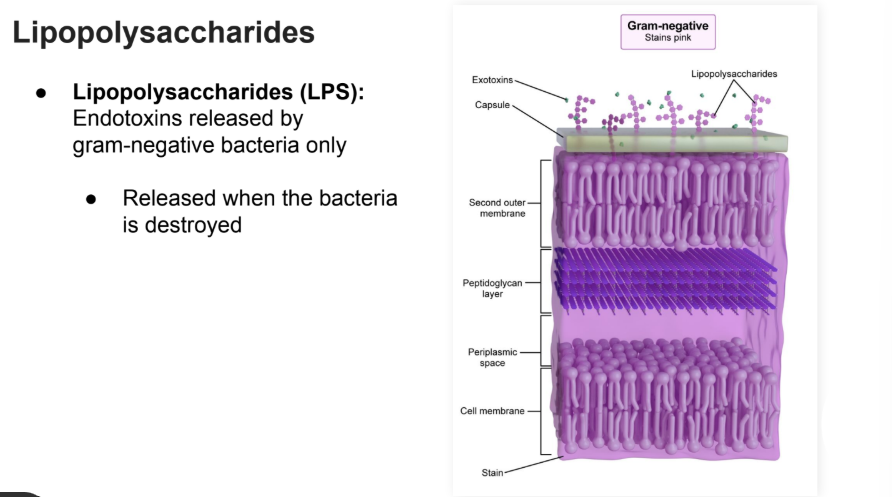
LPS:
Endotoxins released by gram-negative bacteria only
Released when the bacteria is destroyed
Gram Negative Bacteria
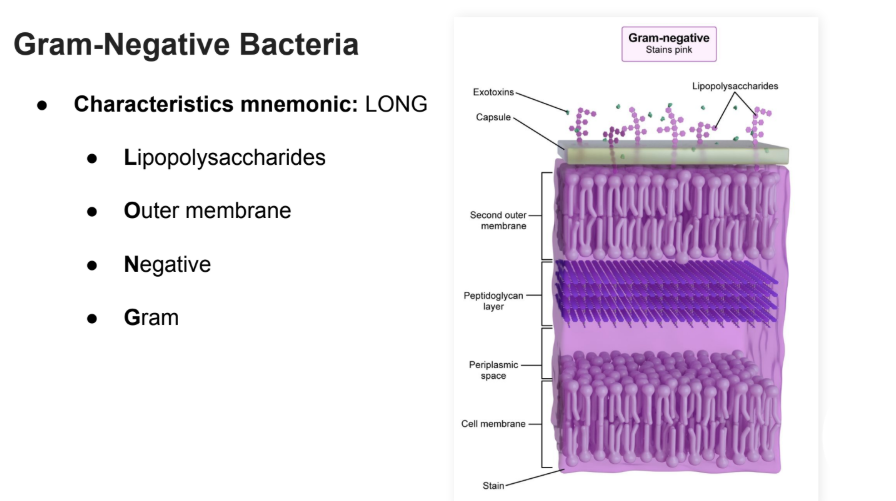
Characteristics mnemonic: LONG
Lipopolysaccharides
Outer membrane
Negative
Gram
Prokaryotes vs Eukaryotes
Prokaryotes: Organisms without membrane bound organelles
Eukaryotes: Organisms with membrane bound organelles.
Prokaryote vs Eukaryote
Cell diameter
Cell Wall
Steroids in membrane
Chromosome location
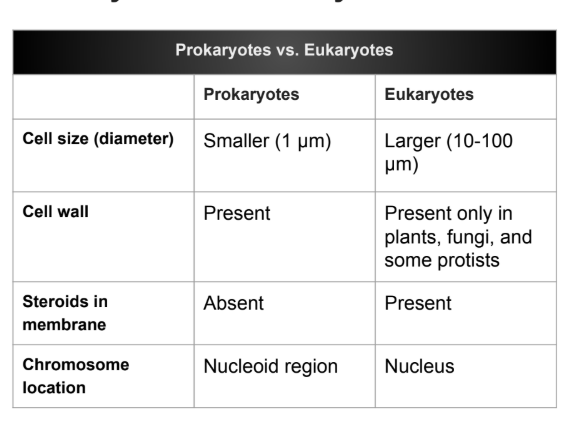
Prokaryote vs Eukaryote
Introns and histones
Plasmids
Origin of replication
(plasmid is round DNA)
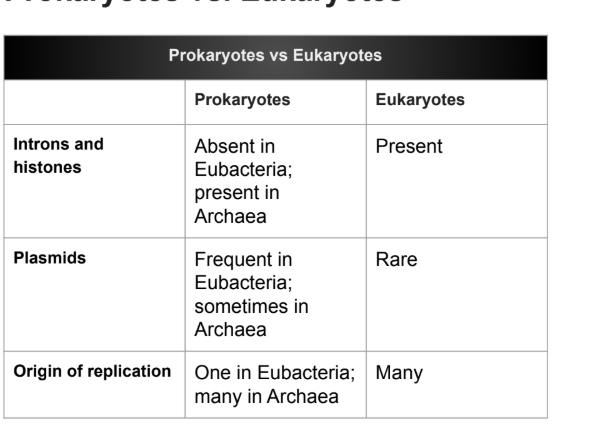
Prokaryote vs Eukaryote
Replication Speed
Ribosome
Transcription and Translation
Post-transcriptional modification to RNA
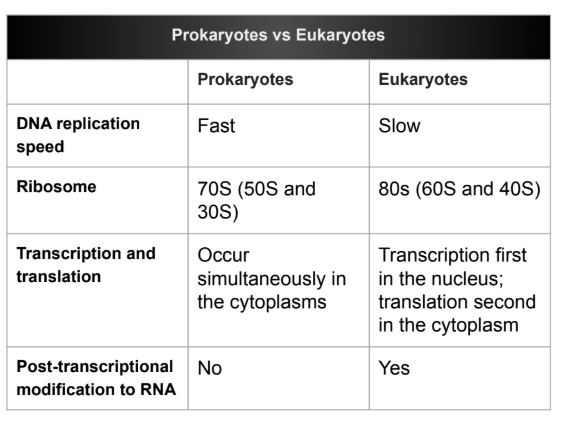
Prokaryotes vs Eukaryotes
Cell cycle length
Cilia
Flagella
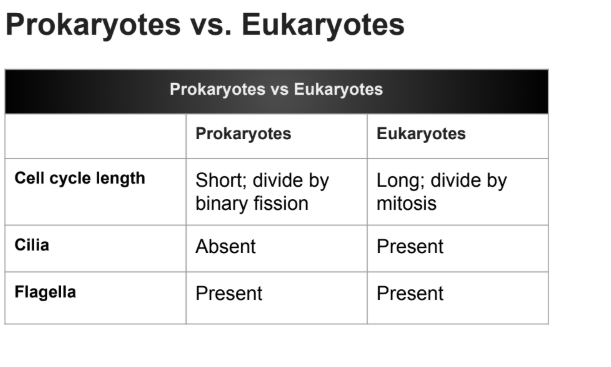
Prokaryotes vs Eukaryotes
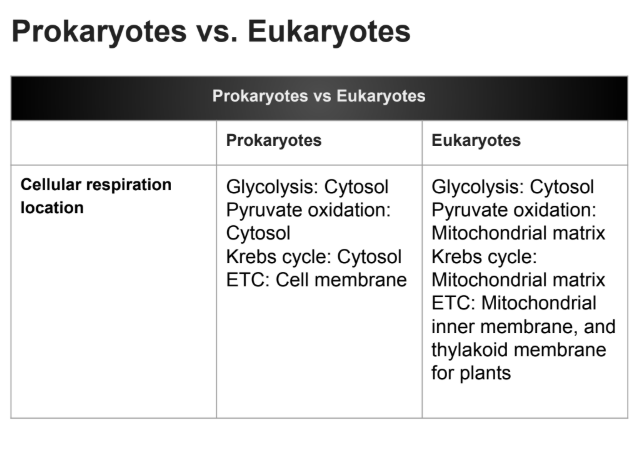
Cellular respiration Location
Protista
Def
Three kinds
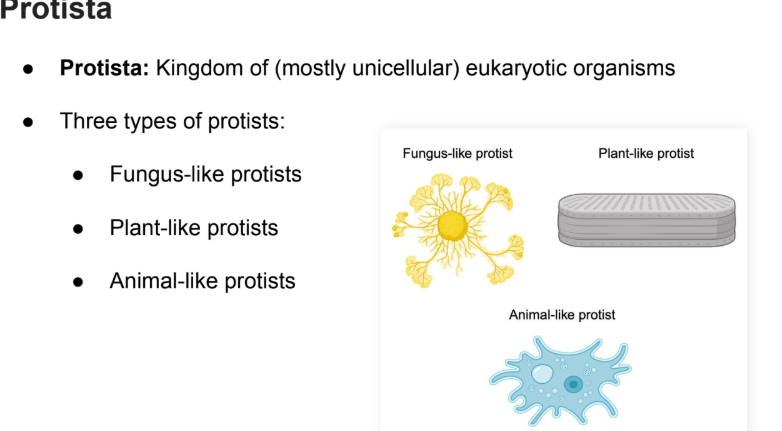
Protista: Kingdom of (mostly unicellular) eukaryotic organisms
Three types of protists:
Fungus-like protists
Plant-like protists
Animal-like protists
Fungus - Like Protists
Cell wall
How do they move
How do they feed?
How do they reproduce?
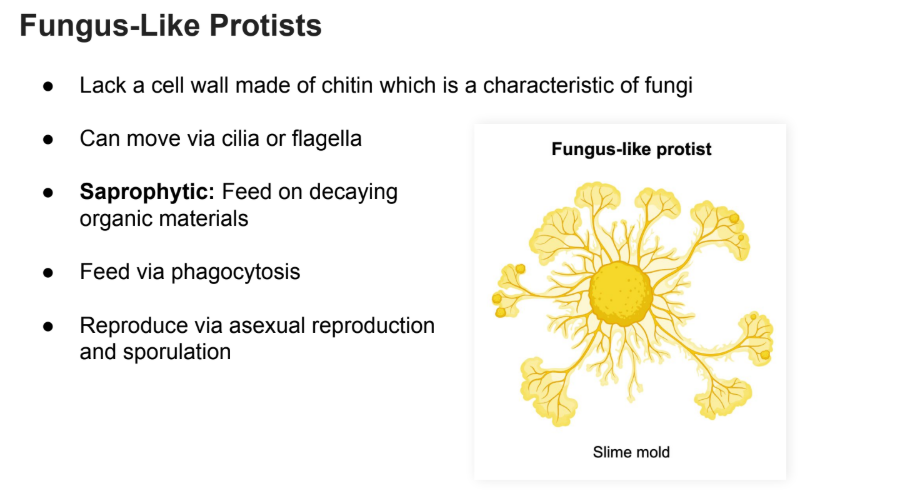
Lack a cell wall made of chitin which is a characteristic of fungi
Can move via cilia or flagella
Saprophytic: Feed on decaying organic materials
Feed via phagocytosis
Reproduce via asexual reproduction and sporulation
Saprophytic
Something that feeds on decaying organic material
Plant like protists
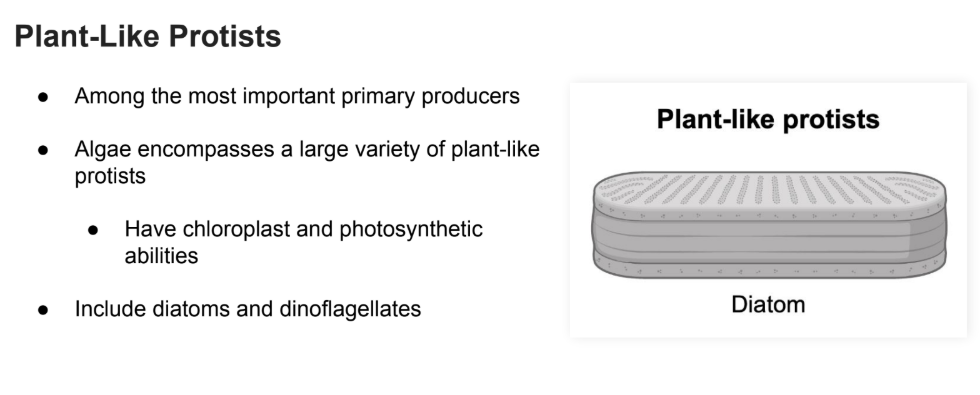
Among the most important primary producers
Algae encompasses a large variety of plant-like protists
Have chloroplast and photosynthetic abilities
Include diatoms and dinoflagellates
Animal Like Protists
Other name for them
How do they store food
common examples
How do they gain eneregy
How do they move
Often parasitic pathogens.
Known as protozoa
Have food vacuoles
Include amoeba and paramecium
they are heterotrophic (gain energy from food)
Move via flagella and cilia
Fungi
What kind of organism are they (Domains)?
Common examples
How do they gain energy
Genetically what are they in most of their life cycle
What are cell walls made of?
Eukaryotic
Mushrooms, molds, yeasts
Heterotrophic
Saprophytic
Life cycle is spent mainly in haploid
Cell walls are made of chitin.
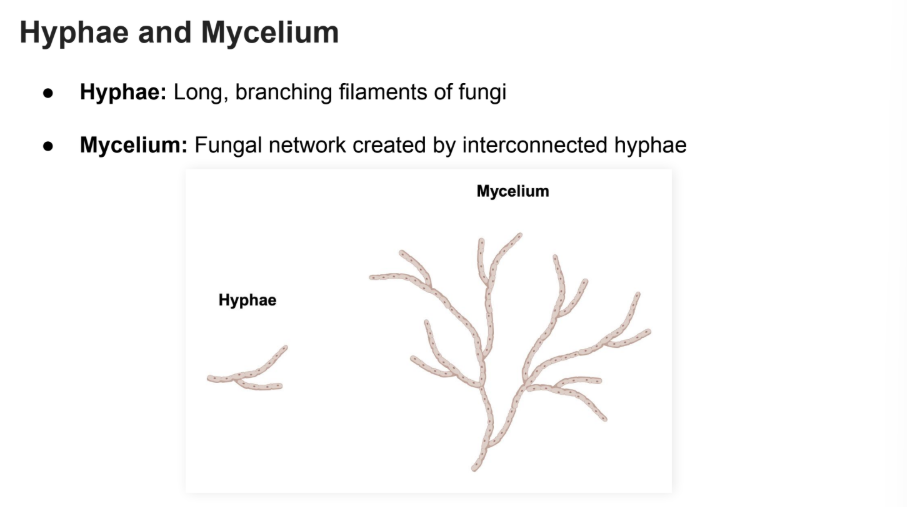
What are Hyphae
Long branching filaments of fungi
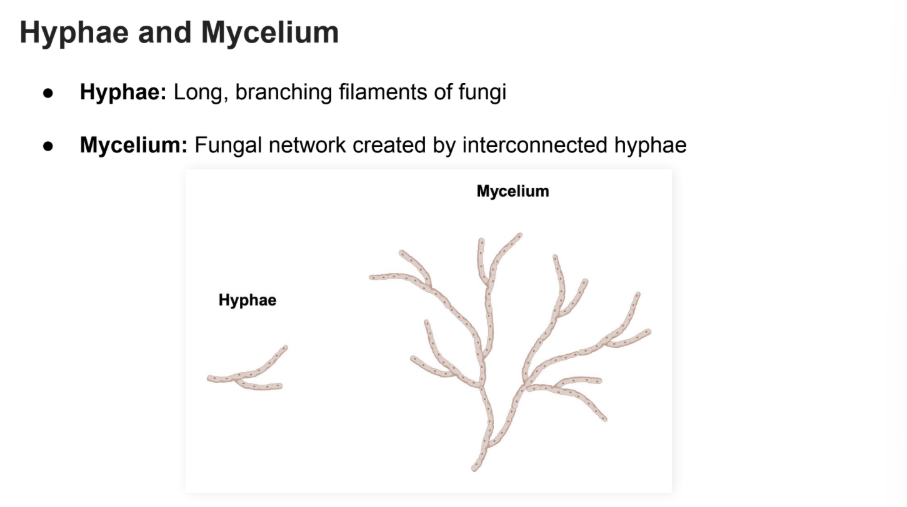
What are Mycelium
Fungal network interconnected by hyphae
Reproduction of Fungi
Can be sexual or asexual.
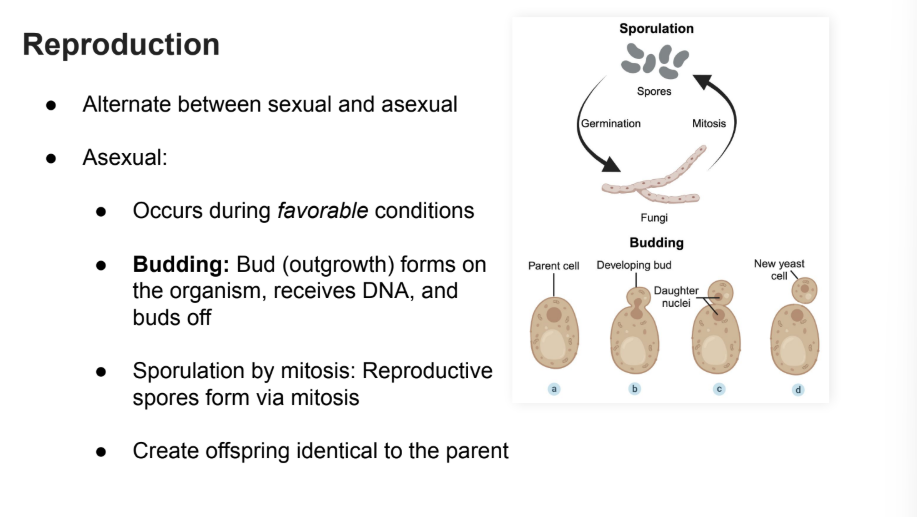
Asexual Reproduction of fungi
Occurs during favorable conditions
Budding: bud outgrowth forms on the organism, receives DNA, and then subsequently buds off.
Sporulation by mitosis: Reproductive spores form via mitosis
Create offspring identical to the parent.
Reproduction of fungi: Sexual
Fungi alternate between diploid and haploid
Occurs during unfavorable conditions
Produce genetically diverse daughter cells to increase liklehood of survival.
Lichens
Fungi
Symbiotic Autotrophs where a fungus is paired with either allgae or a cyanobacteria.
Fungus Role:
Protects the algae/cyanobacteria and provides it with water and nutrients
Algae/Cyanobacteria:
Photosynthesize to provide the fungi with food.
Animalia Characteristics
Domain
Genetic Cell state most of life
How many cells?
How do they get energy?
Aerobic or Anaerobic?
Eukaryotic
Diploid
Multicellular
Heterotrophic
Aerobic
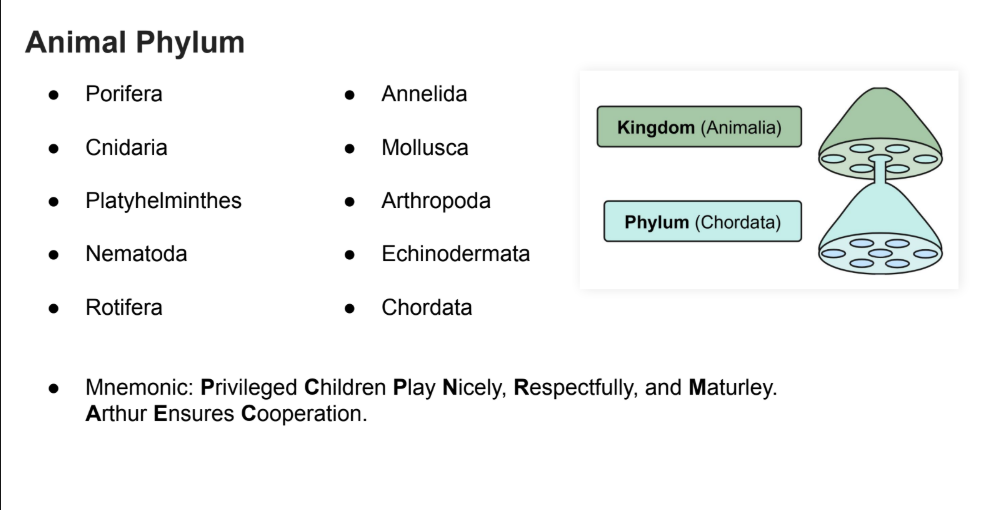
PHYLUMS OF THE ANIMALIA (THIS IS A LOT)
Poriferia
Cnidaria
Platyhelminthes
Nematoda
Rotifera
Annelida
Mollusca
Arthropoda
Echinodermata
Chordata
Mneumonic
Privelleged Children Play Nicely, Respectfully, and Maturley. Arthur Ensures Cooperation.
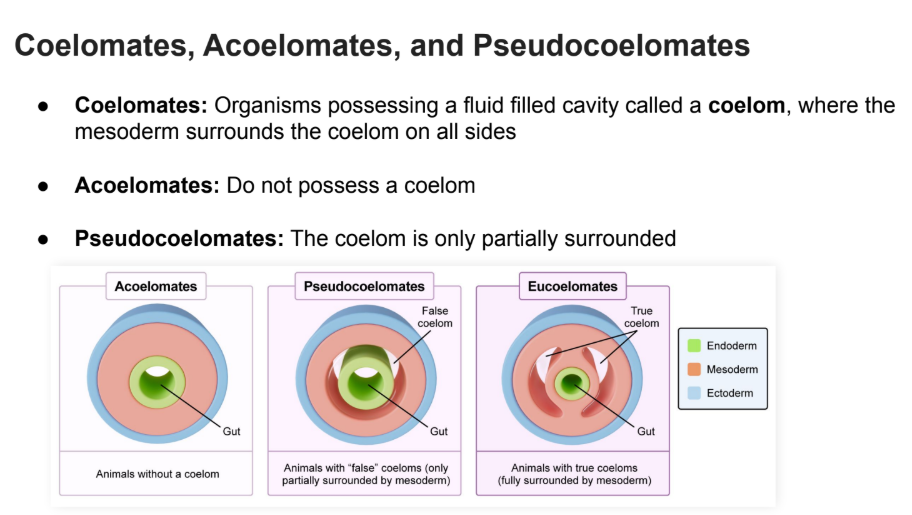
Coelomates
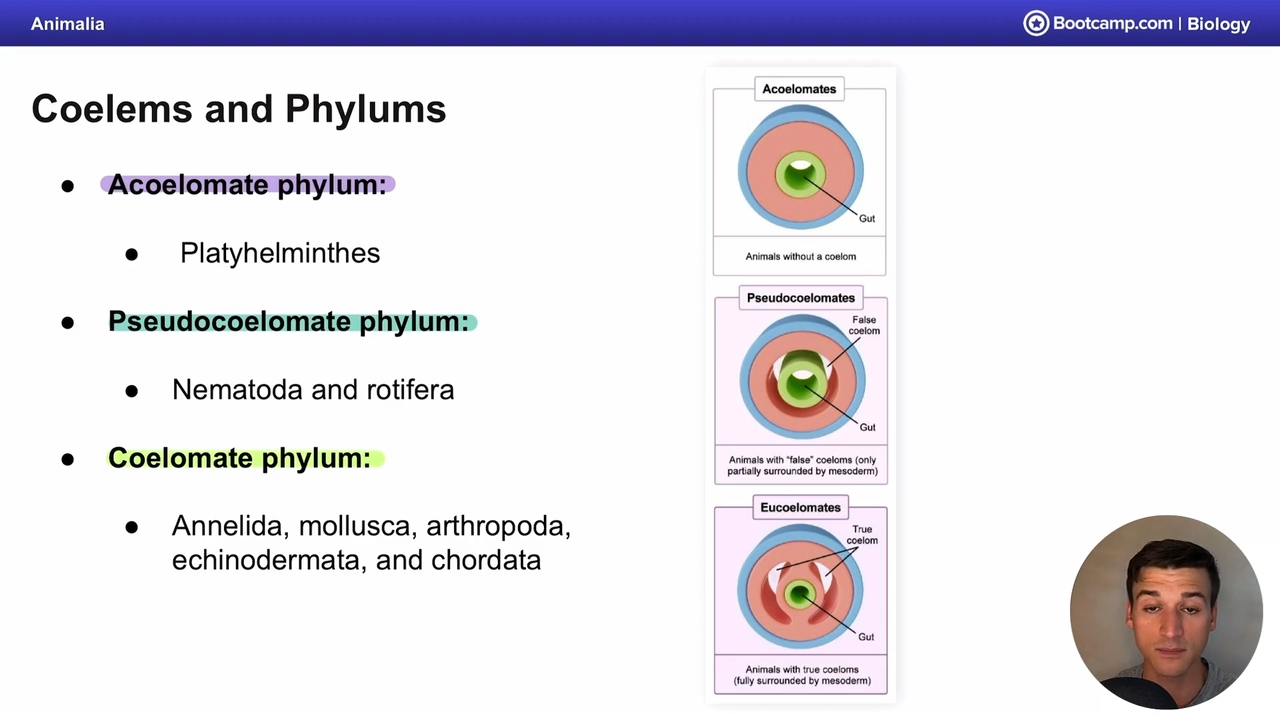
Organisms possessing a fluid filled cavity called a coelom, where the mesoderm surrounds the coelom on all sides
Eucoelomates
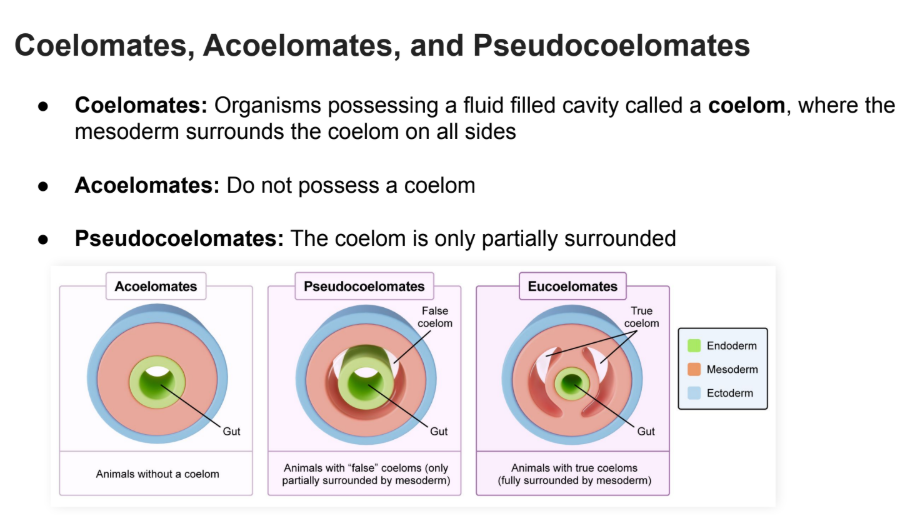
Acocoelomates
Do not possess a coelom
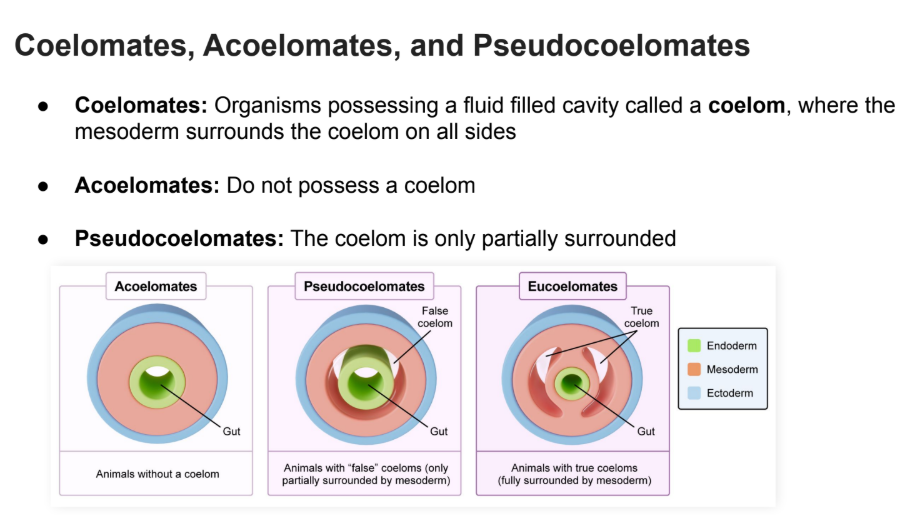
Pseudocoelomates
The coelom is only partially surrounded
Acoelomate Phylum
No Coelum
Platyhelminthes
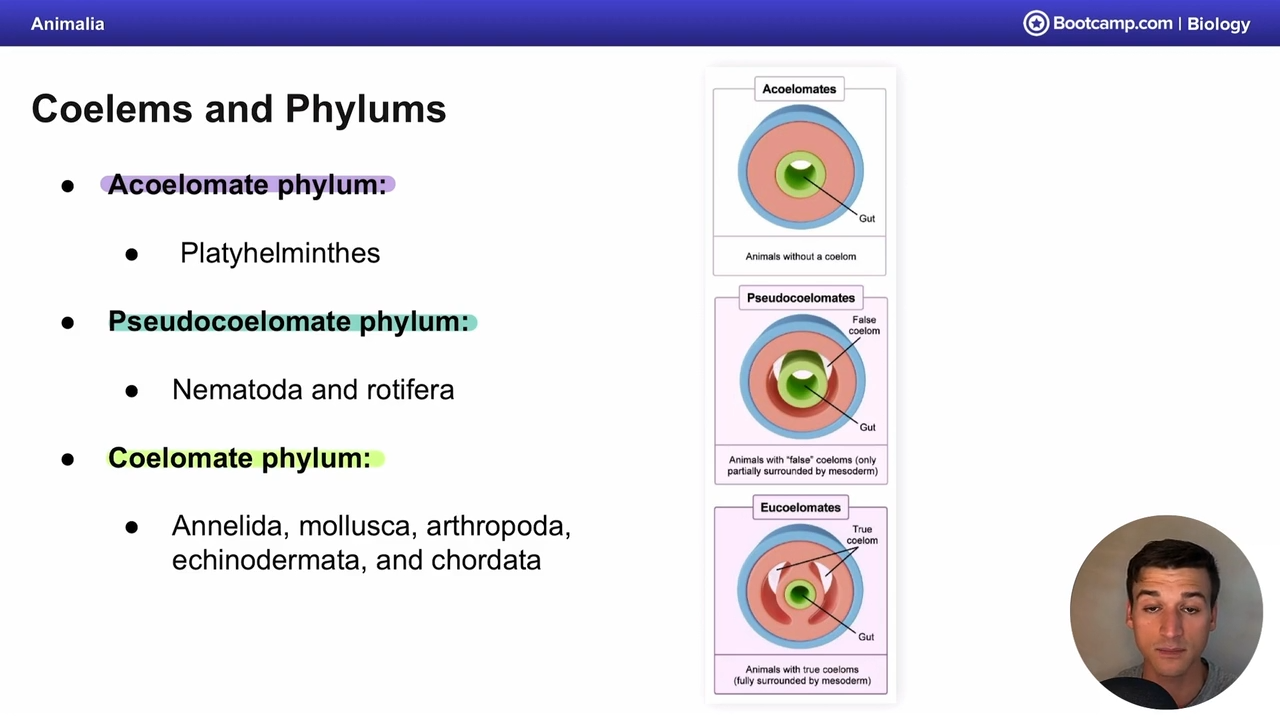
Pseudocoelomate Phylum
Nematoda and Rotifera
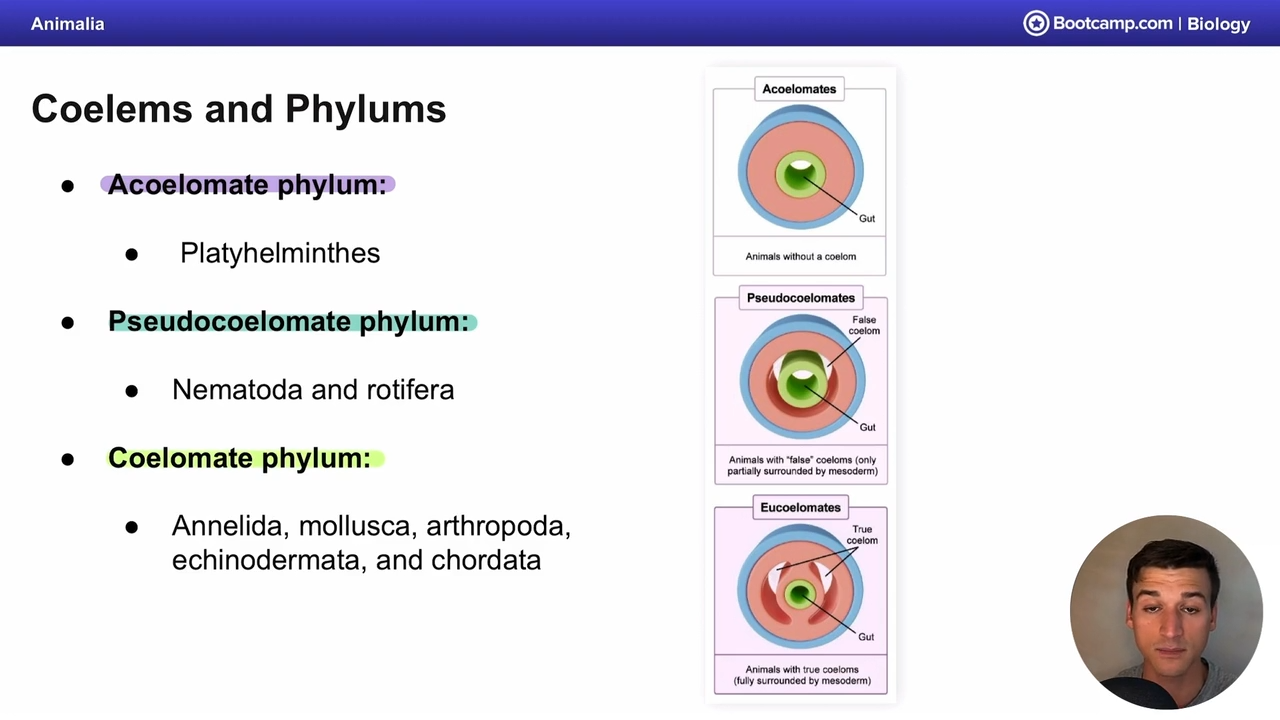
Coelomate Phylum
Annelida, mollusca, arthropoda, echinodermata, and chordata
(everything else)
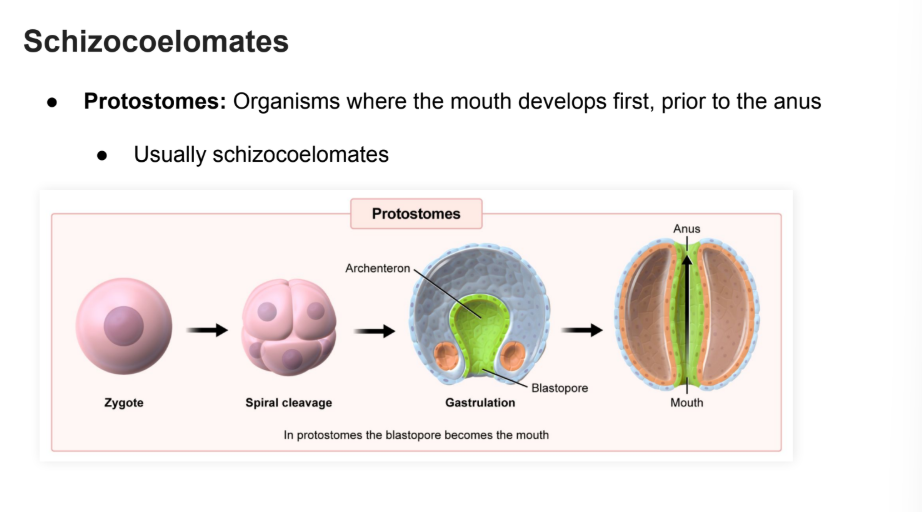
Schizocoelomates
Coelom begins and splits within the mesoderm.
Holoblastic Cleavage
Cleavage throughout the entire embryo, evenly dividing it..
Occurs in animals with little yolk.
Schizocoelomates
Cleavage type
Determinate or indeterminate
Does the anus or mouth develop first
Spiral Cleavage
Determinate
Protostomes: Mouth first, then anus
Spiral Cleavage
Spiral Cleavage: Misaligned cells deviate from their axes, taking on a final spinal orientation
Determinate Cleavage
Blastomeres have a decided fate.
Protostomes
Organism where the mouth develops before the anus.
Usually Schizocoelmates. (coelem begins and splits within the mesoderm)
Enterocoelomates
Cleavage type
Where does the coelom originate
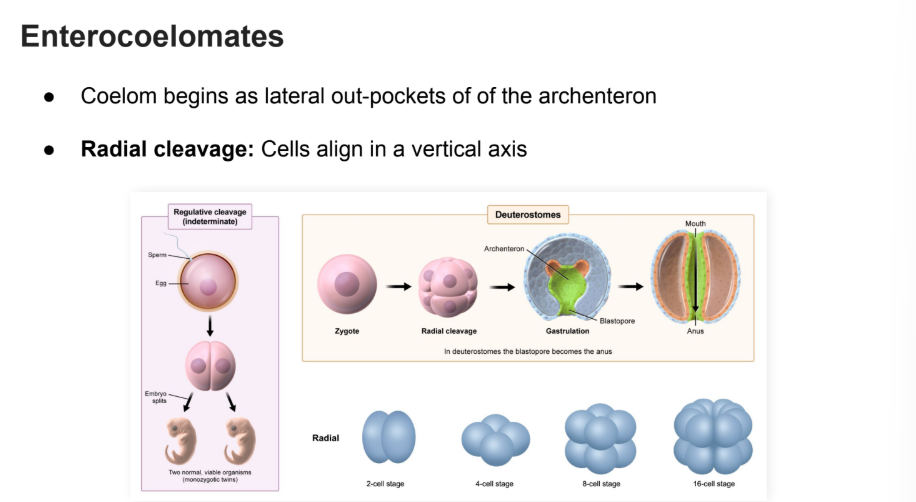
Coelom begins as lateral out pockets of the archenteron
Radial Cleavage: Cells align in a vertical axis.
Enterocoelomates
How does the coelum begin
What kind of cleavage does it have?
Is it determinate or Indeterminate
Does the anus or mouth develop first?
Coelom begins as lateral out-pockets of the archenteron
Radial Cleavage
Deutrosome
Indeterminant Cleavage
Deutrosome
Organisms where teh anus develops first, prior to the mouth
Indeterminate Cleavage
Blastomeres do not have a pre-set fate; resulting in cells that are totipotent.
Porifera
Example animals
Simple, multicellular, porous sponges.
The earliest animals
Neither protosomes nor deutrosomes
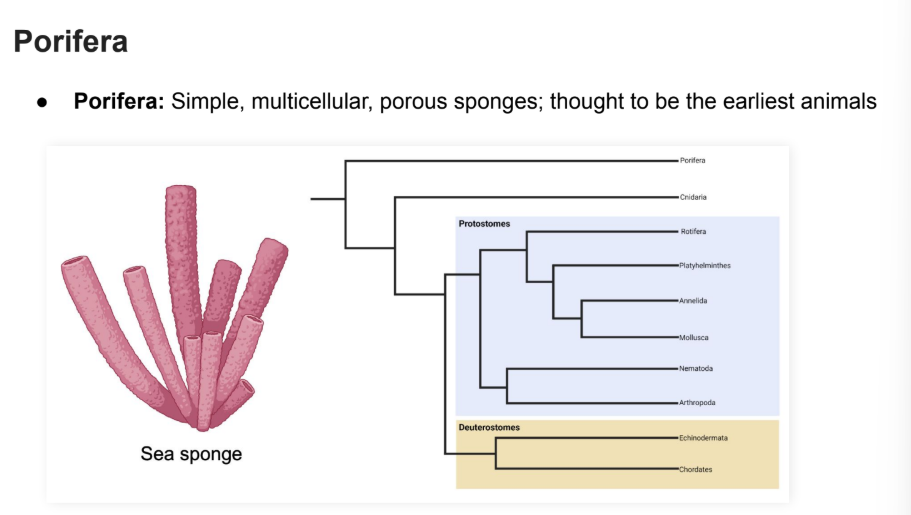
Poriferia Characteristics:
Symmetry
Tissue Organization
Mobility
Habitat
Assymetric: no line of symmetry can be derived.
Parazoan: No true tissue organization
Cannot be classified by coelom type
Sessile: a non-motile organism
Aquatic habitat
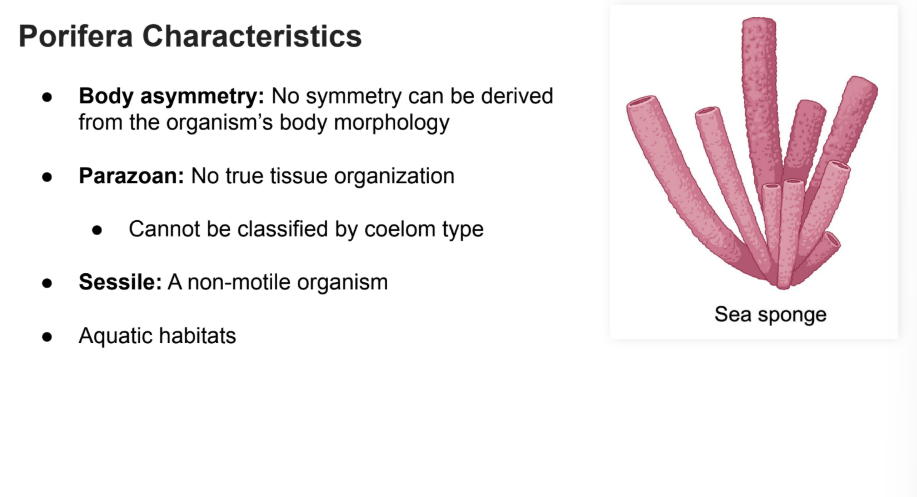
Parazoan
No true tissue organization, these species cannot be classified by COELOM
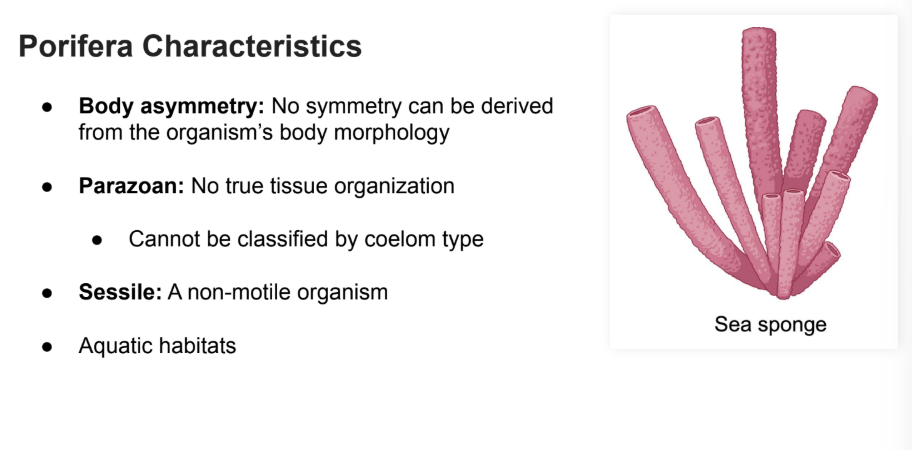
Sessile
Non- Motile organism
Unable to move
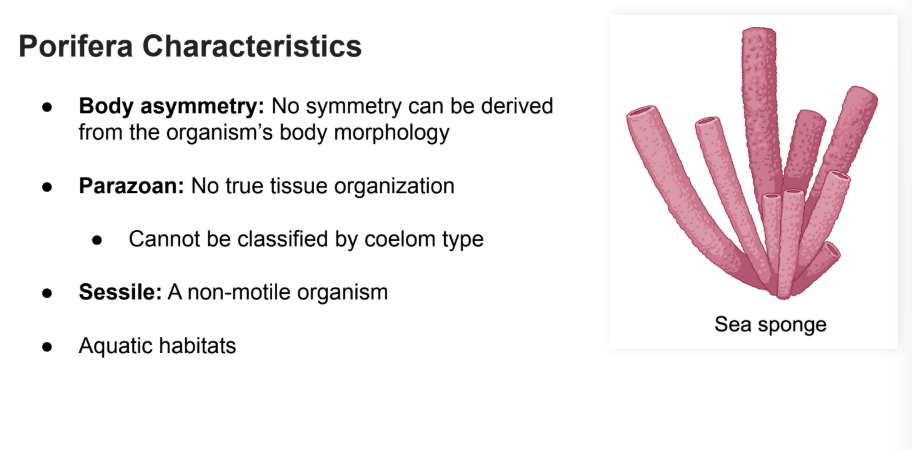
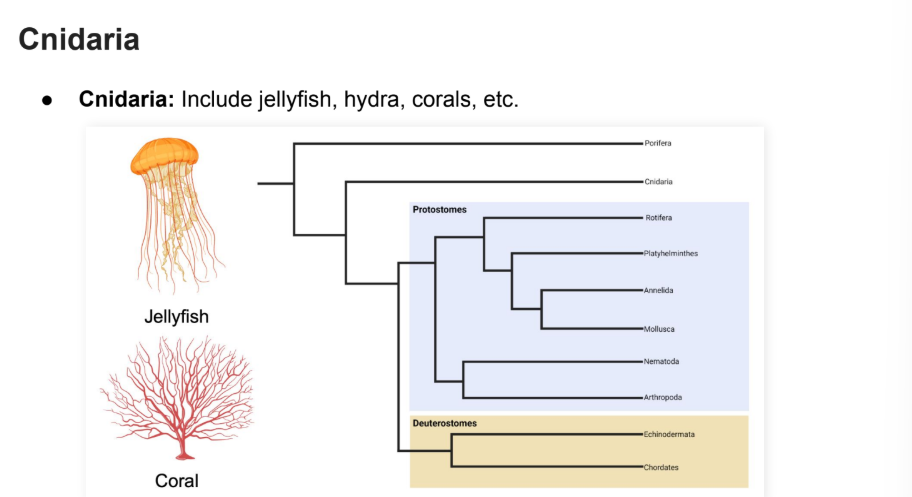
Cnidaria
Example animals
Hydra, Jelllyfish, COrals
Cnidaria Characteristics
Symmetry?
Habitat
Developmental Specialties?
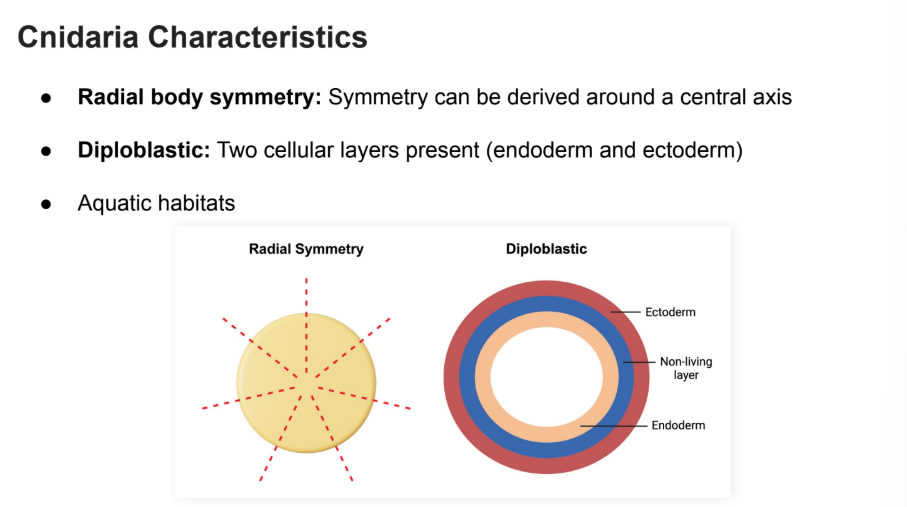
Radial Body Symmetry: Symmetry around a central axis
Diploblastic: Two cellular layers present (Endoderm and Ectoderm)
Aquatic Habitats
Nether Protostomes or Deuterostomes
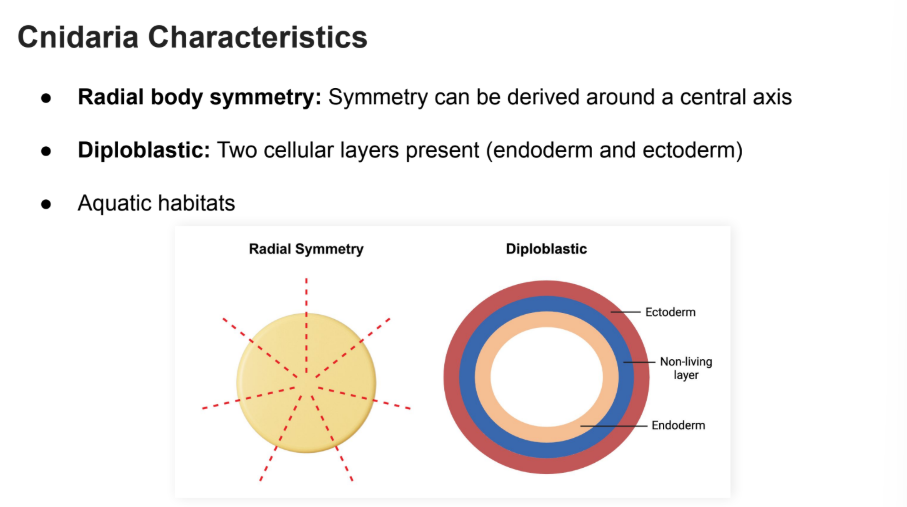
Diploblastic
Only two cellular layers present (endoderm and ectoderm)
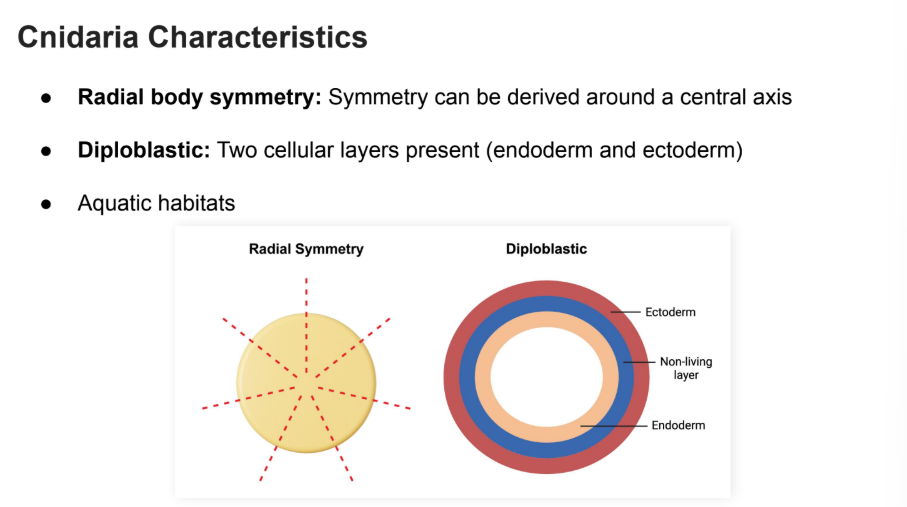
Radial Body Symmetry
Symmetry around a central axis.
Platyhelminthes
Animal Examples
Tapeworms
Flatworms
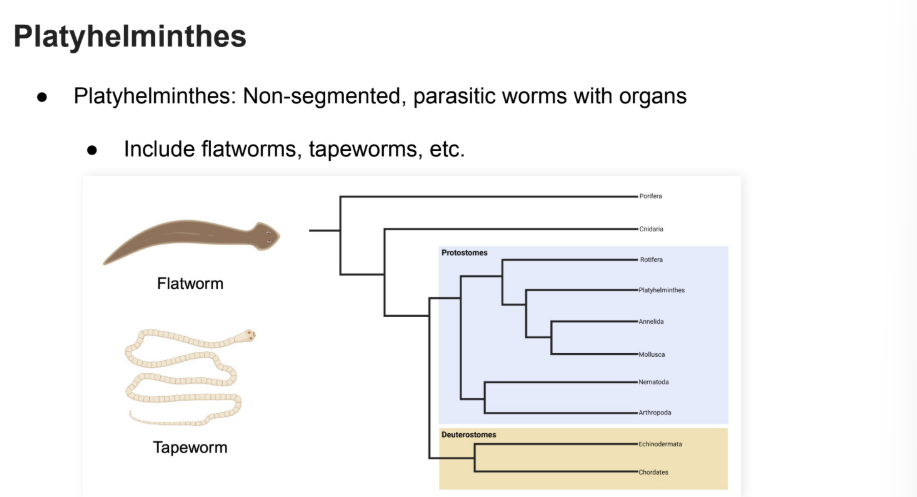
Platyhelminthes Characteristics
Symmetry?
Special organizational Characteristics?
Developmental Specialties?
Coelum?
Protostome or Deutrostome?
Bilateral Body Symmetry (two symettrical halves)
Cephalization: Concentration of nervous and sensory organs in the head
Associated with bilateral symmetry
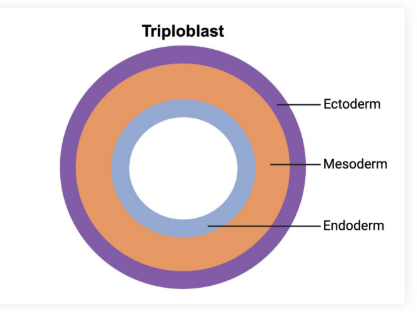
Tripoblastic: (ectoderm, mesoderm, and endoderm)
Most primitive triploblast
Aceolomate
an organism without a coelom
Protostome
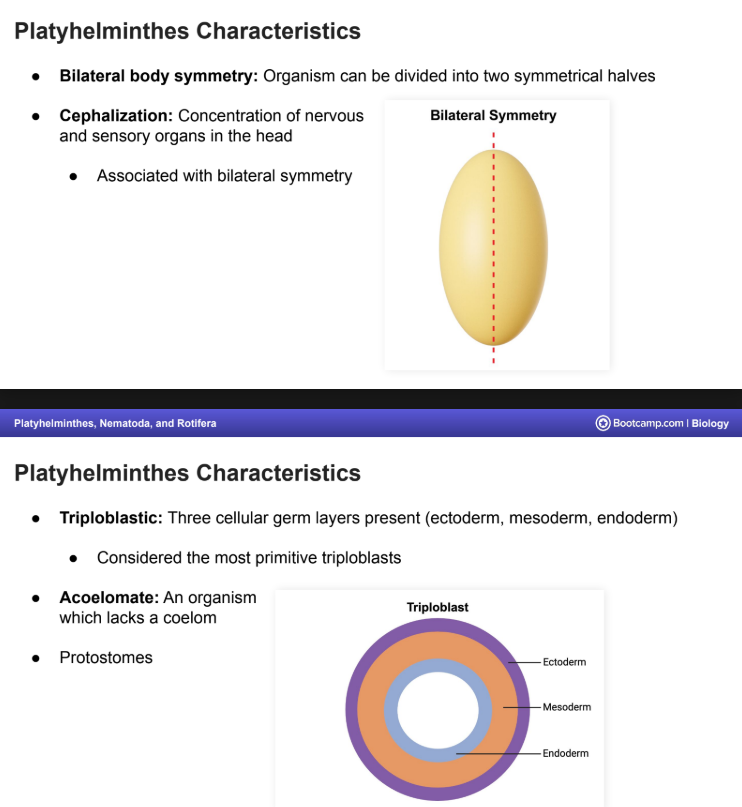
Cephalization
Concentration of nervous and sensory organs in the head
Associated with bilateral symmetry
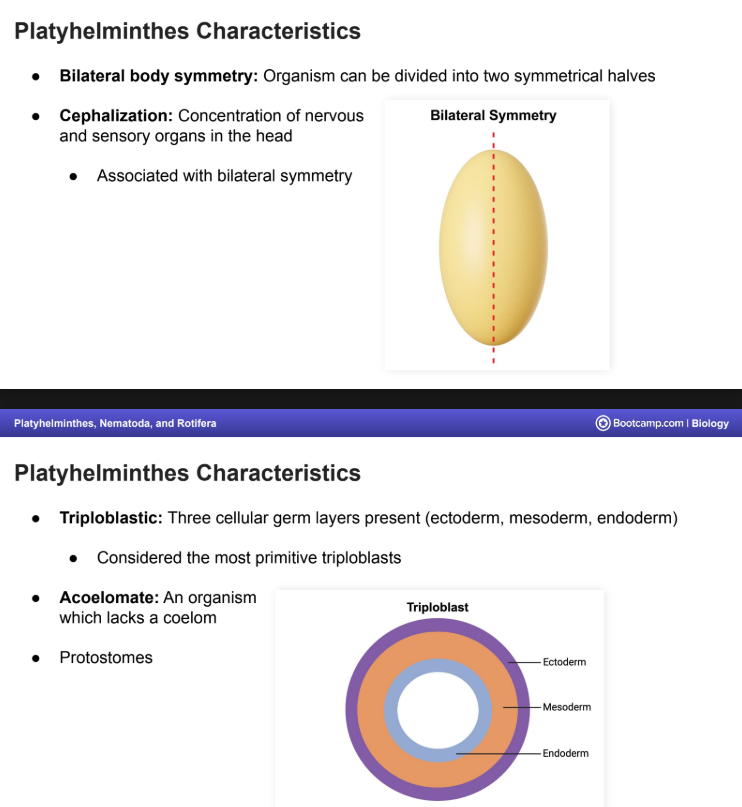
Triploblastic
Triploblastic: (ectoderm, mesoderm, and endoderm)
Nematoda
Animal Examples
Roundworms
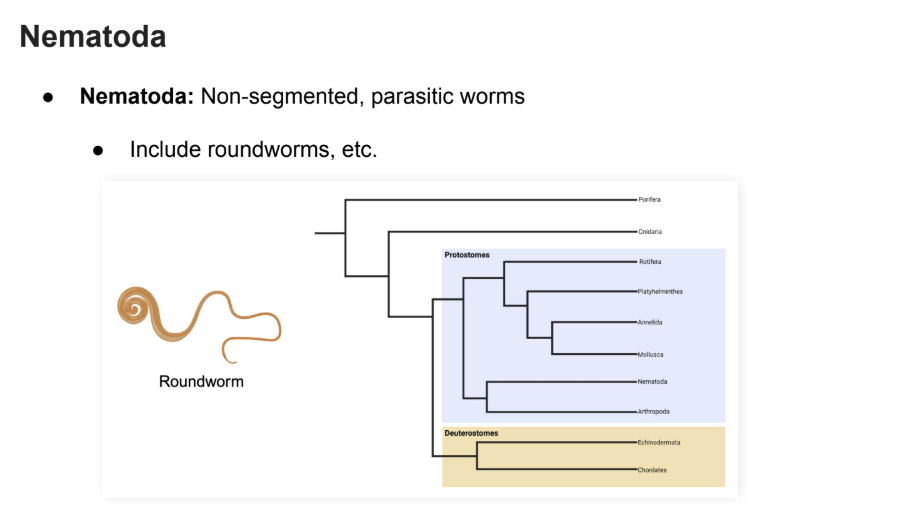
Nematoda Characteristics
Symmetry?
Components of the developing embryo?
Coelum?
Protostome or Deutrosome?
Bilateral
Triploblastic
Pseudocoelomates
Protstomes
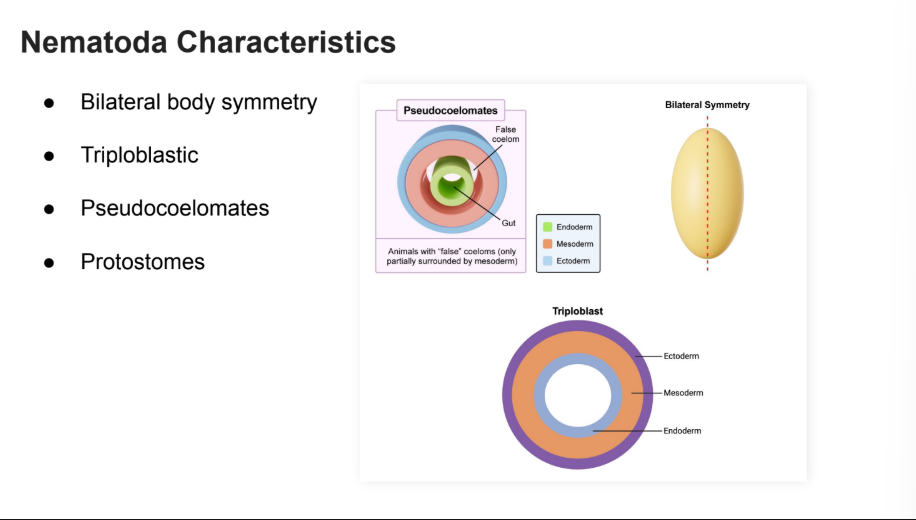
Rotifera
Animal eaxmples
Non-segmented aquatic zooplankton
Rotifers
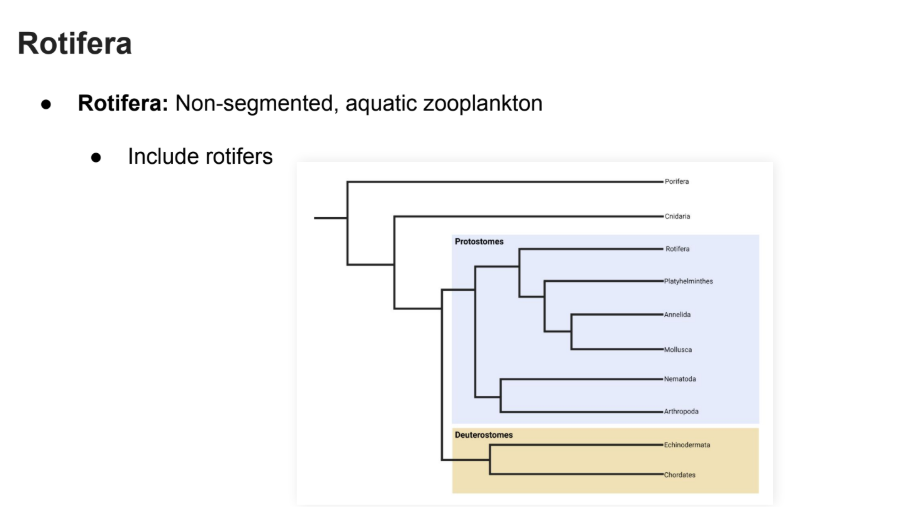
Rotifera Characteristics
Symmetry?
Components of the developing embryo?
Coelum?
Protostome or Deutrosome?
Bilateral body symmetry
Triploblastic
Pseudocoelomates
Protostomes
Annelida
Animal Examples
Segmented Worms
Earthworms and leeches
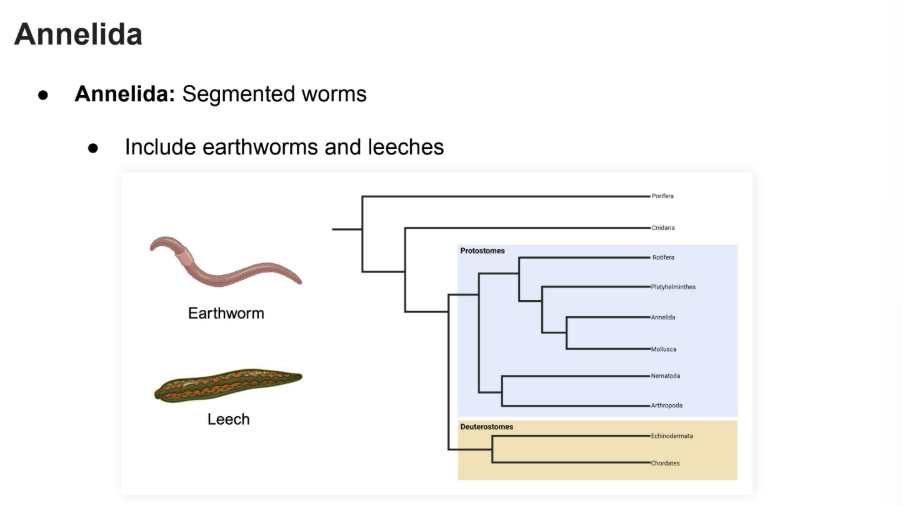
Annelida Characteristics:
Symmetry?
Components of the developing embryo?
Coelum?
Protostome or Deutrosome?
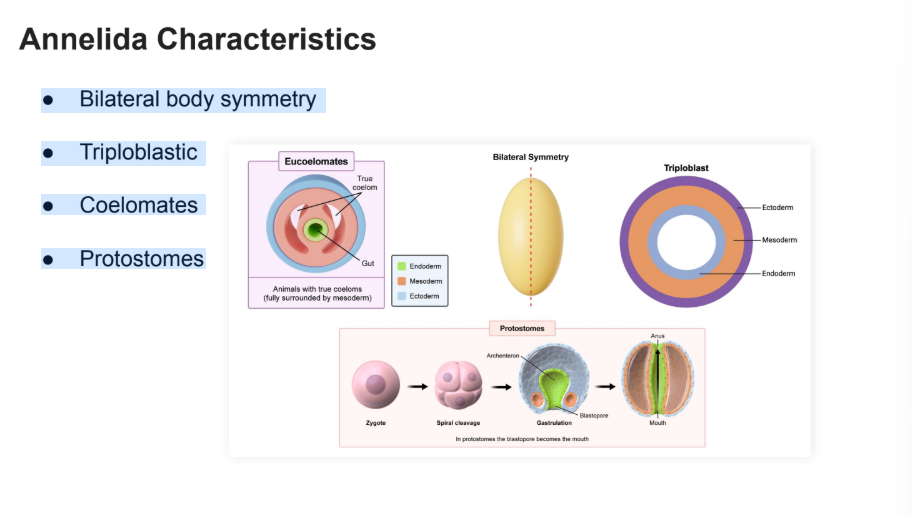
● Bilateral body symmetry
● Triploblastic
● Coelomates
● Protostomes
What phylum first developed body segmentation
Annelida
Annelida: How do they move blood in their body?
Closed Circulatory System:
Blood pumps through vessels via pressure from the heart
Annelida system has multiple aortic arches as well as distinct arteries and veins
Mollusca
Def
Animal Examples
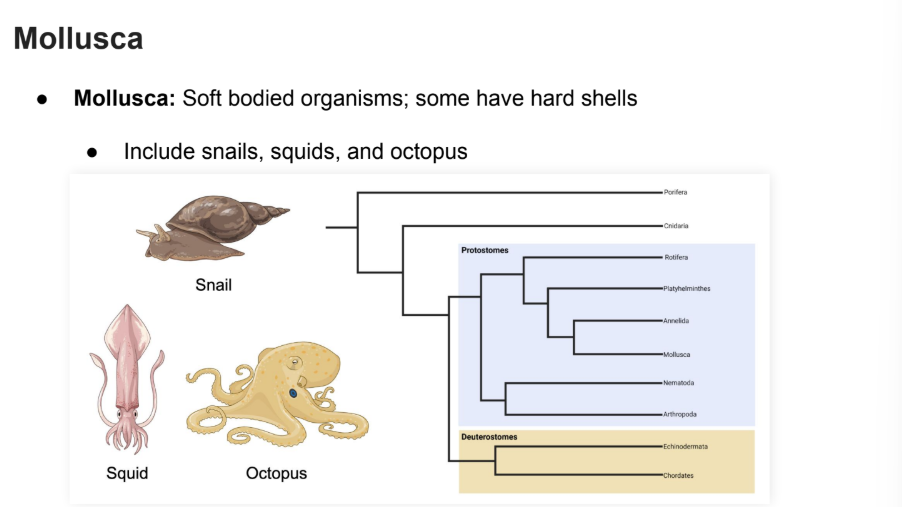
Soft Bodied organisms; some have hard shells
Snails, Squids, and Octopus
Mollusca Characteristics
Symmetry?
Components of the developing embryo?
Coelum?
Protostome or Deutrosome?
Habitat?
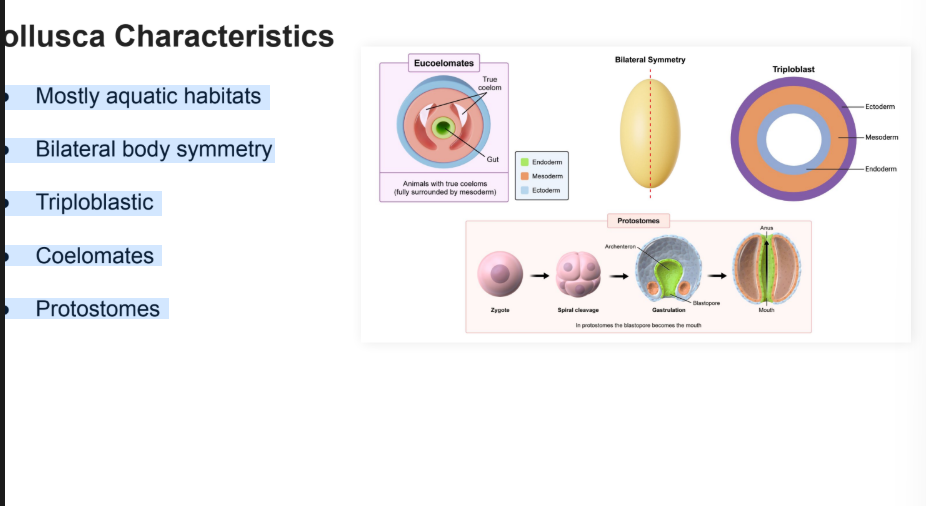
● Mostly aquatic habitats
● Bilateral body symmetry
● Triploblastic
● Coelomates
● Protostomes
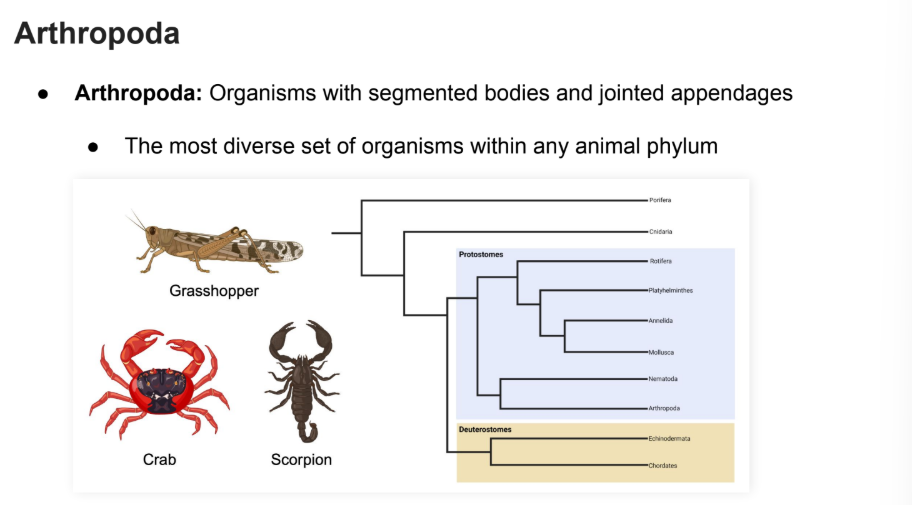
Arhropoda
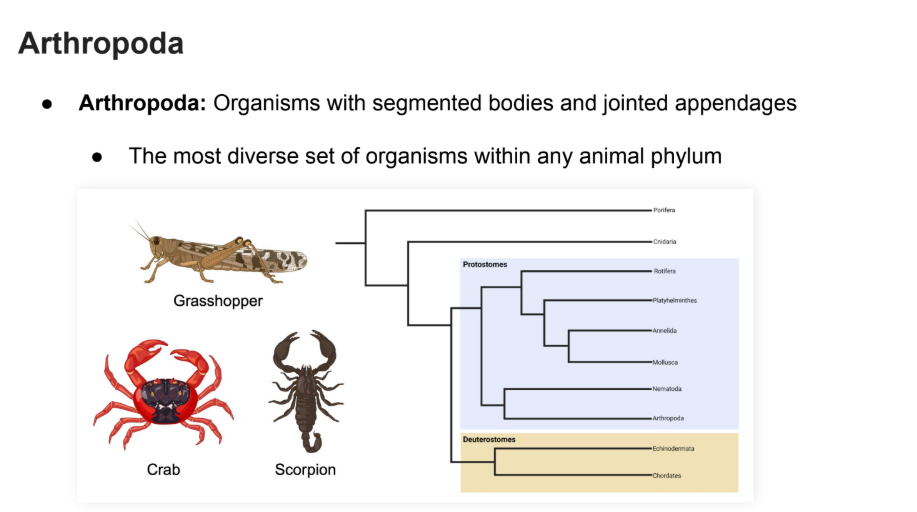
Organisms with segmented bodies and jointed appendages
The most diverse set of organisms within any animal phylum
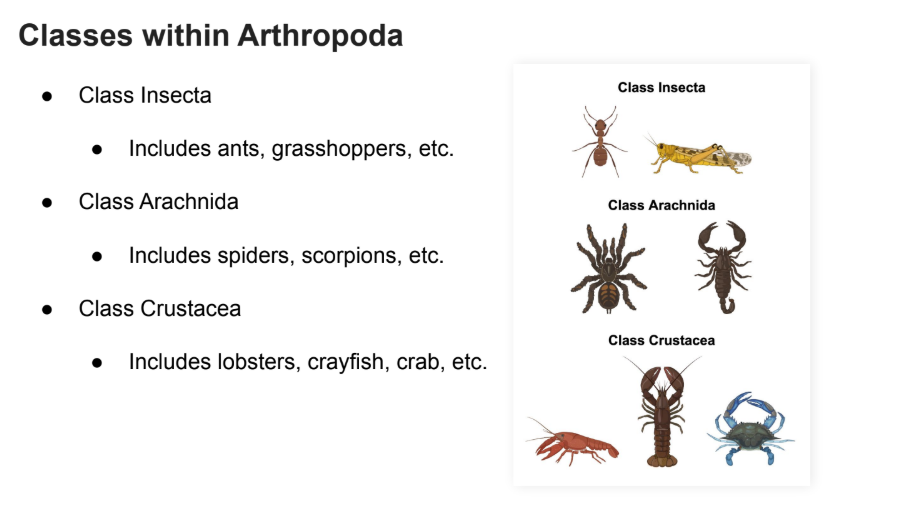
Classes with Arthropoda
3 main ones
Crustacea
Aracchnida
Insecta
Class Crustacea
Lobsters, crayfish, crab, etc.
(part of arthropoda)
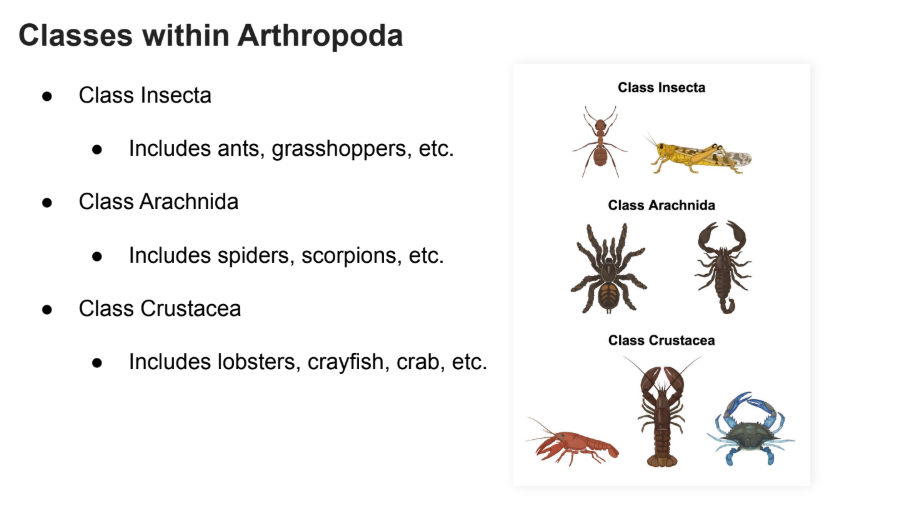
Class Arachnida
Spiders, scorpion, etc.
(part of arthropoda)
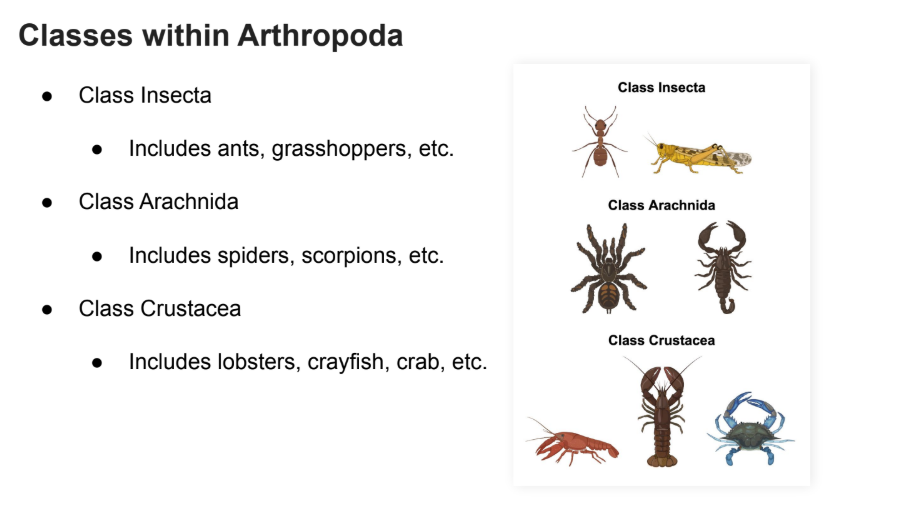
Class insecta
includes ants, grasshopers, etc.
Arhropoda Characteristics
Symmetry?
Components of the developing embryo?
Coelum?
Protostome or Deutrosome?
Exoskeleton or Endo (and what is it made of)
Does it have body segmentation?
Does it have appendages?
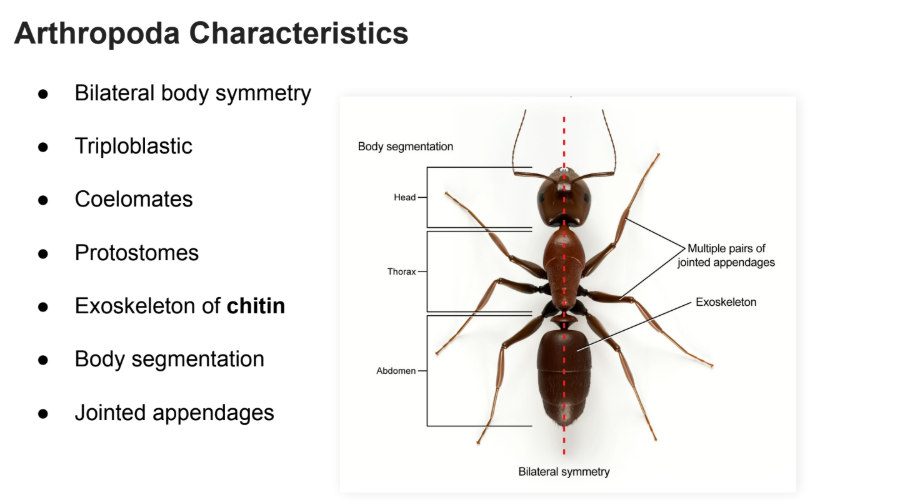
● Bilateral body symmetry
● Triploblastic
● Coelomates
● Protostomes
● Exoskeleton of chitin
● Body segmentation
● Jointed appendages
Open Circulatory System
What has it?
How does it work?
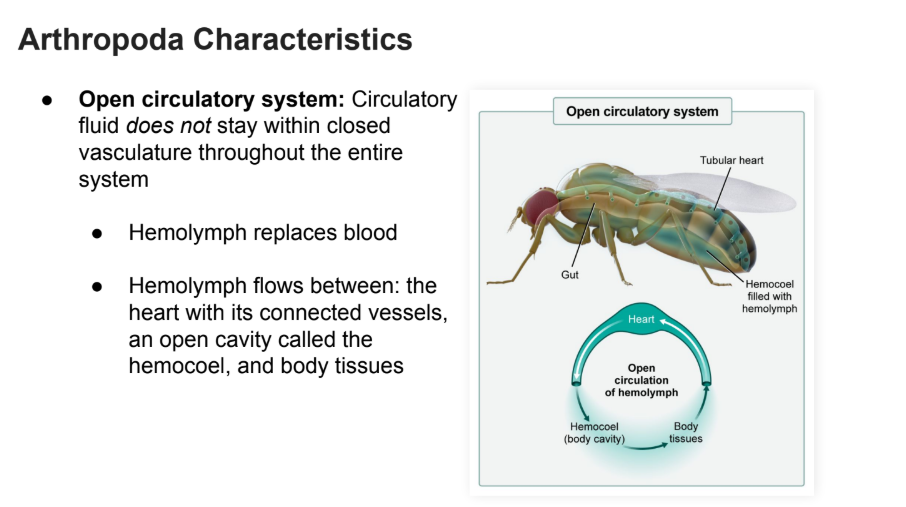
Circulatory fluid does not stay within closed vasculature throughout the entire system
Hemolymph replaces blood
Hemolymph flows between: the heart with its connected vessels, an open cavity called the hemocoel, and body tissues
Echinodermata
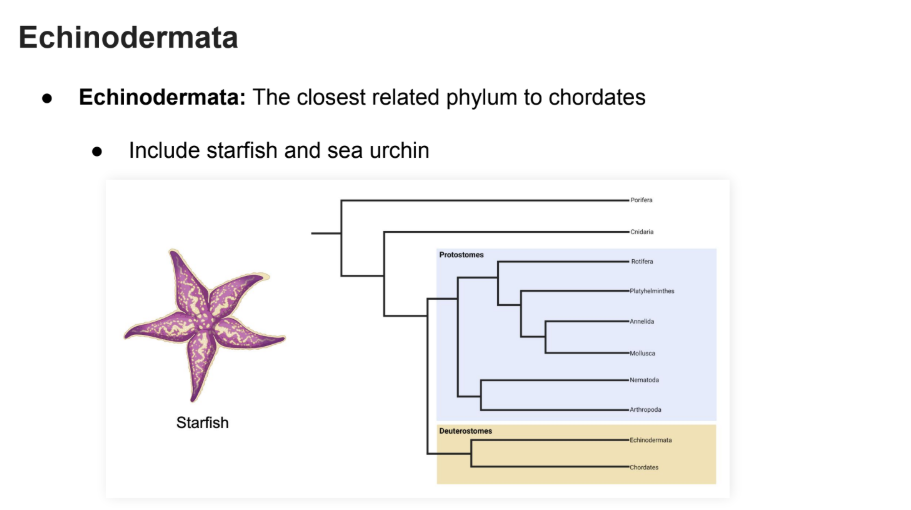
The closest related phylum to chordates
Include starfish and sea urchin
Symmetry?
Components of the developing embryo?
Coelum?
Protostome or Deutrosome?
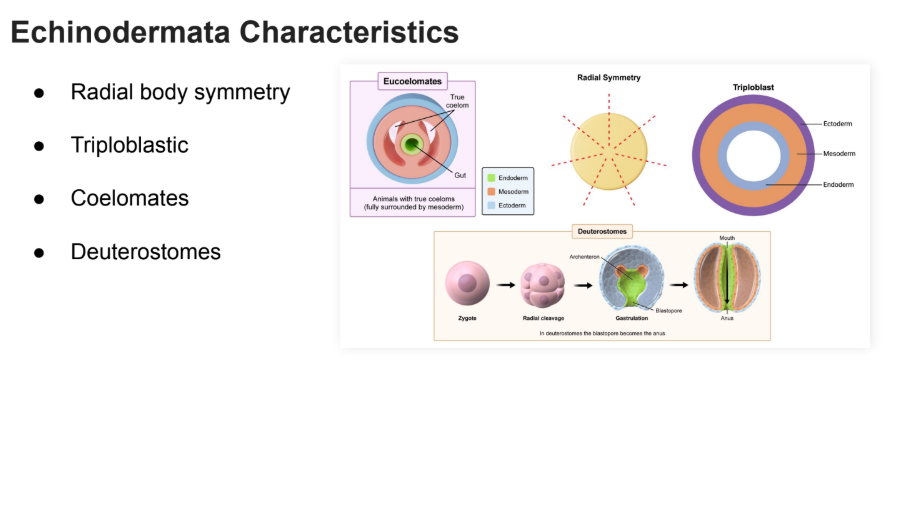
● Radial body symmetry
● Triploblastic
● Coelomates
● Deuterostomes
Chordata
Chordata: Segmented bodied organisms
● Include vertebrate and invertebrate organisms
Chordata Characteristcs
Symmetry?
Components of the developing embryo?
Coelom?
Protostome or Deuterostome?
● Bilateral body symmetry
● Triploblastic
● Coelomate
● Deuterostome
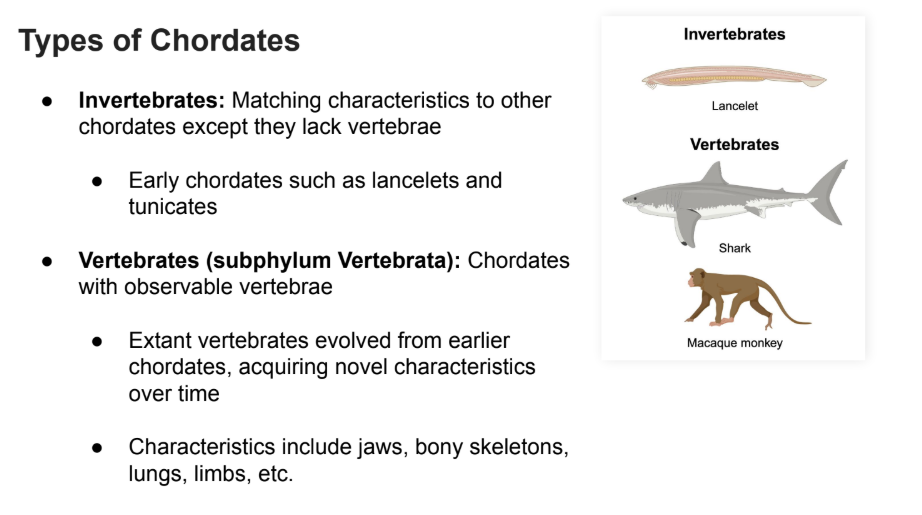
Invertebrates
A type of chordate that has matching characteristics to other chordates except they lack vertebrae
Early chordates such as lancelets and tunicates
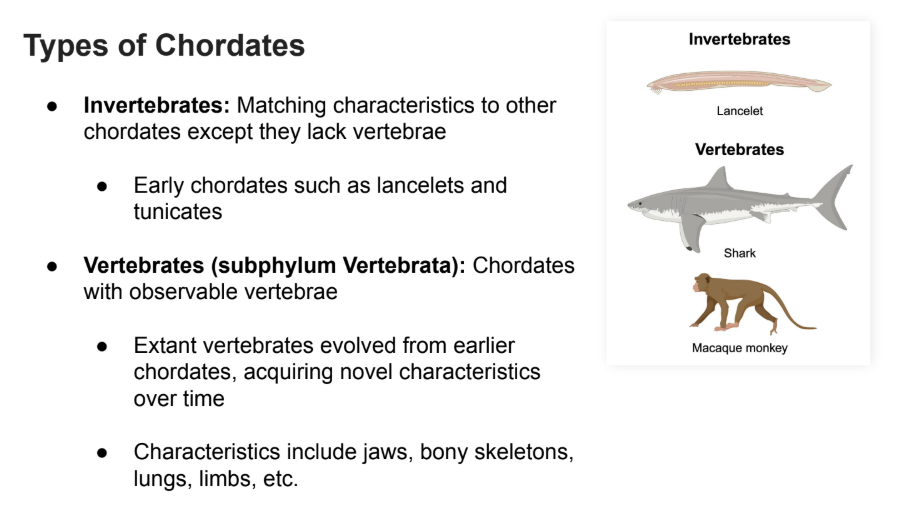
Vertebrates
(subphylum Vertebrata): Chordates with observable vertebrae
Extant vertebrates evolved from earlier chordates, acquiring novel characteristics over time
Characteristics include jaws, bony skeletons, lungs, limbs, etc.
Vertebrate Evolutionary Track
What species went on to form species today
Early jawless fishes
Chondrichthyes: Cartilaginous, jawed fishes (sharks, etc.)
Osteichthyes: bony fishes (catfish)
Lobe-finned fish: bony fish whose fins bore the first resemblance to limbs (like the colecanth)
Amphibians: the first tetrapods to develop proper limbs with digits
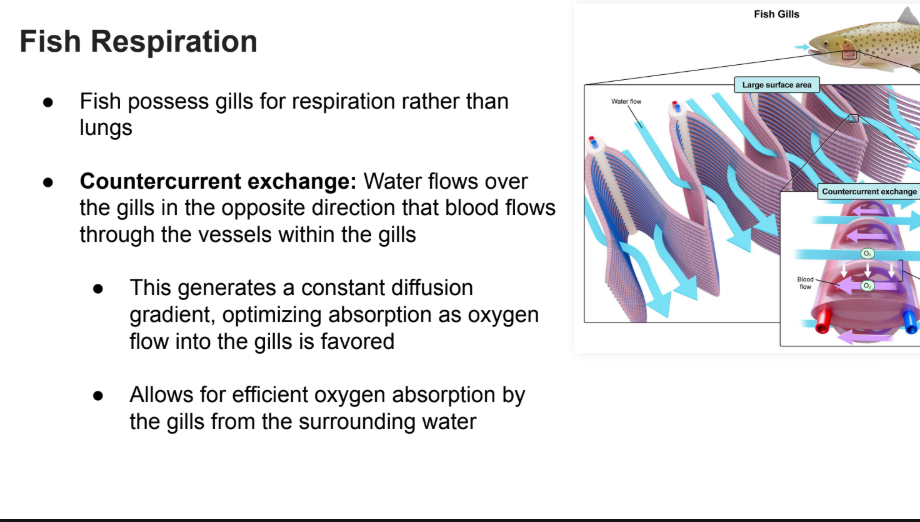
Fish Respiration
Fish possess gills for respiration rather than lungs
Countercurrent exchange: Water flows over the gills in the opposite direction that blood flows through the vessels within the gills
This generates a constant diffusion gradient, optimizing absorption as oxygen flow into the gills is favored
Allows for efficient oxygen absorption by the gills from the surrounding water
Class Mammalia Characteristics
Blood flow
How is blood pumped
How do we respire
What are some unique mammalian characteristics.
● Mammalia: Class within subphylum Vertebrata, composed of organisms considered to be the most evolved vertebrates
Mammalian characteristics common to other vertebrates
Closed circulatory system (all vertebrates)
Four-chambered heart (shared with birds and some reptiles
Respire via lungs
Unique Mammalian characteristics:
Hair, mammary glands (milk), and diaphragms
Which animals have multiple aortic arches?
Annelida
What is the first phylum to get body segmentation?
Annelida (earthworms)