MIS 3000 Exam #3 CH. 8.1
 Call Kai
 Learn
Learn Practice Test
 Spaced Repetition
 Match
Match Flashcards
 Knowt Play
1/32

There's no tags or description
Looks like no tags are added yet.
Name | Mastery | Learn | Test | Matching | Spaced | Call with Kai |
|---|
No analytics yet
Send a link to your students to track their progress
33 Terms
Role integrations play in connecting a corporation
Links different systems, applications, and data so they can communicate and work together as a unified whole
Supply Chain MGMT impact on business
decreases the power of its buyer (raise prices), increase its own supplier power (reduce costs), increase switching costs to reduce the threat of substitute products or services (lock in customers), create entry barriers thereby reducing the threat of new entrants (reduce competition), and increase efficiencies while seeking a competitive advantage through cost leadership (increase profits)
Three technologies that are reinventing the supply chain
Procurement, logistics, materials MGMT
Technologies that are reinventing the supply chain (Tarjan’s Take)
3D Printing, RFID, Drones, Robotics, Blockchain, Computer-Aided Design (CAD), Computer-Aided Manufacturing (CAM), Computer-Integrated Manufacturing (CIM)
3D Printing
rapid prototyping/custom manufacturing through additive deposition of materials
RFID
inexpensive, accurate tracking of physical objects throughout the supply chain
Drones
potential for rapid, inexpensive movement of physical objects through the supply chain
Robotics
cheaper, more accurate production and transportation physical objects through the supply chain
Blockchain
potential for more secure and accurate transmission of data to support the entire supply chain
Computer-Aided Design (CAD)
provides the ability to rapidly render physical design graphically, simulate perfromance, and generate digital specifications
Computer-Aided Manufacturing (CAM)
provides the ability to rapidly set up machines for production via digital specifications
Computer-Integrated Manufacturing (CIM)
an integrated system that supports planning, procurement, inventory, design, manufacturing, and distribution (basically the entire manufacturing supply chain)
Procurement
purchasing of goods and services to meet the needs of the supply chain
Logistics
processes that control the distribution, maintenance, and replacement of materials and personnel to support the supply chain, activates that govern the flow of tangible, physical materials through the supply chain such as shipping, transport, distribution, and warehousing
Materials Management
Integration
allows separate systems to communicate directly with each other, eliminating the need for manual entry into multiple systems
Application Integration
works with other systems
Data Integration
compatibility of data across systems
Forward Integration
Sends data/updates forward to other applications
Ex: Sales System and Order Entry System
Backward Integration
send data/updates back to other applications
Ex: Order Fulfillment System and Billing System
Enterprise System
Provides enterprise0wide support and data across for a firm’s operations and business processes
Enterprise Application Integration (EAI)
connects the plans, methods, and tools aimed at integrating separate enterprise systems
Enterprise Application Integration (EAI) (Tarjan)
software that accesses common data in a database to support multiple functions (sales, production, accounting, etc.)
Common Types of Enterprise Systems
Supply Chain MGMT, Customer Relationship MGMT< and Enterprise Resource Planning
Supply Chain for Manufactured Goods
Plan, Source, Make, Deliver, and Return
Plan
prepare to manage all resources required to meet demand
Source
build relationships with suppliers to procure raw materials
Manufacture
manufacture products and create production schedules
Deliver
plan for transportation of goods to customers
Return
support customers and product returns
Downstream
Retailer, customer, customers’ customer
Upstream
Manufacturer, Supplier, Suppliers’ Supplier
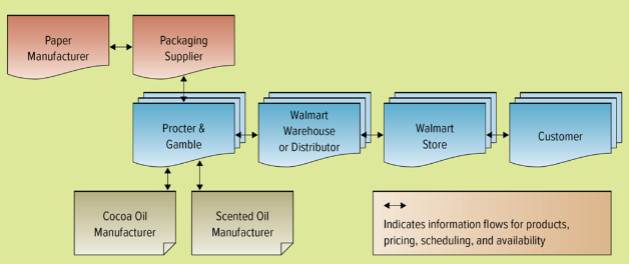
Supply Chain for Soap
managing the supply chain effectively requires good data/information at every step of the process