2) electric flux - Gauss' Law
 Call Kai
 Learn
Learn Practice Test
 Spaced Repetition
 Match
Match Flashcards
 Knowt Play
1/16

There's no tags or description
Looks like no tags are added yet.
Name | Mastery | Learn | Test | Matching | Spaced | Call with Kai |
|---|
No analytics yet
Send a link to your students to track their progress
17 Terms
define electric flux Φ
through a specific surface, measure for the density of field lines passing through a surface
formula for Φ

when is Φ = 0
E is parallel to surface and hence perpendicular to dA
where does dA point for a closed surface
outwards
when does E not contribute to Φ?
doesn’t originate from surface nor end in it
give Φ for a homogenous E and flat surface
EAcosθ
define Gauss’ law
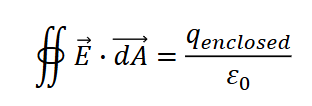
when is it appropriate to use Gauss’ law
high symmetry and/or closed surface
why is Gauss’ law derivation valid for arbitrary closed surfaces
the charge is still enclosed and the difference in strength and area even out
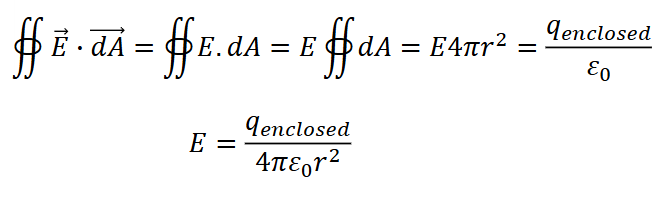
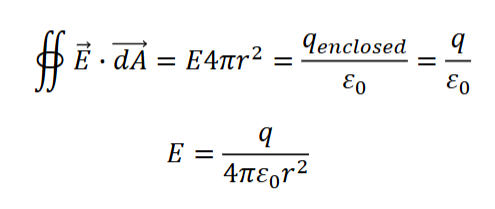
E field of a charged hollow sphere: surface
charge sits on spherical surface
E has same magnitude at any point - take out of integral
E is perpendicular to surface everywhere = parallel to dA - cosθ = 1
A is 4πr²
=> same expression as for point charge
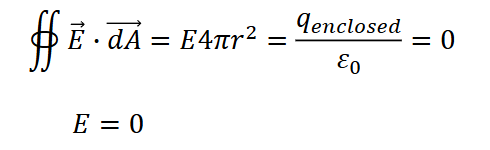
E field of a charged hollow sphere: inside
E has same magnitude at any point - take out of integral
E is perpendicular to surface everywhere
E = 0 and qenclosed = 0
=> same result for massive conducting sphere bcuz charges want to sit as far from each other as possible
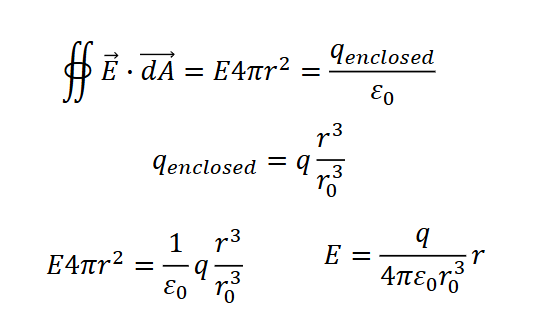
E field of non-conducting charged sphere: inside
charges can distribute over entire volume since they can’t move - non-conducting
draw Gaussian surface: (r < r0) where r0 is radius of sphere and r is inner radius of Gaussian surface
E has same magnitude on surface (bcuz at same distances from center)
E perpendicular to surface everywhere
E field of non-conducting charged sphere: outside
draw Gaussian surface: (r > r0) where r0 is radius of sphere and r is inner radius of Gaussian surface
E has same magnitude on surface (bcuz at same distances from center)
E perpendicular to surface everywhere
=> same field as conducting material FOR EVENLY DISTRIBUTED CHARGES
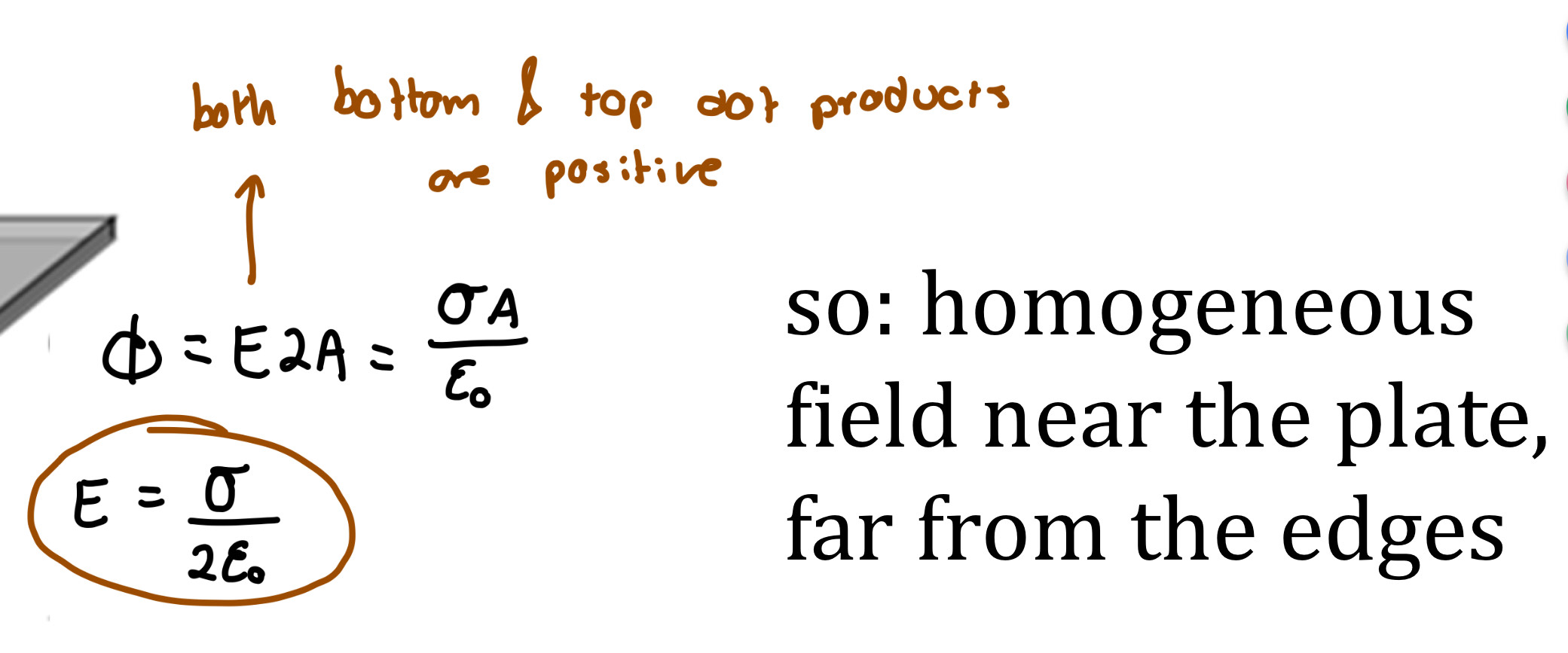
E field of charged plate
total charge density per unit area is σ
determine E near plate: since field is same everywhere and infinitely big plate, distance from plate does not matter
draw Gaussian cylinder
E upper and lower surface is parallel to dA due to symmetry
flux through side is 0 bcuz E is parallel to surface there
E field at surface of charged conductor
charge density per unit area is σ’ (for one side of conductor!!! **)
field lines always perpendicular to surface of conductor: if not, there would be an Eparallel which by definition means force moving charges along the conductor (this is electrostatics!)
draw Gauss cylinder with upper and lower surface parallel to conductor surface
E is 0 on lower surface - sits inside conductor so Φ = 0
=> only upper surface remains: see pic
=> same as plate but /2 !!!! (reflect why **)

what is the point effect (corona)?
since field lines are always perpendicular to conductor surface, net effect for sharp edge makes a huge field: charges are pushed to the tip due to repulsion, making large charge density
smaller radius of curvature → larger field strength
if field larger than air breakdown strength = spark bcuz easy charge transfer
E field of long charged conductor
draw bigger Gauss cylinder around it
charge density per unit length is λ
Φ through side surfaces is 0
** not closed bcuz took side surfaces into account
